“The only difference between a madman and me is that I am not mad,” Salvador Dali. It is a great honor to borrow his words and to be able to make the same declaration: the only difference between a madman and me is that I am not mad.
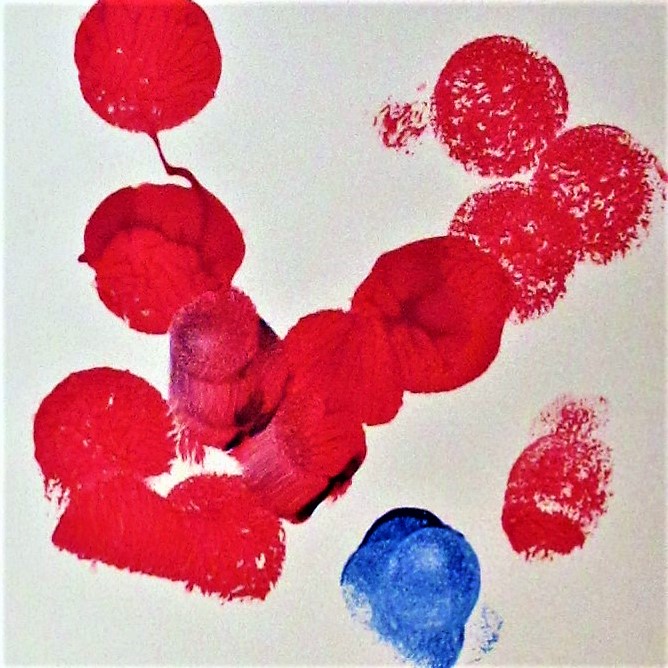
Mikhail Bakhtin: carnival, the world turned upside down, the world going bananas and those bananas dancing, as you can see in the painting above. It is a mad moment frozen in the still time of paint. And why shouldn’t bananas dance? Some one out there will remember Thunder Bay, 1981: ‘you just have to go bananas’ and the bananas duly appeared at half time instead of the oranges. Saint John, 1985: same thing.
And now the dancing bananas have emerged once more to fill your minds with pleasure and your hearts with joy. Go, bananas, go. Bananas-a-go-go. Way to go, bananas. And I tell you, given the current state of society, going bananas is the only way to go. So, in the next election, I shall form the Banana Party and we can all stand firmly, shoulder to shoulder and shout “Oh, Mighty Banana!” and “Go, Bananas!”
Ah yes, and my next painting? Maybe it will be Banana Custard or Banana Splits, not that I have ever done the splits!
This is a painting inspired by one of Messiaen’s works: Visions from Beyond. His music inspired me to write the Meditations on Messiaen, and I have posted several of those poems on this page. For me, creativity is continuous: verbal and visual. The visual includes painting and photography, the verbal, short stories, poems, and short philosophical pieces on life and art. This is the link to the first poem from the sequence entitled Visions from Beyond. I should add that the audio reading is part of what I call creativity too: audio, visual, verbal. The complete package.
My Thursday thought: I feel that I have been blessed. To be able to see, speak, write, hear, and express some of the beauty of this world around me. I know there is ugliness out there, sickness, ill health, poverty and despair. So far, I have been spared. “Why me?” I think to myself, “Why me?” Then I cease to question and I just say “Thank you” to the Spiritus Mundi and to the Muse when she descends.
Every morning, when I wake, my mind runs through some of the hymns I used to sing as a child. “Songs of praises, I will ever give to Thee.” “Laud, bless, and praise Him all thy days, for it is seemly so to do.” “Good Shepherd may I sing Thy praise, within Thy house forever.” Meanwhile, until that time comes, I will do my best to celebrate and sing the beauties of this world in the oh-so-limited ways I know best, poetry and paint!
There is so much happening. It’s hard to keep track of it all. Reading and annotating the material I am working on for my online writing seminar. Painting: a delightful relief and relaxation. Who cares if I can’t paint? I can make meaning out of shape and color, like my friend Matisse. Writing: the poetry is back and I will start revising those short stories again soon. I may also go back to my first novel. I have abandoned it for too long.
Meanwhile, each dawn is a busy dizzy time. This morning I decided to lie in bed until 24 birds had flown past my new bedroom window, one for each new pane of glass. It took about fifteen minutes. I watched the mist rise and then the sun start to break through and when the sun came, so did the birds. Dizzy Dawn is now hanging on the wall, along with another set of paintings I have finished recently.
Life is good. I hope it stays that way for as long as possible.
What would you do if you had a hot line direct to God? What would you say? You wouldn’t need to punch in a number, he’d be right there, at the other end of the line when you picked up the phone. Hello, is that you, God? Yes, I am who I am. Would you then give your name? It’s me, John. I know. How do you know? Have you got one of those little screens that tells you who’s calling? No. I’m omniscient. You’d pause a little at this point, wouldn’t you? What would you say next? What’s omniscient? I am. But what does omniscient mean? It means I am God. I know everything. That would make you think. So, would you ask for definitions, like you just did, or would you move in another direction? Like this. So you know why I’m calling, then? Of course. Wow, that’s another conversation stopper. If he knows why you’re calling, why did you call in the first place? To ask him something? It’s sunny here. What’s the weather like where you are? The same as always. How’s that exactly? Heavenly. Maybe this conversation isn’t going the way you thought it might. You could try again. Well, if you know why I am calling, what are you going to do about it? Nothing. Why not? Free will. But you’ve got to do something. Why? Because I think you should. Are you omniscient? No. Then why should I do what you think I should do? Because… because … And there you are. On the telephone to God. Left speechless. Perhaps you wonder if the phone’s been hacked. You go ahead and ask him. Has this phone been hacked? No. Are you really God? Yes. And this is your direct line? Yes. Can you prove you are God? Of course. Will you prove it to me? No. Don’t you have a code word or something that proves who you are? No. What about a security number? No. So how can I believe what you say? Either you will or else you won’t. But what if you’re a con artist, an evil genius, a thief who wants to lead me astray? Some have said I am just that. What? Who? Throughout the ages, there have been doubters. There have? Of course. But I’m not a doubter. Then why are you asking these questions? If you’re omniscient, you know why I am worried. I do. So what are you going to do about it? Nothing. Why not? Not free will again? Knock and it will open, seek and you will find. You mean I called you to hear those words? You will hear them if you want to. Some have ears and do not hear. But you could do something about that? What do you have in mind? The churches are empty. Make people go to church on Sunday. On Sunday? Only on Sunday? What about Friday, or Saturday? What about the other days of the week? You’re all powerful. What would you advise? Advise? I don’t give advice. Or orders. I have given people free will. They can choose what they want to do. If they want to go to the mosque, the synagogue, the church, they may find me there. There again, they may not. Some have eyes and cannot see. These would walk right past me and even if I hung there on the cross and winked at them, they’d never recognize me. You find it frustrating, eh? It’s like a Socratic Dialog where you only get to answer yes, or no, or three bags full. How persistent are you? Will you keep going? What other direction would you like to take? If the weather’s heavenly where he is, perhaps he’s in heaven. Why not ask him if he ever leaves heaven? Do you ever leave heaven? No. Why not? I am ubiquitous. What does that mean? It means I am everywhere. The people who really seek me can find me anywhere they look. I don’t understand. You’re not omniscient. But how can you be in two places at once? If I am everywhere, as I am, heaven travels with me, wherever I go. So I could find you anywhere I looked? If you knew how to look properly, you would. Others did. Where did others find you? John the Baptist found me in the wilderness. St. Francis of Assisi found me among the flowers and the plants, the flora and the fauna. As did St. John of the Cross. St. Teresa of Avila was slightly more mundane. She found me walking in the kitchen among the pots and pans. Where should I look for you? How would I know? Because you’re omniscient. But I gave you free will. I cannot tell you how to use it. If I did, it wouldn’t be free. Couldn’t you give me a little hint? Not one. Why not? Because a hint from me would be the Word of God. And I am tired of being carried down from the mountaintop with my words carved in stone, only for the misguided to twist them out of shape and give them alternative meanings. People do that? Of course. That’s why so many no longer go to church on Sundays. Where do they go? Some of the good ones go out into the woods and contemplate the snow in winter, the leaves in summer and fall, and they find me there. Others work in the kitchen, or at their knitting, and they find me among the pots and pans, or between their stitches. Still others find me in the crossword puzzle, or the Sudoku, or in one of those brief moments when, alone, they close their eyes, breathe deep, listen to their bodies, and find that I am there within them. You are within us? Deus est in nobis. Meaning? God is in us. So I don’t need a telephone with a direct line to you. Not at all. And remember, telephone lines are dangerous. They can always be hacked. Now I’m confused. Sorry. Must go. There’s an emergency on the other line. You hear the click on the other end of the line as the phone goes down. You are overcome by a tsunami of sorrow and grief, a tidal wave of loneliness and abandonment sweeps you away and you cry out in your anguish that which you have never heard or spoken before, the words of the twenty-second psalm or of Christ on the Cross: Eli Eli Lama Sabachthani? My God, my God, why hast Thou forsaken me?
A whole lot of pens. But will they write one word of poetry?
Sense and Nonsense Wednesday Workshop 18 August 2021
Iterative Thematic Unity
Iterative thematic imagery is complicated term, used by academics, for a literary device that is really very simple. When the same or similar images are used again and again in a text this is repetition or reiteration, hence iterative. When they are bound thematically or within the associative fields already present in the poetry, then the repetition is said to be thematic. A work’s unity may be found within the three classical unities of time, space, and action, or it may be found within the imagery that links and unites. It seems complex, but it isn’t really.
“Now you are a river flowing silver beneath the moon. High tide in the salt marsh: your body fills with shadow and light. I dip my hands in dappled water.” The key images fall into two categories, (1) water: river / high tide / salt marsh / water and (2) light: silver / moon / shadow and light / dappled. Now the sense of the words becomes clear. You / your body is likened to a river seen in the moonlight. It can be touched: I dip my hands. This adds an extra sensory dimension and the depth of the images is apparent. And no, it is not a simple message, but it can be decoded and enjoyed because now you can make it yours.
Sense and Nonsense
When we talk poetry, what do we mean by sense and nonsense? Let us begin with automatic writing. Automatic writing is nonsense. Put your pen on the paper, do not let it off, write for five minutes, whatever comes into your head. The Surrealists published these thoughts, however distraught and distracted as meaningful poetry. Major poets (Lorca, Paz) have used these techniques to engender metaphors and images. However, they have searched among their subconscious thoughts and have rejected the dross to choose the genuine images that enlighten the inner world.
Sense or nonsense? “Eye of the peacock, / can you touch what I see / when my eyelids close for the night?” Key images: eye > see > eyelids > and these are linked to the eyes of the peacock, as displayed on his feathers, and this links to the ancient tale of the Argos and the Argonauts, and to the person who closes his eyes to sleep for the night, and the sense that we can touch (tactile) when we dream (visual), a mixing of the senses. The straightforward logic of the nightly news? Definitely not. But the logic of the subconscious world, of the dream world as defined by Carl Jung? Definitely. These words contain internal meanings that are different for each one of us. Logical meaning? Definitely not. Internal sensation that may generate ease or unease? Definitely. Sense or nonsense? That will depend upon the readers and how they react not in their logical minds but in that deep-seated region of subconsciousness where all imagery is related to what Carl Jung calls the racial subconscious.
Are there words or ideas here that you do not understand? Names and theories that you do not know? Literature in general and poetry in particular take you to places where you have never been and to places that you might never have thought of visiting. However, these are lands that will open their delights before you, if you deign to open up heart, mind, and eyes, and venture out to explore them. Use your dictionary, your thesaurus, your google search tool, and expand your verbal and linguistic horizons. Poetry is not an advert. It doesn’t sell you anything. But it can and does open new worlds and it encourages you to explore old worlds set within you. It will not persuade, cajole, and limit your mind and your choice, rather it will embolden you and help to open new horizons.
Thursday is thought day, but what on earth am I thinking about? Well, yesterday I talked about open and closed imagery in poetry. I also talked about direct meaning and indirect meaning. So today’s thought is in Spanish and I have taken it from a poem of Federico García Lorca (1898-1936). “En la noche, platinoche, noche que noche nochera.” Sense and nonsense: what on earth does this mean? A literal translation gives us “in the night, silver-night, night which en-night-ens (more?) night”. Sense or nonsense? We shall find out. First, I would like you to read this article: https://moore.lib.unb.ca/Scholteach/platinoche.htm
Quite simply, the article discusses the difference between plain speech and poetic language. However, language has a tendency to simplify itself, to reduce itself downwards. Sentences become shorter. Ideas are simplified. Slogans replace thought. Emotion replaces reason. How and why this happens is a mystery, but I can assure you that it has happened throughout history. Just think of the breakdown from Classical Latin to Vulgar Latin to the various Romance Languages and Dialects that have replaced Latin in the areas where it used to be spoken. Break down, eliminate, simplify.
Thursday’s thoughts: why does this happen? How does it happen? Is it accidental? Is it deliberate? Should we follow meekly along and reduce our own thought and verbal processes? Should we just go gentle into that dark, but simplified, night? Should we resist? How can we resist? The answers to those questions will vary considerably. Each person who takes the time to read this will have a different set of reflections. That said, those answers are important, not just to each one of us as an individual, but also to us human beings as an inter-linked chain in society. All poets, all philosophers, all those who care about language, must reflect deeply on how they can preserve it, care for it, and make it mirror the depths, not of their own education, because not all of us privileged enough to be deeply educated, but our own intelligence. I have lived in places where people neither read nor write. It is so easy to dismiss them as ‘stupid’. I can assure you that they are not ‘stupid’ and to think of them is such is to ignore totally the oral tradition, the wisdom tradition, the cultural traditions from which these people come. We underestimate them at our peril.
What can we do? As poets, we can preserve the traditions and dignity of the depths of meaning, logical, emotional, sub-conscious, that is included in poetry. As writers, we can concentrate on using words with care and attention, of making our meaning clear, of elaborating our thoughts in such a way that others can follow them. As readers, we can look at inner structures, the deeper meaning of words, the emotional forces that try to persuade us, sometimes dishonestly, that this or that is best for us. As human beings we can extend our vocabularies, pay attention to words and their effects, and we can stand up for the linguistic and cultural traditions into which we were born, or in which we have chosen to live.
Now, always with your consent and permission, I will offer you the link to yesterday’s blog post https://rogermoorepoet.com/2021/07/28/22862/ Here you will find, if you choose to click on it, and it is always your choice, a discussion on meaning in language that will run parallel to this one.
The Musicality of Words Wednesday Workshop Bastille Day 14 July 2021
The Roman armies marched all over Europe and, as they marched, they sang marching songs, traces of which lingered, along with the Latin language, everywhere they went. Think of the poems in his book as songs, each with its own special rhythm. You can find music in a single word, in a group of words, in a single line. You can hear and feel it too when you follow the punctuation and move with the words across adjoining lines. Unfortunately, far too many of us have become used to slogans and advertisements: three words repeated incessantly, two verses of a song that loop continuously. Many of us have forgotten how to read anything other than newspaper headlines and simple sentences. We have also forgotten how to listen to words, how to gain multiple meanings beyond the simplistic message of slogan, sound byte, scandal, and news. Diversity of meaning is what you learn when you read poetry, for poetry is more, much more, than the delivering of a simple message. To read a poem is to set out on a personal journey of exploration, into your own memories and mind, as mediated by the poet’s words. It is also to explore the vast treasure trove of our personal relationship with our language. Remember: a poetry book is a dream you hold in your hands.
Comment: Words have meaning, but they also have music and the musicality of meaning must never be forgotten for when music an meaning combine, a new set of meanings is formed that depend as much upon the ear as they do upon the decoding mind. This is all a part of what we refer to as the poet’s voice and remember this style of poetry is not to be found in newspaper headlines nor on the radio and television news, scaled down as they are to the lowest common denominators of language.
Look carefully at the painting that heads this Wednesday Workshop. Look at the movement and the musicality of linked forms and colors in a still, silent, two-dimensional space. Meaning takes on different meanings and becomes something different when we look at these words of color, these soundless sounds, these rhythmical movements of color. Beauty is in the eye of the beholder. Indeed it is, and in poetry, it is also in the musicality of the words and the flow of the ideas that bind the words and change their meanings.
Spotify Remember to scroll down to the correct audio episode.
Mirror Image (on seeing the outline of a painting on the reverse side of my painted note-book page)
What price these corkscrew lines, reversed, seen through a glass, darkly, the wrong side of a tapestry, all twisted threads and imaginings, no clear pattern of thought or design, as if designated by an errant hand and signed by a man with a mission to bewilder, confuse, muddle, shock, turn inside out, back to front, upside down all our notions of what is what, and who is when, and why, and where?
Yet there is meaning to this madness, a sense of a blind man trapped underground in the labyrinth of his darkened mind with only a thin thread of belief to guide him, upwards and outwards, away from the torrid torment of doused flames, the damp spark’s midnight glow, the search for substance in a new world, insubstantial in a neologism, whirled through inner spaces and spun, guileful, out of the back of the hand to spin, this way, that way, who knows which way, according to the moment of delivery, the angle of acceptance, the untrained brain of the recipient, tottering on the brink of a world with a definite end: the suicide of logic.
Click on the link below to peruse my books for sale.
Spotify Remember to scroll down to the correct audio episode.
Chaos Theory
Chaos theory: it states that we don’t know what we’re doing and it wouldn’t really matter anyway, even if we did, because life lacks meaning, chance rules, and Lady Luck with her lusty locks attached to her forehead and she, all bald and hairless from behind, must be caught as she arrives, because later is much too late, and when past, she’s gone for good and our good luck’s gone with her, and we’re left for ever, sitting there, head in hands, bemoaning all that milk spilled before we ever had a chance to actually taste it.
Click on the link below to peruse my books for sale.