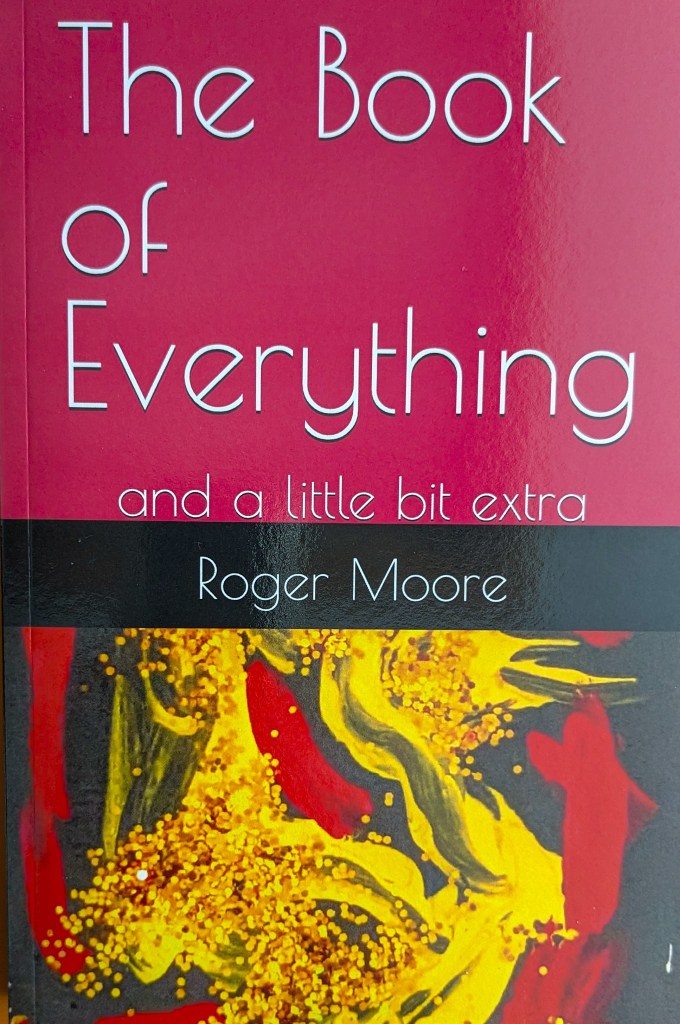
The Book of Everything

Discourse Analysis
and
The Meaning of Meaning

Words have dictionary definitions that allow us to agree on what they mean. In this fashion, when I say ‘my grandmother’, you automatically know that I am referring either to the mother of my mother (maternal grandmother) or the mother of my father (paternal grandmother). This is the dictionary meaning of the word ‘grandmother’.

But words have lives of their own, and their meaning changes when used by individuals. You, the reader, never knew my grandmothers. You never will. They both passed away a long time ago. I loved them both, but for very different reasons, and to me they were as different as different can be.

This means that when you, the reader of these words, reach the word ‘grandmother’, the faces you see, the emotions you feel, the memories conjured up by that word are totally different from mine. Same word, same dictionary definition, different personal memories, experiences, relationships. In addition, the role that our grandmother(s) played in our lives will be very different too. That role may vary from culture to culture, from language to language, and from the social structure of the changing society in which we live.

For example, when I first went to Santander, Spain, I visited a family who lived in a large, detached house that contained three generations of the family – grandmother and siblings, father and mother, grandchildren, and an assortment of aunts and uncles. No need for babysitters in that household. Everybody had a vested interest in the development of the young ones and the older ones received tender, loving care, twenty-four hours a day, every day of the week.

I lived from time to time in the same town as my own grandparents. I saw them regularly, but rarely on a daily basis. When my parents sent me to my first boarding school, age six (if I remember correctly), I lost contact with my family. My paternal grandfather died when I was away at school. My maternal grandmother died while I was away at school. My paternal grandmother died when I was living in Spain. My maternal grandfather died when I was living in Canada. Alas, after those early years, I scarcely knew them. My experience, then, was so different from that of other people.

When I moved to Canada, the Atlantic Ocean separated me from my parents. My daughter, born in Canada, grew up with no close knowledge of her grandparents. The word ‘grandmother’ did not mean the same to her as it did to the grandchildren in Santander, or to me. How could it? All those miles between the families, and visits limited to a couple of weeks every other year at best. Although the dictionary meaning is always the same, what a difference in the emotional meanings for each person using that word.

Discourse Analysis, the way I use it, builds not on the dictionary meanings of words, but on their emotional and personal resonance. I take the standard, dictionary meaning of words, twist it, look for meanings at different levels, and then build an alternative narrative on that changed meaning. I have great fun doing so.

Part of that verbal fun comes from my childhood. I listened to Radio Shows like The Goon Show and Beyond Our Ken. Giles’ Cartoons gave my names like Chalky White, the skeletal school teacher, or Mr. Dimwitty, a rather dense teacher in another school. These shows also twisted the meaning of words and drew their humor from such multiple meanings. The Goon Show – “Min, did you put the cat out?” “No, Henry, was it on fire?” Or on an escaped convict – “He fell into a wheelbarrow of cement and showed every sign of becoming a hardened criminal.” Or from Beyond Our Ken – “My ear was ringing. I picked it up and answered it. ‘Ken here, who am I speaking to?’ ‘Larry Choo.’ ‘Ah, Choo.’ ‘Bless you, Ken.’ Verbal scenes like these – it’s hard to get visual pictures from listening to the radio – remain engraved in my memory banks. More than engrained, they become part of the verbal system from within which I write.

This system includes Direct Discourse, Indirect Discourse, and the Twisted Discourse of an Inventive Mind that still wishes to create. It also comes from Francico de Quevedo’s Conceptismo, from Ramón del Valle-Inclán’s esperpento, and from certain aspects of Albert Camus’s Theory of the Absurd, all blended with the poetry of Jacques Prévert and the songs of Georges Brassens. This from the latter – “Tout le monde viendra me voir pendu, sauf les aveugles, bien entendu.” Everyone will come to see me hanged, except the blind of course.

This is not always easy humor, nor is it a comfortable way to see the world. But it is a traditional one with a long literary history. The title of my book goes back to Francisco de Quevedo, of course, who, in 1631, in Madrid, published El libro de todas las cosas y otras muchas más / The book of everything and a lot more things as well. Don Roger turns to his good friend Don Francisco whenever he needs a helping hand.

The pieces themselves were first published on my blog rogermoorepoet.com. They have been revised, and I have added some more pieces in a similar vein. Tolle, lege – Take and read.  Above all, enjoy this world of mine, with its subtle and not so subtle humor, its sly digs at many of our follies, and its many forms of creativity.

The Book of Everything
and
a little bit extra

Click on the title to purchase this book.

Mystery and Magic

Mystery and Magic Rule

            “Sólo el misterio nos hace vivir, sólo el misterio / Only the mystery keeps us alive, only the mystery.”(Federico García Lorca, 1898-1936). The poet and the artist both create metaphors, mysteries, magic. The search for meaning, the attempt to unravel the Gordian knot that surrounds the inner core of mystery is what keeps us, as viewers, viewing, and us, as readers, reading. Sometimes, as in a mystery novel, the ending is closed. The mystery that has spurred us on is revealed and the novel ends. Sometimes, as in many of the poems and stories in my books, the ending is open. The mystery continues and we never leave the land of wonderment that we first entered when we opened the book. There is no closure. Words and memories, metaphors and images, lines and rhythms, remain trapped in our mind with the brightness of butterflies that flutter before our eyes and flitter away before they can be caught. Beauty is in the eye of the beholder. And in poetry, each beholder becomes a new creator, a new artist creating a private, imagined world.

A private, imagined world: reading The Hobbit or The Lord of the Rings is one thing. The characters came alive and I recreated them in my own mind. I remember the first cartoon rendition of The Lord of the Rings. The characters were no longer mine. I did not respond to them. I left the film early and went off to the closest bar. To drown my sorrows and forget. Same thing with Harry Potter. My own inner visions were not the external visions created for me by Hollywood or whoever. In fact, after seeing one film, I gave up on the whole series. Not my inner creations, not my heroes, not my people.

This might be a generational problem. I grew up in the age of radio, no TV, not until I was 9 years old. I remember listening to the Wind in the Willows on BBC Radio. Voice echoed in my head and each character, each episode was recreated in my own mind. I read my first copy, carefully preserved since childhood, the other night, and Ratty, Moley, and Badger were just as I first remembered and recreated them. The same with The Chronicles of Narnia, read, before they were seen.

Perhaps someone else’s visuals destroy the magic and the mystery we have created. Perhaps there is a huge difference between reading first and seeing first, or seeing first and then reading the novel. I once used A Room with a View as a textbook in a reading and writing class. Many participants had enormous problems with the written version. In fact, they did not understand the written version until after they had seen the Merchant Ivory film. “Oh woe is me: shame and scandal in the family”. But whose shame? Whose scandal? The world is changing ever more rapidly. There seem to be few absolute rights and wrongs. So many things seem to be relative. Mystery and Magic: are these the things that keep us alive?

Intertextuality

Intertextuality

Wednesday Workshop
25 August 2021

            This is another academic word that has a simple meaning. In essence, it means texts talking to texts. Quevedo (1580-1645) writes escucho con mis ojos a los muertos’ / ‘I listen with my eyes to dead men.’ He is suggesting that, each time we read a text written by another person we enter into a dialog with that text and that author. His metaphoric conversations with the writings of the long-dead Seneca become intertextual the moment he put pen to paper and wrote about them.

This intertextuality is a key component of my writing.  You may not recognize all the phrases that I have used previously by other writers. I do. Some other readers will. Just take, as an example, the titles of some of my earlier books. The title of Broken Ghosts (Goose Lane, 1986) comes from these lines penned by the Swansea poet, Dylan Thomas (1914-1953). ‘Light breaks where no sun shines; / where no sea runs, the waters of the heart / push in their tides; and, broken ghosts with glow-worms in their heads, the things of light / file through the flesh where no flesh decks the bones.” Stars at Elbow and Foot, the title of my Selected Poems (Cyberwit.net, 2021) was also inspired by one of Dylan Thomas’s poems. “And death shall have no dominion. Dead men naked they shall be one with the man in the wind and the west moon; when their bones are picked clean and the clean bones gone, they shall have stars at elbow and foot.” The title of Though Lovers Be Lost (Kindle, 2016) also comes from this same poem, one of my favorites, obviously.

Sometimes readers are aware of these intertextual clues that I sow throughout my poems. Sometimes not. It doesn’t matter. There is a resonance in such chosen words and that resonance is there, irrespective of whether you are aware of the word-source or not. That said, the recognition and acknowledgement of intertextual relationships expands the poetic meanings of the creative world even further. It also establishes verbal links between author and author, epoch and epoch, genre and genre, thus establishing a wider intertextual network and a stronger chain of linked literary thoughts and meanings. In our creative journeys, we rarely walk alone, whether we are aware of it, or not.

The art of writing poetry about paintings is known as ekphrasis – which basically just means a verbal description of a visual work of art, whether it’s real or imaginary. The conversion of the visible (painting) to the printed page (verbal) is another link in the great chain of intertextuality, for paintings, too, are narratives with a different form of text. Other component parts are audible to verbal (alliteration, onomatopoeia), touch and feel (tactile) to verbal (as in synesthesia or the mixing of the senses) and the transfer of taste to verbal forms. Many of these transitions and transformations are present, not only in my own poetry, but in surrealism (verbal and visual) as well.

Niche

Jane gave me the honor of writing the foreword to her book and I did so with great pleasure.

Jane Tims: Niche. KDP.
Book Review

Niche, the fourth poetry book published by Jane Tims, is a neat configuration of six segments that elaborate and illustrate the poet’s original definition of the multiple meanings of her title word niche. It is very difficult to separate the author from the act of narration as her keenly observed and skillfully executed drawings, together with their verbal representation on the page, are so autobiographical and so much an extension of her artistic and professional abilities that the objective separation of writer and text is scarcely possible. It is hard to forget that Jane Tims was, and to a great extent, still is, a highly competent professional botanist. The harnessing of the professional botanist, with her unique drawing skills and scientific knowledge, to the poet and auto-biographer is a key factor in the reading and interpretation of this text in which acute observation blends with an intimate knowledge of the observed botanical world, both flora and fauna, and this allows the poet, in her role of poetic narrator and lyrical voice, to weave a network of poems that are, at one and the same time, objective and intensely subjective.

The author emphasizes this when she writes in the Preface that “In biological terms, the niche is the quality of a space occupied by a living thing, the sum total of physical, nutritional, biological, psychological and emotional needs gathered together in one place.” She also reminds us that in human terms “niche can be a metaphor for home, community or personal space” and it is within these metaphoric spaces that the poetry text is elaborated. The text becomes a linked mixture of visual drawings, iterative thematic imagery and associative fields, all centred on the multiple meanings of niche. These terms are both biological and human in nature and the poet’s named world meets at this juncture between the human and the natural.

The section occupying space (1-19) bears the subtitle satisfying need and begins with a setting out of what this means in the following 12 poems and 4 accompanying drawings. The poem ‘apples in the snow’ with its companion drawing stands out for me. The section strategy, subtitled solidifying position (21-43) outlines in poetic terms, how plants, animals, and humans ensure their own survival. The section praying for rain, subtitled, avoiding danger and discomfort (45-68), offers views on discomforts and dangers. It also opens the discussion—relocate or stay where we are? The section mapping the labyrinth or places I have occupied (69-83), which contains the wonderful sentence “When I get lost on the road ahead, I look to the road behind me,” throws open the multiple meanings of home. The section new ways for water, subtitled coping with change (85-98), offers a double landscape, first, external, the things seen, touched, examined, remembered and described, and then the internal landscape that reflects upon them and is reflected in them. Finally, forgetting to move, with its subtitle getting comfortable (99-111), presents an autobiography that links observer (the twin personage of author and narrator) to observed (nature, both flora and fauna, and the added element of autobiography and self) via the symbiotic relationship of botanist to botany.

Two moments stand out for me. (1) Sadness is in seeking the space that is never found. (2) Loneliness is in trying to return to a space once occupied but no longer available. The whole concept of the Welsh word hiraeth is summed up in these two lines. Carpe diem, Jane Tims’ poetry indeed seizes the day and, with its minute, intense observation, it preserves so many precious moments. It also pays attention to that which has been lost, those moments that are irretrievable. They will vary for each reader, but hopefully, like me, you will take great pleasure in discovering them for yourself.

Comment: Brian Henry of Quick Brown Fox picked up this review and published it on QBF. Thank you, Brian and thank you Jane, you both do me great honor. Here’s the link: Niche on QBF 14 March 2021

My Grandfather’s Chair

18581930_1306791786107970_4016640231053970709_n

My Grandfather’s Chair
For Margie Goldsmith

“Write about that chair,” Margie said,
and I wondered what was in her head.
How can I write about that chair
when those who sat in it are not there.

Before the coal fire my grandfather sat,
snoring away, on his lap slept the cat.
At three years old, I climbed that chair,
and blew on the bald spot in his hair.

So many things we no longer know:
my grandpa did the same thing, years ago,
and years before that, his own grandad
did just the same to make his old man mad.

Now I, in my turn, when I drink deep,
like to sit in that chair for a little sleep,
and my grand daughter, there’s no grandson,
climbs up that chair, as others have done,

and sees the bald spot in my hair
and blows and blows as I snooze there.
The years roll back and I see the smiles
of generations woken by a young child’s wiles.

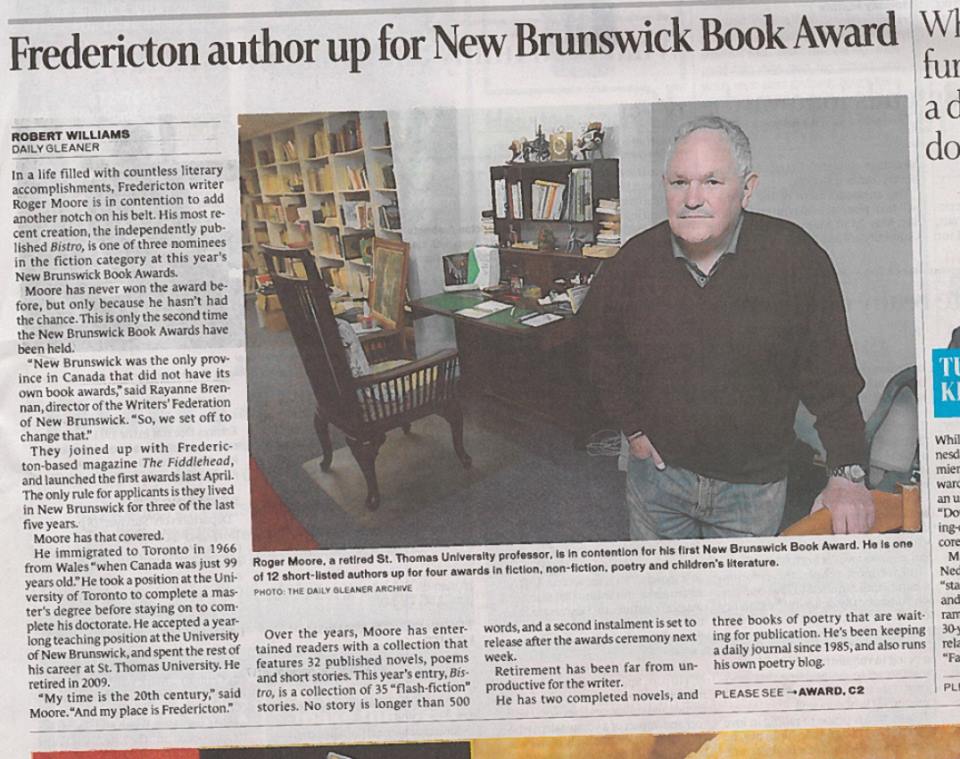
Comment: Talking the other day, I mentioned my grandfather’s chair, the only piece of furniture rescued from my parents’ house, and Margie said I had to write a poem about it. So, last night I did. The result is something very different from what I normally write. This is what in Spanish is called an occasional poem and it celebrates a specific occasion, a specific set of circumstances. Thus, it is written under different rules, rhyme, rhythm, stanzas. It is always an adventure to write something suggested by someone else. Poems like this cross the boundary between poetry of play (which this is) and occasionally enter the realm of poetry that expresses the authenticity of being which, to a certain extent is present in this poem too. The above photo, from our local newspaper, The Daily Gleaner, is the only one I have of the chair which resides in the basement where I keep my books. The article is an old one (2017), but the photo is nice!

Plein Air


IMG_0018 (2)

Plein Air
(for Ruby Allan)

Plein air,”
she said, and I imagined her
sitting before the blank spread of a canvas,
a ship’s sail waiting for a sea-side breeze
to fill that empty space with color and mood.

What routes will her paintbrush take
as it wanders over the new world
lying before her?

Plein air, al fresco,
in garden and street,
before the shops and then
on headland and shore,
alone or accompanied,

with sea birds wading
and the gull’s cry echoing its sea of sound
as the sun sets in its bonfire of brightness
and throws light and shadow,
chiaro-oscuro,
all around.

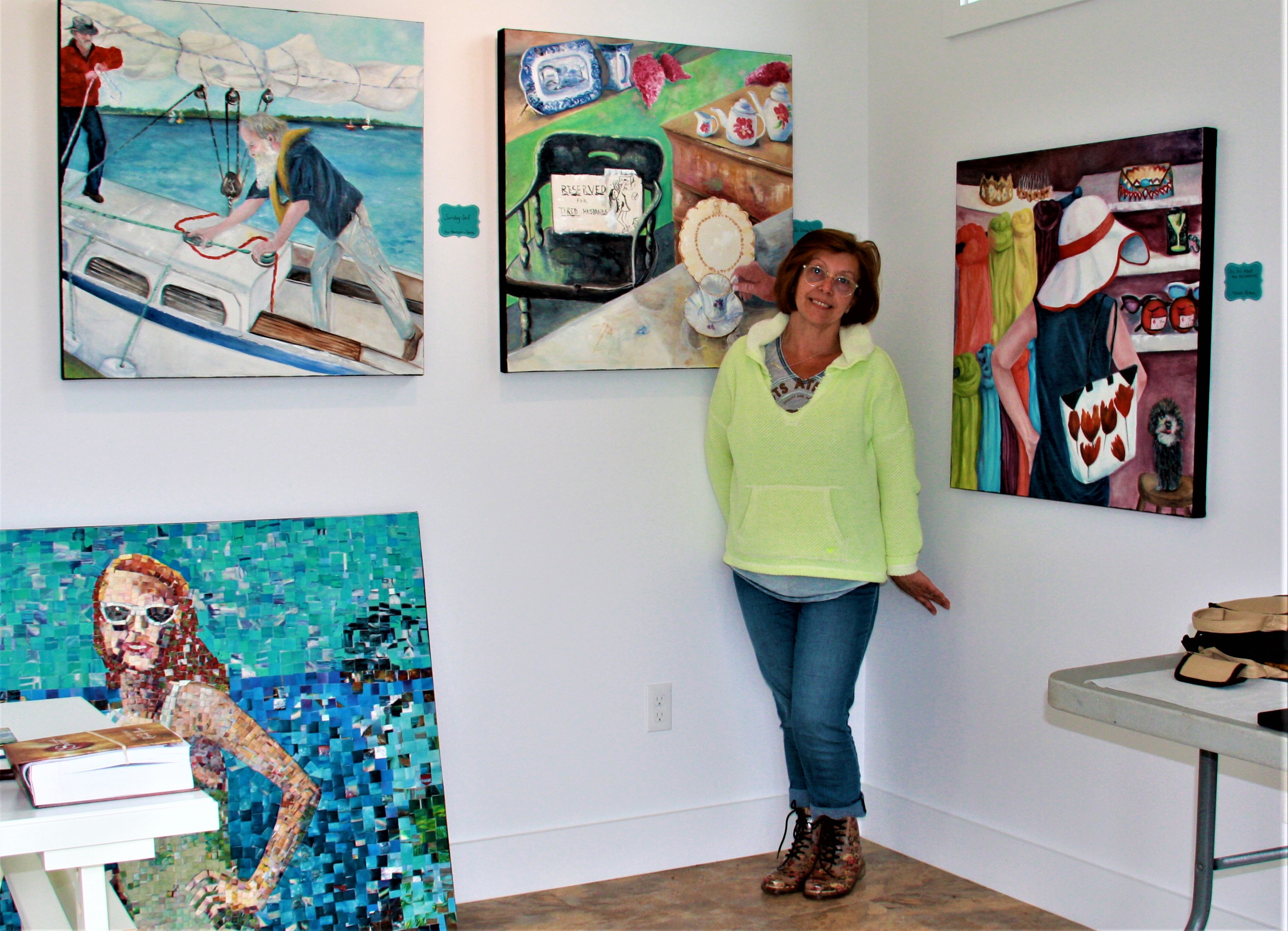
Comment: The lead photo of Ruby Allan in her studio was taken in her KIRA studio in June, 2017, by my friend and fellow artist, the Peruvian pan-piper and flautist / flutist, Carlos Carty. The poem comes from my book, One Small Corner (2017), written in KIRA during my residency. It can be found on page 94 in the section entitled Artists.

In this poem I have tried to capture the idea of Ruby painting in the fresh air (plein air / al fresco) in St. Andrews-by-the-sea. Clearly, as you can see from the above photo, the sea is so important to this town, as are harbors and boats and the men that man and sail them. The light is important too as it changes throughout the day or with wind and weather. As you can see, Ruby’s paintings are filled with light and she catches those magic moments when the world seems to freeze and stand still. I try to imitate visual art when I write, and I try to fill my poetry with those magic moments as I create verbal pictures that seize the seconds and  hold them, even if it be for just a little while.


Ego

cropped-39948917_706398923049634_3046174897211441152_o.jpg

Ego

I am not worthy
to be called her sun,
and yet her world
revolves around me.

She spins in my space
and short-circuits
her own life to make
mine more livable.

I’d like to say ‘joyous,’
but tears are in all things
(sunt lacrimae rerum)
and
death touches mortal minds
( et
mentem mortalia tangunt
).

The best I can offer:
a salt water world,
filled with inadequacies,
drowning us in tears.

Comment: Several things of note in this poem and the voice recording. Should we mix languages in a poem? Why ever not, so long as we explain them. This Latin tag goes back over 2,000 years and links my poem (Intertextuality, remember?) into a long Western tradition. Am I worthy of that tradition? Is my poem? Well, that is a totally different question. However, I am linked in, as you might phrase it. A second question: does my reading of the poem affect your understanding of the poem? If so, how and in what way? Does the phonic word play sun / son affect your understanding of the poem? If so, how? And how does the double meaning of ego work on your mind? Does the Freudian Ego / Id stand out? Or does the schoolboy “Quiz?” “Ego!” spring to mind. Or do you immediately think of the first person singular (Latin) ego as in ego sum lux, via veritas? More important: are you aware of any of this or does the poem disappear into a desert landscape of nothingness with no apparent strings attached? Good questions all: I invite you to think about them all. Blessings and best wishes. Keep safe.

Word without end

IMG_0937 (2)

Word Without End
Antonio Machado

Tree: rowan, mountain ash, larch, tamarack,
hackmatack, spruce, birch, maple, passerines
flying from branch to branch. Birds: more words,

woodpeckers, downy, hairy, pileated, cardinals,
finches, purple, house, golden, rain-rusted robins,
crows, aerial magicians, wondrous in flight.

Spring: fresh branch tips, tiny fox gloves, leaf buds,
folded fiddleheads soon to open their spring magic.
Open: hearts worn on sleeves, open to the world,

wounds, eyes, everything open to beauteous
sun-warmth, snow’s slow disappearance, rising river,
freshet flow freshening this Renaissance,

every day a rebirth, a new beginning,
fresh starts, the world reborn beneath a rising sun,
its yellow disc growing, the new day glowing.

The word as it was in the beginning, head in hands,
heart in mouth, words without meaning, words whirling
golden autumn leaves, words caught in a whirligig,
words all powerful in a word-world without end.

Comment: “La palabra: una palptiación honda del espíritu / The word: a deep palpitation of the spirit.” Antonio Machado (1875-1939). In The Meaning of Meaning, Bertrand Russell discusses what words mean and how they construct, with their endless associative fields, a net of emotions that take us beyond logic into new realms of meaning. As poets and creative artists, we are conscious of the emotions we attach to each word we use. If the poetry is good, then that network of emotional associations reaches out to a wider audience and draws them into our own world view. If we are less skillful, then the emotions are trapped in our own claustrophobic words and fail to reach out, to lift up from the page, to achieve take-off. As we develop as poets and writers, we become more and more aware of the ways in which the microcosm, our own world in miniature, reaches out to the macrocosm, that wider world outside. When we achieve a blend between those two worlds, even if it be in nothing more than a metaphor, nothing more than a felicitous phrase or a delicately timed rhyme, then we reach a new level, a level that we strive to retain and attain anew every time we create.

For me, many of the secrets of poetry can be found hidden in the rhythm of words, the music of their joining, the harmonies they create when they play off each other, old and older meanings reflecting off the newer meanings we give them as we shuffle them anew and put them through their paces.

img_0146-3

Yesterday, my beloved placed seeds on the back porch, and a chipmunk, her pet chipmunk, came and sat on her foot as he chomped the seeds. Today, this first chipmunk was followed by a second chipmunk. Patience my friends. Keep writing. Keep striving. Keep experimenting. Keep your faith and your creed. Your words will one day reach out, like seeds to chipmunks, and will sow themselves in the mind’s of your readers. And those readers will beget other readers, much as one chipmunk plus one chipmunk will eventually equal many more than two chipmunks. Oh the joy of words, the loving search for le mot juste and the meaning of meaning. In the words of the immortal Cervantes: Paciencia, y barajar / patience, and shuffle your words. The results will creep upon you one morning, unaware and, like the chipmunks, they will catch you by surprise.

Self Isolation Day 21

IMG_0638

Self-Isolation Day 21
Bakhtin’s Chronotopos
Man’s dialog with his time and place

Chronos / time + Topos / space = chronotopos: the time and space within which we live.

Chronos: this morning, when I woke up, I moved back into my own time and space. But what is my time? It was 5:45 am when I awoke, so was that my time? I stayed in what the Spanish call the duermivela, that drowsing dream-world in which we all wander, half-conscious. I stayed there until I decided to get up at 7:45 am. Was that my time? Well, yes,  all of that is / was my time. But time extends further than that. Real time is static and only exists in this second as I type the s of second, but look how it has flowed or flown. So my time drifts backwards into a knowable and then an unknowable past. I knew my parents, and my grandparents. But I know nothing of their childhood, their war days (WWI and WWII), their courting, their marriages. Their time is time lost for me. Sure, I can invent it, renew it, recreate it … but it can never be mine. All I can possess is this Second when I preSS the S key, a Second that haS already flowed paSt me, flown and gone. The same with future time. It is there, stretching out before me, for how long, I do not know. It is not yet mine, and when I come to possess it I will only posses it, really possess for those precious Seconds when I inhale, or exhale, or press the S key. And now I have bewitched you, and your concept of time, and your keyboard will never be the same.

Topos / Place: so what is my place? When I awoke this morning, it was the kennel-cave of the bed in which I hibernate each night. Then it morphed into the bathroom where I dressed and prepared for the day. After that, I walked downstairs. Descending the stairs, a step at a time, feeling for the steps with my cane, as I do, I find that each step is my place. Luis de Góngora, one of my favorite Spanish poets, wrote, a long time ago that “Cada pie mal puesto es una caída, / cada caída es un precipicio”each footstep, badly placed, is a fall, / each fall is like tumbling down a precipice. Ipso facto, I must take care not to fall each time I place my foot on a stair, and each stair, therefore, is my concentrate of time, and this moment of time manufactures my space.

Then there is my breakfast place, my office place, my work place. Time spent in each of these spaces is a link backwards and forwards, past, present, and future all inexorably bound in each passing second that I live.

But there are other spaces, spaces in which time flows at a different rate in objective time (the thirty minutes you spend in the dentist’s chair) and subjective time (the hours and hours those thirty minutes take to pass as each second limps by, like a three legged tortoise with gout). hen there is creative time: and creative time, especially on the computer, leads us into a different space, a sort of hyper-space, in which we hover between this place (the place of the office and the house) and that place (the place in which we create our visions and dream our dreams). Lost in that creative hyper-space we drift in a timeless amniotic sea where all time is one and all places are one and we are the masters and mistresses of our own creative universe. Y aquí, as my good friend José Hierro once told me, el tiempo no tiene sentido / here time has no meaning.

Jane Tims wrote these words to me today. “The idea that some of our words will live on, on the page… I wonder where our WordPress and Facebook words will reside in 300 years? Will some antiquities student make the headlines having managed to upload the forgotten words of people who wrote about the days of the coronavirus?”

My reply: “These are very true words, Jane. It looks like you have gifted me with the topic of tomorrow’s blog! Thank you.”

Indeed, the online medium is so ephemeral and can be wiped out in seconds. Tweets can be erased, changed, and altered. Written words and written histories have also been erased and wiped out. In our brave new world, the truth changes from day to day with no vital record attached to it. Historians always say that the conquerors write history … and when they do so they usually destroy the writings of the conquered. I think of all those Mexican Codices, destroyed by the Spanish priests on their arrival in Mexico as the works of the Devil. We know so much from the surviving ones, for example the history of Ocho Venado, born in 1063 and sacrificed in 1113 in accordance with the fifty two year annual cycle. Only five Mixtec codices now survive, one, the Vindobonensis, still bears the scorch marks from when it was plucked from the flames that were meant to devour it. Man’s inhumanity to man. How much have we lost? How much are we losing? How much will we retain? And what is truth …?

As for us and our chances of survival, another good friend of mine, the poet and philosopher José María Valverde once wrote of nosotros, los pobres poetas de hoy, destinados a ser polvo seco de tesis doctoralwe poor poets of today, destined to become the dry dust of doctoral theses. In spite of all this, it is our fortune and our duty to exist within our time and our space, to live letter by letter, painfully tapped on the keyboard, and to engage in our dialog with our own time and space, for that my friends is all we have, the single instant of that one letter S.

Comment: The watch in the photo belonged to my father. I wind it up and wear it on his birthday every year. It now measures my time, as it once measured his, and its place, at least once a year is on my wrist. Its function is to tell me the time. One day, it will do the same for my daughter, and then my granddaughter and they too will have their dialog with their own time and place.

Self-Isolation Day 20

IMG_1374 (2)

Self-Isolation Day 20
Novels of Action

Yesterday I wrote that “Wolfgang Kayser suggested, a long time ago, that there were three types of novels: novels of action (the easiest to write, if you have that calling).” I hope nobody took the second half of that statement “the easiest to write” too seriously. No novel worth its salt is easy to write and not everybody can write the sort of adventure story, filled with action, that drags the reader on from page to page. Part of the difficult lies in tying the end of one chapter to the beginning of the next and this is most certainly not all that easy to do. In my own case, I tend to bring closure at the end of each chapter, and that really the worst thing I can do. Why continue reading if you already have closure?

Let us look at how a master thriller writer closes his chapters. Prologue: “I will return to my Athens as soon as this mess resolves itself.” What mess? Why Athens? Where is the character now? What is happening? Read on. Chapter One: “As a double precaution, the keyboard and the door know were wiped cleaner than Petrescu’s account” What on earth has happened now? Why wipe clean the keyboard and the door knob? Which account? Why? What will happen next? Read on. Chapter Two: “Behind them, Edward Yorke’s lifeless eyes stared without comprehension at the foreman’s room and the splintered railing above him.” What has happened? Where is it all going to end? Read on. Chapter Three: “He had to move. So deciding, he opened the man’s wallet and found an address not far away?” An address? What address? Who lives there? Why is he going there? What will happen next? Read on. Chapter Four: [Summary] A crack in the wall behind a refuse bin … time for a shower … throw the victim’s pants and shirt out of the window for some bum to find … Who? What? Where? When? Why? Read on. And now for the last words of Chapter Five, the chapter that explains everything. “That hook is baited.” And this is the key … each chapter ends with a neatly baited hook that leads the reader, willy-nilly, into the next chapter. You want to know what happens next, what is on the hook, what the hook is exactly, to do that, you will have to buy the book and read it for yourselves. Look up Chuck Bowie: Three Wrongs. Muse It Up Press.

Alas, I have not yet finished with Chuck. In June, 2017, he drove to St. Andrews to visit me one afternoon while I was at KIRA. We sat by the sea-shore there and chatted about his latest novel, Body on the Underwater Road. He was working out all the details and we struggled here, and wriggled there, as we computed the many possibilities. Such good fun. So, here I am, a poet telling a story about a master story-teller-seller. How silly I am. I’ll offer up a poem instead.

Underwater Road
Chuck Bowie

We met at St. Andrews, at low tide, on
the underwater road. In secret we
shared the closed, coded envelopes of thought,
running fresh ideas through open minds.

Our words, brief vapor trails, gathering for
a moment over Passamaquoddy,
then drifting silently away. Canvas
sails flapped white sea-gull wings across the bay.

All seven seas rose before our eyes, brought
in on a breeze’s wing. The flow of cold
waters over warm sand cocooned us in
a cloak-and-dagger mystery of mist.

We spun our spider-web dreams word by word,
decking them out with the silver dew drops
proximity brings. Characters’ voices,
unattached to real people, floated by.

Verbal ghosts, shape-shifting, emerging from
shadows, revealed new attitudes and twists,
spoke briefly, filled us with visions of book
lives, unforgettable, doomed, swift to fail.

Soft waves ascended rock, sand, mud, washed
away footprints, clues, all the sandcastle
dreams we had constructed that afternoon,
though a few still survive upon the page.

And that, as the lion said, is the end of the gnus.

Comment: Three Wrongs is part of the Donovan: Thief for Hire series. Adventure series follow similar patterns: the problem, the solver (shining hero), the complication (dark arts adversary), further complications, resolution: problem solved. The Arthurian Romances set the pattern for linked adventure series back in the 12th and 13th Centuries. They were followed by the literary knights of the novels of chivalry. Perhaps the most famous of these, Amadis de Gaula / Amadis of Gaul, was imitated and parodied by Cervantes in Don Quixote. The numerous books of Amadis were followed by Son of Amadis, Nephew of Amadis, Cousin of Amadis. Perhaps nothing breeds success better than success. Think of the Sharpe series from the Peninsula War or the Hornblower books, or, more recently, Master and Captain and the recent Royal Navy series from similar times. Look out for Son of Donovan … a series coming to your bookstore soon.