Paella

Paella

A bullfrog lives in my computer.
He eats all the full stops and I can’t
type a period to end my sentences.

I imagine he thinks they are tadpoles,
though the commas, with their short,
twisted tails, would be visually better.

I could live without commas, I can’t face
an endless future with no periods in sight
and www-comma-com just isn’t right.

I guess I could survive a future without
frogs, though cuisses de grenouille appear
each summer at my local super market.

I ate a paella québécoise in a Spanish café
in Montreal once. It was full of frogs’ legs
and was very, very tasty. I wonder if I can
catch that bullfrog and put him in a paella.

Commentary:
Almost a true story. Something did go wrong with my new laptop. When I brought it home, I couldn’t access the [ . ] – not great for working on the web or for writing normal sentences, with punctuation. The man in the computer shop who sold me the computer, didn’t believe me when I took the computer back and told him about the problem. I asked him to send me an e-mail. He tried and – guess what? – no period [ . ] for the .com – most frustrating. Never mind, I got a new new computer out of the deal, and a much better one.

Sweet Dreams

Sweet Dreams

Amnesia survives in these amniotic waters,
moving in time to the water pump’s heart beat.
I close my eyes and dream. Nothing is the same.

Do I drift dreamily or dreamily drift?
The bath-tub’s rose-petals bring memories –
primroses, bluebells, cowslips, daffodils dancing

beneath the trees in Blackweir Gardens,
or beside Roath Lake, where I biked
on gravel paths so many years ago.

Photos float before me, pictures of moments
I alone recall. Spring in Paris, the trees
breaking into bud along the Champs-Élysées.

Santander in summer, walking the Piquío
as it slumbers beneath the jacarandas.
One winter in Wales, up in Snowdonia,

I ran down a valley between high hills,
on a freezing night, with only the stars
to keep me company, so cold, I nearly froze.

Autumn at the Peace Park in Mactaquac,
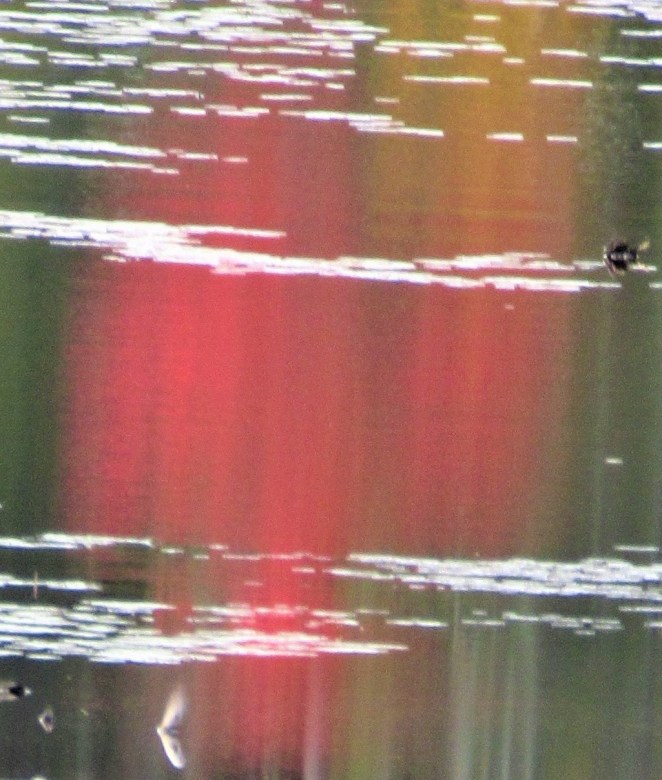
with leaves reflected in the head pond.
Or the Beaver Pond with its fall orgy

of gaudily painted trees, leaves drifting down
on this first chill wind, to settle like tiny,
colorful birds in my beloved’s hair.

I remember the look in her eyes when
I caught a falling leaf and put it in
her pocket, telling her to save it,
like a falling star, for a rainy day.

Autumn

Autumn
and all that jazz

1

Slow last drag of summer’s sad trombone
sliding its airs between stark, naked trees.

Golden memories float face down in tranquil
waters, life and the summer drained away.

A voice, her voice, ripples across the pond,
echoes over drowned and mirrored leaves.

2

Grey the sky, white the birch trees:
Narcissus kneeling, dark waters flooding

Tumble-dried by this autumn sky,
leaf words falling, still her voice echoes.

3

Tintinnabulation: a tin-pan alley of leaves
blown against windscreen and car windows.

I, who a grief ago sat here watching her walk,
now sit here alone, waiting for her return.

4

Here beginneth the gospel of the fall,
the fall of all things finally into deep water.

Fall, fall asleep to the rhythmic leaf beat
that summons us all to our appointed end.

5

I who am nothing know nothing, save that I
am a burnt-out ember, cold, in a grey-ash grate.

Grating of old bones, these hips and knees,
and if I fall, sweet heart, please love me more.

Commentary:

The trees and the grass are all stressed out and we are looking at an early fall this year. So many bright berries on our Mountain Ash and Crab Apple trees. Yet the grass all dry, the hollyhocks brittle, and so many flowers dried up and gone.

Things


Things

I fumble in my mind for things
long lost in an upper attic.
I can no longer read the words
I wrote. What does this mean?

At night I dream of things
beyond my reach. My fingers
clutch but cannot clasp
those clouds that clutter.

Who, oh who, the owl cries,
can free the mice that nibble
through my mind and set me
gnawing at my own soul?

Once upon a time, a long
time ago, I thought I saw light
at the end of the tunnel.
I travelled on a ghost train.

The light I saw was a gaslight
ghosting my mind with fictional
fantasies of an illusive kingdom
that would never be mine.

Elusive, these memories of things
that never were, but might have been.
Will o’ the wisps dancing shadows
on the salt-marsh of my unknown life.

Commentary:
Memory loss. I guess it happens to all of us at one time or another. One of my long-lost friends visited yesterday and between us we could hardly put two consecutive memories together. Every other sentence was punctuated with a pause – ‘Now, when did that happen?’ ‘What was his name? I can’t remember now.’ ‘Me neither.’

I am not particularly worried by such happenings. I am a poet and a story-teller. Sometimes, I forget the truth – so what? – I just go ahead and reinvent it, tickling it here, sticking a spot of paint there, adding a word or two, or a magic moment. I often remind myself of Oscar Wilde when he created a magic moment of verbal ingenuity – “I wish I had said that, Oscar.” “You will, Roger, you will.”

Best of all, even in those moments when personal memories fail me, literary magic returns. I think of Dylan Thomas and his words spring to my mind – ‘time has ticked a heaven round the stars’. Wonderful. Or Francisco de Quevedo ‘soy un fué, y un será, y un es cansado.’ / ‘Tired I was, tired I am, tired I always will be.’ My own translation from the summer of 1963 when José Manuel Blecua introduced me to the poem, or rather Blecua introduced the poem to me, in that summer’s courses of the UIMP.

So, according to this theory, even when you feel lost, you are never really lost, because there are an enormous number of people living inside your head, who who will step out from the shadows, when needed, and give your memory a little boost. But don’t get too carried away. Think too of José María Valverde and his poetic premonition: ‘Pobres poetas de hoy, destinados a ser polvo seco de tesis doctoral.’ / ‘Poor poets of today, destined to be the dry dust of doctoral theses.’ (My translation).

Dust to dust and ashes to ashes – ‘Serán ceniza, pero tendrá sentido. Polvo serán, pero polvo enamorado.’ Quevedo, of course. But you didn’t need me to tell you that. You might need me to help you with the translation, though – ‘Ashes they’ll be, but ashes with feeling. They will be dust, but dust that burns with love.’ (My translation, with a little bit of exaggeration [sorry, don Francisco!] just at the end.)

Pioneer Sky

Pioneer Sky
04 September 2020

Sky and clouds float side
by side in the beaver pond,
mingling shape and color
with the autumn leaves.

When the walking trail
became too crowded,
the beavers left their lodge.
They moved to another pond,
lower down than this one,
and there, where fresh milkweed
grows, they built another dam
and a brand-new lodge.

The great blue heron still
stands on guard, patrolling
his usual watery haunts.
He searches for solitude
in untroubled waters,
weaving his wary way
between white and blue skies
mirrored in the pond below.

Just when I think that life
has become meaningless
I look up at that Pioneer Sky,
celestial blue for hope –
white clouds for purity,
and I seek new meanings.

I also find them
in the rippling patterns
of the Beaver Pond.

Clepsydra 12 & 13 – Pilgrim in this barren land …

Clepsydra 12 & 13 –
Pilgrim in this barren land …

12

… pilgrim in this barren land
     lost in my wanderings
          the wander-lust still tugging at me

in my back-pack
               dusty with memories
                    photos that only I have seen
                         sepia
                              spotted in places

only I know names and faces
     recall relationships
          a mystery to me, an outsider,
               such images haunt me
                    move me in ways
                         I do not understand

the irregular heart-beat
     of my life walks inside me
          down new corridors of time
               fresh music
                    strums my heart-strings

a heart
     a bridge a time too far
          lost I wander the woods
               searching for things
                    I know I must find
                         my lost self among them …


13

… but to find myself
     I must first lose myself,
          not in a barren land
               nor in the inner depths
                    of my suffering mind
                         nor the deeper depths
                              of another’s body

am I nothing more
     than an offering on the altar
          where nothing alters more
               than this interchange
                    eye to eye
                         mind to mind
                              body to body

will the I ever transform
     into the power of us
          together
               both of us

and are we much more
     than one plus one
          with three or four or more
               conjured from the word
                    that was from the beginning

or is all of this
     nothing more than
          the woven magic of pillow-talk …

Butterflies

Butterflies
Miguel de Unamuno

… butterflies … temporal forms … fluttering …
existing for one sweet day … they perch … spread
their wings … fan us with their beauty … flourish …
catch our attention … then caught by a gust
tear their wings on a thorn … and perish … blink
your eye and they are gone … yet reborn … they
cluster and gather in dusty ditches …
congregate on bees’ balm … smother Black-Eyed
Susan and Cape Daisy … shimmer in shade …
butterflies by day … fireflies by night …
terrestrial stars floating in their forest
firmament … dark tamarack … black oak … bird’s
eye maple … silver birch … impermanence
surrounds us … dances beneath stars … sings with
robins … echoes the owl’s haunting cry …
eternity held briefly in our hands …
then escaping like water or sand … black
words on white paper capturing nothing …
… my dialog … my time … my place … butterflies …

Note: “La poesía da permanencia a las formas temporales del ser / Poetry gives permanence to the temporal forms of the self.” Miguel de Unamuno (1864-1936)

The temporal forms of the self – and so much today is unsettled, changing, insubstantial. I have often wondered how one makes time stop. Is it even possible to do so? Time and tide wait for no man. And why should they? Fray Luis de León – “Con paso silencioso, el cielo vueltas dando, las horas del vivir le va hurtando.” / With silent step, the ever-turning sky, steals away life’s hours. Or Fancisco de Quevedo – “Que sin saber ni cómo, ni adónde, la edad y la salud se hayan huído. Falta la vida, asiste lo vivido, y no hay calamidad que no me ronde.” Without me knowing how or where, age and health have fled. Life is lacking, past life flew by, and there isn’t a calamity that doesn’t hound me.

Ars longa, vis brevis – art endures, life flies by. My translations are freer than usual today, but I too feel like being creative in my own language. So, if we can’t slow time down, what can we do? We can create – poems, paintings, photos. We can read – and translate from one language to another. We can, like butterflies, perch on flowers and enjoy our brief days in the sun. Mindfulness – we can make the most of each moment by living it thoroughly and well. Carpe diem – we can seize each moment of every day and live it to its full measure. And, above all, we can write and read poetry – because, as Unamuno says – Poetry gives permanence to the temporal forms of the self.

On Loneliness

Loneliness

58 What relationships have a positive impact on you?

I think one of my poems answers this question best. I write “one of my poems” but it is really my ‘free’ translation of one of Francisco de Quevedo’s sonnets – Retirado en la paz de estos desiertos. I have changed the poem slightly, but I am sure Don Francisco (1580-1645) will excuse Don Roger’s impoverished effort (2023).

On Loneliness
29 December 2023

Resting in the peace of these small rooms,
with few, but welcome books together,
I live in conversation with my friends,
and listen with my eyes to loving words.

Not always understood, but always there,
they influence and question my affairs,
and with contrasting points of view,
they wake me up, and make me more aware.

The wisdom of these absent friends,
some distant from me just because they’re dead,
lives on and on, thanks to the printed word.

Life flits away, the past can’t be retained.
each hour, once past, is lost and gone,
but with such friends, I’m never left alone.

And there are so many of those literary friends. I still read Rudyard Kipling and I have just finished Kim, Captains Courageous, Stalky and Co., Puck of Pook’s Hill, and Rewards and Fairies. I read these first when I was nine or ten years old, and I return to them regularly. Other friends include Garcilaso de la Vega, Fray Luis de León, St. John of the Cross, Quevedo, Góngora, Calderón, Miguel de Unamuno, Antonio Machado, various members of the Generation of 1898, the majority of the poets from the Generation of 1927… and these are just my Spanish literary friends. I have French friends, English friends, Anglo-Welsh friends, Canadian friends, Mexican friends, and, in translation, many, many more. My relationship with each of these friends has had an impact upon me.

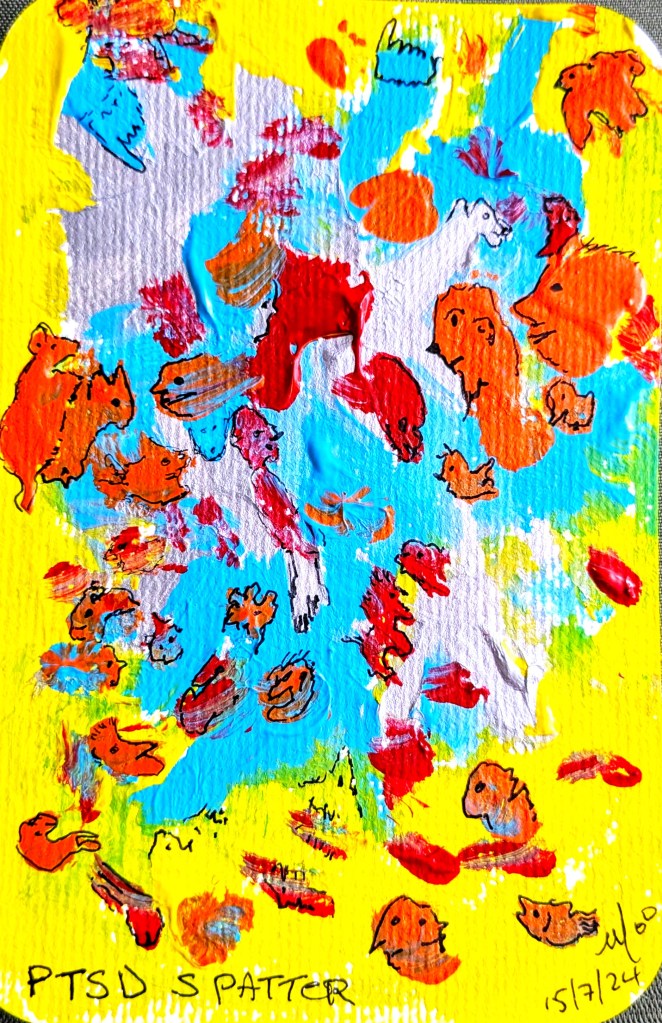
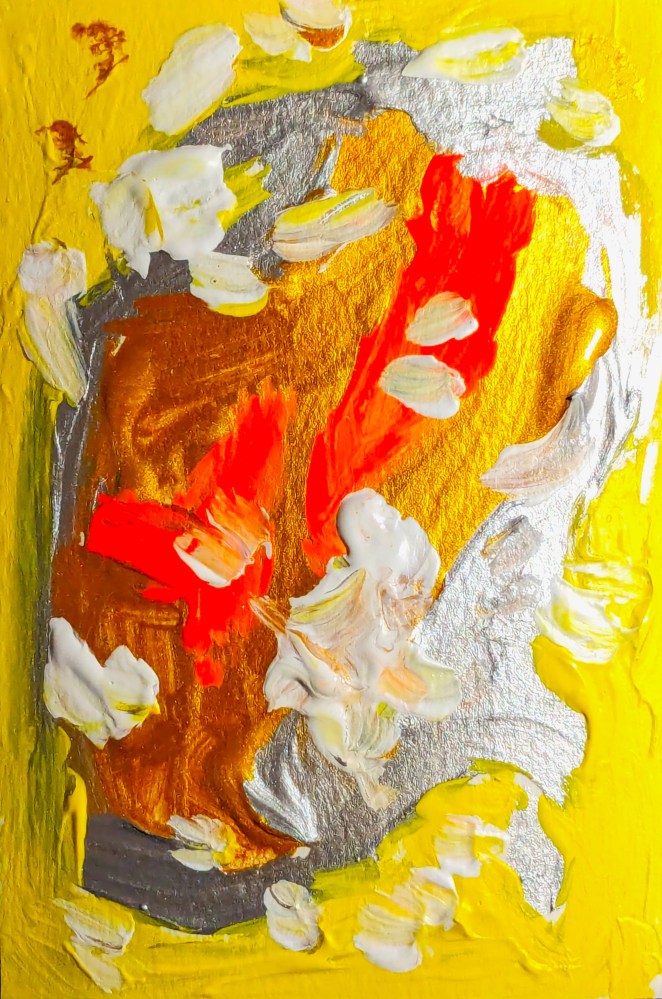
A recent painting, by my friend Moo, is called Fiat Lux – Let There Be Light. It is reminiscent of Dylan Thomas’s poem, Light breaks where no light shines. Intertextuality – Quevedo drew inspiration from the Stoics. I drew inspiration from Quevedo. Moo drew inspiration from Dylan Thomas. The nature of creativity, and its continuing links throughout the ages, shines clearly through these wonderful associations. Long may they continue, and may others enjoy them and be influenced by them as much as I have.

Comment:
The funny thing is that I do not remember writing this blog prompt, nor do I remember having translated Quevedo’s poem into English. I wonder how many other forget-me-nots there are out there. Or, to be more precise, in my books and in my notes. A treasure trove – that’s my guess. Borges wrote of Quevedo that he was more a library than an author, and I am beginning to think that way about my self. A strange world, this, one in which the creator abandons, and then forgets, his creations. Perhaps we should change the image – not so much a library as an orphanage, and so many lost and abandoned orphans wandering around The Little World of Don Rogelio.
Time Flies

Time Flies

… bends like a boomerang,
flies too rapidly away,
limps back to the hand.

Endless this shuffle of unmarked
days dropping off the calendar.

Hands stop on the clock.
The pendulum swings:
time and tide stand still,
do not move.

‘As idle as a painted ship
upon a painted ocean.’

The painting in my grandma’s room:
seemingly moving seas,
sails swelling out,
but the ship doesn’t move,
it stays firm in its frame.

Our garden fills with birds
and squirrels, light and dark.
Morning ablutions: each day
a twin of the day before.

The TV screen churns ceaselessly,
tired, shadow faces boring us
with shallow wit
and worn-out wisdom.

Time:
an albatross around the neck,
an emu, an ostrich, a dodo,
an overweight bumble bee,
too clumsy, too heavy to fly.

What brings a tear of joy to your eye?

What brings a tear of joy to your eye?

Peeling onions, of course. As my Welsh grandfather told me, years and years ago

“If, if, if,
onions climbed a cliff,
potatoes would rise
with watery eyes
if it wasn’t for if.”

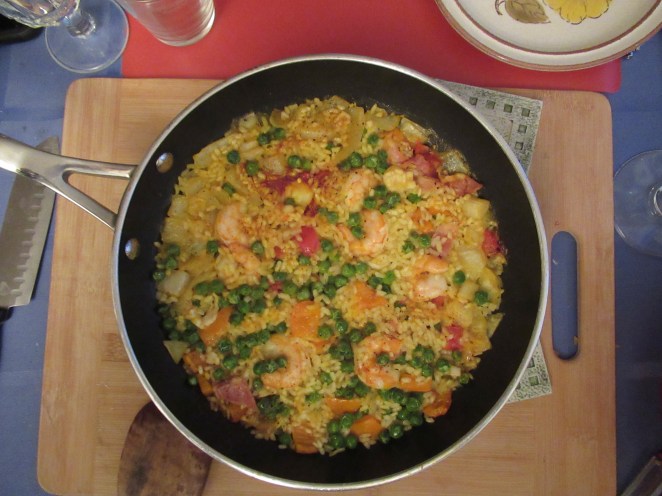
There you have it, in a nutshell, or should that be an onion skin? So, why does peeling onions bring a tear of joy to my eye? Because of the things that I make with them, of course. Where would paella be, if there were no onions in the mix? Can you imagine French Onion Soup with no onions in it? How about a Spanish Omelet / tortilla española? Okay, okay – I know some purists, especially in Galicia, say that the tortilla española should consist of egg, potato, salt, and nothing more, save a touch of olive oil, perhaps. But most of the tortillas españolas that I have enjoyed (and made) include an onion or two to blend with the potatoes. And how about salsa mexicana or salsa pico de gallo? Unthinkable without their dash of sliced onion.

So, peeling onions – that always brings a tear of joy to my eye, because I know how I am going to use them and how tasty they will be. And for those who have forgotten the hungry in this world, myself included in this particular post, do not forget Miguel Hernández and his poem Las nanas de la cebolla / The Onion Lullaby. Reading that poem and understanding its background will surely bring a tear to your eye, as it always does to mine. This time, however, it won’t be a tear of joy!