Clepsydra 25 & 26

25

… how will it all end
     does it not need closure
          something to bring
               the water-wheel full circle
                    a golden key to open
                         what

the museum’s door
     memory’s door
          the archives where
               so many memories lie
                    gathering dust

though some may tell the truth
     whatever that is

or does the story go on and on
     never pausing
          never ending
               wrinkle after wrinkle
                    threaded through time
                         after time
                              the candle
                                    burning

the clepsydra
     dripping all life away
          the pendulum
               swaying
                    back and forth …

26

… Westminster Chimes
     chiming the quarters
          church bells
               ringing out a warning

the hills alive
     alight
          with burning beacons

what new armadas
     sailing now off our coast
          what fireflies flicker
               their thunderous roar
                    frightening birds in trees
                         driving deer
                              into the woods

how many people
     cast forth like bread
          upon the waters
               to return ten-fold

hark to the bells
     ringing out again
          St. Clement’s
               St. Martin’s
                    the Old Bailey
hark to the children singing
     dancing in a circle
          never-ending
               until the music ends

and the last child
     is caught by
          the lowering arms
               trapped
                    a fish flapping
                         in the osprey’s grasp …

Commentary:

I wonder how many people still sing the children’s song about the bells of London? Images from it – intertextuality – occur throughout Clepsydra.

“Oranges and lemons,”
ring the bells of St. Clement’s.

“You owe me five farthings,”
say the bells of St. Martin’s.

“When will you pay me,”
ask the bells of Old Bailey.

“When I grow rich,”
sing the bells of Shoreditch.

“And when will that be,”
sing the silver bells of Battersea.

“I do not know,”
booms the great bell at Bow.

“Here comes a candle
to light you to bed.
And here comes a chopper
to chop off your head.”

The song appeared at children’s parties. Two of them joined hands, held their hands high, like London’s Tower Bridge, and the children, in a long chain passed beneath the ‘bridge’ as the song was sung. At the end, the children speeded up and they tried to avoid the last verse when the bridge’s arms descended and two children were caught. These then had to replace the original two gate-keepers and the game started again. At least, that was how I remember it being played.

It is worth remembering how violent in their imagery children’s songs can be. The games seem sweet, but they often have dark undertones, some going back to the Black Death – “Ring a ring a rosies, a pocket full of posies, atishoo, atishoo, we all fall down.” If you don’t know what that all signifies, go down the rabbit hole with Alice and the white rabbit and look it all up! And find out what a farthing is, and a penny farthing – go on – I double-dog dare you!

And remember – poetry carries its own meaning – or multiple meanings – and they are not always easy to find. Dig, my friends, dig. There’s gold in them there hills.

Cage of Flame

Cage of Flame

Now you are a river
flowing silver beneath the moon.
High tide in the salt marsh:
 your body fills with shadow and light.
 I dip my hands in dappled water.

Twin gulls, they float down stream,
then perch on an ice-floe
of half-remembered dreams.

Eagle with a broken wing,
why am I trapped in this cage of flame?
When I turn my feathers to the sun,
my back is striped
with the black and white
of a convict’s bars.

Awake, I lie anchored
by what pale visions
fluttering on the horizon?

White moths wing their snow
storm through the night.
A feathered shadow ghosts
fingers towards my face.
Butterflies stutter
against a shuttered window.

A candle flickers in the darkness
and maps in runes
the ruins of my heart. Eye of the peacock,
can you touch what I see
when my eyelids close for the night?

The black rock of the midnight sun
rolled up the sky.
Last night, the planet quivered
beneath my body
and I felt each footfall
a transient god.

When will I be released
from my daily bondage?

Commentary:

Moo reminded me that this poem also existed as a prose poem. here it is in prose layout. Think about it and let me know which version you prefer. Is one easier to read than the other? Do the rhythms come through more strongly in one version? Meanwhile, since he hasn’t painted a cage of flame, nor a river flowing silver, he suggested that if I really felt like the poem suggested I might feel like, then All Shook Up – with its warm, colorful flame images, might be just the poem to fit the crime. Better, he said than playing billiards on a cloth untrue, with a twisted cue, and elliptical billiard balls.

I wonder how many people recognize that little tip of the hat to the past glories of English Comic Opera? Since Canada post is on rotating strike – talk about twisted cues and elliptical billiard balls – then send your answers by highly trained snails (snail mail) or dog sled via whatever route still has enough snow for the huskies to haul on. Meanwhile, Ottawa has declared that the Maritime provinces are continuing with their suffering a buffering from lack of rain and severe drought. I do long for that river flowing silver, not to mention high tide in the salt marsh. We need water badly. And the sooner the better. Aquifers, rivers, wells, they all need filling.

Ah, the majestic game of cricket – and how I long for that summer test match curse – Rain Stopped Play. Or as the BBC commentator said on the radio one day – I heard him – “play has been stopped because of piddles on the putch – oh, sorry, I mean puddles on the pitch.” I wonder what Mr. Hugh Jarce would have thought of that. I know he always loved that old cricketing Chestnut – ‘The bowler’s Holding, the batsman’s Willey.” Unlike much wanted rain, it didn’t stop the match, but the commentators who perpetrated that jest laughed so much, the commentary stopped for nearly five minutes. Oh, the things one remembers as one gets old. Now, where did I put my glasses? I wonder if my beloved knows.

Cage of Flame

Now you are a river flowing silver beneath the moon. High tide in the salt marsh: your body fills with shadow and light. I dip my hands in dappled water. Twin gulls, they float down stream, then perch on an ice-floe of half-remembered dreams. Eagle with a broken wing, why am I trapped in this cage of flame? When I turn my feathers to the sun, my back is striped with the black and white of a convict’s bars. Awake, I lie anchored by what pale visions fluttering on the horizon? White moths wing their snow storm through the night. A feathered shadow ghosts fingers towards my face. Butterflies stutter against a shuttered window. A candle flickers in the darkness and map in runes the ruins of my heart. Eye of the peacock, can you touch what I see when my eyelids close for the night? The black rock of the midnight sun rolled up the sky. Last night, the planet quivered beneath my body and I felt each footfall of a transient god. When will I be released from my daily bondage?

Drink up thy Tizer!

Drink up thy Tizer!

I wonder how many people actually remember Tizer, the Appetizer. It used to be sold in grocery stores and corner shops. Don’t forget the Tizer, shrieked the adverts. I hated the stuff – but others loved it. Sweet, sticky, a little bit like dynamic Lucozade – and who remembers that, I ask. The same people as had cod liver oil poured down their throats when they were little children in the United Kingdom. An old and almost forgotten generation with its own traditions. But this post is not about Tizer, it’s about cider. Good old Somerset / Zummer Zett scrumpy.

I met Scrumpy when I went to Bristol University. It was an alternate drink to beer, and many pubs sold cider, in one form or another. A pint of cider – sufficient unto the evening was a pint thereof. After a couple of months, one could manage two pints of Scrumpy. Our drinking competitions including drinking a Yard of Ale. Someone always brought one when we went on a coach trip and we always ended up in a bar, in the middle of nowhere, trying to drain our yards of ale. I remember one lad bravely trying to quaff a yard of cider – scrumpy at that. Honk city – and it had nothing to do with the geese. But it was spectacular.

My own adventures with scrumpy really started in my second year at Bristol. The boarding house I lived in stood close to the Coronation Tap, one of the best cider house in England, if not in Bristol. First night I went in there and asked for a pint of scrumpy the barman suggested I have just a half. In my best Somerset accent, I said no, I’d appreciate a full pint. The barman duly placed it before me. As he did so, the man standing next to me at the bar suddenly woke up from his meditations, poked me in the ribs with a boney finger, and announced “Ah, lad. That’ll put lead in thy pencil.” I looked over at his pint of scrumpy and saw a slice of lemon floating in it. “What’s that lemon doing there,” I asked. “I’m waiting for the cider to eat it,” the man replied. “Better for the scrumpy to eat the lemon than to eat my insides.” Another night, at the Cori Tap, I met an old gaffer who wouldn’t touch scrumpy. I asked him why not and he replied that one night he’d managed to down seventeen pints of scrumpy. “That’s a lot,” I said. “What happened?” “Oi spend three weeks in ‘orspital, in bed, doan I?” He muttered.

In my third year, Hamburg University Athletics Cub arrived by coach to participate in an athletics competition with Bristol. The Cross-Country Club became the Athletics Club, in the summer, and we specialized in distances from 400 > 800 > 1500 > 3000 > 5000 > 10,000 metres. Thirsty work on a hot summer’s day. We took the Hamburg athletes back to our apartment building and spent the Saturday night slurping scrumpy down the Tap. They slept on the floor at our place, and next morning, a Sunday, they went shopping early. When they came back to their coach, they all grinned happily at us, and waved their bottles of Tizer in farewell. I looked around and saw that they had twenty cases of those bottles stored in the bus. “Ve vill have gut trip to Hamburg, no?” I started to laugh and they all joined in, waving their bottles at me. I didn’t have the heart to tell them that Scrumpy came in barrels, not bottles, and that they had not purchased cider at the local stores. Alas, they had bought 20 cases of Tizer the Appetizer. Somehow, in translation, cider had become Tizer – oh the glories of discourse analysis and the meaning of meaning.

Clepsydra 21

Clepsydra 21

… she left me
          at the lighthouse
               rising tide
                    beach diminishing

and grew smaller
     as she walked away

I search the sand for sea-gems
     sand-dollars
          cerulean sea-glass
               rarest of all the reds

ground down
     polished
          sanded to perfection

so many worlds
     in a grain of sand
          their words going unspoken
               carried away by the sea-wind

the wind that haunts
     caves and cliffs
          hooting like a ghost train
               in a forlorn
                    tunnel of love

love lost
     love found
          an old love
               rediscovered
                    only to be lost anew

what is this thing
     called love …

Commentary:

Listen! “Can you hear the music?” “No, but I hear singing even though there’s no one there.” I know, I know, we have had this conversation before. Moo didn’t have a painting along the lines of ‘what is this thing called love’, so he dug out this one – Walking on Air – the painting, not Moo. But then, Moo’s a silly old romantic and verses and songs settle in his mind. All too often, when he walks he finds he’s ‘walking on air’! The two of us, Moo and me, have always loved that song. Great to work it into a commentary on a poem (again).

Love – what is this thing called love? And how many types of love are there? We use the word so frequently, or infrequently, if we are Mr. Grinch. But what does it mean? Love of self, love of other? And how many others can we love – I know that Minnie had a heart as big as a whale, but how many loves can fit into it? Love of father, mother, daughters , sons, brothers, sisters, cousins – how far do we go? Winning sports teams – everybody loves everyone on the team when they win they cup. That love is so much harder if they lose it – especially if there is a goat on the team, and I don’t mean greatest of all time! I mean sacrificial.

I love you with all my heart! Does that include the pacemaker and the stent? What does atrial fibrillation mean in that situation? Good questions. Neither me nor Moo have the answers. Write your answers on a postcard and send it to – where? With Canada Post on strike, you will need a team of real snails. Hitch your postcards to them. Threaten them with the salt shaker. And off they go. Snail mail is back. Or you could place them on a dog sled, hitch up the huskies and Mush, Moo, mush! Away they all go hauling the mail. Why does it always be the mail? Why can’t it be the Femail? Mail – Femail. Oh, but I love that. There, you see. We’ve just added another meaning to love. Let’s hope none of the huskies lies down to rest. That’s called a Canadian flat tire. Oh, I love that one too.

I am running out of time, space, and ideas. And that’s only one word from the poem that we’ve looked at. Oh, shame and scandal in the letter-box.

Absence

Absence …

… makes the heart grow
callouses scabs you can
pick at with your finger
nails bleeding fresh blood

they remind you that you have
a heart feelings something
buried so deep you need
a pick and a shovel to dig
a shaft with wooden slats
placed carefully at the sides
so your mine won’t collapse

you dig deeper and deeper
until in the gloom you see
the feathered fluttering —

a broken-winged canary
sacrificed in its cage
so part of you can escape
flee the mine
and come out alive

Commentary:

A golden oldie. Moo thought Poppy Day (11/11/2024) would be a suitable painting. Those who survive rarely forget those they were forced to leave behind. Kindred spirits, they travel though life together, the live one carrying the other on his shoulders as he would have done earlier, had he been able to.

Moo still has a teddy bear. He tells me he has always slept with one. His first teddy was an Australian Koala, a real stuffed koala given him by his Australian family, back when he was born. Moo was reading a book on the Battle of Britain (15 September 1940). It had a picture of the gunner from a Bolton Paul Defiant, sitting in the gun turret. Behind him, he had his little teddy bear. Moo couldn’t stop crying. He thinks he might have been an air gunner in another life, and when he saw that teddy, it brought back so many memories – flak, night fighters, search lights, tracer bullets, pain, flames, and then the unending darkness. So many did not come back, especially the tail-gunners. Their absence is still a presence to someone in their families. And so it should be.

Autumn Leaves

Autumn Leaves

I used to run,
jump, and catch them
in mid-air,
one, two, three
in each hand.

Now
I stand and wait
for them to fall
and land, perhaps,
on my clothes
or catch in my hair

the Leprechaun luck
of my Irish heritage,
so long-denied,
with its pot of golden leaves
waiting for me
at summer’s cast-off
rainbow’s end.

Commentary:

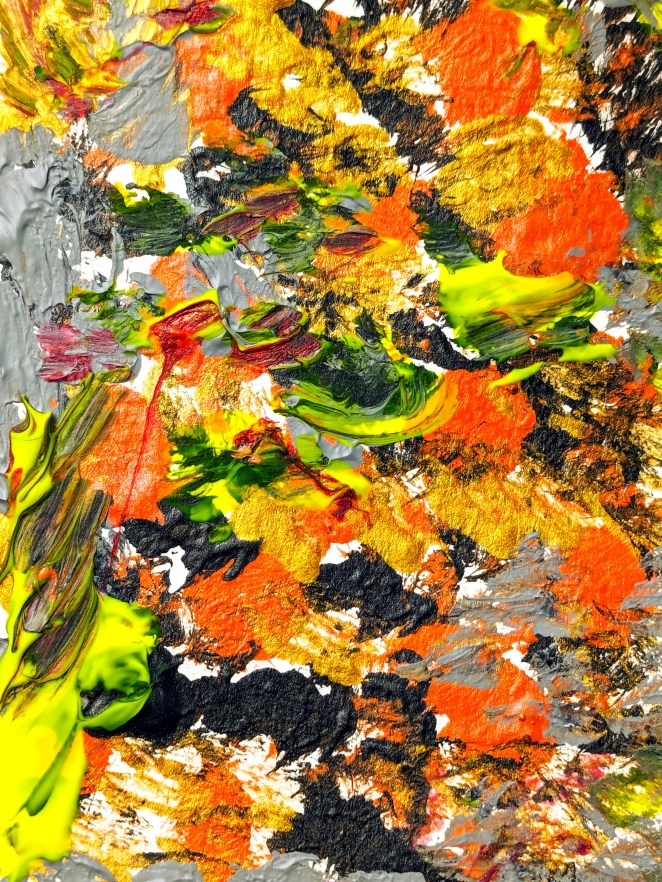
Autumn Leaves, but where does it go to. Good question. Moo asked me that the other day. I just had to tell him that I didn’t know. However, he did offer me the perfect painting for the fall and the changing leaves. Fall Folly Age. I never realized that he could play with words like he plays with paint. Anyway, I know that last winter he painted a picture of little white dots with wings. “What are they?” I asked him. “Snow flies,” he replied. “You know, when the snow flies …” “When the snow flies do what?” “I don’t know.” Moo and I live in a mysterious world, as you have probably come to realize.

Any way, the combination of fall foliage and fall folly age is quite a good one and it shows the folly of ageing and trying to chase down falling leaves when gadding about in the garden with two sticks, one in each hand. Of course, in case you don’t like that painting, and I hope you do like it, because I do, then here’s another one for you.

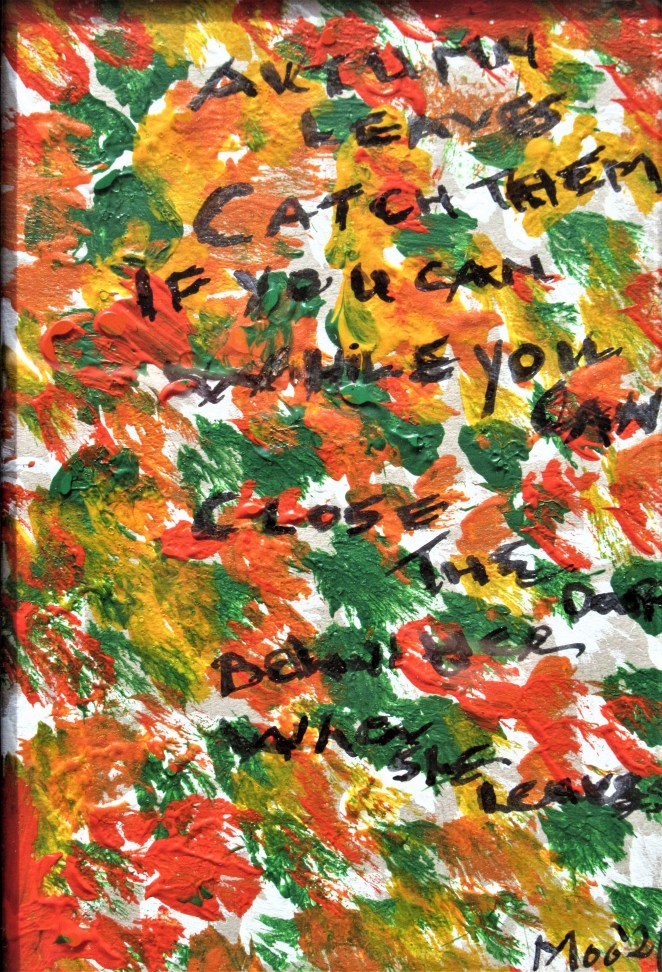
The text reads – “Autumn leaves – catch them if you can – while you can -and close the door behind her – when she leaves.” Oh witty Moo. Painting and occasional poetry too.

Monkey Meets Pontius Parrot

Monkey Meets Pontius Parrot
(With glorious  memories of Macarronic Latin)

Pontius Parrot is very clever
and very pontifical.
“Pretty Polly!”
He pontificates from his pulpit.

His name isn’t Polly
and he doesn’t have a pulpit
but he parrots words
in Macaronic Latin:
“Caesar adsum jam forte.”

Pontius Parrot is perky at the podium
and bounces up and down,
preening himself self-consciously,
rattling his chains,
shaking his bars,  and speaking Latin:
“Brutus aderat.”

He is marked with shame and scandal.
A dysfunctional family of feathered friends
 has henpecked him until he is black and blue
and he has thrown up copiously:
 “Caesar sic in omnibus.”

He dips his wings in holy water,
calls for some soft soap, 
and washes his feathers and claws.

Poor Pontius Parrot,
he can only say “Repent!”
“Brutus sic in at.”

Commentary:

I asked Moo if he had ever painted a parrot, but he told me that he hadn’t. However, one of his favorite viewers, had once called this painting a pile of spaghetti wriggling in tomato sauce and he thought that spaghetti was close enough to macaroni for it to serve as a painting for Bony Macaroni Latin.

I had to explain to him what we mean when we say Macaronic Latin. Back to that boarding school and we used to invent all sorts of Macaronic Latin phrases. They used to cane us with bamboo canes. So here’s the verb paradigm in Latin for ‘to cane a student’. Bendo – whackere- ouchi – sorebum. Of course, it helps if you know what Latin verb paradigms look like. They are easy to remember and are aide memoires for the four main parts of the verb. Bendo – I bend over – first person singular, present tense – whackere – to whack or cane – infinitive – ouchi – I said ‘ouch’ – past tense – sorbum – the inevitable result – past participle.

Now, if we look at the italics in the poem we see a poem within a poem, and that smaller poem is written in Macaronic Latin.

“Caesar adsum jam forte.
Brutus aderat.
 Caesar sic in omnibus.
Brutus sic in at.

Translation

Caesar had some jam for tea.
Brutus had a rat.
Caesar sick in omnibus.
Brutus sick in hat.

Oh never underestimate the ingenuity – linguistic and / or otherwise (and we won’t go into that one right now) – of the bored-to-tears Public Schoolboy. Especially if he is not destined to be a Perfect Prefect like Perfect Prefect Plod – who was never any good at Latin, if I remember well. Neither was I come to think of it. Horrible language, dead and reeks like the dead rat that Brutus ate.

As for the ‘repent’, well, usually, just before he beat you, the master doing the beating would enquire as to your health and ask you if you repented of your sins, crimes, bad language, being cheeky to Perfect Prefect Plod, or whatever else you had done (like smoking or holding a girl’s hand in public instead of a boy’s). You always said ‘yes, of course I do, sir,’ in the vain hope of avoiding a beating. But, bad luck, the cane descended anyway, ouchi was heard, and the victim retired to the bath room to examine his past participle, also known as his sorbum.

I bet you never imagined any of that. Wow! What a great lesson I have taught you today. Think about it all and think about it carefully. Now you know why Pink Floyd sang “We don’t need no education.” But what an education it was. And remember, the Duke of Wellington, Old Nosey, once said ‘my battles were won on the playing fields of the pubic schools of England.’ Oh dear – I hope I got that right. I fear there’s a letter missing somewhere.


Monkey Visitsthe Chimpanzees’ Tea Party

Monkey Visits
the Chimpanzees’ Tea Party

Dressed to the nines in their gala outfits,
they have come here for the tea party.
Hairy penguins, they waddle back
and forth across the temple,
then lunge for a table with its jumbo shrimp,
smoked salmon, scallops, baked oysters.

Faces slashed from ear to ear
by enormous grins,
“Food’s free!” they say
and stuff themselves
regardless of the consequences.

Serviettes tucked into collars,
they scoff lobster and crab.
Birds of Paradise, subtle delicacies
flown in from half a world away,
decorate the tables.

There is something about them, though,
these chimpanzees,
gripping cup handles
between finger and thumb,
enormously pleased to be the centre of attention,
however clumsily they walk,
in their hired-for-the-occasion,
ill-fitting, black and white penguin suits.

Commentary:

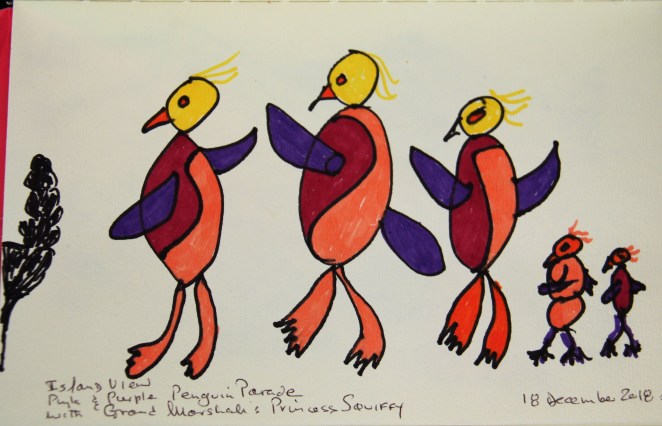
Moo apologizes. He hasn’t painted any chimpanzees, but a long time ago (2018) he drew and colored this cartoon. Pink and Purple Penguin Parade with Grand Marshall, Princess Squiffy. You can just see the end of Princess Squiffy’s tail as she vanishes out of the cartoon, encouraging the Pink and Purple Penguins to follow behind her behind. Oh the joys of leading the parade. Not everybody wants to do it though, many are content not to lead, but just to follow. Perhaps we should have called our cat MacNamara. After all, he was the leader of the band. But I don’t think Princess Squiffy would rather be anything other than what she is – a princess.

This poem, from Monkey Temple (of course / wrth gwrs) reminds me of Parents’ Day at my Boarding School. After several weeks of scarcely edible food, the tide would suddenly turn. Thursday, prime rib roast beef for supper. Friday, roast chicken with all the trimmings. When our parents arrived on the Saturday, all we could talk about was the wonderful food we had been eating for the last two days. Cunning, eh? We all had to dress up for Parents’ Day. Sunday starched collars, collar studs and all, and nice clean Sunday School ties.

Tea on the lawns in summer – unforgettable. A marquee, in case it rained, but otherwise tables laden down with a variety of skillfully cut sandwiches, little triangles, with no crusts, followed by endless helpings of strawberries and cream. The boys served their parents, fleeting back and forth to full the rapidly emptying plates. One boys father, I won’t say whose, devoured 12 bowls of strawberries and cream before the headmaster call the son over and begged him to beg his father not to eat all the strawberries and cream as some other parents’ would like some also.

Griffin Hunting – not a typical public school sport but one in which my school most certainly indulged. Our school symbol – a griffin – woven with gold thread on a dark blue background symbolized for the younger boys the perfection of the Prefects. To Hunt a Griffin was to behave in such a way as to attract the attention of older boys (already Perfect Prefects) and the school masters so that one became a candidate to climb the ladder and become a candidate for Griffin-hood. Some of us, myself included, preferred the anonymity of Robin Hood and were happy in our chosen roles of outlaws in Sherwood Forest and agents provocateurs and anarchists. Not for us the gentle counting of innumerable sheep. We chose rather the perils of after-dark transistor radios and the joys of Radio Luxemburg.

I remember being caught out of bed one night, on my knees, in a corner of the dormitory. All the dorm occupants were squealing and making a terrible noise. This attracted the attention of Perfect Prefect Plod – and in he came, threw the door open, and switched on the light. “You!” he pointed at me. “What do you think you are doing, out of bed?” “I am catching a mouse, Prefect Plod,” I replied. “You are a nasty little liar,” said Prefect Plod. “There are no mice in our nice clean house.” “Oh yes there are,” I replied, and I showed him the little mouse that I had cradled in my hands. “Give that to me,” ordered Prefect Plod. So I did. And the mouse took an instant dislike to him and immediately sunk its sharp little teeth into his thumb. I remember Prefect Plod running out of the dorm screaming “Matron! Matron!” and the little rodent swinging back and forth and hanging grimly on.

Those boarding school days ended 63 years ago. Hard to believe, really, but I still have such vivid memories of them. And of the Perfect Prefects, gripping cup handles between finger and thumb, enormously pleased to be the centre of attention on Parents’ Day, however clumsily they walked, in their spruced up for the occasion, Sunday Suits and Shirts, with their Golden Griffin ties. I always think of the Chimpanzees’ Tea Party when I think of the special performances of that little lot ‘for a Prefect’s lot is not a nappy one, nappy one.’

Gorilla Drives the Zoo Bus

Gorilla Drives the Zoo Bus

Gorilla drives the same zoo bus
all day, every day;
same starting time, same finishing time,
same route, same stops,
different passengers,
but every passenger the same:
faceless.
Gorilla doesn’t want to know their names.

“Please tender the exact fare!”
Not a penny less, not a penny more,
and he polices every penny.
Bus conductor and master
of every passenger’s destiny,
he opens and shuts the door,
letting passengers on and off the bus,
but only at official stops.

Every passenger has a ticket,
and he punches every ticket
with a neat, round hole.

He never makes mistakes.
He grinds, like God’s own mills,
exceedingly small.

He has spent all his life in uniform.
He has a belt and braces to hold his trousers up.
He’s always prepared for the worst.  

Ten, fifteen, twenty years:
an anonymous wife;
anonymous little babies;
at shift’s end, a pension,
and another bus.

St. Peter’s at the wheel.
He doesn’t want to know
where gorilla wants to go:
he wants to know where he’s been.

Commentary:

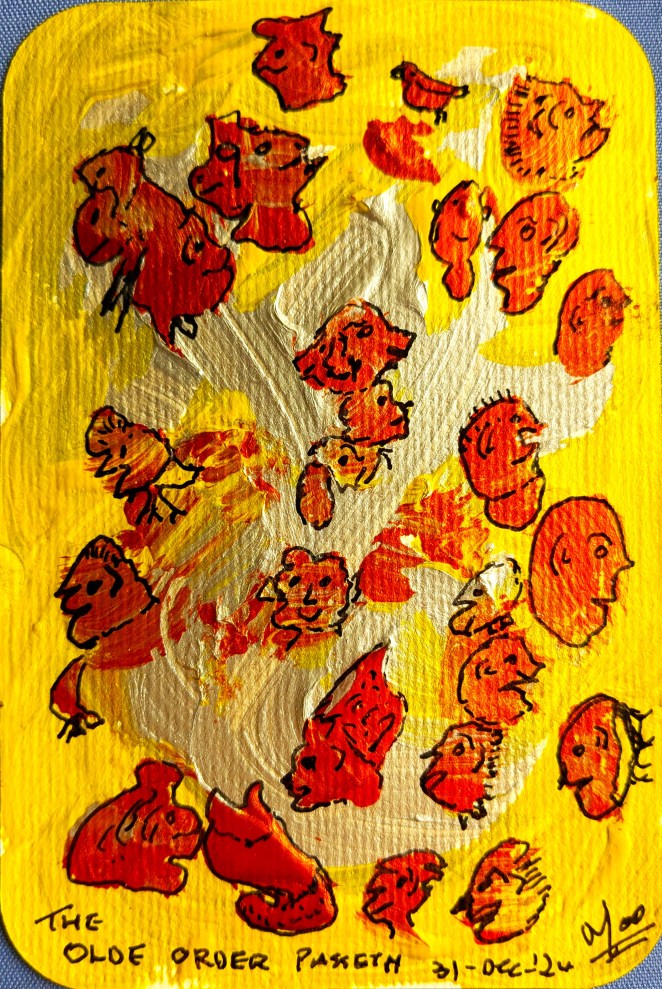
Moo didn’t have a painting of a gorilla driving a bus, so he offered me a painting of the passengers instead. Look carefully – you might even find a portrait of me or you in there. Who knows where Moo goes and who he sees? I certainly don’t. Remember Picasso – he used to run downstairs, out into the street, see a face he liked, and run back upstairs and paint it from memory. I wonder if Moo does the same thing. I’d ask him, but if he doesn’t want to answer the question, he just grunts. And I can imagine him grunting at that one.

Anyway, we all know and recognize the gorillas when we meet them. They are totally unimportant, have a miniscule job to do, but do it with absolute authority and the utmost perfection. Like Gorilla – “Not a penny less, not a penny more, and he polices every penny.” – “he opens and shuts the door, letting passengers on and off the bus, but only at official stops.” – “he punches every ticket with a neat, round hole.” – and probably in the exact same spot of every ticket! – “He never makes mistakes.” – and if he does, it’s the passenger who suffers, because ‘Get on, get off, who ever you may be, I am the lord of the bus,’ says he.

What will happen to us at the end of our shift? I really don’t know. And I don’t think anyone else does, either. Will St. Peter be there to greet us? (I don’t know.) Has the Zoo bus replaced the ferry over the River Styx? (I don’t know.) What will we be asked when we get there? (I don’t know.) How will we answer? (I don’t know.) Is there a little book in which all our deeds, good and bad, are written down? (I don’t know.) Are we to be divided into sheep and goats? (I don’t know.) What will poor monkey do when he is turned into a sheep or a goat? (I don’t know.)

So many questions, deep questions, packed into one small poem. Most of those questions unanswerable. But that’s one of the joys of poetry – to open a poem is to open a tin of calamares – there’s always another something or other left in the corner. Look, over there, bottom left, right at the bottom of the can, I spy with my little eye another question. ‘What is that question?’ you ask. Sorry, mate, I’m afraid I don’t know.

Hair Cut

Hair Cut 

Curly locks, wisps of grey and silver,
curve around my ears, cuddle my collar.
I stand in the bathroom, look at my scissors,
glance in the mirror, and start to hack.

I turn my head swiftly from side to side,
watching white hair falling, like snow.

“All done!” I look at myself in the mirror:
hair shorter, still sticking out in clumps,
but some curls still tickle and cling.

Not bad for front and sides. I still
can’t see the back, but if feels fine.
“Right” I say. “I’m ready for the show.”

What show? The one where I sit before
the computer screen and admire myself
before I click in the code, type the password,
and join the virtual meeting that today,
in the pandemic, passes for face to face.

Commentary:

Face to Face – Moo helped me with this one by allowing me to have one of his ‘face to face’ paintings. Thank you, Moo. Sorry I said you weren’t too bright yesterday. And we both got the singer of All Shook Up wrong – it was Tommy Steele of course. Also, as you explained to me, you may not be great at adding two and two and making four, and you may be unenlightened with words, but wow, when you add a colour or two to the palette you are enlightened and enlightening and dazzle people with the lightness of your enlightenment. There – hope we can be friends again now. I would miss your paintings if you withdrew your services.

And this is a Golden Oldie. In 2020, when Covid walked with us, I started cutting my own hair – hacking might be a better word – and I have continued to do so ever since. In fact, I have only been to the barber’s three times since 2020. Each time, the hair lay so thickly upon the floor behind the barber’s chair that we walked knee deep in the white stuff. Great fun. How the young lady made fun of me. Right down the middle of the back of my head she found a large mullet that I couldn’t reach with either hand. She found that so funny. Asked me if I wanted to keep it. Of course, I said no!

I remember those face to face on the computer days. At least we couldn’t catch Covid from an image talking back to us on a screen. I always find those online meetings so difficult and awkward. I love the awkwardness of that word – awkward. The facilitator always began with – ‘Now, let’s all introduce ourselves.’ What on earth do you say on such occasions. ‘Easy,’ Moo told me. ‘I always say “Hi. I’m Moo. I’m a painter.” Nobody bothers me after that. Once somebody asked me what I painted and when I replied ‘houses’, everyone lost interest and the facilitator moved on.’

I always get tongue-tied and can never manage to be coherent. In fact, I am neither coherent nor cohesive and I often fall apart. “Hi! I’m Roger. I’m a writer.” This always opens the doors and the windows to all sorts of questions. ‘What do you write?’ ‘Have you published anything?’ ‘What’s your latest work?’ Of course, if I had any sense – and often I have less sense than Moo – when someone asks me ‘What do you write?’ I should reply. ‘English.’ Or ‘Italics.’ Or ‘Greeting cards.’ That last would be as much of a show stopper as Moo’s response – ‘houses’! Of course, I could get really inventive and say ‘Bilingual jokes for Christmas Crackers.’ Another pet peeve – have you noticed how the French and the English don’t match up? I could have a great old rant about that one. But don’t let’s talk about Fortune Cookies!

And suddenly, we have strayed a log way from the act of getting our hair cut during Covid. But, like many diversions, the journey is often more important than the destination, especially if we are amusing ourselves! And I hope you had some fun and took some joy from my words.