Rage, Rage 48


Rage, Rage
48

I carry memories
and scars like a snail
wears its shell
and I leave behind me
a slither of silver words.

I’m a broken gramophone,
needle stuck in a groove
repeating the same verses
again and again.
This repetition
drives me insane.

My thoughts just drift.
My body is a ship
in the doldrums,
no wind to fill its sails.

I pick up my paint brush
and paint myself –
lonely and blue
as idle as a long-lost lamb,
alone with nothing to do.

Comment:

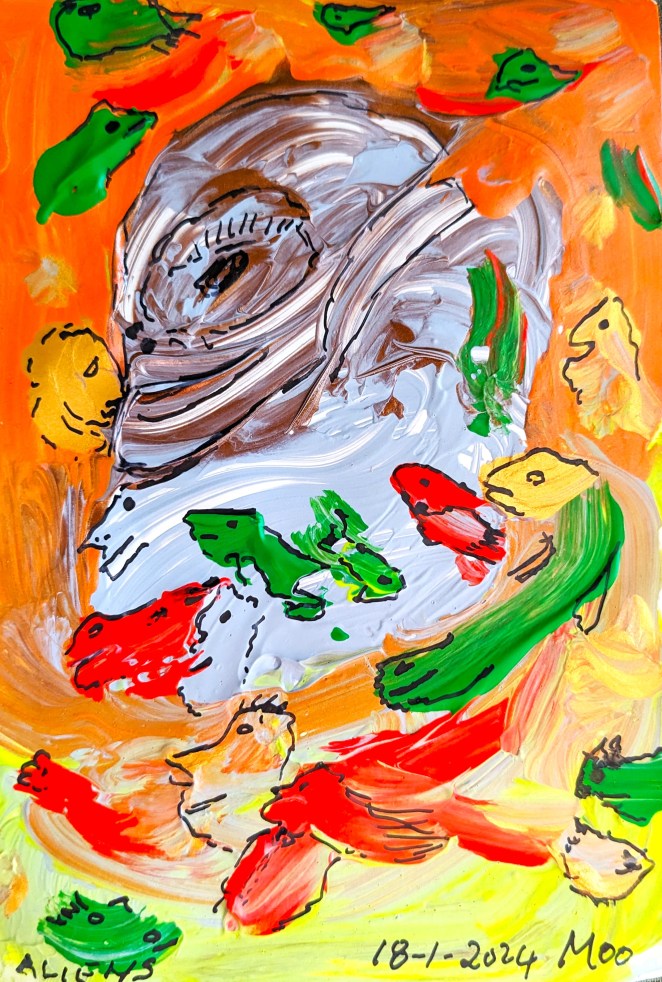
The alienation of an alien nation – and I wonder if they really are here, those aliens. So many strange happenings in my life. The silver slither of words drags me through so many lost moments in time. Fray Luis de León, I spoke to him last night, asked me the question – “Es más que un breve punto / este bajo y torpe suelo comparado / con aquel gran transunto / donde vive mejorado / todo lo que es, lo que será, lo que ha pasado?”

It’s a lovely verse in Spanish, but not so easy to translate into English. Let’s try – first, word for word – “Is it more than a small dot this low and stupid soil compared with that great sky world where now lives improved all that is, all that will be, and all that has happened?”

A comment on the translation – first, the length of the sentence and the way in which it is complicated by inversions and ideas expressed in words which have little direct translation. Then there is the expression – 1. a small dot – un breve punto – a short moment in time. 2. low and stupid soil – este bajo y torpe suelo – clumsy earth below. That clarifies, a little the meaning. 3. that great sky world – aquel gran transunto – that great sky above. 4. lives improved – vive mejorado – lives a better life.

Here goes: “Is this clumsy earth below more than a short moment in time compared with that great sky above where now lives a better life all that is, all that will be, and all that has happened?” Not great, but we can live with it.

As Miguel de Cervantes said “To read in translation is to look at the reverse side of a tapestry.” So, to imagine the real side of the tapestry we need to count our syllables – they don’t match. We need to measure the length of our lines. They don’t match. We need to sharpen our metaphors and images – they don’t really match. And, last but not least, we have to imagine the Platonic, Terra-Centric universe in which the sun moves around the earth and the earth is the centre of all life.

I should add the cultural association of words. In every language, each word has an “associative field of cultural meanings”. Those “associative fields” differ from language to language. So, even getting the verbal meaning correct means that you do not necessarily get the cultural associations right. In fact, it’s almost impossible to do so. It’s a fascinating world and one which I have explored in various academic articles.

I would like to take cultural meanings a step further. In Don Quixote, II, 11 – I quote from J. M. Cohen’s Penguin translation of 1950 (rpt 1961) – Don Quixote says to Sancho ” … if I remember rightly, you said that she [Dulcinea] had eyes like pearls, and eyes like pearls suit a sea-bream better than a lady” (p. 533). I will leave aside Sancho’s mixing of the Petrarchan metaphors and concentrate on the single word sea-bream. To compare someone’s eyes to those of a sea-bream is comical in English. However, the word has several associative fields in Spanish which are worthy of deeper study. Secondary meanings of a sea-bream – besugo – include 1. a mild insult, as in no seas besugo / don’t be a fool / an idiot / stupid. 2. Diálogo de besugos – two people talking and neither one listening to the other. 3. Ojos de besugo – a blank or dazed expression. Quite simply, the translation besugo > sea-bream functions at the literal level, but by no means at the cultural level of the associative fields.

Alas, some days I’m a broken gramophone, needle stuck in a groove, repeating the same things again and again. Maybe one day I will get them right. And maybe I won’t. Better minds than mine have struggled with translating Spanish (poetry) into English (poetry), and most have failed. Many, dismally. We won’t mention names. Sometimes the best translations are not translations at all, but poems that recreate the original in the target language. I am quite happy with my translation of the meaning of Fray Luis de León’s poem – but how sad would be any attempt to transfer the verse form from Spanish to English? Five lines of seven and eleven syllables each – wow! Go for it. But remember – fools rush in where angels fear to tread.

Never mind. Maybe tonight I’ll have another little chat with Fray Luis de León and Miguel de Cervantes, Quevedo too, if I am lucky. Maybe their English will be good enough to give me a few hints. I’ll let you know later if any one of them does come to visit.
Rage, Rage 46 & 47

Rage, Rage
46

I fall into
the easy sleep of age,
pencil in hand,
notebook on knee.

Shadows grow longer
as my life grows shorter,
day by day.

Now it is so easy
to stumble and fall,
each slip a steep slope
down which I slide.

So difficult now
to regain my feet.

I must crawl to where
I can haul myself
first to my knees
and then stubbornly
upward until I can stand.

47

Now-a-nights
I fall easily into dreams
that all too often
turn into nightmares
that rise up from my past
to trouble my sleep.

I struggle and scream
and pinch myself awake,
only to find my cheeks
wet with tears and my mind
all shook up by the return
of childhood fears.

Freud and Jung pull the strings
of those mental puppets
that dance in my head.
Some nights I am afraid
of falling asleep,
for fear that I may never
get up from my bed.

Comments:

Coming to the end of Rage, Rage. When it is finished, that will also be the end of the trilogy – Clepsydra [Chronotopos I], Carved in Stone [Chronotopos II], and Rage, Rage [Chronotopos III]. I have written a fourth volume in the sequence – No Dominion [Chronotopos IV], but this is very personal and I will probably only share it with family members and the closest of friends. However, do not despair – I have an alternate fourth volume, but that is still being written. It us under wraps, and may well replace No Dominion. We shall see.

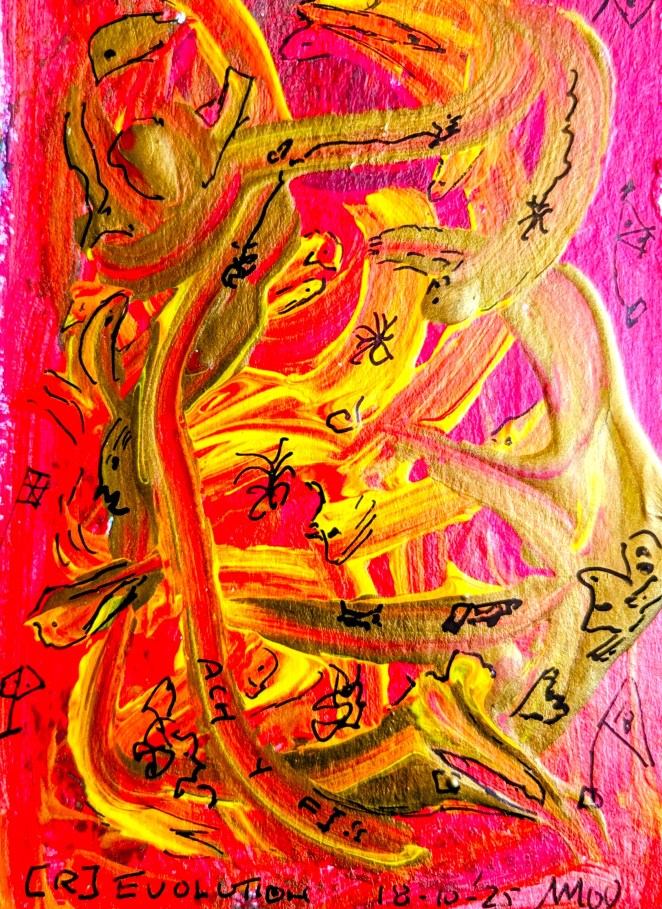
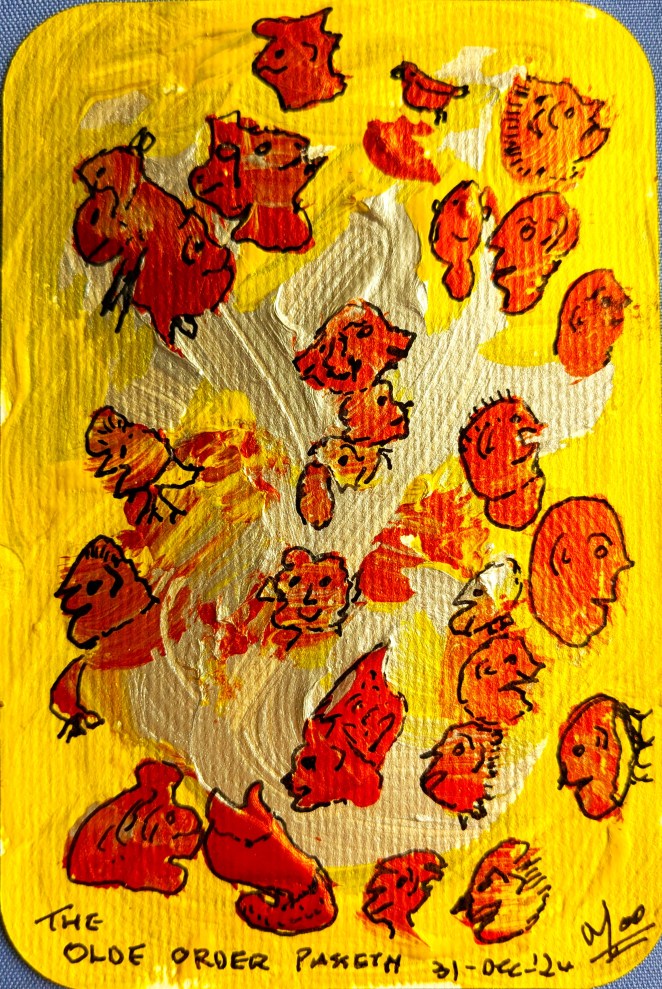
As for Freud and Jung, they certainly do pull the strings of those mental puppets that dance in my head. Moo says that there should be no strings attached. He has therefore drawn all those strange puppet like figures, a but like an Aunt Sally, really, but has left out the strings and the man / men / woman / women / people pulling them. An Aunt Sally or a lovely bunch of coconuts? Time well tell, if you ask it nicely.

Maybe one of my teddies will tell. They all romp around the room with me at night and I am sure they suspect much of what goes on in my dreams. Here they are – a selection of friendly teddy bears. Be very careful, though, they can be very grumpy, especially if you wake them up suddenly. They don’t like things that go BUMP in the night.

Rage, Rage 26

Rage, Rage
26

In my dreams, I track 
the sails of drifting ships,
white moths fluttering
before the wind.

I think I have caught them
in overnight traps,
but they fly each morning
in dawn’s unforgiving light.

I give chase
with pen and paper,
fine butterfly nets
with which to catch
and tame wild thoughts.

I grasp at things
just beyond my fingertips.

I wake up each morning
unaware of where
I have traveled
in my dreams.

Comment:

White moths fluttering before the wind – my dreams at night. How do I trap them, catch them, squeeze them between my fingers, hold them, pin them to the show case of memory? I remember in Oaxaca – the young boys, trapping the moths. Huge, gigantic butterflies, moths, as large as birds. They severed their wings, and sold them to the passing tourists. Such beauty, such colour.

I heard an angry buzzing, looked down, and saw flightless bodies, wings clipped, rowing their stumps of bunt oars, skidding sideways across the gutters, and dreaming painfully of the stars.

Rage, Rage 18

Rage, Rage
18


I nod off again and dream
of a summer beach,
burning sand, tide way out,
sparkling waves, clouds moving,
inaudible, as they drift by.

I dream of my beginning
and find a forlorn formlessness
that sought the solace of sound
only to discover waves and wind
as I drifted on an amniotic sea.

The wind of change has blown.
I awake and pick up my book.

Voltaire –
“Si jeunesse savait,
si vieillesse pouvait.”

“If youth knew,
if age were able to.”

Comment:

The wind of change has blown and, by all accounts, it is still blowing. A Nor’ Easter here, swinging down from the Arctic and bringing us cold weather, ice, and more snow. Driving isn’t too bad, for the roads are cleared regularly, especially when schools are in. Most enterprises have cleaned, salted, and sanded their premises. Some haven’t. Yesterday, it took two people to move my shopping cart from the shop to the car, a matter of about thirty yards. The wind was so strong. It tussled and tugged, drove me where I didn’t want to go, and two people stepped in to help me. Then I discovered an undug doorway. I parked my car at a sharp upward angle, on the snow. A man offered me his arm. I said no, but he stood beside me, hands held out to help, just in case. Leaving that same shop, I was accompanied by a young lady who insisted on carrying my bags, taking my arm, and leading me to my car. The dangers of falling on down hill ice were even greater than going uphill.

I dream of my beginning, more and more often nowadays and now-a-nights. I know, spell check underlined that word. A neologism, not a proper word. But I like it, for though I dream by day, nodding suddenly into a shallow sleep, it is by night that I really do my dreaming.

At night, I find I can roam a world that has become hostile in the light of day. I can, and do, dream of my childhood on the Gower Peninsula. The fields are still there. My grandmother walks among the bluebells, and together we tell the time by the old dandelion clock. The larks still rise on Bishopston Common and Bluebells, Cowslips, and Primroses still hide beneath the trees. The sands at Brandy Cove are still clean. There is no pollution in my dreams and no oilers clear their tanks in the pristine waters of the Severn Estuary. There is no industrial haze and, on a clear day, I can still see, from the steps of the bungalow, Ilfracombe, across the bay.

And the people – my family and friends are still there. My uncles and aunts, my cousins, all young still, my parents and my grandparents … and all my dogs return, one by one, from their canine adventures. At night the cows can be heard crunching grass, and wheezing in my dreams. I met one, once, on a night trip to the outhouse – we had no indoor plumbing. And, on one memorable night, I stepped into a wet, warm cow patty, left like an anti-personal landmine, just outside the back door. I still shiver as I think of that warmth creeping up between my toes. No amount of wiping has ever really removed it. It haunts like the ghosts of summers past that drift at midnight round my room. waiting to be plucked from the air.

Rage, Rage 4

Rage, Rage
4

I walk from room to room,
startled by shadows,
and open doors,
search under the table,
look behind chairs.

Nothing. No one.
The house stands
still and empty,
but for the sadness,
the silent sadness,
that fills each room
with their remembered
presence.

Commentary:

Absence and presence. How many of us feel that something is there, walking beside us, or just behind us? How many feel that an empty room is not empty, but is filled with a presence, something we feel, half-recognize?

I have been in houses, invited for the night, where I would not sleep. Why? I do not know. But I felt a presence, a prescience, if you wish, that filled me with a desire to leave and not to stay.

What is it? Is it other memories, other lives, that impinge upon ours in this current time frame? I do not know. But I do know that there are houses and rooms in which I will not stay. I also know that there are others that throw open warm arms to welcome me.

Look at Moo’s painting(s). How many of them welcome us in? Do some of them shut us out and make us shiver with a fear, not of the unknown, but of the hardly-remembered, that lies in wait to shake us out of this dream which is our present life?

Kipper Kapers

Kipper Kapers

Old Welsh Intelligence Test Question: “Does a kipper swim folded or flat?”

5-4-3-2-1 –
Time’s up, Ladies and Gentlemen.
So – what’s your answer?

Yes? No? Maybe? I don’t know?
It’s a trick question of course / wrth gwrs. And Kippers can play tricks on you too as they flipper and flapper, and flip and flop. Especially if you eat them late at night.

So this is a painting of a midnight Kipper Kaper Attack, when you want to sleep, but can’t, because you don’t know the answer to the kipper IQ test and all those little kippers are capering around and making fun of you and mocking you.

How do you avoid a Kipper Kaper Attack when the bad dreams start and the Kippers Kaper? Well, you answer this next Welsh IQ test question. “Adam and Eve and Pinch Me when down to the river to swim. Adam and Eve got drowned. Who do you think was saved?”

And if you answer “Pinch Me!” Then I will, and when I do, you’ll wake up, and you’ll be safe from another Kipper Kaper attack until the next time you eat them.

There – simple isn’t it?

What’s something you would attempt if you were guaranteed not to fail.

Daily writing prompt
What’s something you would attempt if you were guaranteed not to fail.

What’s something you would attempt if you were guaranteed not to fail.

Well, I remember when Arthur Lydiard was coaching Peter Snell, this was back in the early sixties. He ‘allegedly’ said – and I write from a decaying memory – that anyone could be trained to run a mile in under four minutes, using his methods. Next day, it is rumored that a fifty year old man, overweight, smoking a cigar, turned up at training and asked Lydiard to fulfill his promise.

Well, maybe it was Percy Cerruti training Herb Elliott. Same time frame. Different memories. Great coaches and great athletes. So here am I, at eighty (well, nearly), and I have always wanted to run a mile in under four minutes. My fastest time was 4:07 – downhill, with a following wind, during the Bristol University Rag Run (1966 – Bristol – Stamford Bridge – Hastings – Bristol). So, I am guaranteed not to fail, eh? I also hope you will guarantee that I do not fall, eh? And can I use both my canes, or only one, eh?

Okay, so this is how we’ll do it. You load me on the back of a flat bed truck. It has one of those walkways on it, with handrails on both sides, like they use in the rehabilitation centers. I won’t need my canes then. The truck drives a measured mile, in 3 minutes and 59 seconds exactly, and I “run aka speed walk aka speed lurch” all the way, hanging on to the handrails, thus covering a measured mile, in under four minutes, and achieving a life-time goal, attempting which I am guaranteed not to fail.

What was that line from Man of La Mancha aka DQ (and I don’t mean Dairy Queen) – “to dream the impossible dream.” And now, tired from my exertions, I will take a brief siesta and see if, in my impossible dreams, I can bring that time down a little bit lower. New world record, anyone?

Night and Day Dreams

Winking Night Bump

Night and Day Dreams

Someone stole the nose from a sacred statue.
He placed it on his face and I watch it
as it crosses the central square.

A moving shadow: zopilote flies high above.
I talked to him once on a midnight bus.
He begged me to fold his wings
and let him sleep forever.

The balloon lady sells tins of watery soap.
Children, newly released from school,
fill my days with enchantments.
They blow soap bubbles, tiny globes,
circular rainbows, born from a magic ring.

The voices in my head slip slowly into silence.
Some nights I think they have no need of me,
these dreams that arrive in the early hours
and knock at my window.

When morning comes, I watch them fade
and then I know they cannot live without me.
When I am gone, they will go too.

Click on this link for the original poem.

https://wordpress.com/post/rogermoorepoet.com/23643

Click on this link for Roger’s reading.
Night and Day Dreams

Dreams

IMG0023_1.jpg
Dreams are important throughout mythology. Do we create them ourselves? Or do they come to us as celestial messages? Can they exist without us? Or do we form a symbiotic relationship, each dependent on the other?

Dreams

I once stole the nose from a sacred statue.
Today I watch it cross the square attached to a face.
Eight Deer walks past with a fanfare of conches:
you can tell him by his donut with its little tail.

A shadow moves as zopilote wings his way across the square.
I spoke with him once on a midnight bus.
He begged me to fold his wings and let him sleep forever.

gringa called Nuttall sells tins of watery soap.
Her children fill my days with enchantment
as they blow bright bubbles through a magic ring.

Eight Deer, eight years old, sets out on his conquests.
Nine Wind births nine of his people from flakes of flint,
or was it from the magic tree in Apoala?

The voices in my head slip slowly into silence.
Sometimes I think they have no need of me,
these dreams that come at midnight,
and knock at my window.
Other times I know they cannot live without me.

Daydreams

Duermeivela: that time when the waker dreams he is waking, yet is still asleep. His mind wanders through a labyrinth of old memories, streets and squares, myths and legends. It is a mythical time of great creativity. To wake up from it is to be filled with hiraeth: a longing for all that is lost and can never be recaptured.

Daydreams

The alarm clock shuffles
its pack of sleeping hours:
a clicking of claws,
needles knitting outwards
towards dawn’s guillotine.

A knife edge
this keening wind
sharpening my bones
tingling fingers and toes.

Ageing eyes refurbished
in the morning’s sky fire.
Ravishing rainbows
dazzling the eyelash of day.

Old myths grow legs.
They wander away
to gather in quiet corners,
where the wind weaves
dry leaves into endless
figures of eight.

 An old man now,
I dream of white rabbits,
running down tunnels,
escaping the hunter’s hands.

When my dreams break up,
they back into a cul-de-sac:
a wilderness of harsh black scars.

Scalpels, my finger nails, carving
red slashes on white-washed walls,
trenchant shadows, twisted dancers,
old warrior kings
bent into pipe wire shapes.