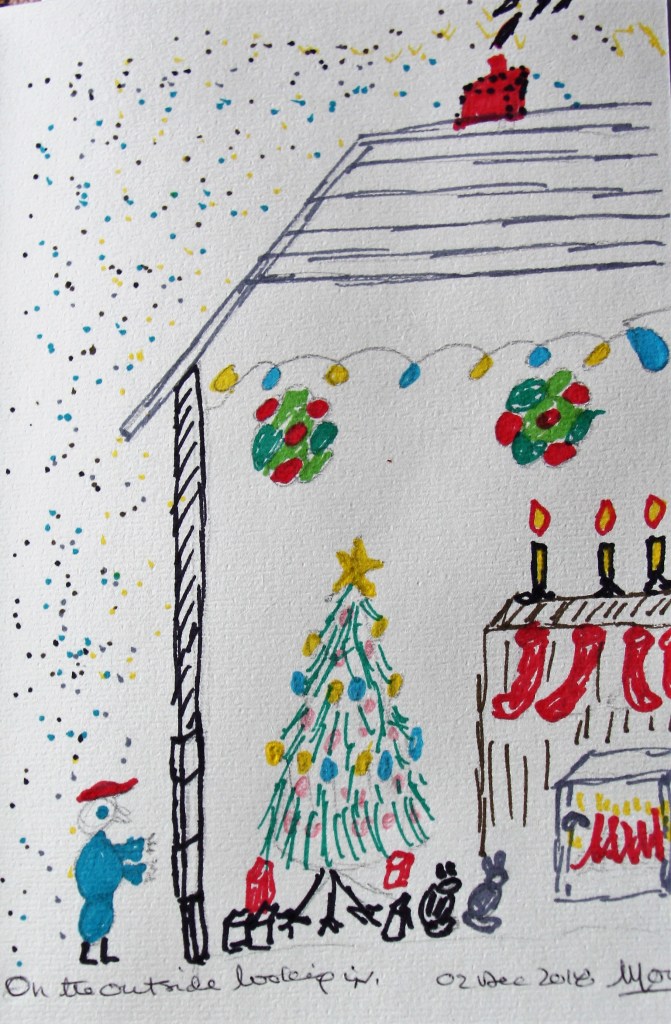
Just one leaf dropping from the tree and the fall a call of nature and no freak chance of fate. What throw of the dice eliminates Lady Luck? None at all, or so the poet says, lying there, indisposed, his ribs cracked hard against the wooden boards of the porch and his right foot caught in such a way that the hip slips slightly from its socket and try as he may he cannot stand but lies there in the chill evening wind, a lone leaf, getting on in age, plucked from his tree and cast to the ground.
Comment: And don’t forget the family of crows, sitting in the tree, giving me the eye. watching every movement. I half expected them to flap down on to the balcony, and take a closer look, but when I started to move, it was game over, Rover, and they all cawed and flew away.
Dear reader who reads my poems: sometimes I say what I do not mean to write and write what I don’t mean to say. Rhymes
make things clearer, for I puzzle what I might say, and plan ahead so an awkward word will not intrude. Words, birds in flight,
bright as postage stamps across the absurd white snow of a page or a digital screen. When I think about it, I assume about a third
of what I say, I really mean. Who has seen the early morning wind drifting our thought-cloud across the lawn, moving shadows cast on green
blades of grass, as we think our thoughts aloud, each thought a pea in a pod, as some we clasp between finger and thumb while others crowd,
and the loud, uneasy word slips from our grasp to wound or injure or otherwise to hurt and maim. It’s not my aim to do this. My word is not an asp
or a viper or a screw to be driven. I lay no claim to hurt and yet sometimes a word slips sideways and does not say what I mean it to say. I aim
to please, to tease, to provoke, in so many ways and yet I often hurt where no hurt is intended. If I have done you wrong and my word displays unintended ends, forgive me: let all rifts be mended.
Words are formed from a combination of letters and sounds. Join them together and they will march like Roman soldiers, in groups of meaning. A cohort, ten words, ten men, commanded by a Decurion. One hundred words, a century, commanded by a Centurion. Six thousand words, a legion with six thousand possible implications attached. I use the image of the Roman Legion because meanings in poetry are Legion and our Western Poetry tradition, of which I am a part, goes back more than two thousand years to Roman times and beyond. Tolle, lege: Latin for take and read. Sortes Virgilianae: fortune telling by chance words drawn, originally, from Virgil’s Aeneid and now from this poetry book. Choose your words and sentences at random. Interpret them as you will.
Associative Fields
While each word has an individual dictionary meaning, words are much more powerful than the dictionary. Each word is surrounded by a network of associations, called an associative field, and those connections are different for every reader. This means that each word and its associative field have very personal emotional strings attached. When you understand this, you will also understand that each reading, each interpretation, is your own and nobody else’s. This is not a grade school classroom. Here, there are no poetry thought police to tell you that you are wrong, that you are mistaken, that you do not understand what the teacher is telling you.
Take the word ‘grandmother’. The dictionary meaning is clear. Your grandmother is the mother of your father or the mother of your mother. Each of us has, if we are lucky, two grandmothers. Some of us have more than two. The emotional ties between you, as reader, and your own ‘grandmother(s)’ will determine your own personal version of the word’s emotional and poetic tones. Now you must apply these individual meanings to each word you read. Reading poetry in this fashion will allow you to create your own personal world of tone, meaning, associations, and emotions. This is what poetry brings to you, not a handful of information to be scanned for knowledge, but a series of sights, sounds, memories, all personal, that are triggered in your mind by the impact of the poet’s words.
Comment:Wednesday Workshops are my attempt to express some of my ideas and theories on writing in general and on poetry in particular. Hopefully, the will encourage other writers to think about their writing and to deepen their knowledge and understanding of what we do best: think and write. By all means add your own thoughts to what I have written here.
I cover my face with a white mask of soap and carve intricate patterns with the razor.
… painted masks … death masks … the masks the priests wear in the pre-Columbian Oaxacan codices … the prisoner struggling … not yet fully understanding his fate … around him … animal masks … priest masks … the jaguar cult of the regiments … they strip him down … paint his body … arm him with flowers … place him on a pedestal … from there he will dance his last dance … fight his last fight .. his destiny … like the bull in the bull ring … to die bravely showing no fear … he strikes first with the flower … his opponents strike back … one by one … with their obsidian knives … each wound a flesh wound on legs and thighs … the heart pounds … the blood flows .. faster and faster … more flowers … more knives … more blood … until almost bloodless the prisoner weakens and stumbles … rough arms seize him by the arms and legs … they carry him to the sacrificial stone … bend him over it … chest exposed … and tear the living beating heart from the cavity the carve in his chest … the severed arms and legs bounce down the temple steps to the waiting crowds … tomorrow his spirit will return as a hummingbird … and dance around the sun … for now his torn heart sizzles in the sacrificial fire … a horse’s head … teeth bared … grins from the temple walls …
My razor, held like a flower, slips and I gash my lip. The slow blood seeps through the soap streaking my mask with faint shades of pink. I shiver and stare at my reflection in the mirror. It’s a very plain face with a nose slightly larger and more hooked than it ought to be. I think of it as the prow of a ship or a bird’s beak: an eagle perhaps. My nose is very much like the nose of the man who died in the flower dance. In spite of the warmth in the room, I shiver again.
Spotify Remember to scroll down to appropriate audio episode.
Vets A Thursday Thought
Mary Jones
I met her unexpectedly in a restaurant in St. George. I was masked, but she knew me right away. She hadn’t changed. How could she have? She is as she is. Straight forward, upright, honest, true to her words and her values. Ex-military. A United Nations Peace-Keeper. A Blue Beret. World traveller to some of the roughest, toughest, ugliest, craziest spots. Everywhere she went, she helped keep the peace.
She came back home to find out what she already knew: that rural New Brunswick was as wild as anywhere she had been. She was anonymous, here, was just another number in a book, a casualty in a nameless war of attrition after which the winners rewrite the history of events, twisting them this way, that way to suit themselves and their own instincts and interests.
“Best of the best,” I wrote in the book I gave her. Fortuitous, it was, finding her again, finding that copy close to hand, reserved for her alone. That book and this poem are my tribute to her for her courage, her fortitude, and her strength of will. They are also a tribute to her role in making the world a safer place in which others, less fortunate, can create, without fear, their lives.
Comment: There is very little more to be said. Each former soldier is an individual with a history and personality of their own. This is my tribute to a very good friend who served her country and the United Nations Peace Keeping Forces with pride and distinction. Mary Jones, I, an academic, a writer, and a non-combatant, salute you for all the positive values which you have brought into this sometimes troubled world of ours. You and your well-being are in my Thursday Thoughts.
The Nature of Art and the Art of Nature is a book of poems each one of which celebrates humanity’s relationship both with the natural world and the way that world is recreated by artists in so many different forms. In order to read these poems and receive full value from them, it would help to know how to approach them.
Preparing to Read
First, de-clutter the mind. Poetry cannot be hurried or rushed. Remember, it is better to read one poem a hundred times than to read one hundred poems once. Prepare yourself mentally and physically for your reading. Sit down. Make yourself comfortable. Close your eyes. Concentrate your mind on something you find peaceful: a sail on Passamaquoddy Bay, a rose in Kingsbrae’s Rose Gardens, a butterfly in the Butterfly Garden, or a fine white cotton cloud in a cerulean sky. Breathe in and then breathe out. Now slow your breathing down. Breathe in, count up to four, slowly, breathe out, counting up to six. Breathe in, count up to six, slowly, now breathe out, counting up to eight. Breathe in, counting up to eight, and breathe out, also counting up to eight. How long will you sit there? When your breathing has slowed and your mind is clear, you will be ready to start. You will know when that is.
Open your eyes. Take your book and begin to read. Don’t start on page one and rush through. Dip in, here and there, find a title or a first line that you like, and read that poem. Read it two or three times. Then move on, randomly to another poem. Select individual lines, phrases, sentences. Savour the words. Roll them around in your mind. Read them to yourself, quietly. Then read them out loud. Try to capture their essence, their rhythms. Taste them, as you would a fine Spanish Manzanilla wine. Select another word, another line, another poem. Seek and you will find some sequence that you like. Return to it often.
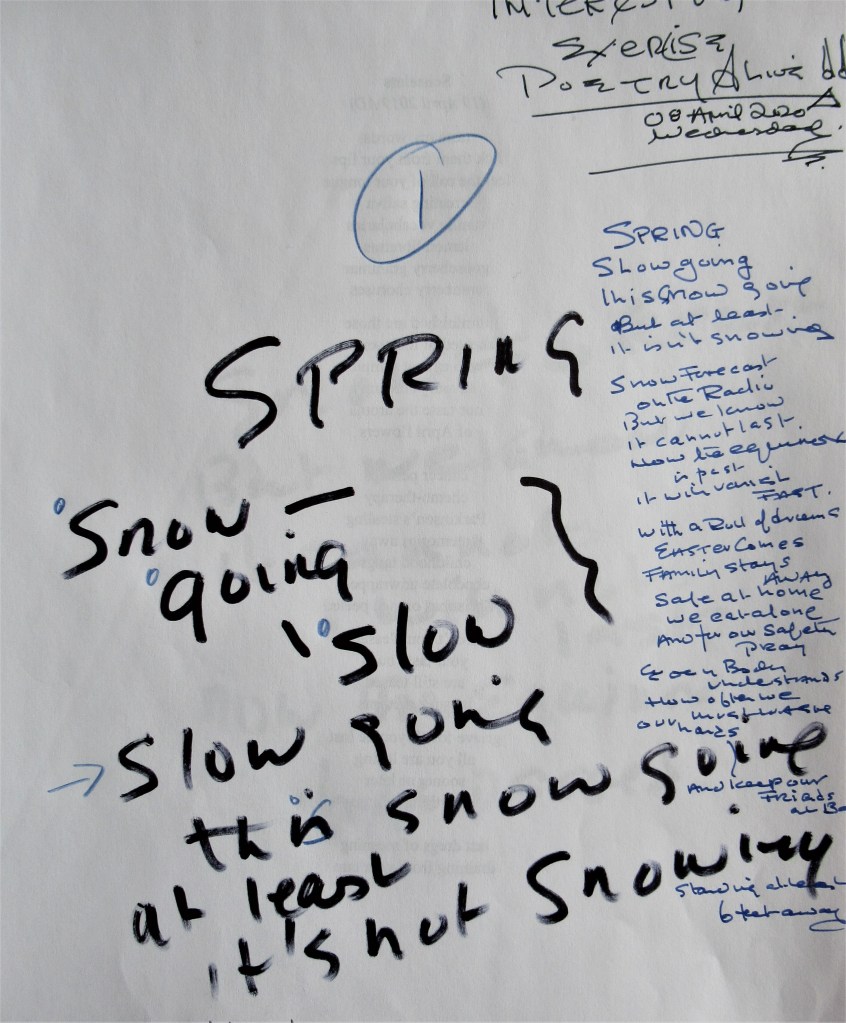
Comment: I will restart my Wednesday Workshops. The Nature of Art, the manuscript on which I am currently working, has an Introduction on The Nature of Poetry. I will put this up in installments. The handwritten opening page comes from an online video on Creativity and Writing Poetry during the Pandemic. This poetry video is the first one in the series. Click here for link. Other workshops on writing can be found by searching Writing Workshops on the Blog search (top right hand corner) or by going to this link Poetic Creativity and Thoughts on Writing
She is an oyster, silent at low tide, yet with a host of pearls waiting inside her, ready to be released. When set, she will release those pearls herself, stringing them together, like Chantal’s beads, into a skein of meaningful, enigmatic moments.
Enigmatic, yes, but, like Elgar’s Enigma Variations, a Russian Doll puzzle of secrets and intrigue. Comic book artist, she evolved to graphic designer, then multi-tasked first to Kinetics, and then to a painter who reaches out in empathy to the world around her.
For her, all art is linked and communications are key, on many levels. Visualization. Achievable goals. A step-by-step process with each step foreseen, planned beforehand, and each step always taken with an open mind that accepts the true response, leaving falsehoods behind.
Kinetics, yes, but she is above all a loner. Kayaking. Hiking. Weight-lifting. Yoga. Meditation. Mindfulness. Caring. Sharing. She sends me her web page and I am blown away by her empathy with birds and the natural world, that world her oyster and her, an oyster in that world.
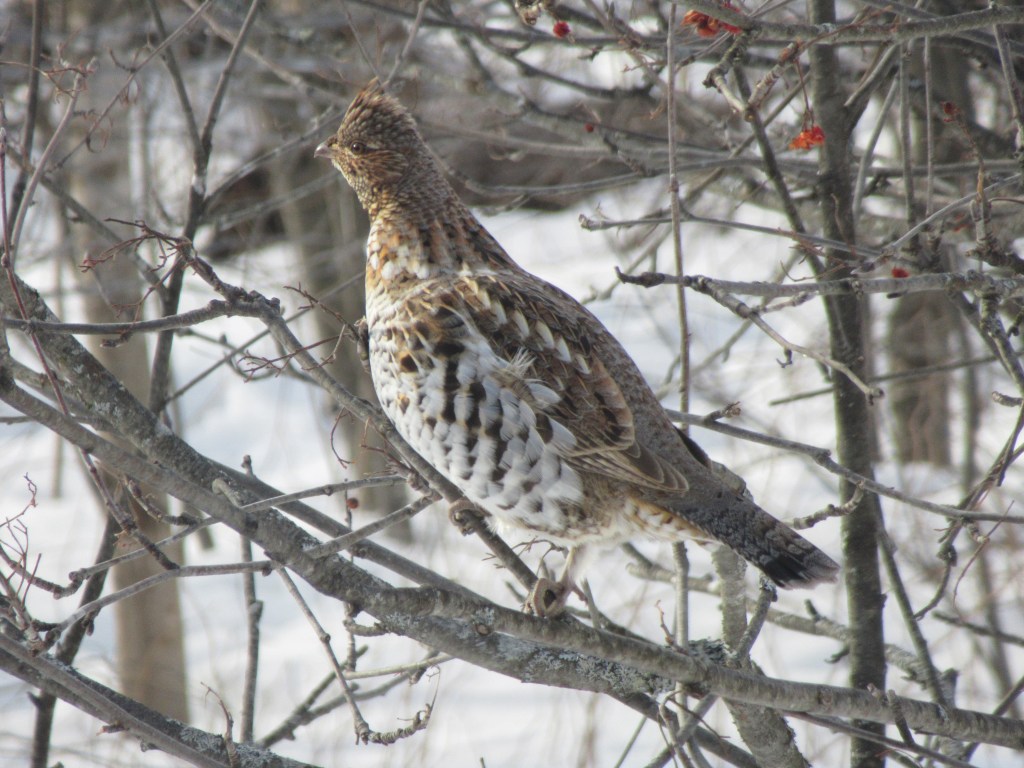
Comment: This particular bird visited our Mountain Ash in the garden at Island View. Kaitlin saw my photo and asked if she could paint it. I sent it to her, and this is the result. Wild life to Still Life to art and never Nature Morte! Together, Kaitlin and I have preserved forever the surprise visit of this beautiful bird.
Spotify Remember to scroll down to the appropriate audio episode.
Sculptures in the Gardens
It’s the only sculpture garden in Canada. It may even be the only one in the world in which the sculptures shake off their shackles and come alive at night when the moon hangs heavy in the sky and shifting shadows prowl beneath Kingsbrae’s trees. Deadly nightshades, roaming with no thought for the humans who walk around by day taunting these sculptures, thinking they are lifeless, mere images set in stone.
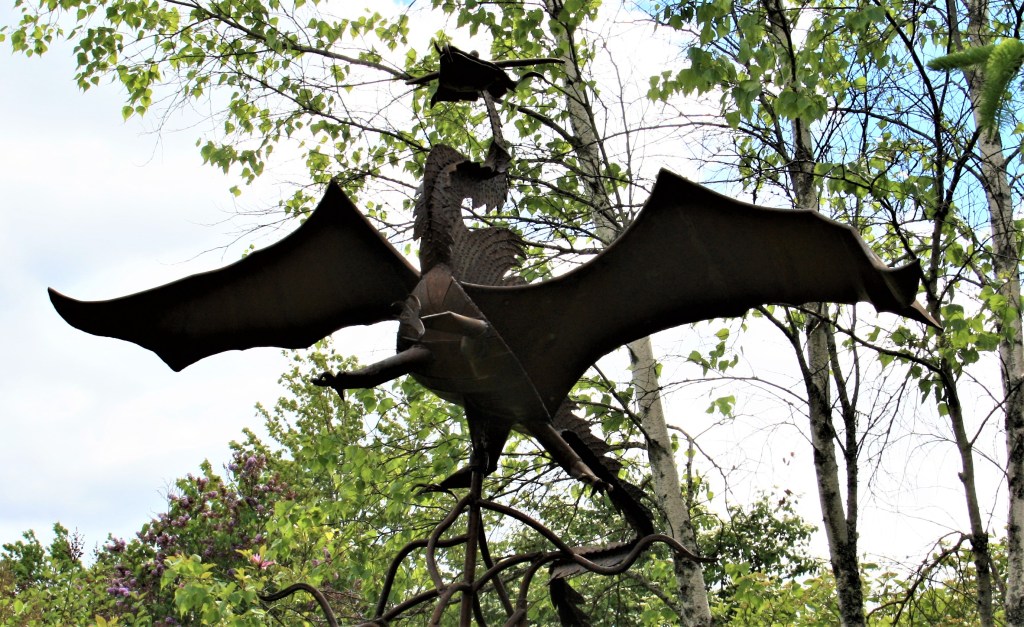
Beard not the lion in his den, nor the fox running wild, nor the chubby bear whose clumsy run belies his speed and strength. The dragon opens iron wings, but beware of the hot forge lodged in the snap-dragon’s mouth.
Have you seen the cerulean whale, marooned and ship- wrecked on these foreign soils? Once upon a time, in a fairy tale, he roamed the seven seas and plundered men and ships with abominable ease. Ease and the easel, plein air paintings, sculpture portraits taken from life and converted to a ship’s canvas that will never sail.
Ask not who is that bearded man, for he might be the one Don Juan invited to supper. Ah, the hard rock ship-shock when with a thunderous knock he arrives, an unexpected guest, at the coward’s door. And shake not his hand lest his fearsome grip turn you to stone or drag you down to hell.
Spotify Remember to scroll down to appropriate audio episode
Painting a School Outing Beaver Pond, Mactaquac
The yellow of the school bus is easy, but what colors do you give the rainbow of kids arcing out through the exit? And how do you portray their energy, their noise, their origins when such a variety of accents assaults your ears and drives the wildlife into silence?
What colors would Rimbaud have given to their vowels, their consonants, their high-pitched tones? You can sketch their orderly rows as they snack on the top-hat magic pulled out of backpacks. But it’s not so easy to paint the pop of cans, the scent of chocolate bars, or the crackle of chips released from packets and popped into mouths.
Running round after lunch, they drive the wild birds wild with their unorganized games of tag, their impromptu dances, their three-legged races, their winners and losers, their joys and sorrows. Fishing nets are produced from nowhere. Girls, boys wander to water’s edge in search of prey: incipient frogs, newts, tadpoles, bullheads, but how do you paint the wet and wriggle of them?
Try painting this. Whistles sound. Kids regroup. The bus reloads and goes. Now paint the silence. Sketch the tranquility of woods, bird-calls back, of the beaver pond with its lilies stretching their green necks skywards towards a pale blue sky where cotton clouds cluster together in celestial flocks. A pastoral scene, this painter’s paradise.
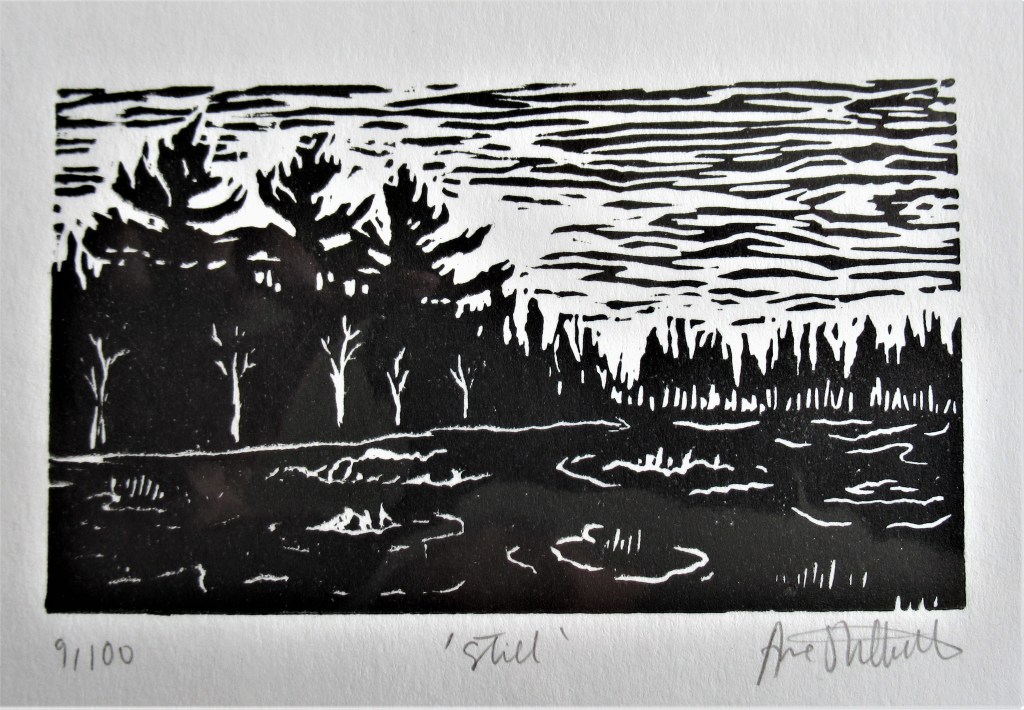
Comment: The woodcut was a gift from my fellow KIRA artist in residence (May-June, 2021), Anne Stillwell-Leblanc. It goes well with this poem about nature, noise, and the absence, then presence, of silence. For those of you who do not know the Beaver Pond at Mactaquac, it is well-worth a visit. My thanks to Anne for her permission to use her art work.