Snake

I don’t have a photo of Pwll Ddu.
Here’s the Beaver Pond at Mactaquac instead!

              … and once when we went to Pwll Ddu, to the Black Pool, in English, where the stone bank holds the river back and we can sail our boats on the pool and the water is warmer than the sea … and one day, a long time ago, we saw this snake swimming across the backed up river, between the banks of reeds at the end of the valley, of Bishopston Valley, where the trees meet the salt marsh which leads into the sea … and he was a big snake, though I don’t remember what sort of snake he was … and he didn’t have a care in the world, just swimming across the water in the sunshine, hissing to himself, then he climbed the bank with a slither and a slurp … and was gone as quickly and as mysteriously as he came and we were left there playing, paddling, building dams, throwing stones at lumps of wood and pretending they were enemy battleships, waiting to be sunk … and playing ducks and drakes … and making the flat stones, like pieces of slate, slip and skip across the surface, one bounce, two bounces, six, seven, eight, and nine bounces … and the little ripples on the pool’s surface moved slowly outwards and suddenly my cousin trod on a broken bottle and there was blood everywhere … because someone had used a bottle for a battleship and had broken it with a broadside of stones … and we had to stop everything and strap him up and take him home and then he went to hospital and they gave him stitches, eighteen stitches, in the sole of his foot,  and an injection … and suddenly what with the snake and the broken bottle, we cursed the pool at Black Pool, at Pwll Ddu, the name of which the boys from London could never pronounce, with their different accents and their capital styles, and though they were a part of us, like their mother was a part of us, they weren’t really part of us and they didn’t speak like us and they didn’t have our accents and they couldn’t pronounce the Welsh … and the neighbours laughed at them behind their backs …

Fish Nets

Fish weirs in Fundy
Poles in Passamaquoddy
anonymous local artist

              … and speaking of fish, there are the fish nets on their poles stretched from horizon to horizon, at low tide, and the fishermen in their waders walk out to the nets where the mud is squishy from the sewage system which dumps all the sewage in Swansea bay, but the tide was younger then, and stronger, and there weren’t so many people, so the beach was always swept clean in those days by the tide, and the sewage was always swept out to sea … and the fish were nice and fat and healthy and you could buy a couple of whiting or flounders, dirt cheap, and bring them home, if you asked nicely, and plaice and sole, well, they’re all flat-fish, really, and our cousins from London could never tell the difference between them, but we can, and I’d tell you, but it’s so long ago, that I’ve almost forgotten, and it’s partly size and partly colour, and partly spots, and I forget so many things now …  but I don’t forget the sea as it licks at your toes, and you standing there, early in the summer, as white as an ice cream, and the sea climbs up to your ankles, and then your knees, but on Swansea Sands, at the Slip, or at Brynmill, you have to walk miles and miles before it reaches your waist … especially when it’s out and low … but you have to be careful for there can be deep holes and the mud can be slippery … though nobody ever falls down, oh, we were so much cleverer when I was young, … but there are rumours of quick sands out there at low tide, out beyond the fish nets … out where the banana boats ride … out where the bright lights are seen at midnight … the flashes and flares … the mysteries of the unidentified flying objects, saucers and the like, that visit us in Swansea, to learn to speak Welsh, or so the locals say, so that later they may n=mingle among us, and eventually take us over … once upon a time, when I was young, and the world was all new-born, that was not a conspiracy theory … and it was not fake news … maybe that’s why we moved to Cardiff …

Summer in Swansea

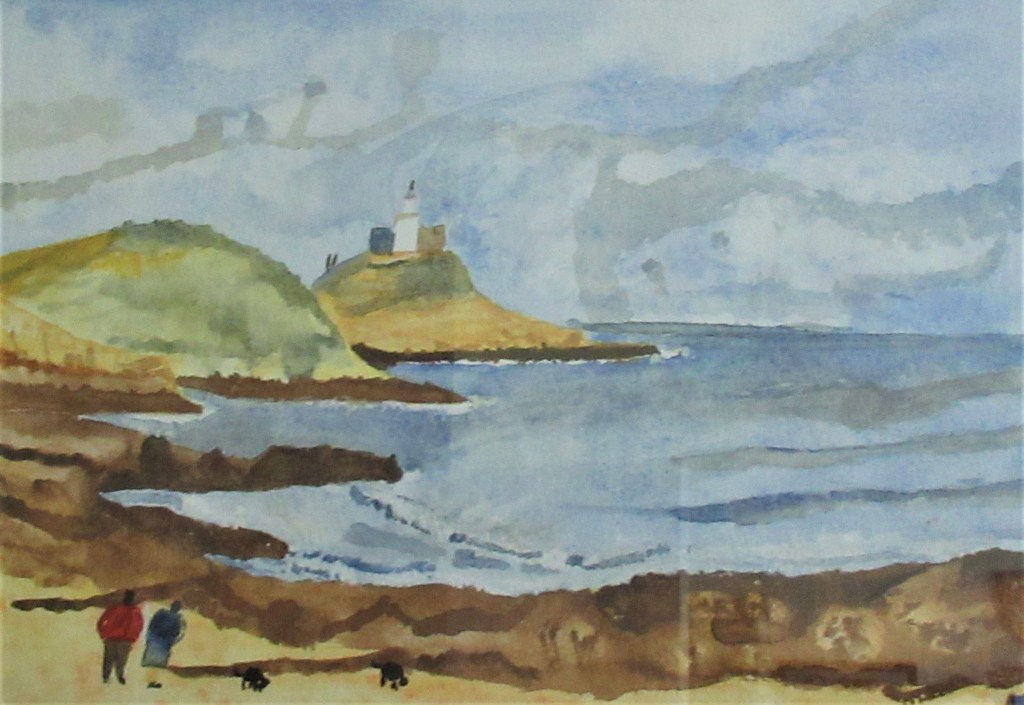
My Uncle Frank’s first water color:
the Mumbles Lighthouse from Limeslade

              … but it’s watch out for the dog, for the dog gets everywhere because he’s on holiday too and everybody’s on holiday in this little sea side town and the cousins have come down from London with their cockney accents, born within the sound of Bow Bells, though they’re half Welsh by blood, though you wouldn’t believe it with those incredible accents which nobody can understand … and they’ve never seen the sea, though their mother was born here, beside my mother, beside this self-same sea which has never left and which still flows in and out, even now, and it still flows through my bones and “Look at all the water!” my youngest cousin cries and then he really cries because London, the capital of England, is concrete and tarmac and all petrol smell and smog and fumes and busses and he’s never ever seen the sea, the sea’s open spaces, the wide open arms of the bay held out to embrace you with Swansea Docks on the left, a working area of ships and shipyards where my grandfather labours and takes me on workdays, even in summer, and shows me the ships and his friends and everyone is happy and laughing because it’s summer and it’s hot and there’s lots of employment and the banana boats are lining up in the bay, at low tide, waiting for high tide, when they can enter harbour and be unloaded and this happens all year round, but it’s really in summer, when the sun is as yellow as the bananas, that the banana boats become significant and we show them to my cousin who has never seen the sea nor the banana boats, though he knows what a banana is and where to buy them and what they cost, but he never knew they came in on these boats, these great white summer boats, from Africa and the Caribbean,  with their funnels all yellow and their bright stripe of blue, Elder and Fyffe, and the boats all lined up in the bay and look: to the right there’s the Mumbles and the Mumbles has a pier and a playground and you can go out and walk on the pier and at the end there’s the life boat and the life boat has a slipway for the life-boat to run down into the sea to rescue people who are shipwrecked, but only in winter because in summer the sea is calm and shiny and it runs in and out twice a day, like an obedient dog, and why is the beach wet? Because the sea weed … and the pier is a world full of wonders, with its peep shows and its games and the old men fishing off the end, chatting and gossiping, and not ever worrying about whether or not they catch the fish which many of them throw back anyway, so they can catch them again tomorrow  …

Summer in Wales

Summer in Wales
aka
Cricket, lovely cricket!              

Summer in Wales is always as I remember it: glorious days of sun and sand and blue skies and warm winds … and especially the sun on the beaches with the water sparkling and little boys and little girls playing cricket on the dry wrinkled sand packed hard when the tide goes out and leaves the land stranded … and uncles and aunties bowl under arm, not over arm, so the little ones could manage to score lots and lots of runs … and I remember us, standing breathless between the wickets, or at the wicket, if there was only one set of stumps, or a picnic basket stood on its side, or three pieces of driftwood, with sea-weed for bails, and what are bails, you ask?

              Well, bails are the sea-weed that is draped over the driftwood that stands as stumps. And we guard our stumps with the cricket bat that somebody has brought and we bowl with wet tennis balls, because nobody will risk a red, leather ball on the sands, with the wet tide standing there, waiting for the ball to be hit at it, or into it, and it’s cold, but not that cold, and when uncle hits the ball, right out so sea, someone has to run after it, then dive, and then swim after it, and if it’s real runs you want, then uncle runs two or three quite quickly; then the aunties tell him to stop running so fast or he’ll have a heart  … so he slows down and trots four or five; then he walks six and seven; and when you throw the ball back, he’s walking eight or nine; and then the dog intercepts the ball, catches it in his teeth, and starts running around with it in his mouth and everyone is trying to catch the dog except my uncle who is now limping very, very slowly between the wickets, but he’s already up to eleven or twelve; and then the little ones start crying because “It’s not fair!” Loud sniff! Then uncle stops in the middle of the wicket and sits there, waiting for somebody to run him out; except everyone is tired, except the dog, who is tireless and completely energized, and now the centre of attention; and nobody is going to catch him;  and finally uncle walks to the wicket and he lifts the piece of seaweed with his bat and everybody appeals, then he’s finally “OUT!” because officially he’s hit his own wicket and that’s illegal and now the game can go on once more, with everyone happy and God’s in his heaven and all’s right with the world …

And the dog has dropped the ball right at the edge of the waves and is barking furiously at the incoming waves as time and tide march up the beach and sweep us and our memories all away.

Walls

Walls

             
I remember little Willy, the mad boy at the end of our lane, whose cries of “Uh! Uh! Uh!” were the closest he came to speech. His presence still haunts me, for my father and grandfather made throaty sounds ‘Uh! Uh! Uh!” to chide me whenever I did something wrong or disobeyed the dictates of their adult world, their grown up world that layered cement on top of the high brick wall, that inserted bottles in the still wet cement,  that waited for the cement to dry, and then smashed all those bottles with a hammer and locked little Willy, the boy with whom I must no longer play, into a high-walled cage whilst I watched and waited and knocked at the door and asked politely: “Please: can Willy come out and play?” But my only companion was his wild sound “UH! UH! UH!” flawed words torn with clawed hands from his throat and floated like invisible butterflies over the cruel glass jest of the wall they had built between us.

After the Lecture

After the Lecture

After I delivered the lecture at London University, as it was back then, I caught the tube and descended at Paddington station. While waiting for the train back to Cardiff, I sat in the station bar and ordered a pint of beer and a Cornish pasty. An older man wearing a sweater and jeans asked if he could join me. I didn’t say ‘yes’ but he sat down anyway and straight away began to talk.
            I paid no attention to him until he rolled up his sleeve and showed me the collection of scars that ran crisscross, hard and welted, over his left wrist.
            “Failed attempts,” he said. “But I’ll get it right next time. “I wouldn’t want you to make the same mistakes I did. If you want to kill yourself, you must do it this way,” he reached across the table and picked up the knife I had used to cut my pasty. He pulled out a dirty hanky and wiped the knife in it. Then he laid the blade not cross-wise but parallel to the artery in his wrist. “And you must dig deep, first time, and at a slight angle.”
            “I’ve got to go,” I told him as a tinny voice came over the Tannoy. “That’s my train.” I stood up, leaving the remains of my pint and my pasty on the table.
            I got to the door of the station bar and looked back. Then I watched as my table companion finished my pasty and reached across the table to claim the remains of my beer.
            “Quite the lecture,” I thought. “Good job I didn’t spit in the glass.” Then I realized that both my day’s lectures had been effective, in one way or another.

To be Welsh on Sunday

To be Welsh on Sunday
in a dry area of Wales

              To be Welsh on Sunday in a dry area of Wales is to wish, for the only time in your life,  that you were English and civilized,  and that you had a car or a bike and could drive or pedal to your heart’s desire, the county next door, wet on Sundays, where the pubs never shut  and the bar is a paradise of elbows in your ribs and the dark liquids flow, not warm, not cold, just right, and family and friends are there beside you  shoulder to shoulder, with the old ones sitting  indoors by the fire in winter or outdoors in summer,  at a picnic table under the trees or beneath an umbrella that says Seven Up and Pepsi (though nobody drinks them) and the umbrella is a sunshade on an evening like this when the sun is still high  and the children tumble on the grass playing  soccer and cricket and it’s “Watch your beer, Da!” as the gymnasts vault over the family dog till it hides beneath the table and snores and twitches until “Time,  Gentlemen, please!” and the nightmare is upon us as the old school bell, ship’s bell, rings out its brass warning and people leave the Travellers’ Rest, the Ffynnon Wen,  The Ty Coch, The Antelope, The Butcher’s, The Deri, The White Rose, The Con Club, the Plough and Harrow,  The Flora, The Woodville, The Pant Mawr, The Cow and Snuffers — God bless them all, I knew them in my prime.

Comment: When I lived in Wales, a long time ago, there were twelve counties and each one of them voted whether or not to allow open pubs and hence drinking on Sundays. The ‘dry’ areas did not permit drinking, but the wet areas did. Hence there was mass migration from dry to wet every Sunday, especially after Sunday morning chapel. I dedicate this piece to every dedicated Welsh boy who fled his dry county to quench his thirst in a wet one! NB This piece should be read out loud, fast, in a Welsh accent and also in a single breath! Mind you, I find that hard to do nowadays.

Weather or Not

Weather

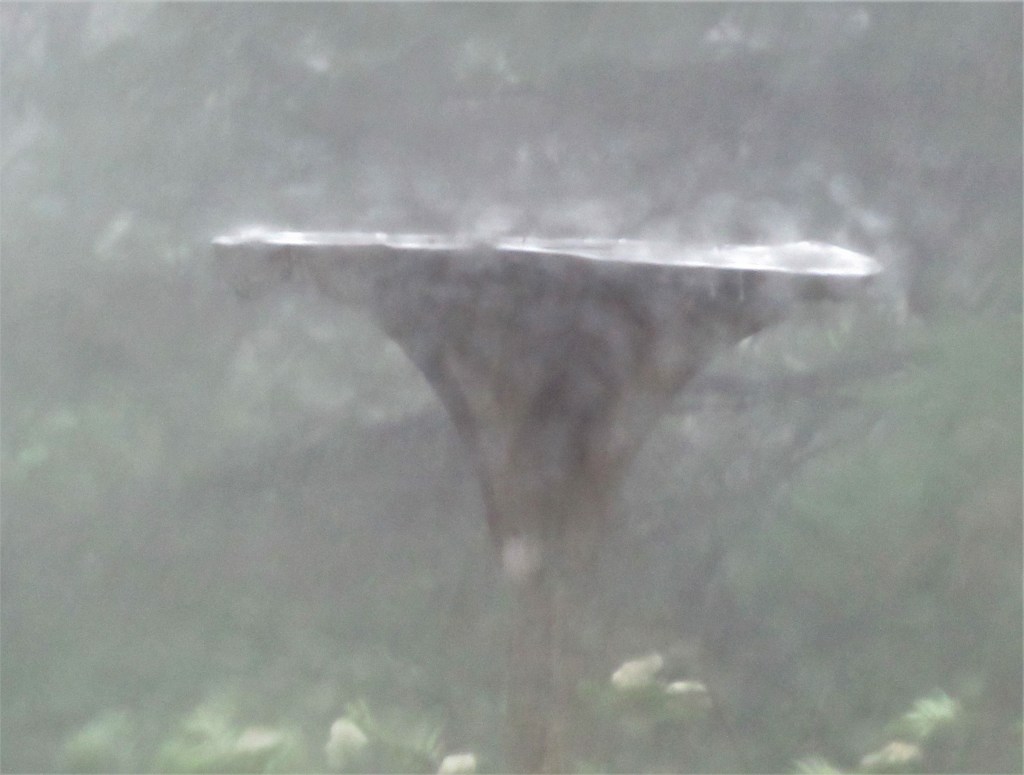
We got an incredible one inch of rain in ten minutes last Friday evening. I got some wonderful photos and no, that is not my hand shaking.

In fact the weather in June has been most strange. The end of May saw four consecutive days at 32 C / 90 F. This was followed by four consecutive nights of frost. And then this devastating rainstorm on Friday evening.

Bird Feeder in Winter

Los Días de Noé / the days of Noah, as they say in Spanish. But our one inch of rain fell in just ten minutes and the wind was horrendous. Similar storms are called chubascos and I’ve also heard tromba.

Whatever: it was cold, dark, windy, and wet and 13,000 homes went without power.

Bird Feeder in Spring
(same angle)

Black Death

Black Death
1438

Outside my window
horizontal hail
rain blown sideways
surgical the wind
dismembering trees
uprooting the weakest
flattening the strong
rages the storm

Who am I
the one who abhorred thee
who now adores thee
and kneels before thee
in grief and pain

Death’s Dance before me
each street filled
with skeletal horrors
bare bones dancing
naked beneath a star-
spangled sky

‘No thought is born in me
which has not “Death”
engraved upon it.’

Michelangelo

Don’t Look Out

Don’t Look Out the Window

Don’t look out the window, you don’t want to
know what’s lying out there. Don’t look out.

Play ostrich. Place your head in the sand,
pretend there’s nothing there to worry you.
Pretend you can see the missing PPE,
the vanished masks, the surgical gloves,
the sanitized hand-wash that everybody needs.
Just don’t look out the window. Don’t look out.

Pretend there’s nothing out there. Deny that
nearly two million people are ill.
Deny that a hundred thousand have died,
not in vain, but from ignorance and vanity
 and a total denial of scientific truth.
Just don’t look out the window. Don’t look out.

Just look at these walls that surround you.
Smile back at the smiling faces, the nodding heads,
the puppet-string politicians who agree with
every piece of nonsense that issues, meaningless,
from empty mouths. Surround yourself with people
who believe what you believe, who think and do like you,
fellow narcissists and bullies, cheats and liars,
who have deceived and stolen, lied like you, to build
enormous fortunes while they have cheated on
their wives, gone bankrupt, and borrowed shady money
in questionable deals with shabby, foreign banks.
Don’t look out the window. Don’t look out.

All those employees know a bum deal
when they are on the sharp end of one.

But nobody speaks out and nobody,
but nobody, dares open those curtains
for fear of seeing that reborn beast,
its hour come at last,
slouching down the streets.
Close your eyes. Don’t look out the window.
Don’t look out.

Comment: I rarely comment on political events, let alone write poems about them. That said, I do not consider this poem to be a political statement. For me, the key to the poem can be found in the final five lines beginning with ‘for fear of seeing …’. I have explored inter-textuality before in these pages. I hope the reference to W. B. Yeats’ poem The Second Coming, is clear.