Reyes

IMG_1318 (3)

Reyes

The Spanish Christmas comes on the Twelfth Day after our traditional Christmas: January 6, today. 32 years ago, we spent Reyes in Madrid. We arrived in time to see the Christmas Parade and what a sight that was, with the three Wise Men, los reyes magos, riding on their camels at the end of the parade. It had just snowed and the city, streets and squares, shone white.

It’s funny what we remember and how we remember it. “Mira, mira, mira!” “Look, look, look!” Then, in the distance, descending from the Puerta de Alacalá, the Three Wise Men. Behind us, a little boy screamed at his mother. “Don’t you want to see los tres reyes magos?” she asked him. “No,” he yelled. “I don’t believe in the three wise men. I want to go home and watch soccer on the telly!”

I wore a white sweater that evening. When I got back to the hotel, I discovered that every inch of sweater that had emerged from beneath my coat was now grey. Even the air was filthy and pollution lay in ambush everywhere. “Every time I cough, I get a mining souvenir,” Max Boyce used to sing. Well, after a couple of days in Madrid, I too was coughing up souvenirs, but they didn’t come from coal dust underground. They came from the very air I was breathing out in the city streets.

Later that week, we took the train out to the Casa del Campo to see those same three camels in the zoo. In the distance, the Guadarrama stood out clearly against the sky. The zoo welcomed us and we enjoyed breathing in the fresh air and seeing the animals in the wide open spaces behind the invisible bars that allowed us to view them in a more natural habitat.

Christmas / Reyes: a magic time for remembering things that seem to have vanished, yet that sneak up on you and shake you awake when you least expect it.


IMG_0124

Butterflies

IMG_1053 (2).JPG

Butterflies

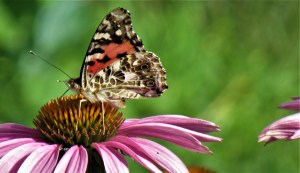
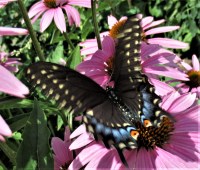
Here today and gone tomorrow. Ephemeral. Like all of us ‘poor creatures, born to die’ (as Dylan Thomas once wrote in Under Milkwood). It seems strange to look back on last summer’s photos and to remember that yes, they were here, those butterflies. Outside the window. Perching on the flowers. Showing their varied colors. Alive. Vibrant. Raising and lowering their wings.

Once upon a time, a long time ago, when I wore a grey suit and lived in a concrete, four-walled cell that they called an office, I was asked if I would edit a new journal for one of the institutions with which I was involved. ‘Sure,’ I said. ‘That would be great.’ ‘We’ll need you to submit a title and a theme,’ they said. ‘Sure,’ I said. ‘Of course I will.’

I thought about many things: titles, themes, topics, writers … Then I thought about other journals with which I had been involved in various capacities. Then I considered walking in the footsteps of the Journal of Higher Education with all of its cutting-edge articles and high-powered inspiration. I breathed a sigh of frustration, then of relief. ‘Got it,’ I said, and the Journal of Lower Expectations was born.

Alas, it was a butterfly that never spread its wings. ‘Your services will not be needed,’ came the curt reply when I submitted the title.

Think about it: a couple of years back, there were no bees in the garden: CCD (Colony Collapse Disorder). Last year, there were no birds. The feeders stood empty, and bird flu was the cry on everyone’s lips and the plague on every bird’s beak. Ephemeral. Butterflies on a rock. Australia burns and people are rescued from the beaches where they have taken refuge in the sea. Everyone, everywhere, now needs to live with lower expectations.

IMG_1058 (2).JPG

Butterflies and birds and bees: will they be back next summer? Who knows? I certainly don’t. But then, I am a true agnostic. I have no scientific background worth speaking of and neither ax no knife to grind on this topic. I genuinely do not know where we are heading. But I believe least those who protest most, especially when they bluster and bluff and try to pull the cocoon of disbelief over my eyes by shouting loudly their point of view. I have eyes. I can see, even if there are no butterflies, birds, or bees to be seen. Alas: I can still see and suffer their absence.

Please
will ye no come back again?”
Poor kangaroos, kookaburras, koalas,
wallabies and platypus ducks.

IMG_1047 (2).JPG

We will miss you so much if you any of you,
let alone all of you,
along with the butterflies, birds, and bees,
go AWOL.

Black and White

IMG_1519.JPG

Black and White

There is a moment in winter photography when the world of color turns to black and white. Color is still there, but today it travels incognito, anonymous. The world is formed by shapes, trees draping their branches, snow weighing them down, dressing them in wedding gowns for their marriage with the new year spirits that haunt sunlit, moonlit snowbanks and dance across the snow. Even the clouds exist to give a soft, quiet dramatic touch to the winter beauty that visits the garden. And yes, it will always be there, even if we are not here to see it because it will carry on without us. As for us, we are secondary, mere witnesses to winter’s beauty and the nature that surrounds us.

IMG_1554.JPG

Amateur photographers can sometimes capture this effect in a moment of luck (or occasional inspiration). Great painters have always known this art of the minimal. El Greco drew light from darkness, his portraits often finding their own fire and lighting up from within.  Caravaggio, too, knew the values of chiaro-oscuro, light and dark, black and white. Velasquez was the master of the spotlight that highlighted the eggs frying in the pan, the hand of the water-carrier. Goya, in his etchings [The Disasters of War, The Caprichos] and dark paintings, drew mood and anguish from this contrast between light and dark, black and white.

image1-1.jpeg

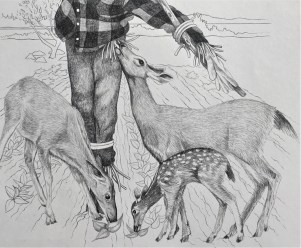
My friend Geoff Slater has caught such a moment in his sketches for Scarecrow. Above he catches the precise moment when the scarecrows, male and female, reach out to each other, and beneath a Van Gogh planetary sky, dare to dream of mobility and love. The dream world: so important to us all and especially to the creative artist who dwells in each of us. Deus est in nobis, the Latin poets used to say, it is god within us. The god of black and white who transforms the world into color and light.

image3 (10)

Black and white, light and dark, winter trees, Clare, two scarecrows, deer and crows: labors of love that reach out and catch us unawares, blowing our hearts wide open, letting in the sun and the wind and the ever present joy of seeing things, seizing them, sizing them up, in black and white.

image2 (15)

Deer Dance

IMG_1572.JPG

Deer Dance

They came with the snow, of course. Last year there were seven, this year six of them sniffed their cautious way, step by step, into the yard. I looked out of the bedroom at 3:00 am, and there they were, standing beneath the mountain ash and reaching up to the lower branches to snaffle the berries. They also dug into the snow and ate the fruit that had fallen beneath the tree. The night was cold and dark. I didn’t want to risk the camera and have the flash or the laser beam frighten them so I just stood and watched.

Next morning, I wondered if it had all been a dream. Then I saw the dance-steps in the snow. They have been back a couple of times now and this morning Clare spotted seven, in the early morning light, ghosting their almost perfect camouflage through the trees. So now we have a couple of questions: are there two groups this year, one of six and one of seven? Or had the seventh deer from last year rejoined the group?

We think the group of six has larger deer while the group of seven has two seemingly smaller ones. But this may be a trick of moon light and shifting moon shadows. Climate change: the local deer at sixes and sevens. What would Ocho Venado, the Oaxacan / Mixtec King known as Eight Deer, think of it? Ah, a conundrum indeed. And when and if I work out any answers, I will let you know.

Aliens

IMG_1584 (2).JPG

Aliens

They came in from nowhere. Appeared on the coaster. Smallish, slightly flaky, dried on the outside, they craved liquid. Climbed into the coffee. I fished them out on a spoon. They floated down my throat.

Now they are within me. They have taken possession of my system. Now nothing is the same and I see things in a different way. That plate on the table, diminished and slightly blurred.

IMG_1585.JPG

Those flowers, edible now. Those geese in the garden, my brothers and sisters.

IMG_1380 (2).JPG

That cat, my friend.

IMG_1374 (2).JPG

Let it snow ….

IMG_1532 (2).JPG

Let it snow …

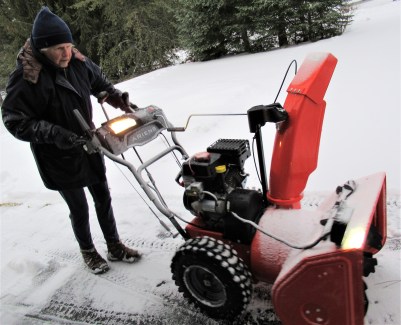
A New Year, a new snowblower, and the same beautiful handy-person. Luckily I can cook, so when the hard work is done, that handy-person can sit down to hot tea and buttered crumpets. Oh the joys of retirement. Some never retire, though, and a handy-person’s work is never done. Mind you, cooking, for me, is a joy, not a chore, so I don’t ever think of it as ‘work’, that nasty, old-fashioned Anglo-Saxon four-letter word. In fact, come to think of it, teaching and research were joys, never chores. As a result, I have never done a day’s work in my life. Nor did I ever want to.

IMG_1526 (2).JPG

And that’s what I wish you all for the New Year: brave blossoms that stand out against a snowy background, joys that make each day a pleasure and never a grind, happiness that drowns out the daily sorrows of this Vale of Tears through which we are passing, and a clock without hands, so that you never have to count the hours as the days tick slowly by.

IMG_1571 (2).JPG

May each morning fill you with joy, happiness, and a sense of adventure. And may the evening sky fill you with peace and contentment for a day well lived.

Decade-End


IMG_1482 (2).JPG

Decade-End

My neighbor with the bird-killer cats has left the neighborhood and we have started to see the birds returning. Now we can refill the feeders, knowing that the birds will all be relatively safe. And the squirrels, red and grey, and the chipmunks. We had a beautiful snowshoe hare visit the garden, but he saw those cats and moved on to other pastures. I saw one last week, though, moving across the road ahead of me, caught in the car’s headlights amidst the whirl of snow. A ghost drifting lightly over the roadside drifts. Beautiful.

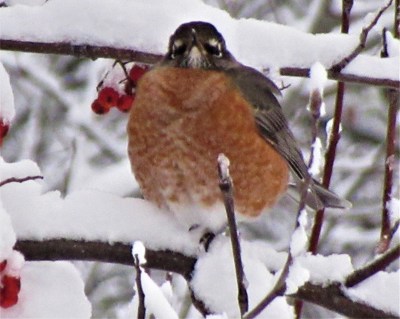
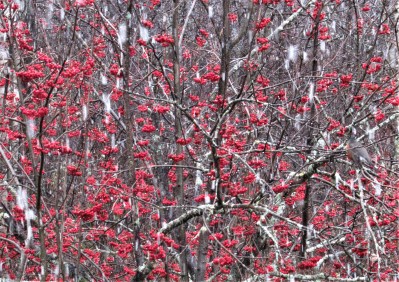
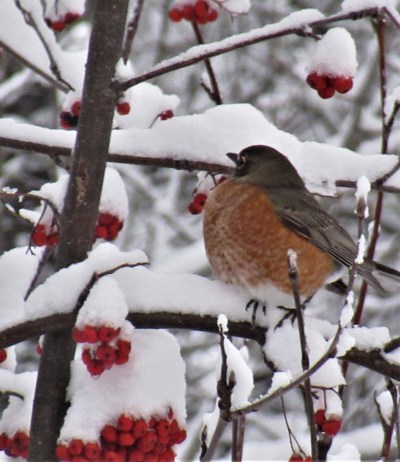
The deer have returned with the snow. There are six of them now, where last year there were seven. They gathered under the mountain ash and walked round and round, hoovering up the fallen berries. Usually the robins clean the berries out, but their visits this year were so brief. Snow came early and the robins moved on, even though a multitude of berries garlanded the tree.  Here’s a robin looking wistfully at the falling snow and wondering what to do next.

IMG_1471 (2).JPG

So winter is back again. The snow is falling as I type. I have had second thoughts about blogging. In fact, I haven’t blogged since 19 October 2019. Work on my journal and my latest books and chap-books has kept me busy elsewhere. To blog or not to blog, that is the question. And I face that same question with Facebook too: shall I or shan’t I? As of now, I have no answer to that question. If you have an answer, please let me know.

IMG_1478 (2).JPG

The Medallion

img_0265.jpg

The Medallion (Solace 7, 8, & 9)

7

St. James, Santiago, the patron saint of Spain and of the Conquistadores. Pale, egg shell blue walls, darkness ruling inside the church. It will do so until the sun peeps in the stained- glass windows and awakens all the sleeping colours. I bow my head, then my knee, and kneel at the back. Ahead of me, I recognize some of my neighbours who concentrate on the gestures of the priest as he mumbles to himself before the altar.

The early morning shadows creep across the walls until a single beam of sunshine descends and shatters the altar into a thousand tiny chips of fragmented light. My hands are pallid butterflies fluttering in the sun’s rays and a rainbow halo adorns my head. I shift away from the sunbeam and move to the side-chapel dedicated to the statue of St. James.

… St. James the Moor-Slayer … Santiago Matamoros … he stands on the severed heads of the Moors he has killed … behind him hands tied behind their backs dusky skinned warriors march away into slavery … my eyes are level with those severed heads and I stare eyeball to eyeball at a decapitated Moor … beside the statue stands a photo of the Gate of Glory, la Puerta de la Gloria, in the Cathedral of Santiago de Compostela in Spain … … generations of pilgrims have laid hands upon the Tree of Jesse, imprinting their fingers into the stone … human hands clasping rough granite in a search for comfort and warmth …

8

When I leave St. James, I find the witchdoctor squatting, in a trance. His fire burns low and a strong scent of copal rises from the coals, hangs heavy on the air, then slowly dissipates. I stop for a second to study El Brujo and the witch doctor speaks without opening his eyes.

“I spoke to your mother yesterday.”

“That’s nonsense,” I replied. “My mother’s dead.”

“What ails you, my son?”

“I’m not your son.”

“It’s a wise man knows his own father,” El Brujo opens his eyes. “One night, many years ago, Jaguar crept between your ribs and took your heart into his mouth. When he closed his jaws, your heart was as heavy as stone and Jaguar broke his tooth upon it. He cursed you and your heart remained a rock within your chest. At night, when you sleep, you dream of dust and ashes.”

“You speak in riddles,” I try to remain calm yet the words fan a sorrow within me that I thought had died a long time ago.

“Perhaps, but my words speak true.”

            … curses, stone, dust, ashes, broken heart, rock, heart in mouth … a marigold path, zopilote, high in the morning air, fire-red his wing-tips, and then an old stone bridge, a river below it with the snow floating down to be carried away by the current, three crones dancing on the steps of an orphanage, three beautiful ladies dancing on the temple steps, an old man, dead, then alive and walking in his burial clothes … hummingbirds dancing round the sun … red slashes of blood … tulips against a white-washed wall … an old man vanishing into a tomb … death’s face simmering in the moon’s dwindling pool …

“You must make a sacrifice, my friend.”

“I don’t do sacrifice, not like that boy this morning.”

“No, not like that,” El Brujo shakes his head. “You must sacrifice your beliefs and allow me to bless you.”

“I have no beliefs.”

“Even that is a belief.”

“Then I am sacrificing nothing.”

“If that is what you believe, it is so. Here: take this. It’s yours by right,” El Brujo offers me a medallion on a braided leather thong. “This is your mother’s gift to you.”

“You’re crazy. I told you: my mother’s dead. She didn’t leave me this.”

“I tell you that she did.”

“Did you know her?”

“I did.”

“I don’t believe you.”

“You may believe what you want. But tell me, does the medallion call you?”

“I like it, yes. I can’t say it calls. How much?” I put my hand in my pocket.

9

“You do not have enough money to buy it, and if you did, you wouldn’t be the man I think you are. And in that case, I wouldn’t sell it to you,” his eyes took on a faraway look. “However, it comes from your mother and I promised your mother I’d give you this.”

            El Brujo’s eyes hold a power that disconcerts me. I lower my head to his fire and the copal makes my eyes water. I cough and my vision blurs. My lungs fill with perfume and El Brujo pushes me closer to the incense. I inhale deeply and break out in a sweat.

“You must wear this always. It will protect you,” El Brujo places the medallion round my neck. I place my hand upon it, feel its rough edges, and see through my tears that it is incomplete, for it has been broken in half. What remains shows half a cross with some broken roses where the crucified Christ would normally appear.

“But it’s broken.”

“Not broken, but divided. You must find the missing half.”

“Did my mother tell you that?”

“Your mother is dead.”

El Brujo lapses into silence and stares me down. Then he breaks into a weird, wailing chant, using a language that I do not know. As he sings, he leans forward and brushes my eyes with an eagle feather that he draws from his pocket.

“Now, you will be able to see.”

… an old woman dressed in black, pushes at a young man … colored threads hang out from her basket … they flap like flags in the single ray of sunshine that breaks into a million tiny sparks of fire … hummingbirds, tiny warriors, wing their dance around a sun that bears a man’s  face … a pair of scissors snips at the string that ties a child’s balloon to the earth and it floats away up into the air high above the cathedral tower … fire catches its wings and it flares like zopilote, the trickster, in the dawn’s early light … the cathedral spire is a notched measuring stick conducting the clouds as they dance and weave their patterns … within the prison of the sky … trenchant shadows, twisted dancers, old warrior kings bend themselves in and out of shape as they struggle to escape … an old man  wrings his hands, then vanishes …  a soap bubble floats away on the wind … a young girl stands on a bridge in winter … snow swirls and  draws a curtain around her body as she falls into the waters below … an old crone wrapped in rags carries a bundle of clothes to a set of steps and leaves it there …

            “The medallion vibrates, it’s heavy and warm.”

“It knows you.”

“What do you mean, ‘it knows me’?”

“Did you feel nothing? Did you see nothing?”

“I saw nothing,” I cough and clear my throat. “I saw nothing at all.”

El Brujo looks at me long and hard. He opens his mouth to speak, then shrugs his shoulders.

“Come, you have accepted the medallion your mother left you. Now accept my blessing.”

“Why?”

“Because I ask you to. Are you such a coward that you cannot accept a blessing from an old man? Here, kneel beside me,” El Brujo taps the ground at his side and, wondering what on earth I think I am doing, I kneel beside him.

El Brujo

cropped-dsc02710-1.jpg

El Brujo (Solace 5 & 6)

5

I light the gas stove and run water from the tap into the coffee pot. Some things, especially the stupid ones,  are so automatic.  I am in a dream state, still half asleep, not thinking, half-dreaming, still influenced by the mescal. I turn off the tap and open the fridge. I take out a plastic bottle of cold water and pour into an open saucepan that I place on the gas.

Thoughts tumble through my head, night thoughts, crazy thoughts, hallucinations fuelled by last night’s mescal.

… the man in the moon now wears my father’s face … he perches like a scarecrow on the dead stick of a returning rocket … and the Mexicans  launched a rabbit to the moon before the Americans ever went there, well, a rabbit to the sun anyway, and he put it out and caused the moon to be formed, moon-raker, moon-maker, jack rabbit, rabbit pie in the sky … and the second sun sizzling, then put out, staring now, like a blinded eye … death’s face simmering in the stew-pot moon and everyone doomed as the white rabbit scuttles down his narrow escape tube and back into his burrow … high flames flicker on zopilote’s wings and bring an end to darkness … Zopilote, the Trickster, the bringer and bearer of the sun’s early morning fire … Lucifer, the morning star, the bearer of light, a new star rising among star-crossed generations … red scars of tulips, casting shadows on white-washed wall, twisting shadows, shadows dancing as they struggle to take shape … three women, dancing in the limelight, and the old man, standing there, wringing his hands, then vanishing, a soap bubble, borne away on the wind that catches children’s balloons and floats them away, up into the air … to where the returning warriors play their hummingbird games around the sun, returned from their death like all the dead, here in Oaxaca, are said to return … and the people placing food and drink on altars in their homes for their dearest beloveds to return once a year … down the moonlight’s marigold path, to feast and be fêted by their families … all the dead … returned …

“All the dead …?”

But this is nonsense: I can’t believe I saw my father last night. I couldn’t have seen him. I buried him a long time ago, a long way away. What did I see then, a living man, a man who looked like him? But he was wearing the suit in which I buried him. It had to be my dad.

I just don’t understand. There must be someone I can ask, a priest, an elder, someone who knows all about the local customs and what happens here. I can’t believe it was him. Do things like that happen? I’ve got to find out, I’ve got to know. There’s so much I want to know.

6

A solitary bell that hangs in the tower of the church of St. James.  Every day, an altar boy climbs the tower steps, with a hammer in his hand, kneels beside the bell, and beats it. The bell lurches into life and lets out the cry of a struck anvil in a hot forge where the farrier tends the horse’s hoofs. Six times the hammer strikes to warn the parishioners to hurry along, because morning mass is imminent.

A sudden urge to go to mass sweeps through me. I dress quickly, hurry down to the courtyard, and meet Mario, the handyman.

Buenos días, señor.”

Buenos días, Mario.”

“It’s peeg day, señor.”

“So it is. I won’t forget,” I slip out of the front gate and hurry down the street.

Outside the church door, two young people squat on the ground in front of El Brujo, the local witchdoctor. The young man, eyes closed, threads a cactus thorn through his lips. Dark blood oozes and El Brujo catches it in a little earthenware bowl. Beside him the young girl carries a flower-filled basket on her head. The aroma of the incense El Brujo burns on his fire tickles my nostrils.

            … light are the flowers … heavy cruel stones lie beneath them and weigh the basket down … twelve girls in floral dresses stand outside the church of the Soledad… they pick up their baskets … place them on their heads … hand on hip, one arm swinging free they wait for the high priest to bless them … then they start their pilgrimage … twelve girls … twelve churches … each will leave a floral tribute in a church … the twelfth … the petitioner … will continue to the cathedral .. alone … the petitioner frames a question as she waits for the blessing … will her mother live? … and her lips whisper an answer … please let my mother live …perhaps …  if   her brother sheds enough blood … if her daughter carries a heavy enough weight for long enough …

            El Brujo looks at me and snaps his fingers. I shake my head and my dream flees. El Brujo closes his eyes and hums a rhythmic chant. I walk past the group and enter the church.

Codex

Ay Ay Ayeres

Codex (Solace 3 & 4)

3
Down below, in the courtyard, the handy man wakes me as he tumble dries a TV ad in the washing machine of his song sparrow throat. He gargles with gravel and churns stony lyrics skywards until they grate at my bedroom window and drag me from my dreams.

My ears fill up with a crackle and roar. Wave after wave of sunlight breaks over the azotea. Blind with music, deaf with light, I am awash in the sea-surge rhythm of this surfacing sun. My dreams break up like biscuits and between my fingers I feel a sandstorm of crumbs.

Morning blows fresh colours into each corner of my waking mind. An early breeze shakes cobwebs and dust from my brain. New visions crawl out from the vellum codex I left open last night on my table. Red and green gods wearing black and white masks crawl through spaces still alive in my mind. Sometimes they move when the eye doesn’t watch them, but when I concentrate, they freeze in intimate poses. I link them with lines and arrows and vow that my life will never again be scarred by their secretive smiles.

The red glare of the day’s first rocket climbs its ladder of sky to smash at the gods’ front door. A second rocket draws me back to daylight. Awake, I lie there, counting. A third explosion is much closer. The fourth rocket surges skywards and the fifth and sixth rockets are two fiery giants exploding above my apartment. I pull back the bed clothes and swing my legs over the side of the bed. My day has begun.

4

The codex lies open on the dining room table I use as a desk. I scan the interpretation I made late last night, transferring the visual to verbal.

“Two breasts: one green, one yellow, symbolic of the hill where the church stands; the church itself bi-coloured, strong stone walls, a spire. A large red heart symbolic of the love we bear for you, our masters. Two feet walking the path of enlightenment you opened before us are accompanied by two hands pointing the way. The feet below the heart; the hands above the heart, like wings; and the heart becomes the body of the new place you have built for us. And in the heart is our sacred symbol: the Earthquake, a sign of leadership and power used only by those of Royal Stature and the Noblest Blood. Attached to the heart is the Numeral One which means Lord of the Earthquake; for you are Number One in our Hearts. Attached to the heart is a speech scroll showing felicitous words of praise; below it is the sacred earthworm, and beneath that the serpent head of wisdom and the flint knife promising strength through sacrifice.

But be wary: for our symbols are double-edged! The colors of the hill are divided, as the hill is divided, showing strife and division. The church is on top of the hill, for the symbol has conquered the people, and the people are starving, subject, and destroyed. The feet are pointing in opposite directions, for the people are stalled. They have no forward movement, nor will of their own, for they are conquered by the sword and not by love. And the hands are pointing in opposite directions; for the right hand knows not what the left hand is doing. And the hands are reversed showing anguish and distress. The sign of the heart is the sign of the disembodied heart, torn from the heaving chest of the vanquished and thrown to the dogs. The sign of the earthquake is also the sign of movement. And that movement is a bowel movement. And one movement in the middle of the sacrificed heart is the victor excreting on the vanquished and treating them with scorn and contempt. The scroll protrudes from the nether part and says that the victors are speaking words of excrement, that verbal diarrhoea issues from their lips. And the serpent has no feathers; it cannot fly. It is as a snake treacherous and bitter, crawling on the ground. The head of the serpent is two tongued and tells of treachery and of deceit. The flint is attached to a heart; it speaks of the heart that is as hard as flint, knowing no mercy. And at the end that heart will receive no mercy in its turn.”

Figures on the codex page take on a fresh life. They walk and strut, nod their heads, move their limbs. The sun climbs in the sky. Shadows shorten. Footsteps march steadily across the page from right to left. I blow a kiss to the piggy-back bride and she waves back.

Too much, too early. I reach for the remains of last night’s bottle of mescal and gulp them down. Order is restored. The cartoon figures go back to sleep. Normality, whatever that may be, returns.