Clepsydra 8

8

… those other faces fading
     drifting away
          their smiles their frowns
               melting away into the dark
                    where no star glows

they cannot return
     nothing walks the woods
          save a silence
               where once they strode

empty the hand
     once held out to help them

silent the prayer
     emerging from pale lips
          and unanswered

where are they now
     those who walked
          this way before us
               glum ghosts
                    hushed their chorus

I promised
     to remember them
          but I forgot them
               as one by one
                    they slipped away …

Clepsydra 6 & 7

Clepsydra 6 & 7

6

… I say I walked alone
     along a long lonely road

nobody could cross that threshold
     nor enter that inner sanctum
          where hungry metal monsters
               lay in silent ambush waiting

nobody could share that sacrificial altar
     the single bed with its iron frame
          on which I lay on my own waiting

uniformed attendants
     locked themselves
          behind their concrete defences
               away from the radiation
                    so dangerous

while I waited
     for those circling stars
          that would burn
               and scar me
                    to descend …

7

… and single beds
     were only meant for one
         
just me
     strapped in
          tied so tight
               lying motionless
                    as I waited for
                         the bed to rise …

upwards
     into that dark night of the soul
          and I the sole sufferer
               under a claustrophobic sky

behold my body
     a mass of red and green striations
          burned by pin-pricks of light
               walking across my body
                    follow the red map
                          painted on my body

burns and blisters
     body and mind scarred
          scared by knowing
               all this suffering
                    might be in vain

others walked this road before me
     some never returned
          empty places at breakfast
               hushed whispers
                    faces turned away

when the tide turns
     it brings with it
          the joy of life
               a spark of hope
                    life’s waters
                         resuming their flow …

Comment:
All that happened to me ten years ago – but the memories are still fresh in my mind. At night, I often watch those planets circling, closing in, those star ships, guns blazing, burning my skin. So many of us have walked that lonely path, lain on that bed, faced those demons. Holst’s Planets – it amazes me that the music still plays in my mind, the celestial dance still goes on in the ballroom of my head, and the memories refuse to fade, though the burns on the skin have vanished and are long gone.

Clepsydra 4 & 5

Clepsydra 4 & 5

4

… candles and the clepsydra
     marking time
          witnessing
               the transition
                    from day to night

drip-by-drop
     falling water
          flickering candle flames

less certain
     than the monotonous
          tick-tock
               of a pendulum clock
 
time and tide
     wait not
          for ship nor man

though time is marked
     on calendars
          and prison walls

days passing into weeks
     spring into summer into autumn

daylight lengthening
     shortening
          until bleak mid-winter
               comes again …

5

… black midnight
     all is lost
          who now can count the cost

stiff upper lips
     forget how to pray
          fingers clasping
               unclasping
                    never grasping
                         life’s simple flow

with silent steps
     planets and stars
          slowly turning
               writing out our lives

sun by day
     moon by night
               the sky alight
                    with shimmering fires

midnight curtains
     burning lights
          crazy curtains
               drawn in night’s sky

a lost dog hurls
     his coyote cry
          who on high
               now listens to his call

not the planets
     nor the Archer
          nor the dog star
               who never barks
                     anything
                          but summer’s flames

pity the poor dogs below
     bitches in heat
          waiting alone
               for their lover’s paws
                    their welcome snuffles

locked and bolted
    the door
          heightened
               the canicular heat …

Rock

Rock

You are the rock
on which I build
my life.

You are the fairy castle
planned in paradise
where the sun always shines
and stress is distant.

How often have I mapped
your inner islands,
traveled your well-known ways,
always discovering
new sacred spots
where I can immerse myself
in your inner serenity?

You are the fortress
within whose walls
I can forget my past
and create my future.

What’s your favorite recipe?

What’s my favorite recipe?

I find it hard to talk about my favorite recipe at a time when so many people in this world of ours are desperately short of food. I get regular messages from the local food bank – can I help them out? And I try to do my best. Alas, my pittance is a drop in the ocean of want and need.
Our local supermarkets have food baskets that you can add to your food bill. These will then be handed over to those who distribute food to the needy. Then there are the checkouts where I am regularly asked if I will add $2 to my bill for the food bank. I usually give $5 or $10.
I see old men sitting at the entrances to stores, a coffee cup before them with some petty cash in it. I also see homeless, workless people at traffic lights with signs held up, asking for cash.
I don’t want to start on war zones, on the accidental-on-purpose starvation of people, on the targeted destruction of homes, animals, and crops. Nor do I want to contemplate the rising prices of what used to be staple groceries and are now becoming luxury items – olive oil, meat, coffee.
While I can still afford some, but not all, luxuries, far too many people can’t. And yet you ask me what is my favorite recipe? Well, here goes –

Take one pound of charity, stir in a pound of love, add a spoon full of humanity, mix with half a pint of the milk of human kindness, sprinkle the mix with a half cup of sugar – to take away some of life’s bitterness, pepper it with ground Good Samaritanism – to add some neighborly love, and complete it with essence of humanity – to remind us that we are still human. Then distribute it, free of charge, everywhere you possibly can but, above all, not just to the needy, but to those who are capable of changing the situation, but for some reason or other, refuse to do so.
Pax amorque.

Carved In Stone

Carved in Stone

Brief Introduction

“Poetry explains itself. If it doesn’t, it’s inexplicable.” Pedro Salinas.

I entered this collection of poems for the Alfred G. Bailey Awad (poetry manuscript), WFNB, 2025. Alas, it did not win an award, but the judge, Kathy Mac, made some excellent suggestions as to how I might improve the manuscript. I have followed her advice to the best of my ability.

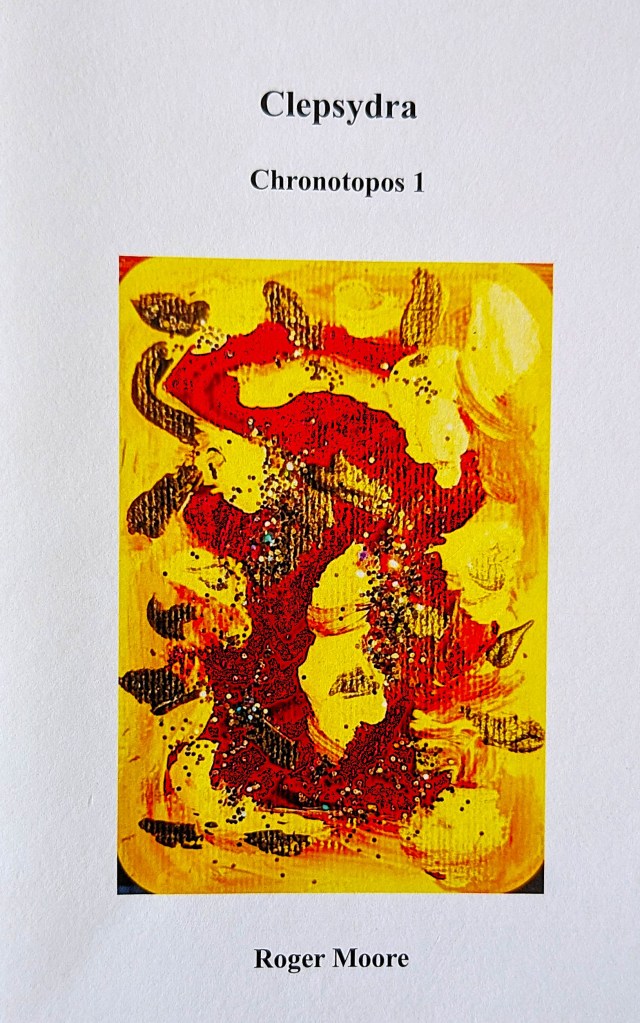
Carved in Stone is the second dialog (Chronotopos II) in my Bakhtinian Dialogs with my time and my place. Clepsydra, Chronotopos I, won third place in the Bailey Award (2025) and has already been published. I have one, possibly two, more Dialogs planned.

Reception Theory – I write, you read. Any meaning that you extract from my poetry will depend on your own culture and background. Tolle, Lege – Take and read. Read slowly, and with care.

I am a poet, a dreamer, if you will. These are my dreams. When you enter my world, you mingle your dreams with mine. The result, I hope, will be an interesting intellectual blend of new creativity. Pax amorque.

1

Behold me here,
filled with a sort of shallow,
hollowed-out wisdom
accumulated over decades
while listening with my eyes
to the words and thoughts
of writers, long-dead.

Imprisoned in book pages,
do they bang their heads
against walls that bind,
or hammer with their fists
at the barred lines
of their printed cages?

These spirits long to break free,
but they choke on library dust
and pollen from verbal flowers
that bloom unseen.

Those old ones avoided
the traps of temporal power,
or, once trapped,
gnawed off a precious limb
to limp into freedom.

Comment:
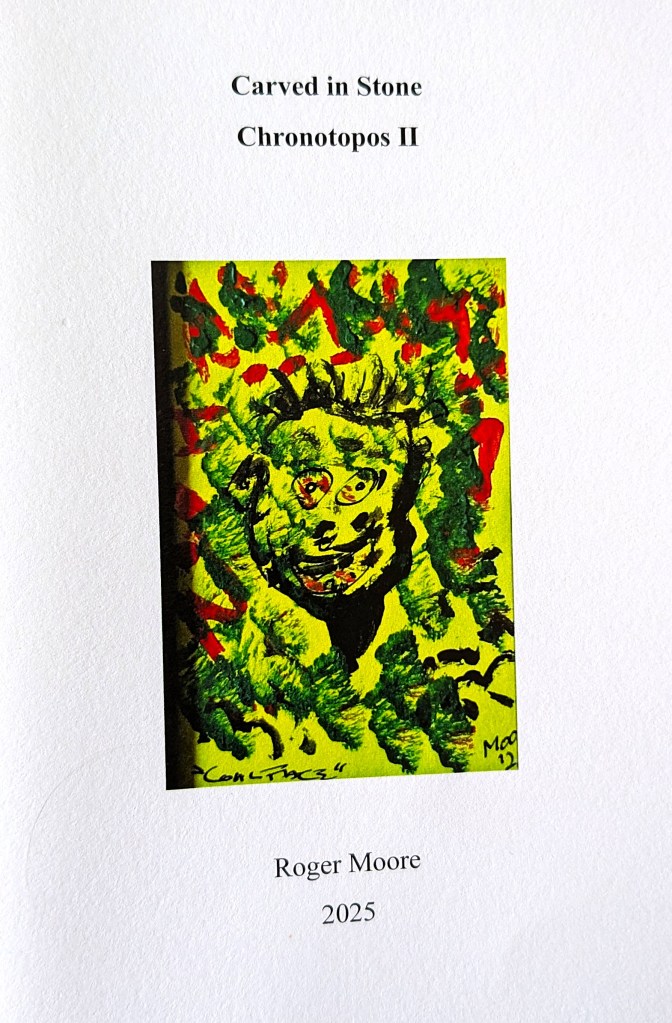
The cover painting, painted for me by my friend Moo when he read the manuscript of this book, is called Coal Face. It refers to the young Welsh boys in the Rhondda coal fields, aged 8-12 years old, who went down the mines to work at the coal face. This happened when the coal seams grew thin and only small children had the ability to work at the coal face and carve and mine the coal. Here are the relevant verses (44 – 45).

44

The old man, withered,
last house on the left,
leaning on his garden wall,
coughing, spitting up
coal dust and blood.

He’s not old, when you get close,
just grown old, underground,
where emphysema
and pneumoconiosis
devour men and boys.

He spits on the side walk.
Mining souvenirs,
Max Boyce calls them,
and they appear
every time the young man,
turned suddenly old,
starts to cough.

He can’t walk far,
wearing carpet slippers,
soft and furry,
just leans on the wall.

He fell, or was pushed,
into the trap at an early age,
when the coal seams
had grown so thin,
that only a small boy
could kneel at the coal face
before the black altar
of the underground god.

There, with a pick and shovel
he learned to carve and shape
those seams.

45

No candles burned at that altar.
A single match, let alone
a candle flame,
would spell the end,
if gas leaked from the seam.

Only the canaries,
confined in their cages,
sang songs.

Doomed,
like the blind pit ponies,
never to see the light of day,
they lived out their lives
down there.

So many died underground,
unable to get out,
buried alive,
before they were even dead.

Clepsydra

Clepsydra

WFNB 2025 BAILEY PRIZE: 3rd Place
Citation

Clepsydra relates a process of identity loss, as time’s passing removes the people closest to the eroding narrator. Its consistent form – the manuscript is one long poem made up of 48 sections of varying length, each of which begins and ends with an ellipsis – provides a framework in which the narrator strives to describe how their sense of self drains away, drop by drop, the way the liquid in a clepsydra (a water clock) marks the passing of time. Amazingly, the poems convey existential dread through remarkably vivid and grounded images of things like “seals basking in sunshine, / knowing themselves, being themselves, / thinking themselves safe, / kings and queens of their seal-dom, / never questioning” (19) and “…an osprey, sudden, the swoop, / turned into a stoop, water shattered, total immersion, then emerging, / lusty thrust of wings, claws clasping, / prey imprisoned” (20). Sense slides in and around the sounds of the words as well as in their dictionary meanings. In Clepsydra the author rigorously plumbs a difficult subject: the loss of subjectivity.

Exhortation

Thank you for the privilege of reading your poetry manuscript, Clepsydra. I was quite taken with all of its virtues: a meaningful concept, carried out in an impressive form which is followed both rigorously and nimbly in each section.

Introduction

     The National Museum of Wales, in Cardiff, had a working Clepsydra that fascinated me. School children could enter free, and every week day, during the school holidays, I would visit the museum and also the Clepsydra.

     I have built the structure of the Clepsydra into the verses of this book. The words flow down, from left to right, just like the waters of the Clepsydra. Sometimes they overflow the line, and sometimes they hold back, just a little. This visual construction fortifies the idea of the ebb and flow of time, water, and memories.

     I first met the poetic image of the Clepsydra in the poetry of Antonio Machado – No temas. Tú no verás caer la última gota que en la clepsidra tiembla. / Never fear. You will not see the fall of the last waterdrop that trembles in the clepsydra. I have, for better or for worse, repeated this theme throughout the poetic dialog.

     I would like to thank the judge, the poet Kathy Mac, for her comments and her excellent suggestions. I have followed most of them in this revision of the original manuscript. My thanks go to all who have read Clepsydra at one time or another.

Clepsydra

1

… time, and my own place
     not this dry museum
          filled with dust

its ghosts, running rampant,
     raging silent
          over ancient artefacts

the clepsydra dreaming
     time like its liquid
          slipping
               through clay fingers
 
runnels of water
     ebbing flowing
          continually running down

earthen-throated
     its hour glass structure
         
each terracotta bowl
     lower than the one before
   
a mini-cataract
      a constant waterfall
            second by second
                    time dwindling away…

Nightmares

Nightmares

The jaws that bite,
the claws that snatch,
the hands grasping you
through the railings
as you scuttle upstairs.

Those same hands descending,
beating, shaking you,
back and forth, a rag doll,
then thrusting you into
that cold, dark cupboard
beneath the stairs, no story,
your childhood reality.

And now, those dreams come back
and you lie awake watching
as the grey revenants return
and the nightmares repeat
themselves, again and again.

And return they will, until
that final curtain call,
when the stage turns black,
and you’ll never be taunted,
haunted, and hunted ever again.

Comment:
On Thursday night we discussed the difference between poetry of play and poetry that expresses the authenticity of being. Into which category does this poem fall. Intertextuality – the idea of texts talking to texts. How many different texts can you count, talking to each other in this poem that may even be a Jackpine Sonnet?


Poppy Day

Poppy Day

Remembrance Day
11 November 202
4

I wasn’t there
I never saw the gas clouds
            rolling over our positions
            never felt the barbed wire’s bite
            nor the bayonet’s jab

I never hung out my washing
            on the Siegfreid Line
            (“Have you any dirty washing, mother dear?”)
            never broke out of barracks
            never did spud bashing
            nor feasted on bread and water
            nor heard the rifle’s rapid rattle

I wasn’t there
            to see them carried away in carts
            coughing spluttering vomiting
            or bandages over their eyes
            walking slowly to triage a hand on
            the shoulder of the man ahead
            the sighted leading the blind

I wasn’t there
            but both my grandfathers were
            both decorated
            one mentioned in dispatches
            signed by Winston Churchill
            that one uninjured
            the other one gassed
            coughing up his lungs
            bit by bit for forty years

I am here now
    to remember
    and to honor them
           though so much
    has been lost

Comment:
My friend, the painter known as Moo, painted this poppy today. My generation, unless they served voluntarily, as many have done, was never conscripted. As a result, the horrors and tragedies of combat were never known to us, except as seen through they eyes of other people. I think of Wilfred Owen and his magnificent, heart-rending poems from WWI.
Today, I pay tribute to those members of my family who served in the armed forces by land, sea, and air. I also pay tribute to the veterans who survived, and to those who gave their lives in the defense of our country.

Solitary 1 & 2

Solitary 1 & 2

1

They drove me there,
passed through the gates,
unpacked my trunk,
chatted with the head,
shook my hand,
then drove away.

The metallic clang
of the closing gates
still lives with me.

How old was I?
Six? Seven?
I no longer know
and there’s nobody
left alive to tell me.

I remember so well
the woodgrain on the desk,
the carved initials,
the loneliness that bit,
the barred windows
of that empty classroom.

2

An only child,
taken away,
left among strangers?

Why, why, why?
Doubt’s pinball
bounces round
my empty skull.

What am I?
Who am I?
Why am I?

How did I become
whatever it is
that I became? 

mea culpa
mea culpa
mea maxima culpa

Was I the one to blame?

Comment:
I prefer it as two poems, rather than a poem and a commentary. It may even be better written in the third person. I’ll have to think about that! It’s always a good way to work. Thank you to all who commented, by email or otherwise! Your comments always help me think, and re-think.