Absence

Absence …

… makes the heart grow
callouses scabs you can
pick at with your finger
nails bleeding fresh blood

they remind you that you have
a heart feelings something
buried so deep you need
a pick and a shovel to dig
a shaft with wooden slats
placed carefully at the sides
so your mine won’t collapse

you dig deeper and deeper
until in the gloom you see
the feathered fluttering —

a broken-winged canary
sacrificed in its cage
so part of you can escape
flee the mine
and come out alive

Commentary:

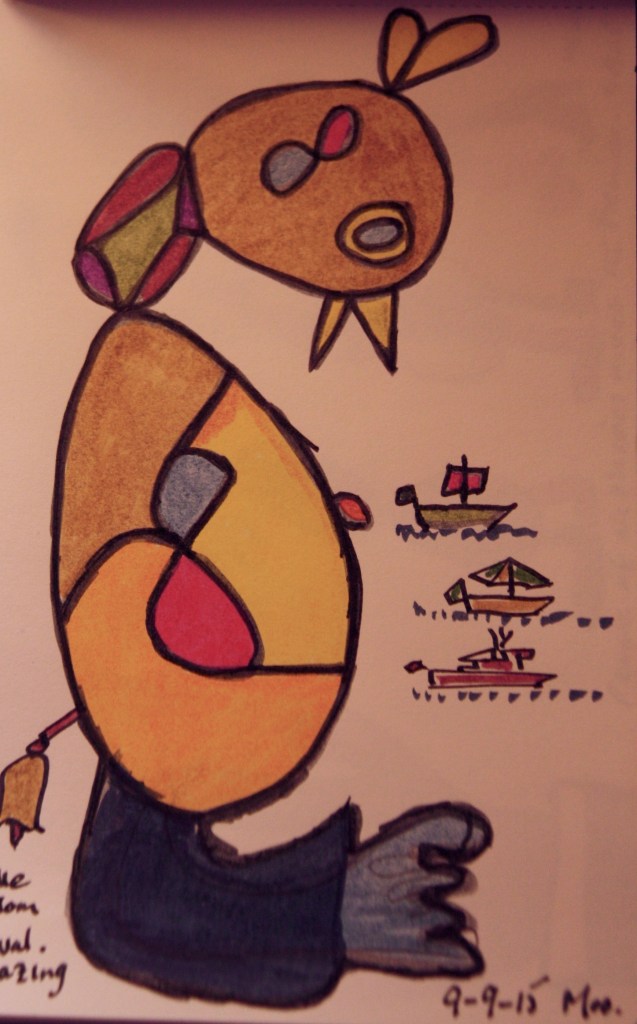
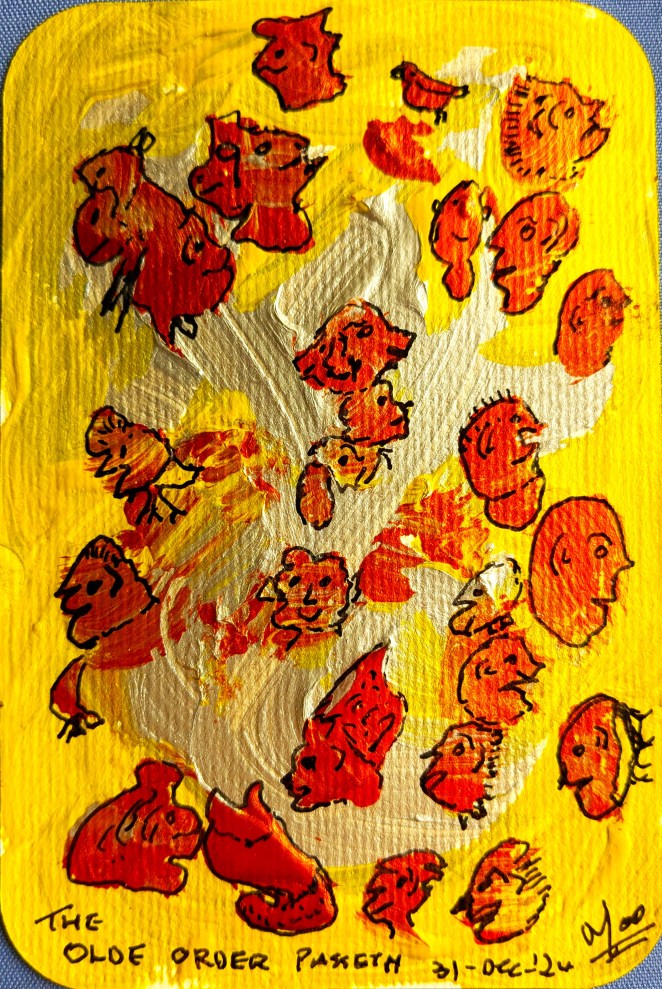
A golden oldie. Moo thought Poppy Day (11/11/2024) would be a suitable painting. Those who survive rarely forget those they were forced to leave behind. Kindred spirits, they travel though life together, the live one carrying the other on his shoulders as he would have done earlier, had he been able to.

Moo still has a teddy bear. He tells me he has always slept with one. His first teddy was an Australian Koala, a real stuffed koala given him by his Australian family, back when he was born. Moo was reading a book on the Battle of Britain (15 September 1940). It had a picture of the gunner from a Bolton Paul Defiant, sitting in the gun turret. Behind him, he had his little teddy bear. Moo couldn’t stop crying. He thinks he might have been an air gunner in another life, and when he saw that teddy, it brought back so many memories – flak, night fighters, search lights, tracer bullets, pain, flames, and then the unending darkness. So many did not come back, especially the tail-gunners. Their absence is still a presence to someone in their families. And so it should be.

Monkey’s Clockwork Universe

Monkey’s Clockwork Universe


Some days, monkey winds himself up
like a clockwork mouse.
Other days he rolls over and over
with a key in his back like a clockwork cat.

Monkey is growing old and forgetful.
He forgets where he has hidden the key,
pats his pockets, and slows right down
before he eventually finds it
and winds himself up again.

One day, monkey leaves the key
between his shoulder blades
in the middle of his back.

All day long,
the temple monkeys play with the key,
turning it round and round,
and winding monkey’s clockwork,
tighter and tighter,
until suddenly the mainspring breaks
and monkey slumps at the table –
no energy, no strength,
no stars, no planets, no moon at night,
the sun broken fatally down,
the clockwork of his universe
sapped, and snapped.

Commentary:

I guess we normal human beings, not the monkeys who live in the Monkey Temple, think of this as a sort of mental and physical burn out. It can happen to anyone really. You don’t have to be a monkey. But if you live in a clockwork universe where you clock in at nine and clock out at five, and regulate everything – your eating, your breathing, your visits to the loo – by the tick of the tick-tock work clock, then I guess this can happen to you.

Escarmentar en cabeza ajena – a lovely Spanish proverb that means ‘to learn from the blows delivered to another’s head’. Much better to let this poor monkey teach you that yes, you have to take breaks or, like monkey, you will break down. You must learn to pace yourself, not to be put upon by others, and to look after yourself. Because, if you don’t, others will take advantage of you and push you to, and beyond, your limits. Don’t learn that lesson the hard way, by ending up broken, run down, and in hospital. Learn from monkey’s experience. Keep the key hidden. Don’t let other people see it, or steal it, or wind you up with it.

Life is hard enough anyway. Look after yourself first. And then you will be much better able to look after other people – especially your family and friends – when they need your help. A difficult lesson to learn, especially in this world of multi-tasking where too many people hold too many low-paying jobs and work long, long hours, day after day, just to make ends meet.

There is no escape from the clockwork labyrinth, you think. Alas, that too is true, all too often. But escape you must. Somewhere, Ariadne’s thread will lead you out. You must seek it, even in the darkness and the gloom. Once found, it will lead you out from the darkness and back into the light. And that is what we must all hope for and work for. Pax amorque – and blessings.

Water

Water

Here, in Island View, my lawn’s parched grass
longs for water, long-promised but never drawing near.
Do my flowers remember when the earth slept without form
and darkness lay upon the face of the deep?

The waters under heaven gathered into one place.
When they separated, the firmament appeared.
Light sprang apart from darkness
and with the beginning of light came the word,
more words, and then the world …

… my own world of water in which my mother
carried me until her waters broke
and the life sustaining substance drained away
throwing me from dark to light.

In Oaxaca, water was born free, yet everywhere
lies imprisoned in bottles, in jars, in frozen cubes,
its captive essence staring out with grief-filled eyes.

A young boy on a tricycle pedals the streets
with a dozen prison cells, each with forty captives:
forty fresh clean litres of drinkable water. He holds
out his hand for money and invites the villagers
to pay a ransom, to set these prisoners free.

Real water yearns to be released, to be spontaneous,
to trickle out of the corner of your mouth,
to drip from your chin, and fall to the ground.

It is a mirage of palm trees upon burning sand.
It is the hot sun dragging its blood red tongue across the sky
and panting for water like a great big thirsty dog.

Commentary:

This year, spring came with lots of rain. At one stage it looked like the waterlogged plants in our flower beds would all drown. Then, just before summer came, the rain went away and we suffered day after day of unbearable heat followed by nights during which the temperatures scarcely dropped.

As a result, the woods dried up and dry lightning strikes started fires. At one stage close to forty wild fires burned, many out of control. Entry to the woods was forbidden by law. Gradually, the fire-fighters fought back, extinguished the fires, one by one, and reclaimed control. I hope everyone realizes the enormous debt we owe to those brave men and women who risk their lives to save not only our lives, but our houses and our properties.

The fires have gone now. We had a day’s rain, 11 mms fell, but it’s not enough. We need more, a great deal more. We need to soak the trees, the grass, and to feed the streams and rivers. We also need to refill the aquifers on which life on earth, as we know it, depends. We need deep ends in our pools, not the shallow ends of depends, when it depends on whether or not the skies open and the heavenly waters fall.

CBC radio last night – farmers say they have lost their winter hay. How will the animals survive our winters with the hay fields burned and dry? One farmer said that, having no hay himself, it would cost him a minimum of $55,000 to bring in hay – if he could find anyone to sell it to him. Unfortunately, the same is true across the Maritimes – drought, forest fires, and a lack of winter hay. Spare a thought (and a prayer or two) for all those poor creatures, born to die, who will suffer this winter on account of this summer’s heat.

This Vessel in which I Sail

This Vessel in which I Sail

Trapped in this fragile vessel, with the pandemic
a passenger waiting to board, I drift from port to port,
looking for a haven, safe, to have and to hold me.

No harbour will let me dock. “No room at this inn,”
they say. “No haven here.” They wave me away.

Now I have no destination. Aimless, I float and every
where I go the message is: “No vacancy: no room at all.”

Unwanted, abandoned, I wander with wind and waves,
my only friends seals, porpoises, and whales.
I walk the whale road, leaving a frail, white wake behind.

This vessel has become a gulag now, a prison
camp where I exist just to survive. Each hour of each day
endless, boundless, like this shadowy, haunted sea.

Today there is no motion, no goal. What is there to achieve
but survival? Each day’s journey is sufficient unto itself.

Commentary:

Moo’s cartoon, Naval Gazing, dates from 2015. That year I spent eight weeks in Moncton at the Georges Dumont, gazing at my navel while waiting for my anti-cancer radiation treatment. Naval gazing / navel gazing, indeed. Good one, guys. You make a great pairing.

The poem dates from 2020 when Covid stalked the streets and we wore masks when we were not confined to our houses. I thought of the tour ships, wandering the seas, with the disease on board, and no port wanting them. It was a strange time.

Golden Oldies, then, both poem and painting. There are signs, small at present, but still visible, that such days are on their way back. We must each ask the question – What is there to achieve but survival? Hopefully we will come up with a similar answer – Each day’s journey is sufficient unto itself. Journey well and journey safely, my friends.

Hello again – our old friend is back!

Hello again – our old friend is back!

Co-[vidi]-s
17 March 2020

I saw time change with the clocks
and my body clock
is no longer in sync
with the tick-tock chime
that denounces each hour.

Hours that used to wound
now threaten to kill.
They used to limp along,
but now they just rush by
and I, who used to run
from point to point,
now shuffle a step at a time.

Around us, the Covidis
thrives and flowers.
Wallflowers, violets,
we shrink into our homes,
board up the windows,
refuse to open doors.
We communicate by phone,
e-mail, messenger, Skype.

Give us enough rope
and we’ll survive a little while,
fearful, full of anguish,
yet also filled with hope.

Comment:

A Golden Oldie, written on 17 March 2020, St. Patrick’s Day.

Only yesterday, I read that Covid is back once more, in a new and mutated shape. Masking is once again demanded in the local Horizon hospitals especially in areas where patients and the public gather. I lost a couple of good friends to Covid last time round. I hope I don’t lose any in this new session. Guess I’ll be continuing to get my vaccinations and keep them up to date.

Whoever is reading this, I wish you all the best. May you stay Covid and illness free. May you also enjoy a long and happy life with sunshine days – and enough rain to keep the forests cool, the trees happy, the flowers flourish, and the wildfires at bay.

Clepsydra 12 & 13 – Pilgrim in this barren land …

Clepsydra 12 & 13 –
Pilgrim in this barren land …

12

… pilgrim in this barren land
     lost in my wanderings
          the wander-lust still tugging at me

in my back-pack
               dusty with memories
                    photos that only I have seen
                         sepia
                              spotted in places

only I know names and faces
     recall relationships
          a mystery to me, an outsider,
               such images haunt me
                    move me in ways
                         I do not understand

the irregular heart-beat
     of my life walks inside me
          down new corridors of time
               fresh music
                    strums my heart-strings

a heart
     a bridge a time too far
          lost I wander the woods
               searching for things
                    I know I must find
                         my lost self among them …


13

… but to find myself
     I must first lose myself,
          not in a barren land
               nor in the inner depths
                    of my suffering mind
                         nor the deeper depths
                              of another’s body

am I nothing more
     than an offering on the altar
          where nothing alters more
               than this interchange
                    eye to eye
                         mind to mind
                              body to body

will the I ever transform
     into the power of us
          together
               both of us

and are we much more
     than one plus one
          with three or four or more
               conjured from the word
                    that was from the beginning

or is all of this
     nothing more than
          the woven magic of pillow-talk …

The Book of Everything

Discourse Analysis
and
The Meaning of Meaning

Words have dictionary definitions that allow us to agree on what they mean. In this fashion, when I say ‘my grandmother’, you automatically know that I am referring either to the mother of my mother (maternal grandmother) or the mother of my father (paternal grandmother). This is the dictionary meaning of the word ‘grandmother’.

But words have lives of their own, and their meaning changes when used by individuals. You, the reader, never knew my grandmothers. You never will. They both passed away a long time ago. I loved them both, but for very different reasons, and to me they were as different as different can be.

This means that when you, the reader of these words, reach the word ‘grandmother’, the faces you see, the emotions you feel, the memories conjured up by that word are totally different from mine. Same word, same dictionary definition, different personal memories, experiences, relationships. In addition, the role that our grandmother(s) played in our lives will be very different too. That role may vary from culture to culture, from language to language, and from the social structure of the changing society in which we live.

For example, when I first went to Santander, Spain, I visited a family who lived in a large, detached house that contained three generations of the family – grandmother and siblings, father and mother, grandchildren, and an assortment of aunts and uncles. No need for babysitters in that household. Everybody had a vested interest in the development of the young ones and the older ones received tender, loving care, twenty-four hours a day, every day of the week.

I lived from time to time in the same town as my own grandparents. I saw them regularly, but rarely on a daily basis. When my parents sent me to my first boarding school, age six (if I remember correctly), I lost contact with my family. My paternal grandfather died when I was away at school. My maternal grandmother died while I was away at school. My paternal grandmother died when I was living in Spain. My maternal grandfather died when I was living in Canada. Alas, after those early years, I scarcely knew them. My experience, then, was so different from that of other people.

When I moved to Canada, the Atlantic Ocean separated me from my parents. My daughter, born in Canada, grew up with no close knowledge of her grandparents. The word ‘grandmother’ did not mean the same to her as it did to the grandchildren in Santander, or to me. How could it? All those miles between the families, and visits limited to a couple of weeks every other year at best. Although the dictionary meaning is always the same, what a difference in the emotional meanings for each person using that word.

Discourse Analysis, the way I use it, builds not on the dictionary meanings of words, but on their emotional and personal resonance. I take the standard, dictionary meaning of words, twist it, look for meanings at different levels, and then build an alternative narrative on that changed meaning. I have great fun doing so.

Part of that verbal fun comes from my childhood. I listened to Radio Shows like The Goon Show and Beyond Our Ken. Giles’ Cartoons gave my names like Chalky White, the skeletal school teacher, or Mr. Dimwitty, a rather dense teacher in another school. These shows also twisted the meaning of words and drew their humor from such multiple meanings. The Goon Show – “Min, did you put the cat out?” “No, Henry, was it on fire?” Or on an escaped convict – “He fell into a wheelbarrow of cement and showed every sign of becoming a hardened criminal.” Or from Beyond Our Ken – “My ear was ringing. I picked it up and answered it. ‘Ken here, who am I speaking to?’ ‘Larry Choo.’ ‘Ah, Choo.’ ‘Bless you, Ken.’ Verbal scenes like these – it’s hard to get visual pictures from listening to the radio – remain engraved in my memory banks. More than engrained, they become part of the verbal system from within which I write.

This system includes Direct Discourse, Indirect Discourse, and the Twisted Discourse of an Inventive Mind that still wishes to create. It also comes from Francico de Quevedo’s Conceptismo, from Ramón del Valle-Inclán’s esperpento, and from certain aspects of Albert Camus’s Theory of the Absurd, all blended with the poetry of Jacques Prévert and the songs of Georges Brassens. This from the latter – “Tout le monde viendra me voir pendu, sauf les aveugles, bien entendu.” Everyone will come to see me hanged, except the blind of course.

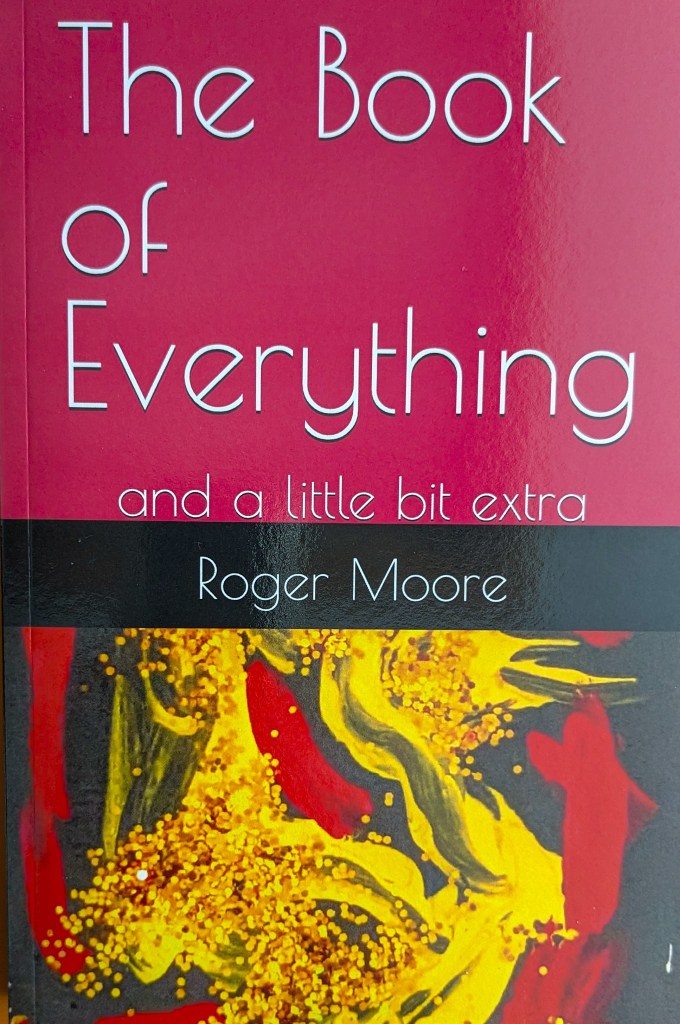
This is not always easy humor, nor is it a comfortable way to see the world. But it is a traditional one with a long literary history. The title of my book goes back to Francisco de Quevedo, of course, who, in 1631, in Madrid, published El libro de todas las cosas y otras muchas más / The book of everything and a lot more things as well. Don Roger turns to his good friend Don Francisco whenever he needs a helping hand.

The pieces themselves were first published on my blog rogermoorepoet.com. They have been revised, and I have added some more pieces in a similar vein. Tolle, lege – Take and read.  Above all, enjoy this world of mine, with its subtle and not so subtle humor, its sly digs at many of our follies, and its many forms of creativity.

The Book of Everything
and
a little bit extra

Click on the title to purchase this book.

Time Flies

Time Flies

… bends like a boomerang,
flies too rapidly away,
limps back to the hand.

Endless this shuffle of unmarked
days dropping off the calendar.

Hands stop on the clock.
The pendulum swings:
time and tide stand still,
do not move.

‘As idle as a painted ship
upon a painted ocean.’

The painting in my grandma’s room:
seemingly moving seas,
sails swelling out,
but the ship doesn’t move,
it stays firm in its frame.

Our garden fills with birds
and squirrels, light and dark.
Morning ablutions: each day
a twin of the day before.

The TV screen churns ceaselessly,
tired, shadow faces boring us
with shallow wit
and worn-out wisdom.

Time:
an albatross around the neck,
an emu, an ostrich, a dodo,
an overweight bumble bee,
too clumsy, too heavy to fly.

Absence in Presence

Absence in Presence

Just before her flight left,
she came up
from the basement,
her cleaning tasks
complete,
and smiled at me.

In the background, music,
a Golden Oldie,
the Rolling Stones playing
This could be the last time.’

Present in her eyes,
and in my heart,
the thought,
more than a thought,
the knowledge
that those words
might actually be true.

Clepsydra 9 & 10

9

… what lies behind this attic door
     ready to spring out
           at the slow push of my hands

cobwebbed
     this world revealed
          a universe of memories
               waiting to be called
                    back into life

what life
     the flickering half-life
          of shadows on a wall     

or the alternate reality
     of planets that lost their way
          and forgot how to dance
               around their sun

do they still move
     in rhythm to an unsung song
          an unstrung guitar
               music no one else can hear
                    played by a wandering star

lost the glimmer
     of life’s candle
          adrift on distant waters,
               but never forgotten …

10

… nor seen
     nor heard
          I am amazed by the maze
               wandering
                    among cluttered objects,

my world takes shape
     in a mad hatter’s workshop
          where things grow legs
               walk this way that way
                    constantly getting lost

I can hear them
     chittering chattering
          but I can neither
               see nor hold them

like so many bats
     they roost upside-down
          little children lost
               in memory’s attic
                    where everything ages
                         slowly gathering dust …