Gazunda

Gazunda

Gazunda
for John Sutherland

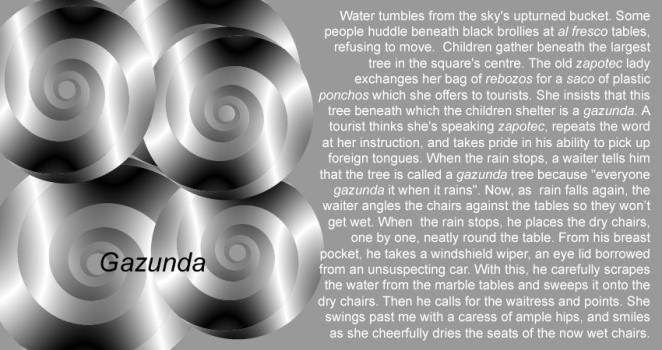
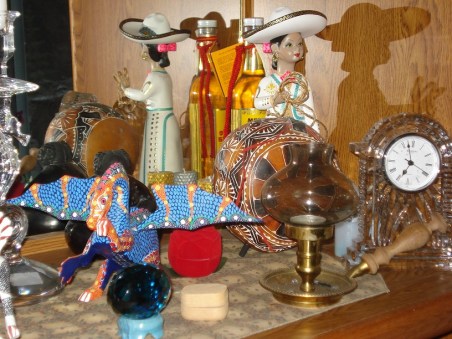
John and I were talking about the rare Gazunda tree the other afternoon. I had forgotten that I had indeed written abut the Gazunda trees that flourish in the zócalo in Oaxaca, Mexico. Oaxaca is a magic place, full of mystery and myth and the myth of the Gazunda tree is not well known outside the confines of the city. I was so pleased to discover this account, written many years ago, when I first became associated with the Escuela de Idiomas attached to the Unversidad Autónoma Benito Juárez de Oaxaca (UABJO).

Much remains to be written about my experiences in Oaxaca and I hope to have a collection of prose poems completed fairly soon. They are golden oldies, but like many golden oldies, they are also golden goodies. The Gazunda trees are very welcome when it rains, but they should be avoided, for obvious reasons, during thunder and lightning storms. Then, nobody Gazunda them. By the way, if you do visit the zócalo in Oaxaca, or anywhere else in Mexico, after heavy (or light) rain, be sure to test the seat of your chair before you sit in it. If you don’t, you will soon find out why all the waiters and waitresses have that open, friendly smile the tourists love so much.

Really? Wednesday Workshop

IMG0061_1

Really?
Wednesday Workshop
19 July 2017

“Steevie K says adverbs are out. You shouldn’t use anything ending in -ly.”
“Really?”
“No. -ly words are banned. They’re as bad as Anglo-Saxon four letter words.”
“That’s folly, surely?”
“No. It’s an absolute from the best of all writers. You do agree, don’t you?”
“Oh, absolutely, in a sort of writerly fashion. I’ll leave all my -ly words on the trolley.”
“Are you being facetious?”
“Absolutely not. Clearly, Steevie K obviously has a point. Totally too many -ly words in use. Well, usually, anyway.”
“What’s more he says that people in general and writers in particular should avoid adverbs.”
“Funnily enough, I actually feel the same way, relatively speaking, particularly nowadays.”
“But you use them all the time.”
“Only in July, when there are comparatively few alternatives.”
“You know, Steevie K counts the number of times people use the -ly word.”
“Surely not? But then, he must truly be thoroughly committed to the extermination of …”
“… words ending in -ly. Of course he is.”
“I bet he lovingly caresses his dictionary as he peruses the -ly section while scratching his belly.”
“There is no -ly section.”
“You are lying, surely?”
“No. Anyway, that’s ly-, not -ly, and ly- is not a letter , it’s a combination of letters. Do you understand?”
“Truly I do. I get on swimmingly with this. All of it, actually.”
“All of it?”
“Totally. I always wondered why they said ‘jello’ not ‘jelly’.”
“Who?”
“Those with the smelly yellow-belly, of course.”
“I’ll report you to the Steevie K thought-police.”
“Surely you wouldn’t do that, not really, that’s not particularly nice?
“Really and truly.”
“Verily, I say unto you: ‘Oh shut up, you falsely bloated, heavily spotted yellow-bellied sapsucker’ …”


Damnatus

IMG_0041

Damnatus / Doomed

‘Poor poets of today: condemned to be nothing more than the dry dust of an unread doctoral thesis.’ They languish, empty headed, in dark rooms, those poets, hunched over their computers, waiting fr someone or something to fill up their heads. They hammer away at their keyboards, correcting their spelling with an  ever cautious spell-check. Intent on making their poems cryptic, they shrug off the sunshine, the beach, the flowers in the garden,  the cardinals, orange and red, who clamor at the feeder, and concentrate on abstract meanings, abstruse words, and twisted thought.

Phone calls go unanswered. Friends are left hanging on the vine to dry. These poets are worse than wallflowers at a dance or lemons out on a date as their crowded heads fill up with metaphors and myths that limp their unsteady ways onto screen and page. Oh pity the blisters on their fingers, the calluses that harden their fingertips to the delights of re-writing, again and again, for they are not real writers but real re-writers, and every thought is a skirmish with unreality, a pledge to continue their servitude to their life’s mission: the curdling of words and the nurdling of poetic thought. What better poetry is there than a hamburger for the hungry or a helping hand stretched out across a street to help a beggar in need … but there are neither burgers nor beggars in these un-windowed buildings, just the poverty of a poetry undiscoverable in its lack of lustre gloom..

Where is the graduate student, earnest, destined to be penniless, who will delve into the notebooks of these poets’ lives and dig out the thought-gems, the diamonds that will make everyone great, publisher and published, poet and practitioner of the uncritical art? Will someone not take that student by the hand and lead him to pastures green, or to the sea, to taste and test the blessed salt and the winds that will drive away the mind’s unwholesome fog and bring light and understanding that will un-cuff the wrists and heal the immortal wounds for, left untreated, they will bleed for all eternity?

Oh the bright bracelet of learning bound round the heart-bleed wrist. Oh the false knowledge gained, that leads poet and critic up and down the slippery garden path towards promotion, tenure, and a seat on the picket fence. Oh those grey human bodies chained to their wooden desks in a dusky library or transfixed on metal seats in academic meditation. Sit and watch while cobwebs sprout in the unused brain and the only certainty lies in footnotes and bibliographical entries that rise like a surging tide to flood the drowsing mind that craves more sleep.

What bright word, what metaphor dim, has poisoned the wit so it effortless moves into the serenity of contemplation? Look on this pathless sea of words, ye mighty, and despair. But take great care: for what if this sylvan warrior awakes, steps out of that figmented dream, sees the reality beyond the shadows, demands a proper challenge, a walk in the park, a vision of the grass that is so much greener on the other side where the administraitors gather and garnish paper and paperclips as they strive for the privilege of herding more and more slovens in their poetic pursuits?

Oh grant them more grants, these purloined poets. Gift them pure visions of things that never were and will never be. Never let them break away from their dissolute dreams that wrap their disadvantaged forms in the ignorance of mental slumber, half-sharpened pencils, and a box of blunt sharpeners..

Three Visitors

img_0221

Kingsbrae 18.3
18 June 2017

Three Visitors

The first one knocked on my door,
called out my name, knocked again.
I got out of bed, opened the door,
looked out: but the corridor was empty.

The second one stood in the corner,
calling, calling … I tried to answer
but I couldn’t unseal my lips. “No,”
the visitor said. “No. Don’t go.”

Lips and throat dry, tongue tied,
I lay in my bed.

My third visitor was David,
and I knew he was dead.

Le Pont Mirabeau

Kingsbrae 8.4
8 June 2017

Le Pont Mirabeau
(click for French original)

The Seine flows down beneath Mirabeau Bridge
and so does our love
must I be reminded yet again
that happiness always follows pain

Let night descend let the hours sound
the days go by but I’m still around

Hand in hand let us stay here face to face
while beneath the bridge of our arms
our gazes interlock
like river waves flowing

Let night descend let the hours sound
the days go by but I’m still around

Love flows away like these flowing waves
love flows away
how slowly life passes
and hope is so brutal

Let night descend let the hours sound
the days go by but I’m still around

Days flow by and weeks flow by
nor times past nor former loves
come back again
under Mirabeau Bridge flows the Seine

Let night descend let the hours sound
the days go by but I’m still around

Comment: I spent the school year in Paris in 1962-1963 and I have always wanted to translate Le Pont Mirabeau from French into English. Today, I found both the time and energy to do so. It’s not a great translation, but it is mine. Click on one of the links above to get the French original.

Absences

Avila 2008 006

Kingsbrae 7.3
7 June 2017

Absences

Pigeons flapping
across abandoned squares.

Clothes peg dripping
raindrops from a deserted line.

Ile Ste. Croix,
lonely in the bay,
longing for Champlain’s
return.

Endless rock and roll
tide after tide
water without end.

A whole day goes by
without putting
pen to paper.

The blank page
waits for the pencil’s
resurrection.

Purple FF

img_0199

Purple

I close my eyes and return to Paris, Easter holidays, 1961. Algérie-française, Algérie-algérienne, the car horns tweet in the street as we drive the boulevards of a city divided. This is all new to me, a seventeen year old student in Paris to learn about French culture. My friends in the car have heard the tooting before and join in the fun.  Algérie-française the driver toots.

Turning a corner, flattened and blackened, still flaming against a fire-burned tree, the metal skeleton of a Deux Chevaux, a ‘tin of sardines’, bears witness to the car bomb that has laid its occupants low.

* * *

Hitching the highway, from Paris to Chartres, thumb stuck out to catch the wind, a purple Citroen stopped and offered me a lift. I trusted the car: a Citroen, like Simonet’s famous detective Maigret used to drive.

When the car stopped and the door opened, I got in and saw that the driver wore black leather gloves. His hand movements on the steering wheel were stiff and clumsy and he made exaggerated gestures when he changed gear.

“No hands,” he explained. “Lost them in Algeria. Listen: I used to be the driver for a top General. I drove him out of an ambush once. I lost my hands later, when the car exploded, caught in a crossfire. They teach you things in the Army. I can still drive.”

He accelerated and threw the car at four times the speed limit through the S bend that snaked through a small group of houses. I bounced from side to side, held back by no seat belt.

“You see,” he said. “They train you to do this before they let you drive. Ambush. The sniper at the corner. The Molotov Cocktail. You must always be prepared.”

I closed my eyes and returned to Paris.

Collateral damage: the young girl with her photo in the Figaro next day, scarred for life; her mother, legs blown off, lying in the gutter in a pool of purple blood.

Maman, maman,” the young girl cried. But her mother was never going to reply.

The Pom-pom-pompiers arrived in their fire trucks, sirens screaming. The ambulances screeched to a halt. The young girl cried. The mother bled out her life-blood in silence. Her blood turned purple and black as it flowed through the gutter.

Parisians emerged from dark doorways and stood there, bearing silent witness. Evening draped itself over the Paris skyline. The sky darkened and became one with the purple of the car bomb’s angry flame. Purple bruises marked my arm where I had gripped myself with my own fingers. An indigo angel squatted above the faubourg street, with shadowed wings, brooding.

* * *

I opened my eyes.

We left the village in our wake, travelling five times faster than the speed limit.

“They trained me for this,” the driver said. “I am prepared for anything.”

He stopped the car by the cathedral in Chartres. I thanked him and got out. He offered me his hand and I shook it. Inside the glove, the hand was hard and metallic. Alcohol sweated out through the purple veins that stained his nose and flowed in abundance over his sun-tanned face.

Teddy Bear Tales TBT 1


Empress 048

Oppressive-Possessives
TBT1

 Teddy Bear Tales 1

 “Possessives are oppressive,” my Teddy Bear whispers in my ear. “I’m not your Teddy and you’re neither my owner nor my master. The world exists without you possessing it. It will continue without you. And yes, I hear you, especially when you talk in your sleep. ‘My wife,’ you mutter, ‘my daughter, my flowers, my garden, my lawn, my birds, my bees, my deer, my house, my grounds, my groundhog, my car, my TV, my team, my Teddy.’ Well, permit me to share a secret with you. None of them are yours. You may think you own them, but you don’t.”

My God …” I sat up in bed and held my Teddy Bear at arm’s length, staring into his button eyes.

“There you go again,” Teddy stared right back at me. “Whatever are you thinking? Those two little words, yours and mine, are a threat to the universe.”

Help!


img_0372

Help!

The world turns full circle
and my mother is on the phone.
It’s four AM. “Help me!” she cries,
from the far side of the Atlantic.

Her ship is sinking fast and she’s
nine sheets to the wind.
“I’ll stick my head in the oven,”
she says, “and turn on the gas.”

What can I say? What can I do?
She makes so many threats.
She’s crying “Wolf!” and her words
now bounce off this duck’s back.

Yet still I wake at night to hear
her whispered words, and they still
chill with their razor’s edge of
“Help me! Help! Please help!”’

Hyperbole: Wednesday Workshop

img_0177

Hyperbole

It is no exaggeration to say that Hyperbole is one of the most exciting and fascinating aspects of rhetoric.

At its most basic, hyperbole means exaggeration. When we start to explore the term, however, it means oh so much more.

Looking up synonyms for hyperbole, for example, we find the following: exaggeration, hype, metaphors, overstatement, amplification, coloring, distortion, embellishment, enlargement, magnification, PR, big talk, embroidering, laying it on thick, making a mountain out of a molehill, tall talk.

But let’s not stop there. Merriam Webster offers this as a definition: The representation of something in terms that go beyond the facts. “Enough food to feed a whole army” is a common example of hyperbole. Here are some more suggested synonyms, with a few overlaps: caricature, coloring, elaboration, embellishment, embroidering, embroidery, exaggeration, magnification, overstatement, padding, and stretching. Related words include: amplification, enhancement, fabrication, misrepresentation, fudging, hedging, hype, puffery, plum-mcduffery, and superlative.

The Power Thesaurus suggests that there are over 263 synonyms for hyperbole. It offers 14 pages of them. Here is the start of page one:

exaggeration / image, parallel, flower

overstatement / exaggeration, adornment, coloring

metaphor / exaggeration

embellishment / exaggeration, excess, decoration

distortion / exaggeration

magnification / exaggeration, fancy, line.

We could go on and on and on with this, world without end, secuale seculorum, for ever and ever, and all that, without exaggeration. The point is clear, we have more than enough definitions here to fill several rather large books and clearly, without being too catty about it, it would take at least nine lifetimes to read and understand them all.

Meanwhile, hyperbole possesses an adjective: hyperbolical. This is sometimes confused with the term hyperbolic which in turn is occasionally confused with the term hyperbollocks, as in the saying: “this article is, without embellishment or exaggeration, a load of hyperbollocks.”

Chuck Bowie comments: “Down the road, I hope we get to see your take on how to employ this useful tool without reducing the document to caricature.”

Roger Replies: Thank you for your comment, Chuck. I think that the application of hyperbole to a literary text or an image within a text depends entirely on the individual author. As authors and human beings, even in our daily speech and our interactions with other people, we can and do exaggerate. How we apply hyperbole to our structures and stories and characters is very individual. Clearly there must be a balance between emphasis (potentially good) and over-exaggeration (potentially bad, but with strong potential for parody and comedy), but so much depends on the individual situation. A stylistic analysis of each instance will reveal if the hyperbole is excessive. However, in my opinion, that necessitates the presence of a text, rather than a doctrinal theory about ‘how to do it’. The easiest way might be to analyze a text or two and see how hyperbole functions in specific circumstances. Certainly, as you so rightly note in the above comment, hyperbole can be used for comic purposes, as I have done in my article. Its overuse can both be criticized and parodied. An interesting study, with the seeds of a doctoral thesis planted therein, would be to demonstrate how, in Don Quixote, Cervantes moves from a hyperbolic parody of his character to a truer understanding of the essential dynamics of the main characters’ essential personalities. If I were fifty years younger, I might start that doctoral thesis.  Alas, within the self-imposed parameters of  this blog, there is neither time nor space. We can continue this conversation at our leisure. Thank you for responding.