Carved in Stone 56 & 57

Carved in Stone
56

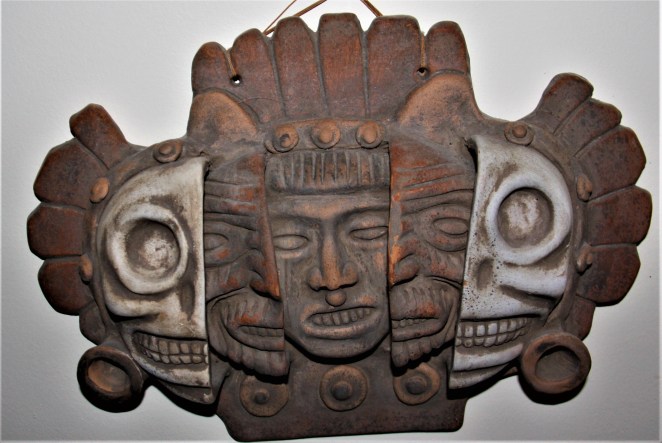
I stand before the Tzompantli,
the Aztec Skull Racks
in the ruins of the Great Temple
in Mexico City,
and gaze in wonder,
at the multiple meanings
of these decorated deaths.

57

At Teotihuacan,
I climb the Sun Pyramid,
with its carved serpent,
slithering sideways,
as the sun moves.

I heave myself upwards,
panting, sweating,
and when I get to the summit,
I sit there, feet over the edge,
and I feel my heart thumping
as I fight to regain my breath.

Now, I feel purified,
cleansed, sweated dry,
as I watch poor mortals
struggle as I did
to take that final step.

I imagine them laid
on the sacrificial stone,
their chests carved open.

Each beating heart,
when extracted,
will cover altar, priest, and sky,
with a fountain of blood,
so hard those hearts
are pounding. Blood seeds
shoot into the sky
to revive the setting sun
as it drowns in its own blood.

Commentary:

Incredible, looking back, those moments in Mexico when I came face to face with a culture, so old, so alien to me, that I had difficulty coming to terms with it. I do not understand human sacrifice. Nor do I understand the mentality of the conquistadores who held the Aztec Emperor’s feet to the fire and burned them to the bone, leaving him alive. And still he would not tell them the secrets of the kingdom.

“The setting sun as it drowns in its own blood.” A nod to Charles Baudelaire, of course, – “Le soleil s’est noyé dans son sang qui se fige.” Wonderful how these images stay with us. Sunrise – and the sun is born in blood – sunset and the sun sets in its own blood. And was it really true that only the blood of humans, drawn through human sacrifice, sometimes voluntary, sometimes not, would keep the sun in the sky?

And there we go – in blood we were born, in blood we will probably die – all hail the power of blood – unless of course / wrth gwrs – it is contaminated. And what will happen to us then?
Carved in Stone 53

Carved in Stone
53

Nor do I belong
in the Aztec city of Tenochtitlán
with its cruel stone gods.

Built originally
in the middle of a great lake,
it defied all comers, and held
the mighty Cortés at bay.

Human sacrifices, night and day –
what is it that makes some people,
carve and shape the living flesh
of others, as if it were wood or stone?

Who could admire a culture,
based on human sacrifice,
death, blood flowing,
just to keep the sun in the sky,
red at its dawning,
westering in the evening
into a sea of blood.

Commentary:
“Man’s inhumanity to man.” Robbie Burns, if I remember correctly. Thus it was and thus it always will be. Man’s need for space, for room around him. The need to establish himself and his own tribe and oust the other. The need to target the other to prove the weakness of those who do not belong. So many ways to target, including humor and jokes, all pointed at the targeted individual.

“What’s the most dangerous job in Ireland?” – “Riding shotgun on the garbage truck. “The jokes never change, just the targets. For Ireland, substitute England, France, Canada, Wales, Scotland. For a country, substitute a town – Fredericton, Island View, Saint John, London, Cardiff, Dublin, Paris. Okay, so they are cities, not towns, but you know what I mean.

Let’s change the joke. “How do you get the [choose one or more] English, Irish, Scottish, French, Welsh, Germans, Italians, out of your front yard?” “Put your garbage cans in your back yard.” And so it goes on and on. Like old Father Thames, who just keeps rolling along, down to the deep blue sea.

Why, I ask myself, why, why, why, do we have to diminish someone else in order to appear strong ourselves? Is it just human nature? Is it the nature of some people? Do all people behave in the same way? If you have the answers, or any answer, the same instructions as usual, send it to me on the back of a postcard, by dog sled, via the North Pole. And if you’re feeling generous, put a $5 bill in the envelope. It will help me pay the lawyer’s bill for suggesting such outrageous nonsense.

Carved in Stone 50

Carved in Stone
50

Here, in the castle of my own home,
I sit and write and patiently wait
for the enemy’s superior forces
to arrive and overwhelm me.

But death is not the enemy.
He is the friend
who has walked beside me
every day, since the day
that I was born.

I know him and I trust him,
though I am unaware
of when he will come to call
and I am ignorant of the shape
he will finally take.

Commentary:

Francisco de Quevedo, the 17th Century Spanish Neo-stoic and Metaphysical poet, wrote “the day I was born I took my first step on the path to death.” And so it is, with all of us. Sometimes we are able to choose our paths, sometimes they are forced upon us, sometimes they appear – with choices – and we make our selection and move on.

There are so many roads to travel. For Antonio Machado (Spain, Generation of 1898) there is no road. There is only a wake upon the sea – “Caminante, no hay camino, solo hay estela sobre el mar.” We must look back, to see where we have come from and where we have been. But there are many other possible paths, beside that of the sea – gravel paths, cobbled ways, log trucking roads in the Canadian Forest, cattle roads, transhumance roads, winding roads, straight Roman roads, roads that run up hill, down hill, or twist and bend following the paths of rivers.

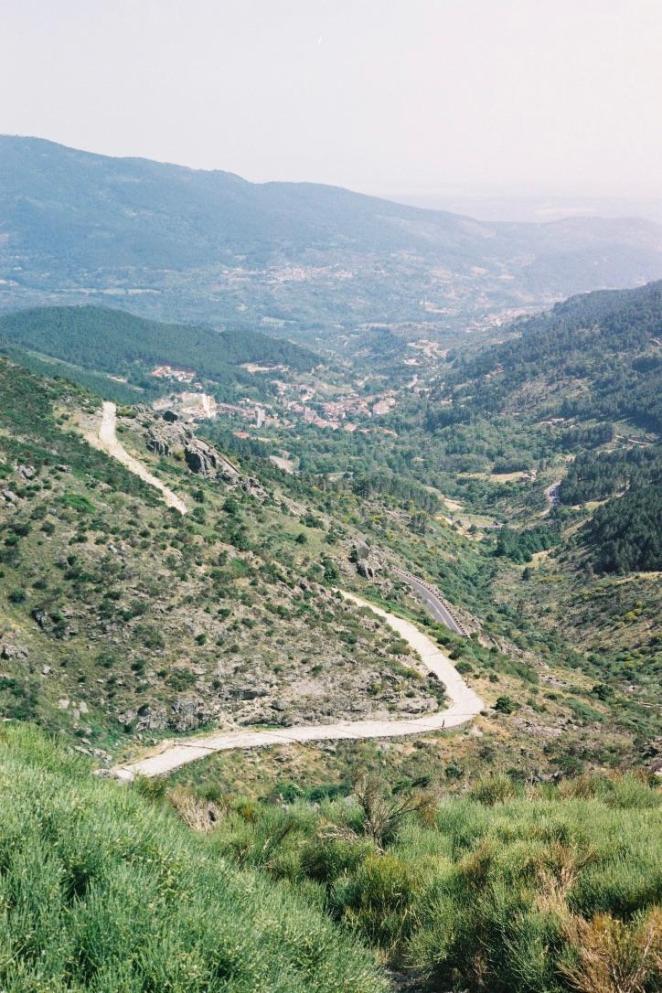
The picture above shows the old Roman Road that leads to the Puerto del Pico, in the province of Avila. It followed the contours of the hill and formed part of the Ruta de la Plata, the road that took Latin American silver from Seville to the Spanish capital in Madrid. Look carefully and you can see the modern highway that runs parallel to the old Roman road. Nowadays, that older road is used for transhumance, the movement of cattle from the valleys in the winter to the hills in the summer. The same road, the same pass, so many different uses, and the road a wake upon the path of so many lives.

Carved in Stone 43

Carved in Stone
43

Back home, in that little cul-de-sac,
the husbands are away,
working their night shifts,
while the wives are at home,
entertaining the truckers,
those long-distance drivers,
who park in that street and lodge there,
overnight, in the houses.

The children, boys and girls,
go out into the street,
climb into the trucks,
duck under the tarpaulins,
and, with all of us sworn to silence,
practice what their elders
are doing back home.

Commentary:
Monkey see, monkey do. And who knows what Monkey sees or does when the lights are turned out, darkness descends, and the honor of the blood cult takes control. Ask the animals, they will teach you. That was the motto of Bristol Zoo, where the Monkey Temple ruled, and Alfred the Gorilla and Rosie, the Elephant, were King and Queen of the beasts.

Knowledge – where does it come from? How do we attaint it? Is there a difference between knowledge, what is known, felt, and worked out for yourself, and education, when you obey orders and do what you are told to do (and how to do it). “We don’t need no education, we don’t need no thought control.” I have always loved Pink Floyd and The Wall. So many walls, so many barriers, so many things to break down in order to build them up again. Songs – Frank Sinatra – “I did it my way!” And who teaches what and to whom, underneath the tarpaulin when the lights are out? “Hey, teacher, leave those kids alone.”

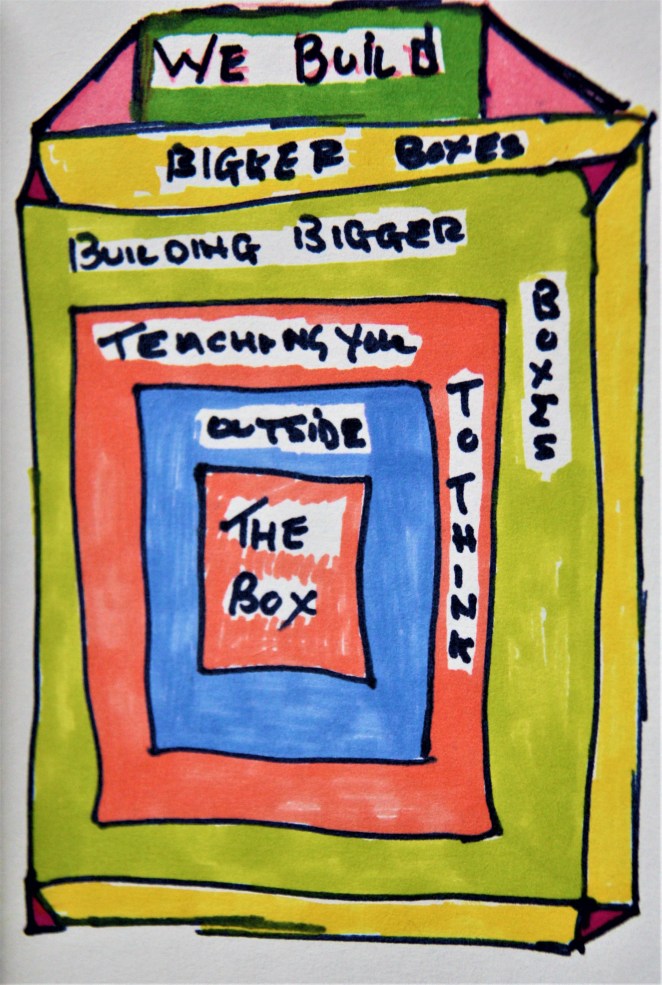
And beware of anyone who tells you that “we teach you to think outside the box.” That person will only give you a slightly bigger box, of his or her own making, inside of which you will be forced to think.

Of course, there are other ways in which we can think about education. How about this one? Filling empty heads with knowledge. How many ways are there to do this? And what is the exact content of the jug from which the knowledge will flow? And how many sows’ ears does it take to make a silk purse? “Hey, teacher, leave those kids alone.” Giddy up, Neddy I’m on my hobby horse now.

Carved in Stone 42

Carved in Stone
42

After school, in a cul-de-sac
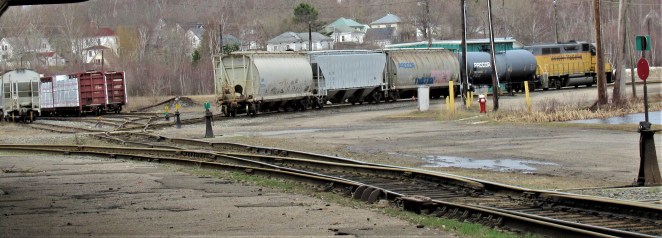
that backs on to the railway yards,
the street boys show me
how to hold a knife,
how to approach a man,
how to ask for a light,
for a forbidden cigarette,
while other boys,
knives in hand, lie in wait
to ambush the victim.

How old am I?
Five or six.

I would go to Woolworth’s
with my friends and distract
the shop girl while the others
stole whatever they could.

Then we would go
to the public washroom,
boys and girls together,
and share the spoils.

Something for everyone,
and everyone sworn to secrecy,
a blood cult, knives
or razor blades inserted,
and wrist pressed to wrist.

Commentary:

Free will or determinism? How does one escape from the back-street poverty of a run-down neighborhood and emerge from the shadows to bask in the light of the sun? Or is it all a dream, a made-up picture of a childhood that never was in a neighborhood that never existed? Vanishing point – the railway tracks fading away into the distance. Point of vanishing – to lose oneself in the mysteries of a past that never was in order to establish a future that never will be. Dream, dream, dream – all I have to do is dream!

And then there are the nightmares, when the dreams are true and the memories are so exact that you can see the blood on the razor blade and feel the almost silent slash of this particular slice of life. Secrecy – and who can tell whether I am telling the truth, or not, here in a foreign land, not the land of my fathers – and I only had one father, that I am aware of, and one mother too – where nobody knows me and the children from that imagined back street would never think of visiting.

For Jorge Luis Borges, whom I met twice, once in Bristol and once in Toronto, – Canada was a land so distant and so cold that it lacked reality. And thus I can dream my dreams, rewrite my past, reimagine myself, in whatever way I want to and I can vanish at any vanishing point I choose and emerge wherever I want to, and do it over and over and again, and who knows the truth? Over the points, over the points, and Liza none the wiser, whoever Liza happens to be!!!

Carved in Stone 35

Carved in Stone

35

My eyes draw sound
out of the white space
of silence.

Silent the pen,
gliding smooth,
over unlined paper,
a skater leaving marks
on fresh ice.

Each mark is a signifier,
or a series of signifiers
constituting a signified,
a message engraved
in the reader’s mind.

Commentary:

Each mark is a signifier, part of a series of signifiers constituting a signified, a message written on paper, then engraved in the reader’s mind. But, of course, the message has to be read, and the reader has to be diligent enough to burrow into the meaning of the message. And what is the meaning of meaning? Ah, we have been down that rabbit hole before and Alice has been through the looking glass, and we have seen ourselves in our daily mirrors, slowly fading as the years go by.

A skater leaving marks on fresh ice or a stone cast into a pond, with multiple meanings, multiple ripples moving slowly outwards, to end up where? Who knows? Not me. I only know that the thrown stone, like the spoken word, can never be recalled. And there’s a 2,000 year history behind those words. Each word a stone, and each stone leaving its mark on many people of many cultures and multiple languages, though English is the language in which I now write.

Frost and snow here this morning. Not much, just a dusting. I looked out of the window at the crows’ prints on the white surface of the garden. My eyes drew silence out of the white space with its runic language written by the crows.

The meaning of meaning – tell me, if you can, what did they say? What did they want from me? What did they mean?

Carved in Stone 32

Carved in Stone
32

I dream of winter snow
snaking its whispering way
down the highway.

Waves draw lacy curtains
across the beach.

Sandpipers wade, pecking,
probing at tide’s foaming edge,
strange writings their footprints,
punctuation,
the holes they leave
drilled in the sand.

Evening now, and a low light
casts its magic on the forest,
gilding the trees.
Dry leaves rustle.

A shadow flickers
at the edge of my eye,
my childhood –
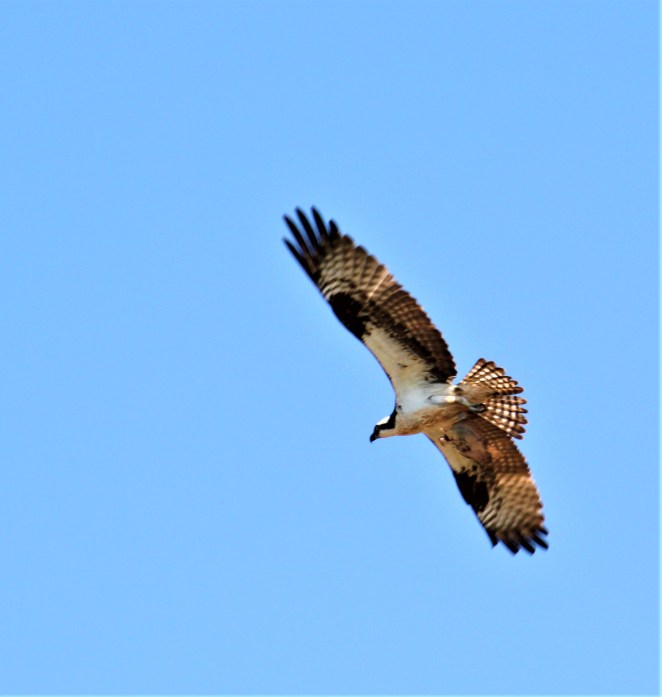
a sea bird soaring.

Commentary:

So inadequate, the word world I create. Sound – winter snow snaking its whispering way down the highway / dry eaves rustling. Absence of sound – waves draw lacy curtains across the beach / sandpipers, with their shrill voices and constant whistling’ / the gentle hiss and buddle where the sandpipers sew their holes.

What about the other senses? I miss the sense of smell, the odors borne on the wind, the different aromas that arises from dry and wet sand, the pong that wet sea weed exudes, the perfumes of sea side grass and wild flowers … And what about touch – the sandpaper scraper of dry sand between the toes, the feel of those lacy curtains as, jeans rolled up, you paddle along the shoreline, the feel of the wind on your face when sea birds soar … and who can ever forget the salt taste of the sea upon their lips?

The Catch 22 of all writers – how much can we include? How much can we suggest? How much must we let slip by? Culture – how can we describe the sea to someone who has never seen the sea? I can ask the questions – but I must leave you to work out the answers for yourself. So inadequate, the word world I create.

Carved in Stone 30 & 31

Carved in Stone

30

A well of beauty dwells within me,
not skin deep, but buried, arcane.

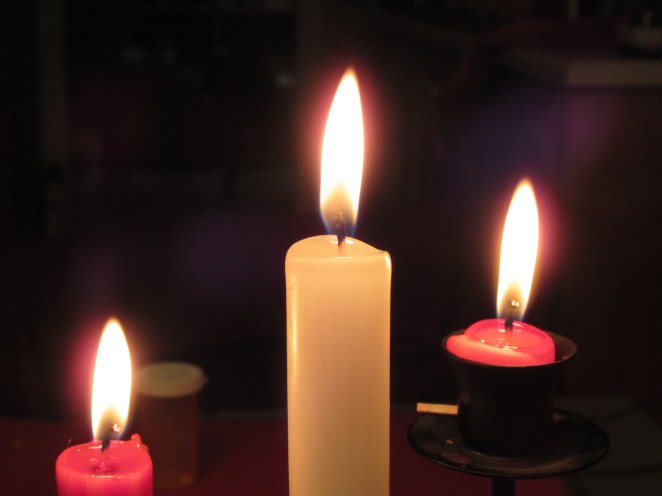
A flickering candle
tethered to an altar,
shimmers at midnight,
when the Latin mass is said,
bringing me light.

In the dark, canonical hours,
shadows move beside me
as I walk long corridors
from dormitory to a chapel
filled with heady incense.

31

I kneel, dumb-founded,
as candle flames wax and wane,
their brightness enhanced
by the midnight magic
that turns doubters into believers.

Spell and symbol, each candle a star,
shining, twinkling, in a galaxy of light,
and everywhere, the incense,
overloading my brain, releasing me
to revelations way beyond
muttered responses, mumbled words.

A world of inner darkness,
yet heart and soul soar together
up to the altar’s immortal light.

My shadow flickering
on the corridor walls,
as candle in hand, half-asleep,
I return to my cold bed
where the long, chill snake
of the bamboo cane
reminds me of tomorrow’s
flagellation.

Commentary:

Shadows on the wall or candles – with which should we start? Verbal and visual – how do they blend and knit together? Does my visual take away from your visual, or does it enhance it? To what extant does my verbal and the commentary on my verbal change the nature of your original thoughts when you re-create, within your own mind, my images, both verbal and visual?

Verbal and visual – now add the sense of smell. “The incense, overloading my brain, releasing me to revelations way beyond muttered responses, mumbled words.” And now remember that I was only six or seven years old when I experienced these things. Add the Latin mass, only half understood, the cold, damp feel of walls and wood beneath the hands. A world of inner darkness, yet heart and soul soaring together up towards the altar’s immortal light.”

My words are black print on white paper. My memories flare – an aurora borealis of senses sent crackling down the spine, in and out of the mind, tumbling the brain into a world … what sort of world? An unimaginable world. One never forgotten. One never re-recreated. One that never existed. One that never could exist. One for which the young child, six or seven years old, yearns for the rest of his life. His unsatisfied life. His unsatisfying life. His meaningless life. His absurd life.

Oh pity the poor puppy, not knowing what he has done wrong, not knowing how to put things right, always inadequate, whining and cringing at his master’s feet. And always, “that cold bed where the long, chill snake of the bamboo cane reminds me of the next day’s flagellation.”

Carved in Stone

Carved in Stone

28

The man who cannot cry
is dry indeed,
his inner space
a wasteland without rain.

Who can now walk forty days
in a desert wilderness,
without water?

Where is that crystal fountain,
with its healing streams
flowing from the rock,
its waters flowing through us,
bringing us tears of sorrow
and tears of joy.

Water and words –
they drift through me
and shadowed waves move,
shifting shape in the changing light.

29

A rising moon,
shimmers over the bay.
It reveals the path
that leads me back
to my primal waters.

Oh, salt flow of tears,
salty the waters
of the baptismal font
washing away all stain of sin.

Immersion in water,
a new start, a new life,
and all the soul-sweet eternities
of water and the word.

Commentary:

Water – such an important commodity, and filled with so much symbolism, religious and otherwise. And our bodies, on average, are composed of 60% water. We can survive for three days without water, if we are lucky. How precious it is. How much we depend on it.

The Bay of Santander, so beautiful beneath the moon. And I remember the full moon’s circle touching a rocky triangle as it rose above Peña Cabarga. Oh, the night life of the fish as they rose in the bay and basked in the moonlight. How often was I tempted to walk out along that moon path and walk the waves to Somo and Pedreña on the far side of the bay.

Immersion in water, a new start, a new life, and all the soul-sweet eternities of water and the word. Total immersion, then, not just in languages, but also in water. Where would we be without those life-long commitments, not to mention the crystal fountain whence the healing streams do flow?

Carved in Stone 27

The philosopher in search of his stone.

Carved in Stone

27

Miguel de Cervantes –
I read and re-read his words,
envious of his ability to reach out
with language that thrills me still.

I see him as a total entity,
while I see myself in pieces,
broken, unable to express
the simplest thoughts.

As I age, I sense the water
slipping from the water-clock,
the candles burning lower.

I still cannot make the mark
I want to make, for they are beyond me,
those marvelous word-worlds.

My words are mortal, his are immortal.
Mine just ink stains on a humble page,
his cast in print, but crafted to last forever.

As I bear witness to those powers,
so much greater than mine,
my eyes fill with tears.

Commentary:

They are beyond me, those marvelous word-worlds. Indeed they are. But I do not seek to create ‘a marvelous word-world’. I am happy with ‘ink stains on a humble page’. I seek to reach out and find those one or two people who accept me for what I am and find their own selves in a small corner of the tiny gardens I discover or create. Not a world, then, but a tiny corner of my own world, described, and offered to those who have eyes to see and ears to hear and hearts and minds to feel and understand.

And what is this infatuation with the poem itself? I no longer write individual poems, I write sequences of linked poems, a set of poetic narratives, if you need to find a label for what I am trying to do. Cervantes once wrote “La épica también puede escribirse en prosa.” / Epic poetry can also be written in prose. What happens if we reverse that statement and say – “A narrative sequence can also be written in poetry.” Interesting, eh?

And what is this desire to leave something, some trace of us, behind? I cannot answer that question. The answer will vary for each one of us, and for each fall wall flower perishing against the garden wall. I look at the homeless, pushing their grocery carts, head down. Their existence is as important as mine. Their desire to survive, for another day, another week, another season – and winter is coming one – is more powerful than any poet’s desire to leave a work – a magnum opus – to celebrate their lives.

And yes, my words are mortal, as I am mortal, as Miguel de Cervantes and all the great writers were mortal. Patrick Lane once told me that if poets leave one poem behind them that is remembered, they have done well. Even the greatest poets, and you can check this in the anthologies over the ages, rarely leave more than ten or a dozen memorable poems. As for me, I am happy to say that I have never had a poem included in an anthology. Not to my knowledge anyway.

And what does Magnum Opus actually mean? I leave you with the quote from Wikipedia set out above. Click on it, and find yet another way to distract, deflect, and change the direction of our lives! Given that road, who would ever want to walk it to its end?