What are you doing this evening?

Daily writing prompt
What are you doing this evening?

What are you doing this evening?

This evening, I am thinking about how September is the month in which academics, thinkers, and philosophers, as well as everyday people, can be reborn. I wrote this article 25 years ago. Re-reading it now, I am amazed by its clairvoyance. Here are my thoughts from way back then.

“September Renaissance: The Annual Adventure of (Re)Creating the Individual.”

This address was delivered to faculty at MOUNT ALLISON UNIVERSITY on 07 September 1999. It is a revision (and an extension) of the adress I delivered to students at St. Thomas University during the inaugural speech delivered to the incoming class of students by the winner of the St. Thomas University Excellence in Teaching Award.

Tomorrow, 08 September, 1999, is a very special day for me, and I would like to share my Special Day with all of you.

“A Special Day?” you think. “It must be his birthday.”

But no, it’s not my birthday. Could it be my Saint’s Day then? If we were in class, and you were all students, I would see some puzzled faces. A hand would be raised: “Please Dr. Moore, what’s a Saint’s Day?”

I would smile at the student brave enough to ask that question. “Good question!” I would say. “When one person asks a question, class, there are twenty people in the room, perhaps more, who wanted to ask that question, but did not raise their hands because they were afraid to do so. Never be afraid to ask questions. Question everything. Question everyone. Ask questions all the time. That, in part, is what you are here for: to ask questions and to learn to ask the right questions.”

So: what is a Saint’s Day? Well, in Spain, people often have two celebrations a year: their birth day and their Saint’s Day. Their birthday is, of course, the day they are born; their Saint’s Day is the Feast Day of the Saint after whom they are named. That was a good question, class, and you have gained a little knowledge! But No! It is not my Saint’s Day.

Why is today such a special occasion for me? Again, if this were a classroom I might, at this stage, do one of several things:

  • I might divide you into groups and ask you to discuss the question;
  • I might turn on a video;
  • I might access the classroom computer and show you a multi-media presentation;
  • I might give you a lecture or a talk or a question and answer session, much as I am now doing;
  • I might send you to the library to find out the answer for yourselves;
  • I might send you to the computer room to surf the net in search of an answer;
  • I might ask you to work together on an interactive listserve and let others help you access the information;
  • I might send you home early with reading material for the next class;
  • I might send you home to watch a specific television program;
  • I might set you the question as a Problem Based Learning Group Research Project (written answers on my desk, tomorrow, by 3:15 pm!);
  • I might ask you to write your essay in a journal page or in a researched essay (due in six weeks time, with annotated bibliography!);
  • I might ask you to tap in to your subconscious and freewrite around the question for fifteen minutes;
  • I might tell you to do some thinking and asking around, because that specific question will be on the final examination;
  • I might ask you to design a poster or your own multi-media presentation demonstrating the meaning of the question and several possible answers …


… Clearly, there is no right or wrong approach and there are many ways of dealing with what is, on the surface, a relatively simple question. You are using many of these approaches in your own classes here at Mount Allison University and I do not presume to tell you that one way is right and another wrong. So much depends on the shifting relationships between teacher, learner, class size, class maturity, work capacity, research resources, and subject matter. At Mount Allison you have a national reputation for the excellence of your students and of your faculty. You have proved over a long period of time your ability to distinguish between the more important questions and the correct research and investigation procedures; above all, you know how to choose those that are most suitable to you and to your own students.

Since this is NOT a classroom, since you are not my students, and since I would have great difficulty in dividing you up into small groups so that you could discuss why tomorrow is such an important day for me, I will provide you with the required answer: TOMORROW, September 8, 1999, is my RE-BIRTH-Day! Tomorrow, I celebrate the day of my RE-BIRTH. Thirty-three years ago tomorrow, I was RE-BORN.

Permit me to share with you the matter of my RE-BIRTH!

It came about like this: On September 8, 1966, I got up at 4:00 am, ate a light breakfast, packed my suitcases into my father’s car, and headed for Heathrow Airport, London. There I boarded BOAC Flight 1040 and at 3:00 pm that afternoon I landed in Toronto, Ontario, Canada. By 3:15 pm, I was passing through Canadian Customs and Immigration and by 3:30 pm, I was RE-BORN as a Canadian.

This RE-BIRTH was not an easy process. It took me a long time to learn to act, think, and speak like a Canadian. It also took me a long time to realize that while the Canadian within me was growing stronger every day, other parts of me, even when they were rigorously maintained, were beginning to die. Thus, at the same time as I celebrate my RE-BIRTH as a Canadian, I mourn the gradual passing away of my Welshness, the slow disappearance of my Welsh family, the fading of my Welsh friends, some of whom I have not seen in more than thirty years.

Yes! I was RE-BORN 33 years ago tomorrow. But this is not the only RE-BIRTH that I have undertaken. There have been many other rebirths:

  • 28 years ago, I emigrated from Ontario and was RE-BORN as a New Brunswicker;
  • 27 years ago, I left the University of New Brunswick and was RE-BORN as a St. Thomas University professor;
  • 24 years ago, I was RE-BORN when I graduated with my PhD and was officially no longer a student;
  • 5 years ago, when I visited the Dominican Republic, I was RE-BORN as a conscious critic of certain neo-colonial policies and attitudes towards Developing Countries; in the DR, incidentally, I was also held up at gun-point — and surviving THAT little incident certainly guaranteed an instant RE-BIRTH which I celebrated in the closest bar!
  • 4 years ago, in December 1995, I was RE-BORN as a pseudo Professor of Education when I visited Oaxaca, Mexico, as part of what was later to be called the St. Thomas University – University of New Brunswick – Universidad Autónoma Benito Juárez de Oaxaca Faculty Exchange Program;
  • And tomorrow, on September 8, 1999, as I celebrate the 33rd anniversary of my being RE-BORN as a Canadian, I am in fact in the process of being RE-BORN yet again.


I will explain how in a moment. Meanwhile let me say that along with the pain and struggle for RE-BIRTH come various things:

  • PRIDE: in the fact that I, along with everyone else in this room, can achieve RE-BIRTH;
  • HUMILITY: in the knowledge of how fortunate I am, together with all of you gathered here in this room today, to be counted among those who are still capable of RECREATING their lives and of being RE-BORN;
  • RESPONSIBILITY: in the knowledge that when we are RE-BORN a new set of duties falls upon our shoulders;
  • ENERGY AND ENTHUSIASM: in the knowledge that I, like every one of you, am capable of sharing the secret of my RE-BIRTH with the students who come to my office and my class almost every day in search of the new selves which they wish to create for themselves.


This summer, to prepare myself for this Fall’s RE-BIRTH, I did the following:

• I revised all my courses;
• I attended the University of New Brunswick Multi-Media Institute for three weeks and completed my Certificate of Multi-Media Studies;
• I reconstructed, with the aid of Clare (without whom I would not be here today, but perhaps I’ll tell you more about that later), my web page;
• I (re)commenced my annual summer reading program to update my thinking.

I say all this to assure you that I know as well as you do that knowledge is not a solitary, self-contained unit which, once attained, stays with us forever. Knowledge is an ongoing process; learning is a lifetime commitment; you, as faculty, teach at Mount Allison University, as I teach at St. Thomas University, not just to earn a salary, but to continue a life-long commitment to teaching and learning. If you are like me, you love the sheer process of teaching and learning; you love the contact with young, developing minds.

I try always, as I am sure you do, to encourage my students to start their life studies with us at St. Thomas and to continue their life studies when they leave university. We do not say “Learn for four years and then you can stop learning for you will have all the knowledge you will need for the rest of your lives.” At least, I hope we don’t.

And it is the same thing for us, as faculty. For we, as faculty, are actively involved in our own ongoing research and scholarship, some of which we publish and some of which we use in our classes; research moreover, without which the knowledge we share with our students would be a dead package, taken from our notes, and handed over without thought or revision, or consideration, to the next generation, much as certain forms of knowledge were handed to me when I was an undergraduate by some of the teachers de cuyos nombres no quiero acordarme / by teachers whose names I do not wish to recall, to borrow the famous words with which Cervantes opened perhaps the world’s greatest novel: Don Quijote de la Mancha.


So what did I read this summer?

Amongst other things, I read about the RENAISSANCE — the RE-BIRTH of Western Civilization in the 15th and 16th Centuries; I also read about the REFORMATION that came about as a direct result of the challenges and questions posed by the RENAISSANCE; and I read about the COUNTER-REFORMATION that sprang up as a reaction to and dialogue with that first REFORMATION.

I also realized, not for the first time, the similarities between our own age and that of the RENAISSANCE. The RENAISSANCE, as Marshall MacLuhan pointed out in The Gutenberg Galaxy, was a time of new ideas and new technology; in addition, a radical change occurred in the paradigm of man’s learning and thinking. The known world was expanding with the voyages of discovery that set out to East and to West. Man’s view of the universe changed with the various discoveries in optics that allowed us to see objects in space larger and in more detail than ever before. This led, of course, to the concept of the heliocentric universe, where human beings were displaced, away from the centre of creation; a new concept for the Church, and one that they fought against bitterly at the time.

In the same period the printing press had an enormous influence on the dissemination of knowledge, and totally changed peoples’ ways of disseminating, creating, receiving and perceiving written information. It is very difficult for us to understand, even today — perhaps especially today — the impact of the printed word on a semi-literate society in which, again according to Cervantes, groups of people would gather in the evenings to have books read out loud to them by the one or two people in the village who could read. Walter Ong has described this process to us in Orality and Literacy, another book which I (re)read this summer. Suffice to say, that for us, as a television generation, it is difficult to understand the initial impact of radio upon our parents and grandparents. For the new generations of students emerging today, it is difficult to imagine life without the instant communication of television, telephone, email, and computer.

In many ways, the impact of print must have been similar to the impact of the electronic technological revolution which we are going through today. And one thing I know for certain, after completing my Certificate in MultiMedia Studies: none of us are aware, nor will we be fully aware for a long time yet, of the full impact of the electronic technological revolution upon the hearts, souls, intelligence, and minds (not to speak of the wrists and eyes) of those who use it and of those who are now growing up, many of whom know no other way of accessing information.

The paradigm of knowledge and technical skill is still changing and developing explosively; as a result, we are still unaware of exactly what can be achieved by the new media. Take computer chess, for example. Chessmaster 2000 had approximately 150 games programmed into its chess library; Chessmaster 4000 not only has 1500 games programmed in, but also presents us with games in which Karpov commentates in digital audio his own moves in his own matches!

Yet, in spite of this tremendous rate of progress, few of us who follow Chess would have dreamed that Deep Blue, programmed by a gentleman from Clare’s home town of Bournemouth, would thrash Karpov, the world chess champion from the Soviet Union, only a year or two down the road. Nor can we understand the extremely rapid progress that leads us in a matter of months, to see the memory banks in a pc clone expand from 1 gig of memory to 4 gigs of memory, to 6 gigs of memory, to the 10.6 gigs of memory that Dell is advertising in its latest computer sales. In some ways, it is like the 10, or 12, or 14 zeros that are now following the initial figures in the MEXICAN FOBAPROA SCANDAL: so many zeros that the concept of the magnitude of the debt is beyond the understanding of most of us.

In our day, then, as in the Renaissance, the paradigm of knowledge is expanding explosively. Knowledge in the Renaissance evolved so quickly that few individuals were capable of grasping the full meaning of the REVOLUTION, the RENAISSANCE, the REBIRTH which they were observing and in which they were involved. In fact, the RENAISSANCE BATTLE OF THE BOOKS or the continuing discussions between the ANCIENTS AND MODERNS were very similar in many regards to some of the discussions regarding the FUTURE OF EDUCATION that we are holding in all the Atlantic Provinces Universities right now. Authority or Innovation? The old ways or the new? Technology or Tradition? Whatever side we come down upon, these discussions are good for us all for they mean we are alive and thinking and that our knowledge is not a dead but a living thing.

This summer, I also (re)read Mikhail Bakhtin; I believe with him, that human beings can live in a DIALOGISTIC RELATIONSHIP WITH THEIR CHRONOTOPOS — that is to say, in less Bakhtinian language, that people can hold a dialogue with their time and their space, a dialogue which can bring about change, new directions, new commitments, in short, a RE-BIRTH.

And now, from Dialogue to Drama: Wayne C. Booth, in Freedom and the Individual (the Oxford University Amnesty International Lectures of 1992) wrote that we are all individuals, writing the drama of our own lives; each student’s entrance to Mount Allison University, in Wayne Boothian Theory, is a chance for that student to begin his or her play again; all students can rewrite their roles and their characters; as we can rewrite our lives and our roles. In short, each one of you can, like me, be RE-BORN. And believe me: September is the month in which this ANNUAL REBIRTH can and should take place.

I also read several books on the THEORY OF TIME: sidereal time, atomic time, linear time, instantaneous or contemporaneous time … many of the courses I teach at St. Thomas University are based on linear time: each term, they progress steadily from Day 1 to Day 36; however, our lives as teachers and learners are also based on seasonal or cyclical time. For teacher and student, the learning and teaching cycle begins anew every September; this is the time of the SEPTEMBER RENAISSANCE or RE-BIRTH. September then is the month for us ALL to be RE-BORN.

In some ways, the most important books I read this summer were all written on or about don Francisco de Quevedo. These books no longer have a single author. We are no longer dealing with one person’s ideas. Thus, although Pablo Jauraldo Pou’s name adorns the edition of the latest and best biography of don Francisco de Quevedo, Quevedo’s life has actually been researched by an extensive team of scholars, students, and friends, so large, that only the most important dozen or so can be acknowledged. The same is true of James O. Crosby’s edition of the Sueños, or of Ignacio Arellano and Lia Schwartz Lerner’s edition of the metaphysical poetry, or of Crosby and Jauralde’s edition of Quevedo y su familia en setecientos documentos notoriales, a compendium of legal documents concerning the Quevedo family which runs from 1572 to 1724.

In fact, when a single author, not a member of a team, writes on Quevedo nowadays, it is to offer a study of just a small portion of the author’s work. In this fashion, Josette Riandière de la Roche’s Nouveaux documents quévédiens: Une famille à Madrid au temps de Philippe II deals with a very short time period and only a selected aspect of the life of the poet. In similar fashion, Santiago Fernández Mosquera’s La poesía amorosa de Quevedo: disposición y estilo desde CANTA SOLA A LISI deals with only one aspect of Quevedo’s poetry, that of the love poems seen in the light of the sonnet sequence to Lisi.

TEAMWORK: it is becoming more and more necessary to work as a member of a team in order to keep up with the knowledge explosion with which we are confronted. I once said, tongue in cheek, that a TIER 2 CIDA GRANT APPLICATION demands the construction of a team. You need

  • a reader who specializes in how to read the AUCC / CIDA guidelines as they change from year to year;
  • an interpreter who specializes in what the current buzzwords are in government circles actually mean and how to use them in your documents;
  • an accountant who specializes in cash flow, international money transfer, and book balancing;
  • a manager who specializes in Results Based Management or whatever form of management system is the current government buzz word;
  • this manager must also have organizational skills to link the various parts of the application to the Results Based Management that is currently demanded by AUCC/CIDA.

Further, the manager must have people skills in order to hold the team together when things are going badly or well, for triumph and disaster, as we well know although both impostors are ever present when applying for Grants from Government Sources; you also need

  • a writer who specializes in writing up the final text so that it will convince the granting authorities that you, the applicant, another often forgotten member of the team, actually knows what you are doing;
  • finally you need what I call a people person or a wheeler – dealer who will get out there and make the appropriate contacts and find out who are the current movers and shakers and who will actually give you the internal promotion that your CIDA GRANT needs if the application is to be successful.

I would also suggest, perhaps not totally tongue in cheek, that a similar team approach to the writing of SSHRCC GRANTS FOR THE HUMANITIES would not be a bad idea.

TEAMWORK: As I said earlier, I completed my Certificate in MultiMedia Studies at the University of New Brunswick this summer. One of the things that I learned was the importance of teamwork in computing.

In our first SCENARIO FOR A CASE STUDY this summer, for example, we were required to design and build a commercial web site. Of course one person can build a website, and a pretty good one at that. But the studio team which we were given consisted of

  • a graphic artist,
  • a sound engineer,
  • a creative director,
  • a computer tech,
  • a multimedia specialist,
  • a photographer,
  • a specialist in digital photography,
  • a graphics designer, and
  • a colour specialist.

We did not have digital video capacity and were forced to contract digital video out. Costing was also a major part of the exercise: how many people, how many tasks, what order for the tasks, how many hours, how much time, how much money! I repeat: the new paradigms of knowledge that are developing around us will be demanding more and more teamwork from us.

I will end this brief presentation by reminding you that this fall, on Saturday October the Sixteenth, 1999, to be precise, the Atlantic Teaching Showcase will be coming to St. Thomas University, Fredericton. I hope to see some of you in St. Thomas, at that meeting. I am, as many of you know, the Chair of the Atlantic Association of Universities Teaching Showcase for this year.

However, I have not arranged the Showcase on my own. On the contrary: I have gathered a team of faculty and together we are working towards the Teaching Showcase. In fact, I have one person looking after finances, another looking after registration, another building a website, another looking after catering, another looking after audio visual equipment, another booking rooms, another organizing the program, another recruiting and organizing student help. We have planned and arranged the program between about eight of us.

An exercise in teamwork, no less.

I know that in all that I have said so far today, here at Mount Allison University, I am talking to people who know as much as I do, or more, about all these things: REBIRTH, RENAISSANCE, TEAM WORK, COLLABORATION. For a very long time, I have been impressed by the quality of Mount Allison’s teachers and by the quality of Mount Allison’s students.

In five weeks’ time, at the Atlantic Association of Universities Teaching Showcase, there will be a session entitled “WORKING TOGETHER: MODELS OF COLLABORATION INSIDE AND OUTSIDE THE CLASSROOM.” This particular session is a perfect example of the type of teamwork I have been talking about today. The session was presented to me in its entirety as a proposal for a single session incorporating 4 papers and some interactive discussion. The session will have a 90 minute slot and I very much hope to be present for what promises to be an exciting time. The session currently consists of a series of four papers, as follows:

  • “Mixing media: High Theory, Low Culture (or Inviting Popular Culture into the Classroom”;
  • “Collaborating with Students: Sharing Power over Syllabus Design”;
  • “Interdisciplinary Collaborative Project: A Model”;
  • “Beyond Discipline: Facilitating Collaborative Student Research”.

The session organizers are all associated with Mount Allison University and I would like to congratulate Professors Pat Saunders-Evans, Deborah Wills, Robert Lapp, Jeff and Ausra Burns on the hard work they have put in to an excellent integrated proposal.

Imitation, they say, is the best form of flattery. I have stood here today and spoken to you and you have kindly listened to my words. Tomorrow, I will spend part of my RE-BIRTH-DAY with you, here at Mount Allison. I have been invited to attend your Learning and Teaching Development Workshops, and I hope to take back to St. Thomas University some of the excellent ideas on which you are working here on campus. You are nationally and internationally recognized leaders in your field. Tomorrow, it will be my turn to listen to, and learn from, you!

Thank you for inviting me here.
And thank you for listening.

Discourse Analysis

Discourse Analysis – Original Question –

I have a question for you. Recently I purchased a book by Forrester- The African Queen. I enjoyed the movie years ago and thought I would like to read the story. The main actors were great. The book highlighted that it showed what it was like being a female during the war, (1) which when I look back on now is one of its main points.

My question or thought on this book is tied around the library system. When I lived in Fredericton I wanted to give a bunch of books to the library, their first question to me was, “How old are the books? I told her and she said anything over five years in not being accepted. (2)

I wondered about this and the fact that many books in school are being removed, (3) how can we tell how much we have progressed? (4)

I don’t like prejudice but it seems we are throwing out too much. (5) Any thoughts on this. I don’t mind some of the history being trashed (6) because for Canada the consentation is for Quebec and Ontario.

Roger’s Response

(1) It’s also about the role of the nun in society. How do ‘holy women’ function in a male society? It sets some of the many questions we are now being faced with, but doesn’t really give any answers. It’s a long time since I saw that film. I don’t think I ever read the book – the themes might well change in print. They are present (some of them) in The Handmaid’s Tale.

(2) The library system seems to have rules and an etiquette all its own. When I donated books to the library, they accepted some for their collections, but set others up for sale on the book tables by the door. My guess is that certain books are ‘best sellers’ and will be read, others are ‘dust gatherers’ and won’t be. They want the former, not the latter. They also have specialized collections. If the books fit the specialized collections, great. If they don’t, then they hit the unwanted category and are moved on. This is particularly true of the UNB Library System.

(3) This is an entirely different question, and one with very deep roots. It deals, in part, with the question of control – quis custodiet ipsos custodies – who shall guard the guards, who shall program the programmers? By controlling what people read, you control their thoughts. One of the worst signs of this was the book burnings of the Spanish Inquisition (15th – 16th – 17th centuries). The Jews were expelled from Spain in 1492. (And the Arabs / Moors, in 1609). Prior to that, these people were ‘processed’ by the Inquisition. The original Inquisition was Papal, aimed at instructing the priesthood in Rome in how to interpret the Catholic Catechism. It was corrupted in Spain (under Fernando and Isabelle) by the Spanish Inquisition, a sort of secret police, which worked rather like the Gestapo in WWII. One of their jobs was to ensure that people who had converted to Catholicism, to avoid deportation, stayed converted and didn’t revert to their old religion, even in secret. Another was to ensure that reading material, religious material, and cultural material, particularly after 1527 (Martin Luther and his 97 theses) when the Reformation started, were all in line with the accepted Catholic thoughts of the time. All books about to be published were sent to the Inquisitorial Censor who vetted them and either approved them, or asked for changes. If he (they were all men) saw the slightest sign of dissent or heresy. Don Quixote, Book One, Chapter Six (DQ,I,6), deals with the book burnings of DQ’s personal library. In certain of the States (down south) books are already being banned. A similar ban, in certain States, that touches us closely, is the banning of Margaret Atwood’s The Handmaid’s Tale.

(4) “There is no earth, no heaven, no extended body, no magnitude, no place and that nonetheless I perceive these things and they seem good to me. And this is the most harrowing possibility of all, that our world is commanded by a deity who deceives humanity and we cannot avoid being misled for there may be systematic deception and then all is lost. And even the most reliable information is dubious, for we may be faced with an evil genius who is deceiving us and then there can be no reassurance in the foundations of our knowledge.” René Descartes (1635)

Descartes expresses this much better than I can. It is one of the major dangers of the age in which we live. How do we distinguish between reality and alternate realities? Which reality is the real reality? What is, or isn’t, fake news? How do we tell? Who do we believe? And why do we believe them?

(5) Another part of the problem is that ‘certain people’ – who don’t believe in science and who exploit people’s scientific ignorance to their own advantage – are willing to destroy the foundations of our knowledge. Burn everything down, they say, and start again. The new starting point is to impose what they believe upon everybody around them. This is a huge and crucial problem that threatens us, as individuals. It also threatens the foundations of our knowledge, as well as the very world in which we live – climate change vs denial of climate change – profits over people, versus government of the people, for the people, by the people. Once one starts asking such questions and looks at the AI systems with their immense persuasive powers and their seemingly uncontrollable spread of Mis-information and Dis-information, then one starts to realize how serious the problem is.

(6) Those who ignore history are doomed to repeat it – Santayana (the Spanish philosopher, I think). However, we must, in certain circumstances, adjust our current beliefs to current realities. Immigration is a major issue – as is how we deal with people, like me, who come from different cultures and beliefs? Not everything written in the past suits our current world view.

I have been looking at old Westerns – “The only good injun is a dead one” (John Wayne). Really? I know some wonderful people in our first nations communities and I have taught them and worked with them and have often been taught by them. “Shoot first and ask questions afterwards.” Really? I won’t comment further on that one, without reflecting on the number of automatic weapons floating around in our socuiety. So many people are being killed by them.

All of this comes down to the big question – freedom of information or the release of just enough information to persuade other people of what we believe and what we want them to believe. Power and Control. Knowledge is Power – Michael Foucault. Control that knowledge and you have power over the people. Noam Chomsky has written widely on this – and his books have been banned in the USA. Bertrand Russell too – The Meaning of Meaning, for example, and his establishing – along with A. J. Ayer – of the doctrine of logical positivism – the removal by means of mathematics of all the emotional content of words.

My friend, you have opened a can of worms.
Long may they wriggle and squirm.

What profession do you admire most and why?

Daily writing prompt
What profession do you admire most and why?

What profession do you admire most and why?

Why admire a profession? I used to admire the fire-fighters when I was in Spain. Then I discovered that a small group of them were setting fires deliberately so that they could get double pay and danger money extinguishing the fires they had set. I used to admire politicians. Then I discovered that they weren’t always honest, had their hands in other people’s pockets, used their positions to entrench and enrich themselves, and pulled all sorts of tricks to stay in power. I used to admire priests. Then I started reading horror stories of child abuse, abuse of power, negligence of priestly duties. And these things aren’t new. In The Book of Good Love, (Spain, 1330-1343) written by Juan Ruiz, the Archpriest of Hita details how the celibate priests were ordered in a letter from the pope of the time to give up the ladies with whom they were living (and with whom they had children) to return to a life of celibacy. All fictitious, of course, but also based on a truthful reality, as was the Seller of Papal Bulls (as described in Lazarillo de Tormes – Spain 1554, and published anonymously because of its anti-clerical content).

I hope, with that short selection of potential professional felonies, I have made my point. In brief, to admire the ideal of a profession is one thing. But to admire the unprofessional conduct of certain individuals who ruin the reputation of their own profession is something else entirely.

Therefore, I would propose that we change the title of this prompt from What profession do you admire most and why?, to What professional do you admire most, and why? Now the question can be answered with ease. I most admire those professionals whose profession is a vocation. They do their jobs out of love and not just for money. They are dedicated individuals who put their profession and the people they serve before their own home comforts, wants and desires.

Such unsung heroes abound. The baker who gets u at 4:00 am, arrives at the bakery at 5:00 am, bakes, prepares, and wraps the goods, until 8:00 am when the customers arrive and the shop opens. This is done at minimum wage, autumn, winter, spring, and in the summer when the heat warnings go out and the bakery is a living hell, what with the ovens and the heat dome outside. The teacher whose work does not end in the classroom, but starts outside, when class has ended, and the students really need the TLC that comes from a teacher who puts them before his/her office schedule of 30 minutes student time a week. The general practitioner who does not retire at age 55 to bask in the sun on a Caribbean Island, but who continues his work, until at age 80, he can tend his flock of patients no more, and who then retires with grace, heartfelt thanks, and love from a job well done.

These are my heroes. These are the professionals that I most admire. Not the profession, but the person who performs that profession with skill, hope, love, commitment, and a dedication that reaches out to embrace that specific professional world, whatever it is, and the people who share it.

Scour the news for an entirely uninteresting story. Consider how it connects to your life. Write about that.

Daily writing prompt
Scour the news for an entirely uninteresting story. Consider how it connects to your life. Write about that.

Scour the news for an entirely uninteresting story. Consider how it connects to your life. Write about that.

Scour the news – what on earth does that mean? Let’s begin with scour – If you scour something such as a place or a book, you make a thorough search of it to try to find what you are looking for. Rescue crews had scoured an area of 30 square miles. Synonyms: search, hunt, comb, ransack. Search, hunt, scour, ransack – well? Which one are you after? And how long have I got? Question: what am I looking for? Answer: an entirely uninteresting story. What a tremendous waste of my time. And, when you get to my age, time is precious.

As for the news, well, what on earth do you mean by that? I speak several languages fluently. Am I looking for an entirely uninteresting piece of news in all of them? As one of the Two Ronnies used to say “You’re having me on, aren’t you? You’re having me on.” Let’s just stick to one language – English. Then let us ponder for a moment the meaning of the news. How many newspapers do you wish me to purchase and peruse? I am not a millionaire, you know. Or do you want me to listen to the news on the radio or the television? If so, how many channels? How about sending me online? I love the thought of that. There are thousands of websites out there filled with all kinds of news, good bad, indifferent, fake, artificial? And you want me to scour them all in search of, and I quote “an entirely uninteresting story”! Pull the other one, as the old comedians used to say, ‘”it’s got bells on”.

I’ll tell you what I’ll do. I’ll scour your prompt, that’s what I’ll do. Having given it a brief analysis, I declare it entirely uninteresting. Next I’ll consider how it links to my life. Well, sorry, it doesn’t. If I were to follow it through, I’d be sitting here for hours, wearing my fingers out on the keyboard. So, what’s the link between your prompt and my life? A total waste of time, that’s what. Sorry, I have better things to do with my life. Like reading Shakespeare – “Friends, Romans, Countrymen, and prompt readers, lend me your shovels. I come to bury this prompt, not to praise it.”

Here endeth the lesson and the prompt.

What are your future travel plans?

Daily writing prompt
What are your future travel plans?

What are your future travel plans?

When Covid struck in Avila, Spain, a small walled city, the abulenses (the Spanish name for people who live there) were confined to their houses and apartments. They got their exercise by walking on their balconies, or walking around their living quarters, however small, again and again.

When I was young, I traveled regularly to Bristol Zoo. The lions and tigers paced restlessly in their cages, or else just lay there, soporific. Maybe their food contained the drugs that curbed their violence. I never asked. But I do remember that relentless padding from one side to another. In the aquarium, the fish swam around and around going nowhere. The same with the seals and the penguins. Alas, they were only animated by feeding time, when the attendants appeared with their buckets of fish. Then the animals came alive and dived, jump, swam, and responded to the food thrown to them to entertain the watchers.

And it was somewhat similar in Avila – the restless pacing, the circuit of the room, the movement to the kitchen or the fridge. Some people lost weight, but many put it on. They got up from the chairs in which they were sitting, walked to the fridge, opened the door, took out a beer or two, and returned to their chairs in front of their tv sets. Language is always renewing itself and, in times of difference and stress, we invent new words. This routine became known as El Paseo de la Nevera – The Stroll to the Fridge.

Now, as my age increases and my energy grows less, a similar thing is happening to me. I count my steps as I limp around the house, hobbling from room to room. I aim for 2,000 steps a day, but sometime manage more than that. I go out, in good weather – not raining, not too hot, not too humid – and time my walks around the garden. I am unable to count my steps when I lean on my Rollator as my hands do not move and they must be in motion, if I am to keep a record on my watch. When walking, I stay as close as possible to the shade and try to keep cool. Each day, I try to walk two or three times in this fashion. Sometimes I even manage four outings at 15 minutes apiece. Occasionally, especially if I go shopping as well, leaning on my shopping cart, I may even manage an hour’s walk or more. When I achieve my targets, I feel fulfilled and satisfied.

While walking in the garden, I do one of two things. (a) I concentrate on the flowers, the ants beneath my feet, the weeds, the moss, the birds, the way nature grows and blesses me. Or (b), I pretend I am back in Avila, or Santander, or Brandy Cove, or Pwll Ddu, or Bishopston Valley, and as I walk, I visit my favorite bars and talk to the family and friends that I miss so much and haven’t seen for so long, most of whom I never hear from nor will ever see again.

And these are my travel plans – to continue doing this for as long as possible. To walk regularly. To continue to dream as I walk. To rejoice in the sunshine of my garden. To survive – and to enjoy each moment that I am permitted to do so.

AMDG Ad Majorem Gloriam Dei.

On what subject(s) are you an authority?

Daily writing prompt
On what subject(s) are you an authority?

On what subject(s) are you an authority?

First, I would like a definition of an authority. Here’s what I found – 1. the power or right to give orders, make decisions, and enforce obedience – as in “he had absolute authority over his subordinates”. 2. a person or organization having power or control in a particular, typically political or administrative, sphere as in – “the health authorities”. Isolating the words enforcement, power, and control, I am delighted to say that no, I am not an authority on anything, and I have no control over anyone. Also, I am not a monarch, and I have no subjects.

What happens if we change the meaning of the words slightly and ask another question? Here is a suggestion from the online Cambridge Dictionary – searching for an answer to my question “What is an example of authority on the subject? – I found this – The phrase “authority on the subject” is correct and usable in written English. You can use this phrase to describe someone who has extensive knowledge or experience on a particular topic. For example, “Dr. Smith is considered an authority on the subject of modern psychology.”

Now this becomes a very interesting question and it can be answered from a variety of perspectives. In our two person household, I deem myself an authority on some forms of cooking. I regard my beloved wife, my better two-thirds as I call her – an authority on the forms of cooking that I have trouble with – for example, baking, cooking vegetables, boiling eggs. She does a wonderful boiled egg. I am hopeless at boiling eggs – either too hard or too soft, usually the former. But I am the authority on Spanish omelets and scrambled eggs. They are my specialities. She makes wonderful chowders. I specialize in gazpachos, sopa de quince minutos a very quick (15 minute) Spanish sea-food soup, and Cawl Mamgu and other Welsh stews.

Once we step outside our kitchen, the world changes. In a world (New Brunswick) where cricket is virtually unheard of (save in the minds and cultures of fellow immigrants) I am considered an authority on cricket. Not that I am an authority, but at least I know what it is and have a good idea of what is happening in a cricket match. Therefore, we must also consider ‘being an authority’ in the context of the audience that receives our words of wisdom. To my nine year old grand-daughter, I am an authority on several subjects. However, I have absolutely no control over her – how she thinks and what she does. I can suggest or persuade, but I cannot and will not enforce.

In the undergraduate classroom, in which I taught for 43 years, I was considered an authority on Spanish by my students. Outside the classroom (and sometimes inside it) I learned more from my students than they ever learned from me, especially in my formative years as a Canadian when I was learning to skate and to ski. Don’t go there – too many painful memories of falling only to rise again!

But when we moved from the classroom to the wider university, to the full Canadian Scene of the Learned Societies, as they used to be called, I became the learner and the authorities were to be found elsewhere, often on the podium, sometimes in the bar. Same thing when we move onto the international stage. There are very few world authorities, in my field. However, there are many wannabe’s, but for them, after careful analysis of their strengths and weaknesses, I have usually had very little respect.

So, today we have opened another can of worms and look at them, wriggling and crawling before our very eyes. Worms – one of my friends really is an authority on earth worms. She knows all about them. Another of my friends is an authority on worms in puppies and kittens. A world wide authority, known every where and often quoted? I doubt it. But certainly in my garden and the vet hospital where I take my pets, they are both authorities.

Ah, the joys of Discourse Analysis – maybe, one day, I can be an expert on that. But take my words, as always, with a large pinch of salt, and, whatever you do, don’t put salt on slugs, and snails, and puppy dog tails. On that point, we can all be authorities.

What are your daily habits?


Daily writing prompt
What are your daily habits?

What are your daily habits?

“The habit (Greek: Σχήμα, romanized: Schēma) is essentially the same throughout the world. The normal monastic color is black, symbolic of repentance and simplicity. The habits of monks and nuns are identical. Additionally, nuns wear a scarf, called an apostolnik.”

So, my daily habits are a little bit monastic. “Monks were very religious, lived simple lives and followed certain rules to discipline themselves. The monks didn’t have any possessions, they didn’t even own their own clothes and they wore a simple garment known as a habit. Monks chose to live in the monastery as they wanted to help others and worship God.”

I can’t say I am very religious, in the church-going sense, but I do live a pretty simple life. My rules and disciplines consist of daily exercises, stretching and strength, a morning wash and shave, getting dressed in my non-monkish habits – jeans, shirt, sox, shoes or sandals. Coffee and fruit for breakfast. Writing – (a) in my journal (b) on the computer (c) in my poetry book. An early lunch, usually a sandwich. A post-prandial walk around the garden with my roller, examining the hollyhocks, the yucca, and the clematis, and checking on the progress of the other flowers.

The daily routine of a monk is somewhat similar. Monks typically wake up early in the morning, often before sunrise. I wake up early, text a couple of my best friends on the cell phone beside my bed, and then I go back to sleep again. I often begin the day with a prayer or a hymn – as do the monks – “Every morning, when I wake, / oh Lord, this little prayer I make, / that thou will keep a watchful eye, / on all poor creatures born to die.” Then I begin my daily routine of work and meditation. The specific activities and schedule can vary, but generally, I spend several hours each day in work (writing) or study (reading).

I try to think like a monk – to think like a monk means to remain calm and focused under all circumstances, especially when life gets challenging. Alas, at my age, I meet challengers all through the day. Things fall to the floor – challenge – can I pick them up with my magic claw? I can’t open bottles and cans – challenge – can I do so with one of my two magic appliances? I actually have three, but one of them doesn’t work. The other two, however, are wonderful. It is almost impossible for me to open plastic wrappings – challenge – can I do so with a pair of scissors, a pocket knife, or must I, in the worst case scenario, use a genuine can opener? Good tip, that, incidentally, especially for bubble packs. There are many other challenges, the worst of which is always what to do if I fall down. We won’t talk about that – I just do my best not to fall.

I also do my best to lead a relatively simple life – I try (1) to do one thing at a time – (2) to commit whole-heartedly to my family and few close friends – (3) to simplify my life and concentrate on what I am doing – (4) to develop my mind by not indulging excessively in social media – (5) to order my existence by making lists of essentials that must be accomplished – (6) to express myself and my love for the world around me in poetry, prose, and paint – and finally, (7) to remember that, the day I was born, I took my first step on the path to death. Beyond that, I do very little more.

What makes a teacher great?

Daily writing prompt
What makes a teacher great?

What makes a teacher great?

When Moo descended from Mount Academia, he brought down with him the ten tenets to which great teachers, knowingly or unknowingly, commit. He asked me to transcribe them here, since they were in danger of being neglected and / or forgotten.

  1. Mastery of the subject – great teachers know their subjects inside out. They do not read their graduate school notes to their students, heads bowed, chins on chest, droning on in a low, boring mumble. They encourage questions and are open to debate with their students about the subject that they know so well and openly love.

    Master thy subject.

  2. Humility – great teachers are humble. They know that they are not omniscient. They also know that knowledge changes across time and that they too must change and follow new ideas. They also know, perhaps instinctively, that some of their students are as intelligent as they are. They never dismiss their young charges as idiots, fools, or lunatics to be beaten and forced into the required shape.

    Be humble.

  3. Flexibility – great teachers are flexible, not rigid. They can bend the rules, reshape the syllabus, change pace and tone to match the needs of their students. In addition, they ask their students about their needs and try to address those needs in a personal way, sometimes on a one on one basis.

    Be flexible.

  4. Reaching out – great teachers reach out to their students as a group and as individuals. They never paint themselves into the know-all corner where they alone know best, and they know, with absolute certainty, what’s best for their students. Great teachers know, above all, that one size, in great teaching, neither fits nor benefits all.

    Reach out.

  5. Equal treatment – great teachers treat their students equally. They do not fawn on the best and scorn the worst, nor do they teach by the WWII convoy system, teaching only at the speed of the slowest. By extension, great teachers try to create an atmosphere of love in learning and joy in the subject.

    Practice equality.

  6. Honesty – great teachers are honest, fiercely honest. They know their own strengths and weaknesses, their own limitations. They work on their weaknesses, striving to turn them into strengths. They also push the boundaries of their limitations, striving always to keep up with the ever-changing frontiers of knowledge.

    Be honest.

  7. Human beings – great teachers know that they are human beings and they recognize early on in their careers, that while they are teaching a subject, they are also preparing fellow humans for a life beyond the ivy-covered walls of academia. By extension, they emphasize the humanity of their students and try always to develop and sustain that humanity.

    Be human.

  8. The meaning of meaning – great teachers reach out beyond their subjects to teach the meaning of meaning. Why is the subject important? What can each individual use this hard-earned knowledge for, in their own lives? How can they reshape their own lives and create better ways of learning and living? This teams up with reaching out and enters the realm of learning for learning’s sake and love of learning and love of knowledge.

    Love thy learning.

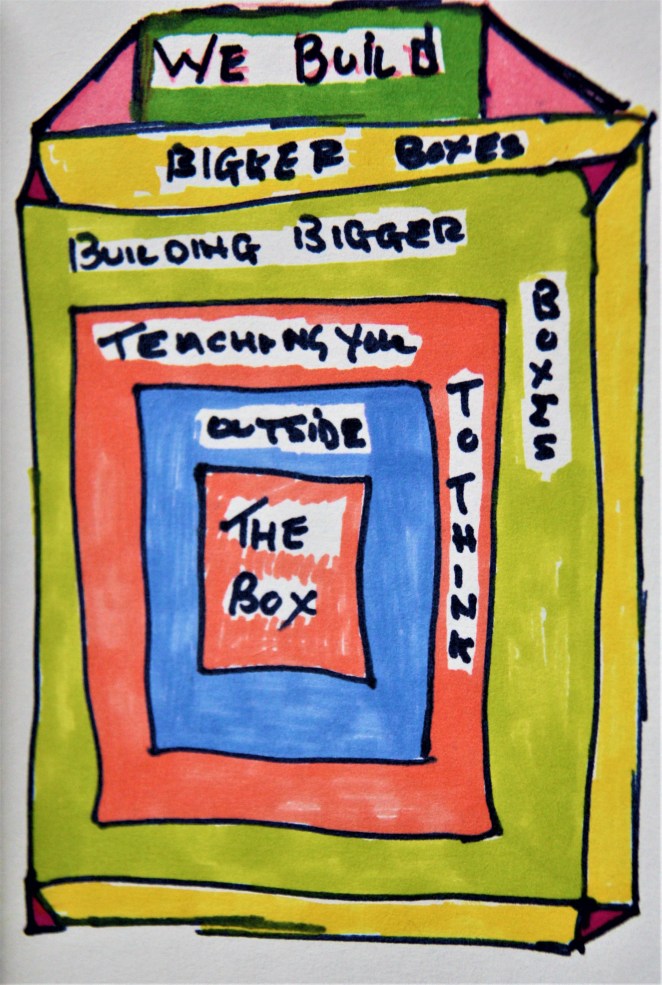
  9. Creativity – great teachers are creative. They open their students’ minds to new ideas, fresh knowledge, better ways of doing things. They never use phrases like ‘thinking outside the box’ and they do not build better boxes, one or two sizes larger than current boxes, inside which their students must now sit, work, and think. Creative teachers tear down the walls of medieval academia and open their students’ minds to the winds of change and fresh knowledge.

    Be creative.

  10. Life long learning – great teachers teach students how to think for themselves, how to teach themselves, how to self-assess, how to check and double-check the knowledge (all too often nowadays, fake news and / or false knowledge) handed down to them from a multitude of sources, far too many of them unreliable. Great teachers teach their students to know themselves. They also teach them how to work out whether a source is a reliable fount of information, or not. In short, they teach life long learning and neither they, nor their students, ever give up hope.


    Teach Life Long Learning.

White Space

White Space

A place of silence,
          white space
at page edge,
          bearing witness
to the absence
          of words.

A place to pause,
          rest,
to think.

A place,
          like the white space
between lines of prose,
          where eye and mind
can pause and rest.

Bewildering
          the pounding
of earwig music,
          the advert repeated

again and again,
          the omnipresent
sound byte.

Everlasting,
          the loop, the loop,
the interminable loop
          that intrudes on
silence.

Words

Words emerge
          from the silence
of blood and bone.

They break
          that silence
the day they are born.

Silence,
          once broken,
cannot be repaired.

A word once spoken
          cannot be recalled.

The greatest gift –
           knowing how to be alone,
how to sink into silence.

A world of words
          smothered at birth
and that world,
          dismissed, forgotten,
sometimes still-born.

A lost world of words
          whirled on the silent wind
that fans the unborn fire within.

The spider web of the mind
          blown clear by the wind
that blows unspoken words.

The hush of the tadpole
          swimming
into its own metamorphosis.

The sultry oblivion
          of blood and bone.

Poetry that expresses the authenticity of being. Playful, yes, but packed with meaning. Taste it on the tongue. Savor it in the mind. Touch the words on the page. Indulge yourself in the white spaces between the words. Read and re-read each poem. Dive into its depths. Swim – but do not let yourself drown. When you surface again, return to the light and remember, all will be well.

A Broken Heart

A Broken Heart

What does a broken heart look like? Good question – and I, for one, don’t know. Maybe my artist friend, Moo, does. He painted this image of a Fragmented Heart the other day. Not that his heart was broken. He told me he was interpreting the words and feelings of a close friend (who shall remain nameless) who has been having the feelings associated with a heart that was actually breaking. Tough times, eh?

Rejections get me down and annoy me, but they don’t break my heart. I submitted a short story to a magazine on January 4, 2023 and got a rejection letter yesterday, May 6, 2024. It was a form letter, 16 months after submission, just to say “no”!

Of course, the few acceptances that I actually do get make up for the many rejections, as is always the case. However, there seem to be fewer of these acceptances as my thoughts look inwards and I turn from ‘poetry of play to poetry that expresses the authenticity of being‘ (Johannes Pfeiffer). In this day and age, I fear that readers seek entertainment and distraction and prefer the light-hearted to the heavy hand of deep thought and poetic authenticity. And remember, I do not distinguish between poetry and prose, as many do. For me, poetry is writing, be it in poetry or prose.

But back to the theme of the broken heart. Here are three linked poems.

Old Wounds

“The slow wound
deepens with the years
and brings no healing.”

The Minister by R. S. Thomas

How deep time’s wounds
have cut and carved,
not just in flesh and bone,
but in the embers
of that slow-burn fire
 they call the heart.

Memory and mind
have also played their part.

Some days, those wounds
don’t ache at all.

But there’s no real healing,
and a moment of madness
or a knife-edged finger nail,
careless, in the dark,
opens them up again
to bleed afresh
and remind us
of the frailty of the flesh.

I Remember

“I remember so well how it was back then.
I was lonely, my heart so broken I couldn’t
count the pieces, nor put the puzzle together,
 although I tried so hard to make it whole again.

I still bear scars, trenches dug so deep,
lines gouged into my body. I can’t always sleep.
Nightmares pave a crooked, cobbled way to day.

Some nights, I wake up suddenly from a dream
and scream the way that stuck pigs scream
when, hot, their blood comes steaming out.
Other nights, in pain and panic, at shadows I shout.

I search for someone to care for me. I want them
to understand my grief and help me forget the thief
who stole my joy and left me this life of disbelief.”

Signs of Age

What is pain, but the knowledge
that we are alive, and relatively well,
and still on the green side of the grass.

Long may it last. For when the pain is gone,
we shall soon follow. And this is age,
and age is this pain, and the painful
knowledge that we are no longer young,
can no longer bend the way we bent,
or touch our toes, or even see our toes,
some of us. The golden arrow pierces
the heart. Fierce is the pain. But when
that arrow is withdrawn and the heart
no longer feels alive, why, how we miss
that pain, how we weep to find it gone,
perhaps never to come back again.

Pain, like rain, an essential part of the cycle
of the seasons, of the days and the weeks,
and all the months and years that walk us
around the circadian circle, in time with the earth
and its desire to open its arms, and welcome us,
and greet us, and bring us our rest, from pain.

So much wisdom sewn into the wrinkled skin,
the gap-filled grin that glows with humor,
the crow’s foot signals of old age,
or merely those we associate with ageing,
and the knowledge that, yes, many
have walked this wobbly way before,
and many more will follow in our footsteps.

Take your pick – ‘poetry of play to poetry that expresses the authenticity of being‘ – but I know which I prefer and ‘still I live in hopes to see poems of authenticity.”