Transitions

Transitions

Modes of limited transitions,
moods of time tapped in time
to time’s rhythmic piano.

Scales fall from my listening eyes
and all-seeing ears.
A transitory awakening,
this glimpse of the composer’s vision,
each note a new version
extracted from abstracts
perceived in color,
each note a hue, and chords
a rainbow spectrum of light
glimpsed darkly through
the raindrop’s distorting lens.

Birdsong and sunshine.
Notes perched
on the matinal branch,
each in tune with the other,
at times in seeming discord,
yet the morning chorus
diluting the day
with the liquidity
of light and sound.

Comment:

Transitions is the fourth poem in the first sequence (Crystal Liturgy) of my poetry book Septets for the End of Time.

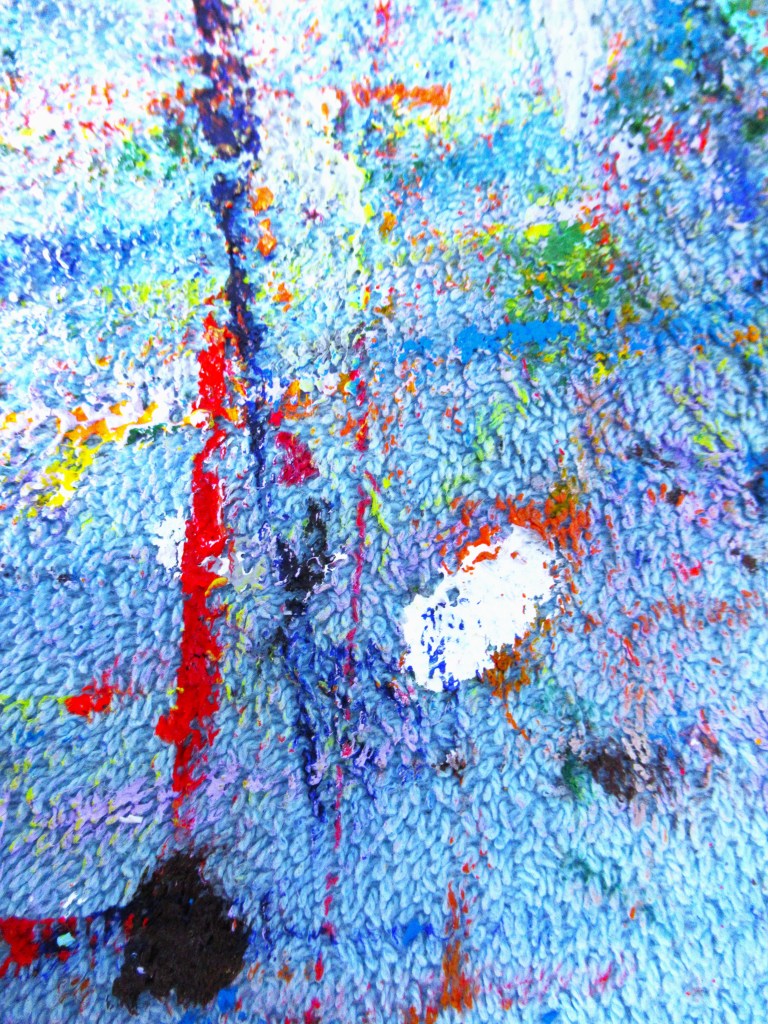
“How on earth did you create that painting?” I asked my friend Moo. “And how do you relate it to this poem?”

“Good questions,” Moo replied. “Difficult to answer, though.” First of all, this is not a painting. It is the background cloth, always changing, always in transition, upon which I create my post card paintings. The idea of transition summarizes the movement from paint, to brush, to painting, and the haziness of the creative moment. It relates directly to your lines ‘Scales fall from my listening eyes / and all-seeing ears.’ This is the point in time, the magic moment, when the painting declares itself. I assume you have the same moment when you write poetry.”

“The two processes are very different, I think. In my poetry, a thought leads to a verbal image, and then each of the words turn themselves into little worlds in which verbal gemstones appear. I try to catch those verbal gemstones and to transform them into poetry. If I listen carefully, then my ears see and my eyes hear the words forming themselves into the right order.”

“Interesting. And yes, that’s what happens in my painting too. The initial mood captured in that first color, and then the minor moods that emerge from the first one gradually woven into the painting.”

“That is somewhat similar to how I write – by listening to the words and doing what they tell me to do. Then I do what they want me to do, not what I want them to do.”

“Fascinating. But there is one huge difference between us.”

“What’s that?”

“I’ll tell you next time.”
The End of Time

The End of Time

A thin violin crying
its cat-gut heart out
in tears of sound, falling,
rhythmic raindrops,
down a grey-streaked face
tight with stress and taut with pain.

Such concentration,
such soulfulness packed
into each mindful note.

An audience of one,
I sit, head bowed, meditating
on the meaning of meaning
and the nothingness
of a being condemned
to oblivion, yet oblivious
of the how and when.

Each note a hammer-blow,
then, the piano pounding nail
after nail into this living coffin,
this body I drag through the motions
of extracting meaning
from this meaningless life.

Comment:

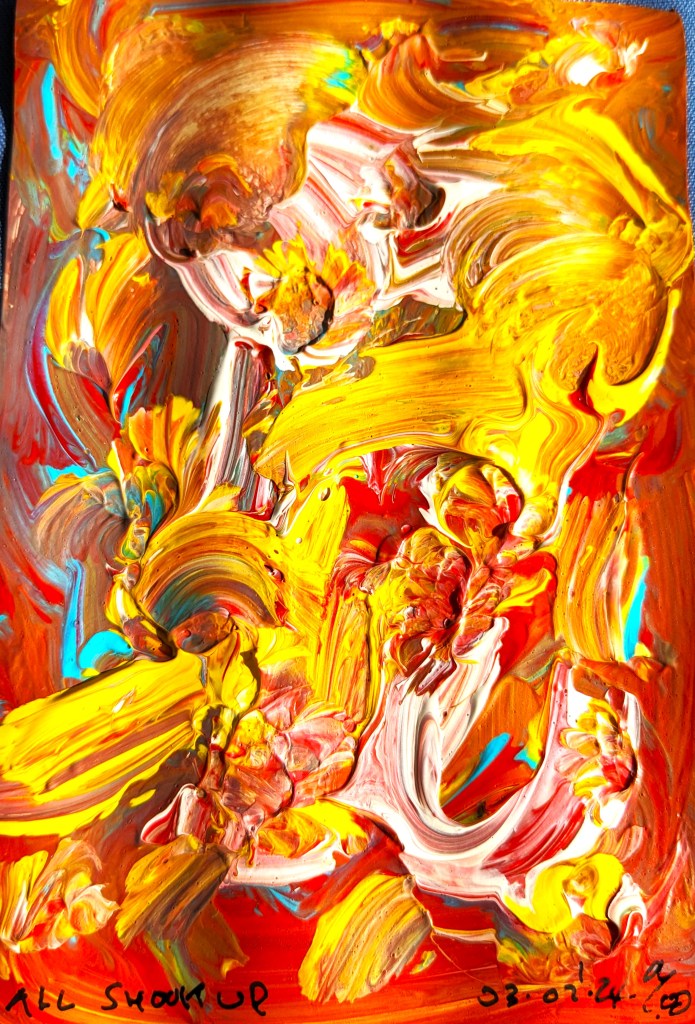
The End of Time is the second poem in the first sequence (Crystal Liturgy) of Septets for the End of Time. The painting, by my friend Moo, expresses his impressions of the nature of the end – but he doesn’t tell me the end of what. Certainly not of our friendship, I hope.

I am always worried by those last two lines: extracting meaning from this meaningless life as I don’t think that life is meaningless. However, there are times when it certainly feels that way. Those are the times when we need our beliefs in truth and the purity of art to survive. But how do you define them, you ask me. In all honesty, I don’t. I can’t. Art changes. What we consider to be true changes. Relativism? Yes, to a certain extent. I know what I believe. I don’t know what you believe. But I would never try to inflict or enforce my beliefs on to you. That is not how I work.

As for Moo, I don’t know how his mind works. I think he just sees things in color and shape and in the creation of movement within the stillness of a two dimensional illusion. I also think he thinks like a child. Maybe, like me, he has entered his second childhood, though I don’t really remember ever having had a first one. Oh dear – the meaning of meaning – one of the great enigmas of this wonderful world in which we live.

Exploring the Divine in Nature

Divinity

outside us or in us
the divine is always with us

green god
of the mountain ash
garlanded now
with autumn berries

lady hollyhock
and her flock
of butterflies and bees

colibri
martyred soul
reborn
as a hummingbird

our garden
a paradise
where the creator
still strolls

some of her
many faces
glimpsed
among the leaves

in this half-light
as the sun
goes down

What would your life be like without music?

Daily writing prompt
What would your life be like without music?

What would your life be like without music?

Very quiet.

I consulted Moo, my favorite artist, on this one and he said that the above answer was much too brief and slightly cynical.
“Look,” he said to me, “this is today’s painting. It’s called Walking on Air.”
“Walking on air?” I queried.
“Yup,” he replied – “I hear music, but there’s no one there.” Then he told me to listen quietly to his painting. And I did. But nothing happened.
“I can’t hear a thing,” I told him.
“How many people do you see inside the painting?” he asked.
“About four,” I replied. “A girl with long red hair, a little girl with a little curl, right in the middle of her forehead, an old man, all hunched up, running away from something, and someone on the left hand-side, at the bottom, but I’m not sure what they’re doing.”
“Idiot,” he said to me. “Open your mind, not just your eyes. Look again. Now what do you see?”
“The same people, and there may be a couple more. How many people do you see, Moo?” “None. That’s why I hear music, because there’s no one there.”
“You’re having me on, aren’t you? You’re pulling my leg? You’re taking the…”
“Easy now,” he grinned maliciously, ” you don’t want your next word to be taken and used in evidence against you, do you? Now, look out of the window. What do you see?”
“I see blossoms…”
“But the trees are bare,” he smiled. “Do you toss and turn in your bed at night?”
“I do. And I’ve gone and lost my appetite.”
“I bet those stars shining in the skies last night, will be shining in your eyes tonight.”
“My golly, Moo, I think they might be. You know, you are a genius.”
“I am indeed. But I usually travel incognito. And listen…”
“Wow. I hear someone singing softly, and the voice is coming from the painting… but…”
“I know. There’s no one there.”

How quiet would my life be without music? As quiet as it would be without art, poetry, a sense of humor, friends who laugh with me, not at me, and people like you, who read this, and don’t think that I am totally insane. Oh yes, and if there was no music in my life, there would be no Great Starts to the Day, and no Poems for the End of Time.

What are your future travel plans?

Daily writing prompt
What are your future travel plans?

What are your future travel plans?

When Covid struck in Avila, Spain, a small walled city, the abulenses (the Spanish name for people who live there) were confined to their houses and apartments. They got their exercise by walking on their balconies, or walking around their living quarters, however small, again and again.

When I was young, I traveled regularly to Bristol Zoo. The lions and tigers paced restlessly in their cages, or else just lay there, soporific. Maybe their food contained the drugs that curbed their violence. I never asked. But I do remember that relentless padding from one side to another. In the aquarium, the fish swam around and around going nowhere. The same with the seals and the penguins. Alas, they were only animated by feeding time, when the attendants appeared with their buckets of fish. Then the animals came alive and dived, jump, swam, and responded to the food thrown to them to entertain the watchers.

And it was somewhat similar in Avila – the restless pacing, the circuit of the room, the movement to the kitchen or the fridge. Some people lost weight, but many put it on. They got up from the chairs in which they were sitting, walked to the fridge, opened the door, took out a beer or two, and returned to their chairs in front of their tv sets. Language is always renewing itself and, in times of difference and stress, we invent new words. This routine became known as El Paseo de la Nevera – The Stroll to the Fridge.

Now, as my age increases and my energy grows less, a similar thing is happening to me. I count my steps as I limp around the house, hobbling from room to room. I aim for 2,000 steps a day, but sometime manage more than that. I go out, in good weather – not raining, not too hot, not too humid – and time my walks around the garden. I am unable to count my steps when I lean on my Rollator as my hands do not move and they must be in motion, if I am to keep a record on my watch. When walking, I stay as close as possible to the shade and try to keep cool. Each day, I try to walk two or three times in this fashion. Sometimes I even manage four outings at 15 minutes apiece. Occasionally, especially if I go shopping as well, leaning on my shopping cart, I may even manage an hour’s walk or more. When I achieve my targets, I feel fulfilled and satisfied.

While walking in the garden, I do one of two things. (a) I concentrate on the flowers, the ants beneath my feet, the weeds, the moss, the birds, the way nature grows and blesses me. Or (b), I pretend I am back in Avila, or Santander, or Brandy Cove, or Pwll Ddu, or Bishopston Valley, and as I walk, I visit my favorite bars and talk to the family and friends that I miss so much and haven’t seen for so long, most of whom I never hear from nor will ever see again.

And these are my travel plans – to continue doing this for as long as possible. To walk regularly. To continue to dream as I walk. To rejoice in the sunshine of my garden. To survive – and to enjoy each moment that I am permitted to do so.

AMDG Ad Majorem Gloriam Dei.

What are your daily habits?


Daily writing prompt
What are your daily habits?

What are your daily habits?

“The habit (Greek: Σχήμα, romanized: Schēma) is essentially the same throughout the world. The normal monastic color is black, symbolic of repentance and simplicity. The habits of monks and nuns are identical. Additionally, nuns wear a scarf, called an apostolnik.”

So, my daily habits are a little bit monastic. “Monks were very religious, lived simple lives and followed certain rules to discipline themselves. The monks didn’t have any possessions, they didn’t even own their own clothes and they wore a simple garment known as a habit. Monks chose to live in the monastery as they wanted to help others and worship God.”

I can’t say I am very religious, in the church-going sense, but I do live a pretty simple life. My rules and disciplines consist of daily exercises, stretching and strength, a morning wash and shave, getting dressed in my non-monkish habits – jeans, shirt, sox, shoes or sandals. Coffee and fruit for breakfast. Writing – (a) in my journal (b) on the computer (c) in my poetry book. An early lunch, usually a sandwich. A post-prandial walk around the garden with my roller, examining the hollyhocks, the yucca, and the clematis, and checking on the progress of the other flowers.

The daily routine of a monk is somewhat similar. Monks typically wake up early in the morning, often before sunrise. I wake up early, text a couple of my best friends on the cell phone beside my bed, and then I go back to sleep again. I often begin the day with a prayer or a hymn – as do the monks – “Every morning, when I wake, / oh Lord, this little prayer I make, / that thou will keep a watchful eye, / on all poor creatures born to die.” Then I begin my daily routine of work and meditation. The specific activities and schedule can vary, but generally, I spend several hours each day in work (writing) or study (reading).

I try to think like a monk – to think like a monk means to remain calm and focused under all circumstances, especially when life gets challenging. Alas, at my age, I meet challengers all through the day. Things fall to the floor – challenge – can I pick them up with my magic claw? I can’t open bottles and cans – challenge – can I do so with one of my two magic appliances? I actually have three, but one of them doesn’t work. The other two, however, are wonderful. It is almost impossible for me to open plastic wrappings – challenge – can I do so with a pair of scissors, a pocket knife, or must I, in the worst case scenario, use a genuine can opener? Good tip, that, incidentally, especially for bubble packs. There are many other challenges, the worst of which is always what to do if I fall down. We won’t talk about that – I just do my best not to fall.

I also do my best to lead a relatively simple life – I try (1) to do one thing at a time – (2) to commit whole-heartedly to my family and few close friends – (3) to simplify my life and concentrate on what I am doing – (4) to develop my mind by not indulging excessively in social media – (5) to order my existence by making lists of essentials that must be accomplished – (6) to express myself and my love for the world around me in poetry, prose, and paint – and finally, (7) to remember that, the day I was born, I took my first step on the path to death. Beyond that, I do very little more.

Describe one simple thing you do that brings joy to your life.

Daily writing prompt
Describe one simple thing you do that brings joy to your life.

Describe one simple thing you do that brings joy to your life.

Painting.

I was always told that I couldn’t paint. “You don’t have a clue. Give it up now. You’re wasting your time, and ours.” Same with drawing and any other form of visual and creative art. I tried to build model aircraft – Spitfires and Hurricanes, Gloucester Gladiators, SE5s -. They were ugly, lumpy, had crooked wings, and never flew properly. The few that I managed to launch often fell apart on landing. Same with model kites. The one I did manage to build took off in a half a gale and got stuck in a tree.

Failure!!!!!

Much later in life I re-discovered Henri Matisse. “I make meaning out of shape and color.” Then I stumbled across Salvador Dali’s famous statement: “I don’t know what it means, but I know it means something.” From there I started to take lines for a walk, and moved into cartoons – you will find some earlier on these pages *click here* – or – *click here* – or just explore these early pages for yourself.

From these cartoons, I moved, with the encouragement of Geoff Slater, the Art Director at Kingsbrae International Residencies for Artists (I was the first writer in residence, June 2017), to actually painting, for the first time, with acrylics on canvas. This led me to my Pocket Paintings / Peintures de Poche, made with acrylics on 4″ x 6″ postcards. What fun. I now have well over a hundred of these and, guess what! – just like my books, I give them away to my friends for free.

These simple, linked acts – writing – painting – gifting – bring me great joy.
Long may it continue.
Pax amorque.

Coming Soon ….

Coming soon ….. to a Rollator near you.

Yesterday I checked the galley proof and all seems well. The distortion on the photo above is all mine (!) and the original cover is much clearer, better, straighter, and brighter.

I have not posted for two weeks, and yet some of my faithful followers have still clicked on this site to see how I am doing. Thank you so much.

Several things happened last month. (a) I started a stretching and exercise program. (b) I upped my walking to 4000 steps a day. (c) I used a combination of Rollator [Nexus 3] and shopping cart to build up, slowly, to an hour a day of aerobic exercise.

That’s all good news for the physical body and the mental state, but not such good news for the creative cycle. Blog postings have suffered and my online social presence has been greatly reduced. On the good side, I have been out and about, around the garden and around the block, and have re-established contact with neighbors, friends, and the local canine newbies and golden oldies.

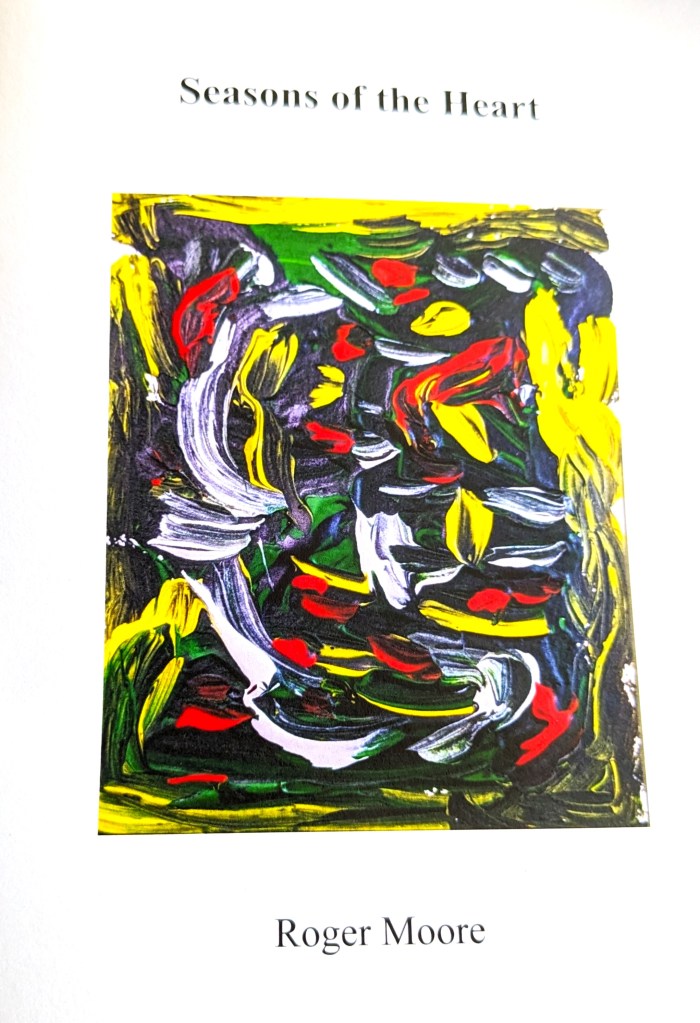
I also managed to edit and correct and revise Seasons of the Heart and this chapbook of poems, based on my meditations on Anam Cara (by John O’Donohue) will soon be available to gift to my closest friends.

As you probably know by know, I do not sell what I call my “Covey Collection” of self-published chapbooks and books. If you wish to support my efforts as an artist, you can do so by clicking on this link and seeing if there is anything that fancies your tickle, sorry, I mean tickles your fancy.

B & W

“Slim words couched
in the empty whiteness
of the page.”
John O’Donohue,
Anam Cara

black words
          white page
thoughts
          floating in space

airs and graces
          whirlwind words
blowing through
          freshening
cleansing

cotton clouds
          silky sky
that one word
          waiting
to be spoken

that one thought
          soon to be word-borne
out from the dark

a new existence
          to brighten us
blind us with light

White Space

White Space

A place of silence,
          white space
at page edge,
          bearing witness
to the absence
          of words.

A place to pause,
          rest,
to think.

A place,
          like the white space
between lines of prose,
          where eye and mind
can pause and rest.

Bewildering
          the pounding
of earwig music,
          the advert repeated

again and again,
          the omnipresent
sound byte.

Everlasting,
          the loop, the loop,
the interminable loop
          that intrudes on
silence.

Words

Words emerge
          from the silence
of blood and bone.

They break
          that silence
the day they are born.

Silence,
          once broken,
cannot be repaired.

A word once spoken
          cannot be recalled.

The greatest gift –
           knowing how to be alone,
how to sink into silence.

A world of words
          smothered at birth
and that world,
          dismissed, forgotten,
sometimes still-born.

A lost world of words
          whirled on the silent wind
that fans the unborn fire within.

The spider web of the mind
          blown clear by the wind
that blows unspoken words.

The hush of the tadpole
          swimming
into its own metamorphosis.

The sultry oblivion
          of blood and bone.

Poetry that expresses the authenticity of being. Playful, yes, but packed with meaning. Taste it on the tongue. Savor it in the mind. Touch the words on the page. Indulge yourself in the white spaces between the words. Read and re-read each poem. Dive into its depths. Swim – but do not let yourself drown. When you surface again, return to the light and remember, all will be well.

Illumination

Two Poems to help you find your way in the dark!

1

Suit of Lights

I am a man of straw
          shivered by raw winds,
frosted by the cold
          enveloping this enigmatic body
with its rattle of drying bones.

I walk with two canes,
          not just a sick man,
but a stick man.

My broken body
          hangs on the coat hanger
of my battered bones,
          its worn-out sack
knitted from skin,
          bonded with blood.

The magic hour descends.

Earth glows
          with a different light,
my world is transformed,
          translucent, bright.

A touch of the almighty,
          this beauty surrounding me,
blessing me.

I wear a sudden clarity
          with this suit of lights.

2

Illumination

You must find it for yourself.
         Were I to tell you what it is
and where it dwells,
          the light it brings you
would be warped,
          untrue.

Only
          you can find
that light.

Only you
          can strike the match,
ignite that blaze,
          trap its warmth
in your own bone cage.

Enlightened,
          you must dig and dig,
deeper and deeper,
          until you lose yourself
in a bottomless pit.

When you are lost,
          look up.

In the dark above,
            you will find
a tiny pinhole of light,
          a star to guide,
a glow-worm
          to light your way
in the darkest night.