Earth Bounty

IMG_1238 (2)

Earth Bounty
by
Victor Hendricken

 The paradox of life: in order to survive, we must consume; by consuming, we create waste; however, we do not see our waste as detritus, but as the product of living. 

Deep beneath earth’s surface, a miner drills a one and one-quarter inch hole eight to twelve feet deep into a rock face that is roughly twelve feet square. The miner repeats his task until the rock face resembles a block of Swiss cheese. Each hole is stuffed with explosive material. Then a blasting cap shaped like a metal matchhead, containing a fuse and trailing a wire pair sheathed in plastic, is gingerly inserted into each hole, buried up to twelve inches inside the explosive.

The miner and his partner (miners always work in pairs) connect the wires from each cap to a common grounded wire. The pair retreats to a safe area stringing out the grounded wire behind them, where they meet up with other pairs of miners waiting for permission from the mine captain to connect the trailing wires to an electrical junction box wired directly to a throw switch on surface. When all miners are assembled, they travel by hoist to daylight, where they hang their personal identification tags on the appropriate tag board confirming they are no longer in the deeps. The board is rechecked and the captain sirens a series of warning alarms and when certain that everyone is safe on surface closes the switch initiating the blast.  All drilled faces explode as one.

The miners hang their work clothes to dry, shower and change into street clothes. Some head home to family; some go to the bunkhouse kitchen; some seek out the comfort of a pub and the company of their workmates. No one is allowed to go underground again until the air is purged of dust and noxious gasses.

A miner drilling into rock containing copper in sulphide, oxide or elemental form is not thinking about copper pots for cooking, or copper wire for electrifying his house, or copper tubing to carry water from well to sink. He is fully engrossed in the task at hand: break the rock into manageable sized pieces and transport it from the deeps to the surface.  He is acutely aware of his dependence on number of feet advanced in the drift today, in the volume of ore bearing rock extracted from the stope.  He gives no thought to the growing piles of waste rock strewn about the nearby surface.

Out on the greenish grey ocean the fisher sets his traps. The location of each cage is identified by a floating coloured buoy.  The day is long and the sea rough.  In nearby locations, trawler lines and weighted nets are released to scavenge the ocean at various depths herding schools of many fish species to a common fate.  Some nets scrape the ocean floor to capture creatures succored there. Occasionally, fishers are forced to overnight on the ocean surface as their prey migrates below to nibble at the bait within the traps, to gather in large schools before the nets.

As each trap is hauled up, emptied and rebaited, the fisher is not thinking about lobster rolls. As he hauls in the bulging net and empties it into the ship’s hold, he is not thinking about blackened cod or fish cakes, sole adamantine or tender filet with baked potatoes and butter.  He is focused on hauling the catch from the deep ocean and filling the ship’s hold; delivering the dead and dying sea animals to the fish plant for processing into human and other food.  He does not count the discarded carcases of species that contaminate his daily catch.

The logger fells another tree, trims the branches and saws the tree into cordwood lengths. He inhales deeply while admiring his day’s work.  Chainsaw in hand, he does not think about houses or furniture.  He does not measure in board feet, nor does he envision dimensional lumber as he hews, stacks and hauls.  He focuses on cords piled, loads counted. Trees are objects to devour, not treasures to be taken.  He does not notice the acres of clear-cut whose topsoil will soon become prey to buffeting winds and torrential rain.

At the end of the day, perhaps on the empty street or in the local pub, the miner’s thoughts may wander to home, to sitting at his wooden table inside his wooden house, to eating a banquet of sautéed fish knowing only the supermarket as the meal’s origin.  At the end of the day, the fisher may walk the dark street from dock to home, peer down an alley dimly lit by doorways leading to cavernous public drinking places. He may wonder at the hidden resources protected by the alley, exposed by the alley. He will not wonder about the light’s source, the tungsten filament in the lamp, or the clinking glasses as he enters the pub.  At the end of the day, the logger will lay down his saw, turn in his axe, enter the pub from the street and take a seat near the alley door. He does not question the source of the fisherman’s platter he is served, nor does he think about the metal in the barroom tables and chairs, nor what goes into making a beer glass.  He marvels at the burnished wooden bar rail, harbours a fleeting image of his chainsaw.

When the three, the miner, the fisher and the logger, by happenstance meet, they do not tell secrets of their trade.  They speak instead of trivia and sports, avoid politics and talk of home. The angry metal teeth on the logger’s saw, the sharply honed edge of his axe, the height and girth of trees felled are no more in mind than the metal and wooden boat into which the fisher loads his catch, than the living, mineralized stope from which the miner draws his bonus.  Each protects his space as surely as a mother holds her child from nosy passers’ by.

Stories of mining pass only between miners; stories of fishing remain solely with fishers; stories of lumbering are wedged into spaces between lumberjacks.  No word is spoken of farmers plowing fields and harvesting crops.

And while we blithely drive our vehicles of iron, steel, copper and zinc, barbecue pink salmon and grey mackerel, slather slabs of butter on thick slices of homemade wheat bread, dance on decks of wood and nails and screws, the miner puts on his slickers and dons his hardhat and lamp; the fisher steps into his waterproof garb and rubber boots; and the logger twice ties his cork boots, sharpens his saw, and shoulders his axe.  The farmer quietly steps into his worn overalls, mounts his high-powered four-wheeled tractor and attacks worn out fields with plow and harrow.

Comment: This morning’s piece by my friend Victor. I publish it here with great pleasure. Victor has a sharp mind and an elegant pen. Hopefully, he will continue writing for me and, always with his permission, I will continue to publish his oeuvre.

Life is a Dream

cropped-img_0279-1.jpg

Life is a Dream

This life is nothing but a dream.
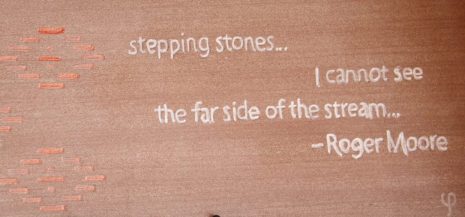
I cannot see the far side of the stream.

Life is a frenzy, a fiction, a story,
sometimes a romance filled with glory,
often a nightmare, bloody and gory.

We seek for answers, no confusion,
but all of our life is an  illusion.

We are but shadows in Plato’s Cave:
reality is what we crave,
but all we get is an early grave.

I’m not the first person who has said it,
but I’d love to take full credit.

Comment:  So many things here. My photo of Jan Hull’s carving that adorns my web page. It is carved in stone, Old Welsh red sandstone, unlike these ephemeral words. Thank you Jan. It links to Segismundo’s soliloquy from Calderón de la Barca’s La Vida es Sueño. I have adapted that piece to the current pandemic because Spain has instructed its people to wash their hands in time with this soliloquy.

¿Qué es la vida? Un frenesí.
¿Qué es la vida? Una ilusión,
una sombra, una ficción,
y el mayor bien es pequeño,
porque toda la vida es un sueño,
y los sueños, sueños son.

What is life? A frenzy.
What is life? An illusion,
a shadow, a fiction,
and the greatest good is small,
because life is a dream,
and dreams are nothing
but dreams, after all.


Fragile

PEI + bockle 2008 059

Fragile

Snow flakes fall fragile
strength in numbers
not in each morsel
falling rom grey skies

a word to the wise
there is no health
nor strength nor wealth
each one of us fragile

one puff of wind
a sudden gust
and we are gone
turned into dust
when that voice calls
go we must

Comment: I sat here looking out of the window. I didn’t mean to write a sonnet, especially such an unstructured one. Then, poetry, like life, sometimes just happens. A sudden gust and the sky filled with snowflakes. Light and airy, winter fairies floating across the lawn, not settling, scurrying on. I blinked, looked again: the wind had dropped and they had gone. Now they’re back, wind-blown, and in a flurry. Just passing through. How many in a minute, in an hour, in a day? Anonymous, no name, the numbers game: some days that’s all we can play.


Day 23 CV-19

IMG_1652 (2)

Day 23 CV-19
Codes and Coding

“Languages: they say that to learn another language is to gain another soul and another set of eyes through which to view the world.” I wrote these words just yesterday [Day 22 CV-22]. The words are mine, but the idea belongs elsewhere. I have borrowed it and adopted it. I would willingly attribute it to a specific author, but I do not know who said it first. I offer my apologies to the to me unknown genius who first spoke these words.

Why codes and coding? A rhetorical question, of course. But codes and coding are the basic elements through which language transfers thought, our thoughts. What is a code? Well, we know all about Morse Code and the elaborate codes through which spies from all countries communicate their needs. A code is a way of converting language, changing it, making it available to those initiated in the code and unavailable to those who have not received such initiation. Sounds simple, doesn’t it?

When I was travelling regularly to Spain for research in Spanish libraries, my first port of call was always the local barber shop. I did this for several reasons. In the first place, my Canadian haircut gave me away as a foreigner. This is the hairdresser’s code. The barber’s shop was always the centre of local gossip. Here, buzz words changed hands, politicians were discussed, all the local news was immediately available. Each of these items was a code, a code that made an insider (acceptable) versus an outsider (not to be spoken to). I remember, one summer in Madrid, not getting served in any bar or restaurant. Check haircut: okay. Check shoes: bought new pair. Check shirt, jacket, tie: all up to date. Inspect lucky customers … ah … they are all wearing a shiny brass pin showing the symbol of Madrid: El Oso y el Madroño, the bear and the strawberry tree, as seen in La Puerta del Sol.

The next bar I entered saw me sporting El Oso y el Madroño in my lapel. Qué quiere el señor? Immediate service and with a smile. These are social codes, the codes that include the winks and nudges of the upper class, the secret handshakes and foot positions, the names dropped so gently and quietly that they never shatter when they hit the floor. There are also language codes. Northrop Frye wrote The Great Code: The Bible and Literature, a study of the mythology and structure of the Bible was published in 1982. In this wonderful study, Frye showed how themes and language from the bible have influenced the structure of Western Literature, particularly that written in English. Within this code, names, themes, miracles, parables, psalms form a body of are common knowledge available to all readers who are christian and whose first language is English.

But there are other codes. Think Petracharism. Petrarch’s poetry, originally written in Italian, was widely imitated throughout Europe. Italian literature, Spanish, French, English, all dip into that code, as does Shakespeare among so many others. Think the Great Chain of Being. Shakespeare is incomprehensible in places unless you unlock this particular code. Think Platonism, Neo-Platonism, Stoicism, Existentialism … okay, so all this is academic, and I do not want to lose you in a sea of academia. So think NFL, think NBA, think NHL, think baseball, think cricket, think rugby, think darts, think all of the things we manipulate on a daily basis in our lives and think how they include some people (those who know and share our codes) and exclude others (those who are unaware of them). LBW, c&b,  c. A, b. B, st. A b. B, w, W, b, lb, dec., rsp …

This is a wonderful line of discussion. It follows along the lines of micro-language and macro-language. Macro-language is accessible to all who happen to speak that language. Micro-language in its multidinous forms incarnadine belongs ONLY to those who share the micro community, be it family, household, village, town, county, region … all that is closest and dearest to our micro-hearts.

Self-Isolation Day 22 / Ducks

Empress 070

Self-Isolation Day 22
22 =Ducks, Patos in Spanish.

Ducks, because the 2 and the 2 seem to float together like a pair of ducks or a pair of Swans. How did Swansea get it’s name? Some say it was because handsome white swans used to swim on the salt waters of the bay: Swan+sea. Other’s say that  was on account of a battle where a man called Swain lost his eye: Swain’s Eye = Swansea. Oh dear, it’s so much easier in Welsh: Abertawe, the mouth of the river Tawe.

Speaking of Welsh, this is the 290th consecutive day that I have done my Welsh lessons. I guess the pandemic has helped over the last few weeks. Nowhere to go, nothing to do, and all those Welsh memories bringing a fresh light to enlighten the darkness that is Corona Virus aka Covidis-19.

Language Teaching: never easy. And I should know after 43 years of teaching Spanish in Canadian universities (1966-2009). Relevance and irrelevance: how do we teach meaningful things? Good question. Dw i eisiau prynu’r crwban ddu fach / I want to buy the little black tortoise. Very useful. I bet they use that phrase on the streets of Llanelli and Abertawe every day of the week. How about Mae’r ddraig coch yn callu smwddio bob wythnos / The red dragon is able to do the ironing every week. Well, well: I suppose I did remember these two wonderful phrases. I am sure I will use them the next time I go to Cardiff.

I much prefer the Welsh of St. David: Gwnewch y pethau bychain mewn bywyd / Do ye the little things in life or Byddwch lawen a chadwch eich ffyd a’ch credd / Be joyful and keep your faith and creed. These two quotes from the patron saint of Wales are full of meaning, especially at this oh-so-difficult juncture in all our lives. Funny really: I laugh at the first two, the dragon and the tortoise, but without them, I would probably never have arrived at the Original Welsh of St. David / Dewi Sant.

Languages: they say that to learn another language is to gain another soul and another set of eyes through which to view the world. We view the world through our languages. Limit the language and we limit the world. Reduce the language, any language, to its lowest common denominator, and we reduce and diminish the world around us. Sparrows, juncos, chickadees, Cedar Waxwings, robins, mourning doves, crows, hawks (Cooper’s Hawk, Sharp-Shinned Hawk, Marsh Hawk) are all reduced to birds. Mountain Ash (Russian or European), Birch, Hackmatack, Tamarack, Spruce … all these are reduced to trees, nothing more and nothing less than trees.

Think about language. Savor language. Roll it round your mouth. Taste it on your tongue. Use the correct names for things. Expand your vocabulary. Do not be satisfied with Grade 9 English. Learn. Advance. Develop. Carry a dictionary (Y geiriadur Gymraeg newydd) and look up words, learn their meanings, learn how to spell them. Never give up. Do not be satisfied, ever, with the lowest level of existence. Flower, flourish, rise up and fight for your own self-education, for your own language, for your own destiny, for your own rights!

Self Isolation Day 21

IMG_0638

Self-Isolation Day 21
Bakhtin’s Chronotopos
Man’s dialog with his time and place

Chronos / time + Topos / space = chronotopos: the time and space within which we live.

Chronos: this morning, when I woke up, I moved back into my own time and space. But what is my time? It was 5:45 am when I awoke, so was that my time? I stayed in what the Spanish call the duermivela, that drowsing dream-world in which we all wander, half-conscious. I stayed there until I decided to get up at 7:45 am. Was that my time? Well, yes,  all of that is / was my time. But time extends further than that. Real time is static and only exists in this second as I type the s of second, but look how it has flowed or flown. So my time drifts backwards into a knowable and then an unknowable past. I knew my parents, and my grandparents. But I know nothing of their childhood, their war days (WWI and WWII), their courting, their marriages. Their time is time lost for me. Sure, I can invent it, renew it, recreate it … but it can never be mine. All I can possess is this Second when I preSS the S key, a Second that haS already flowed paSt me, flown and gone. The same with future time. It is there, stretching out before me, for how long, I do not know. It is not yet mine, and when I come to possess it I will only posses it, really possess for those precious Seconds when I inhale, or exhale, or press the S key. And now I have bewitched you, and your concept of time, and your keyboard will never be the same.

Topos / Place: so what is my place? When I awoke this morning, it was the kennel-cave of the bed in which I hibernate each night. Then it morphed into the bathroom where I dressed and prepared for the day. After that, I walked downstairs. Descending the stairs, a step at a time, feeling for the steps with my cane, as I do, I find that each step is my place. Luis de Góngora, one of my favorite Spanish poets, wrote, a long time ago that “Cada pie mal puesto es una caída, / cada caída es un precipicio”each footstep, badly placed, is a fall, / each fall is like tumbling down a precipice. Ipso facto, I must take care not to fall each time I place my foot on a stair, and each stair, therefore, is my concentrate of time, and this moment of time manufactures my space.

Then there is my breakfast place, my office place, my work place. Time spent in each of these spaces is a link backwards and forwards, past, present, and future all inexorably bound in each passing second that I live.

But there are other spaces, spaces in which time flows at a different rate in objective time (the thirty minutes you spend in the dentist’s chair) and subjective time (the hours and hours those thirty minutes take to pass as each second limps by, like a three legged tortoise with gout). hen there is creative time: and creative time, especially on the computer, leads us into a different space, a sort of hyper-space, in which we hover between this place (the place of the office and the house) and that place (the place in which we create our visions and dream our dreams). Lost in that creative hyper-space we drift in a timeless amniotic sea where all time is one and all places are one and we are the masters and mistresses of our own creative universe. Y aquí, as my good friend José Hierro once told me, el tiempo no tiene sentido / here time has no meaning.

Jane Tims wrote these words to me today. “The idea that some of our words will live on, on the page… I wonder where our WordPress and Facebook words will reside in 300 years? Will some antiquities student make the headlines having managed to upload the forgotten words of people who wrote about the days of the coronavirus?”

My reply: “These are very true words, Jane. It looks like you have gifted me with the topic of tomorrow’s blog! Thank you.”

Indeed, the online medium is so ephemeral and can be wiped out in seconds. Tweets can be erased, changed, and altered. Written words and written histories have also been erased and wiped out. In our brave new world, the truth changes from day to day with no vital record attached to it. Historians always say that the conquerors write history … and when they do so they usually destroy the writings of the conquered. I think of all those Mexican Codices, destroyed by the Spanish priests on their arrival in Mexico as the works of the Devil. We know so much from the surviving ones, for example the history of Ocho Venado, born in 1063 and sacrificed in 1113 in accordance with the fifty two year annual cycle. Only five Mixtec codices now survive, one, the Vindobonensis, still bears the scorch marks from when it was plucked from the flames that were meant to devour it. Man’s inhumanity to man. How much have we lost? How much are we losing? How much will we retain? And what is truth …?

As for us and our chances of survival, another good friend of mine, the poet and philosopher José María Valverde once wrote of nosotros, los pobres poetas de hoy, destinados a ser polvo seco de tesis doctoralwe poor poets of today, destined to become the dry dust of doctoral theses. In spite of all this, it is our fortune and our duty to exist within our time and our space, to live letter by letter, painfully tapped on the keyboard, and to engage in our dialog with our own time and space, for that my friends is all we have, the single instant of that one letter S.

Comment: The watch in the photo belonged to my father. I wind it up and wear it on his birthday every year. It now measures my time, as it once measured his, and its place, at least once a year is on my wrist. Its function is to tell me the time. One day, it will do the same for my daughter, and then my granddaughter and they too will have their dialog with their own time and place.

Wannabe a Creator


IMG_1047 (2)

Wannabe a Creator?

            Not everyone can be a creator, not because they cannot create, but because they do not believe in the powers of creation, the strength of the tsunami, of that tidal wave that sweeps us creators away and drives us into the blackened spaces of our inner minds where a dark sun shines its coal black light and shadows dance their will o’the wisp dance and lead us on and on until we have caught our dreams, squeezed them dry of their nothingness, and turned them into the stuff of an actuality filled with new life, a new reality, a new creation, something that is really ours, yet that will only truly live outside ourselves.
We gaze at each new creation for a moment, in astonishment, then position it in its cradle of reeds, place it in the running river, push it out into midstream and eyes, filled with tears, we wish it ‘god speed’ and send it spinning on its way to who knows where? Our hearts fill with hope as we watch it float away to make its own life, sink or swim, on this sea of sorrows, where someone, downstream, may bend to the waters and speak the magic words and tell a tale, our tale, their tale, or whatever they then deem the new tale to be.
Now, in our time of trouble, is the opportunity to dig deep, to mine our unconscious, to discover and re-discover our innate creativity. Take out that note-book, that pencil. Find that old sketch-book. Bring tat camera back to life. Above all, take the time to be yourself, to remember who and what you are, to re-discover your self and, wherever possible, take this opportunity, for it is an opportunity, to build the new self, the one you still wish to be. There are no greater mortal creators than those people who can create themselves anew. Now is the time to dream ourselves a new and better reality. Now is the time to drop the wannabe and to become a true creator.

Comment: I am taking the time now to multi-task my reading. This means starting and restarting several books at once and then shuffling the readings and pausing a while as I contemplate the pages. More on this tomorrow. Join me then.

Outrageous Fortune

IMG_1186 (2)

Outrageous Fortune

When the Black Dog descends it is difficult to see beyond the latest slings and arrows. Everything hurts and everybody hurts you. “Sticks and stones may break my bones, but words will never hurt me.” But they do. They gouge into the brain, splinter the mind, and leave us gasping for air, mouths open like landed, stranded fish.
How do we stop the hurt? We hurt ourselves more, much more, and then what they do to us can never ever be as bad as what we have done to ourselves. That cut-throat razor, that pop-gun with the cut cord, that carving knife, that finger stuffed into the electric socket … why, they ask, why did you do it? Head down, in silence, I know the answer, but I will not tell them.
They send me to doctors with fancy names who ask strange questions that I fudge or will not answer. They take my family’s money and then write reports and say that ‘his behavior is quite normal for a child of his age’.
Have they checked the scars on my mind, the black holes in my heart? Does the local priest who tells my parents that all is well also tell them about what happens in and out of church, in and out of school? I think of the city watch walking on the castle walls: “Nine o’clock and all’s well!”
Hurt yourself, I say. Hurt yourself so badly that nobody else will ever again be able to hurt you.

Co-[vidi]-s

15 May 2002 Pre-Rimouski 141

Co-[vidi]-s
17 March 2020

Time has changed with the clocks
and my body clock
is no longer in sync
with the tick-tock chime
that denounces each hour.

Hours that used to wound
now threaten to kill.
They used to limp along,
but now they just rush by
and I, who used to run
from point to point,
now shuffle a step at a time.

Around us, the Covidis
thrives and flowers.
Wallflowers, violets,
we shrink into our homes,
board up the windows,
refuse to open doors.
We communicate by phone,
e-mail, messenger, Skype.

Give us enough rope
and we’ll survive a little while,
fearful, full of anguish,
yet also filled with hope.

15 May 2002 Pre-Rimouski 035

Losing It

IMG_1478 (2)


Losing It

When you lose it
whatever it is
your fingers pick at seams
hankies skirts shirts jeans
or strip a label from a bottle
or crumble bread or

there are so many things
you can do
personal things

on the table
a vacant cereal bowl
a silver teaspoon in a saucer
an empty teacup
returning your round moon stare

your hands
twist and pull
your nails
click together

blunt needles knit
then unpick stitches
trying to unravel
then to repair
this ball of empty air