If you were going to open up a shop, what would you sell?

Daily writing prompt
If you were going to open up a shop, what would you sell?

If you were going to open up a shop, what would you sell?

That is a very hard question to answer. I think of all the material things that everyone else can think of, but I do not want to sell commonplace things – antique furniture, paintings, books, stamps, groceries – I could go on and on, but I will resist the temptation to do so.

When I lived in Santander, Spain, the local wines were sometimes called ‘sol embotellado‘ / bottled sunshine. I wouldn’t want to open a wine shop, but I would love to bottle the essence of a warm sunny summer day and – why should I sell it? I wouldn’t. I would give it away, free of charge, to all the needy people, inner city boys and girls, the impoverished, those who live in the streets and sleep in doorways or under bridges at night. Oh the joy and happiness that would come when they opened their bottle of summer sunshine and felt the warm fresh air gather around them so they could breathe it in.

But why stop there? I would also give away ‘essence of butterflies’, that special feeling that comes on the colored wings of a butterfly and combines with the joy of flowers and the gift of taking flight. How special that would be. But sell it? It is much too valuable to sell. Put a dollar, Euro, yen, rupee, or sterling price upon it, and all its powers would vanish, like fairy dreams fading away.

Fairy dreams – yes, I would offer them as well to those who needed them. And not the sort that fade away, but those fairy dreams that suspend us in the wondrous beauty of their ethereal light. And I would bottle hope, and self-belief, and the power to change oneself from what one is to what one is destined to be. And I would add essence of self-knowledge and powder of Davey Lamp light that would enable the seekers to seek in the darkest corners of their souls and find that elusive inner self, and bring it out from the darkness. And I would stock fragrant filaments of firefly that would also allow my customers to enlighten that darkest of nights, the dark night of the soul. And a map of hidden foot paths that would allow the wanderer to wander and never get lost.

How about an elixir of happiness and joy? A quintessence of rainbows, perhaps? Or a magic lantern that would shine out from heart and eyes and enlighten the soul friends of those lucky souls who were able to locate and enter my shop of conditioners, vital vitamins, and soul magic for all those lost and lonely people. And there, that mirror on the wall – look in it, gaze deep into your own eyes, and maybe, just maybe, you will find my shop.

And “What will your shop be called?”, you ask. Look into your heart and you may find the answer engraved therein. It will be called The Gift Shop of Hope Restored. I look forward to welcoming you when you open the door and step in.

What are your daily habits?


Daily writing prompt
What are your daily habits?

What are your daily habits?

“The habit (Greek: Σχήμα, romanized: Schēma) is essentially the same throughout the world. The normal monastic color is black, symbolic of repentance and simplicity. The habits of monks and nuns are identical. Additionally, nuns wear a scarf, called an apostolnik.”

So, my daily habits are a little bit monastic. “Monks were very religious, lived simple lives and followed certain rules to discipline themselves. The monks didn’t have any possessions, they didn’t even own their own clothes and they wore a simple garment known as a habit. Monks chose to live in the monastery as they wanted to help others and worship God.”

I can’t say I am very religious, in the church-going sense, but I do live a pretty simple life. My rules and disciplines consist of daily exercises, stretching and strength, a morning wash and shave, getting dressed in my non-monkish habits – jeans, shirt, sox, shoes or sandals. Coffee and fruit for breakfast. Writing – (a) in my journal (b) on the computer (c) in my poetry book. An early lunch, usually a sandwich. A post-prandial walk around the garden with my roller, examining the hollyhocks, the yucca, and the clematis, and checking on the progress of the other flowers.

The daily routine of a monk is somewhat similar. Monks typically wake up early in the morning, often before sunrise. I wake up early, text a couple of my best friends on the cell phone beside my bed, and then I go back to sleep again. I often begin the day with a prayer or a hymn – as do the monks – “Every morning, when I wake, / oh Lord, this little prayer I make, / that thou will keep a watchful eye, / on all poor creatures born to die.” Then I begin my daily routine of work and meditation. The specific activities and schedule can vary, but generally, I spend several hours each day in work (writing) or study (reading).

I try to think like a monk – to think like a monk means to remain calm and focused under all circumstances, especially when life gets challenging. Alas, at my age, I meet challengers all through the day. Things fall to the floor – challenge – can I pick them up with my magic claw? I can’t open bottles and cans – challenge – can I do so with one of my two magic appliances? I actually have three, but one of them doesn’t work. The other two, however, are wonderful. It is almost impossible for me to open plastic wrappings – challenge – can I do so with a pair of scissors, a pocket knife, or must I, in the worst case scenario, use a genuine can opener? Good tip, that, incidentally, especially for bubble packs. There are many other challenges, the worst of which is always what to do if I fall down. We won’t talk about that – I just do my best not to fall.

I also do my best to lead a relatively simple life – I try (1) to do one thing at a time – (2) to commit whole-heartedly to my family and few close friends – (3) to simplify my life and concentrate on what I am doing – (4) to develop my mind by not indulging excessively in social media – (5) to order my existence by making lists of essentials that must be accomplished – (6) to express myself and my love for the world around me in poetry, prose, and paint – and finally, (7) to remember that, the day I was born, I took my first step on the path to death. Beyond that, I do very little more.

What makes a teacher great?

Daily writing prompt
What makes a teacher great?

What makes a teacher great?

When Moo descended from Mount Academia, he brought down with him the ten tenets to which great teachers, knowingly or unknowingly, commit. He asked me to transcribe them here, since they were in danger of being neglected and / or forgotten.

  1. Mastery of the subject – great teachers know their subjects inside out. They do not read their graduate school notes to their students, heads bowed, chins on chest, droning on in a low, boring mumble. They encourage questions and are open to debate with their students about the subject that they know so well and openly love.

    Master thy subject.

  2. Humility – great teachers are humble. They know that they are not omniscient. They also know that knowledge changes across time and that they too must change and follow new ideas. They also know, perhaps instinctively, that some of their students are as intelligent as they are. They never dismiss their young charges as idiots, fools, or lunatics to be beaten and forced into the required shape.

    Be humble.

  3. Flexibility – great teachers are flexible, not rigid. They can bend the rules, reshape the syllabus, change pace and tone to match the needs of their students. In addition, they ask their students about their needs and try to address those needs in a personal way, sometimes on a one on one basis.

    Be flexible.

  4. Reaching out – great teachers reach out to their students as a group and as individuals. They never paint themselves into the know-all corner where they alone know best, and they know, with absolute certainty, what’s best for their students. Great teachers know, above all, that one size, in great teaching, neither fits nor benefits all.

    Reach out.

  5. Equal treatment – great teachers treat their students equally. They do not fawn on the best and scorn the worst, nor do they teach by the WWII convoy system, teaching only at the speed of the slowest. By extension, great teachers try to create an atmosphere of love in learning and joy in the subject.

    Practice equality.

  6. Honesty – great teachers are honest, fiercely honest. They know their own strengths and weaknesses, their own limitations. They work on their weaknesses, striving to turn them into strengths. They also push the boundaries of their limitations, striving always to keep up with the ever-changing frontiers of knowledge.

    Be honest.

  7. Human beings – great teachers know that they are human beings and they recognize early on in their careers, that while they are teaching a subject, they are also preparing fellow humans for a life beyond the ivy-covered walls of academia. By extension, they emphasize the humanity of their students and try always to develop and sustain that humanity.

    Be human.

  8. The meaning of meaning – great teachers reach out beyond their subjects to teach the meaning of meaning. Why is the subject important? What can each individual use this hard-earned knowledge for, in their own lives? How can they reshape their own lives and create better ways of learning and living? This teams up with reaching out and enters the realm of learning for learning’s sake and love of learning and love of knowledge.

    Love thy learning.

  9. Creativity – great teachers are creative. They open their students’ minds to new ideas, fresh knowledge, better ways of doing things. They never use phrases like ‘thinking outside the box’ and they do not build better boxes, one or two sizes larger than current boxes, inside which their students must now sit, work, and think. Creative teachers tear down the walls of medieval academia and open their students’ minds to the winds of change and fresh knowledge.

    Be creative.

  10. Life long learning – great teachers teach students how to think for themselves, how to teach themselves, how to self-assess, how to check and double-check the knowledge (all too often nowadays, fake news and / or false knowledge) handed down to them from a multitude of sources, far too many of them unreliable. Great teachers teach their students to know themselves. They also teach them how to work out whether a source is a reliable fount of information, or not. In short, they teach life long learning and neither they, nor their students, ever give up hope.


    Teach Life Long Learning.

What notable things happened today?

Daily writing prompt
What notable things happened today?

What notable things happened today?

One of my best friends passed away today at approximately 2:30 pm. She had been rushed into the Hospice and perished within days of being admitted. Such things are never easy, especially when the deceased person is younger than you.

My friend was a wonderful cook. To mark her passing, I made a traditional Welsh leek and onion dish for my beloved, who pronounced it good. Concentrating on the cooking enabled me to come to terms with a loss that is not only mine, but belongs to her family and the larger writing community as well.

My friend wrote prose, but was a poet at heart. Her creativity went beyond the written page and entered into her life, her relationships, and her cooking. A ray of sunshine in the kitchen, she brought the sunshine of her life to her guests when she presented the gifted poems of her food.

The title of the prompt includes the word “things”. A mutual friend contacted me with news of her passing. I contacted two more mutual friends and we shared happy memories – horas non numero nisi serenasI count only the happy hours.

Covid came between so many of us, especially the older generation. It drove a wedge between friends, shut out mutual meeting places, destroyed regular reunions and contact. This passing of a loved one, beloved to many of us, helped us reconstruct the spider webs of friendship, allowed us to share our grief, and enabled us to see the world in a slightly different light – one of joy and happiness – joy in the love we all shared, happiness in recalling the best of those moments.

Vis brevis, ars longa.
Requiescat in pacem.
Pax amorque.

And no, Latin is not a dead language.

What is your favorite season of year? Why?

Daily writing prompt
What is your favorite season of year? Why?

What is your favorite season of year? Why?

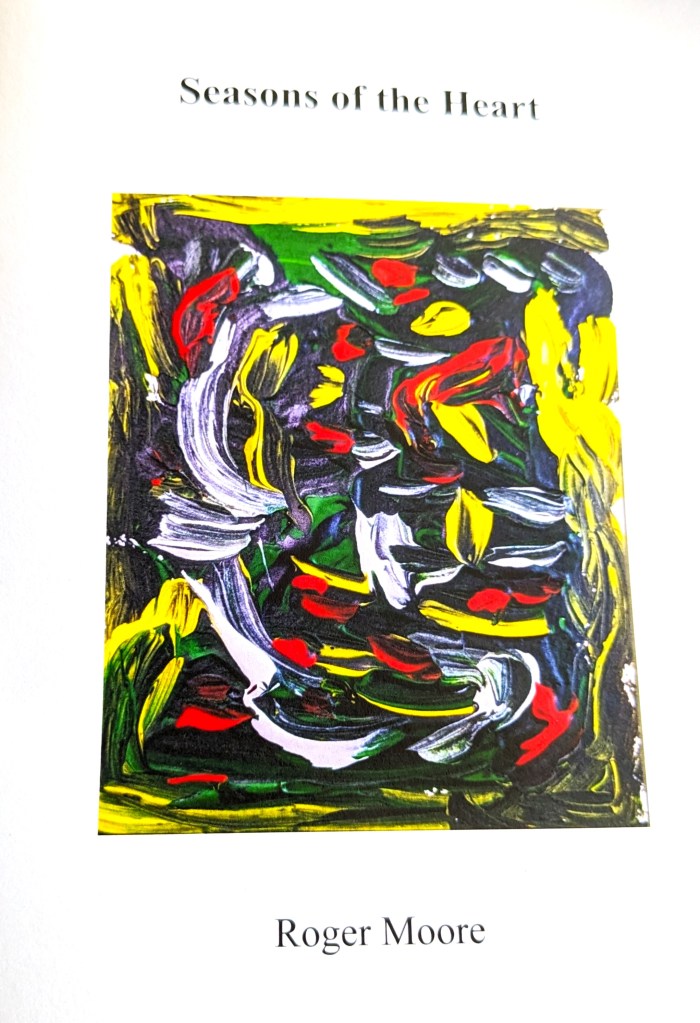
I don’t have a favorite season of the year, nor do I have a favorite Season of the Heart. The book came out today. Hot off the press, it waits to be gifted to my friends and faithful readers.

The heart has multiple seasons, many more than the four with which we endow the earth. The seasons of the heart may occur in any order, for all them may be experienced in a single day. Many will be gifted to us in the brief moments when our modern society allows us the time to meditate and find the inner silence that generates the deepest and most sincere thoughts.

Each heart season – joy, sorrow, remembrance of the past, the dark night of the soul, despair, hope, and there are many more – will recur, some with persistence, others with less frequency.

I enjoy all of them, for different reasons. As Antonio Machado might have written – “In my heart I felt passion’s thorn. When I plucked it out, I was all forlorn for I couldn’t feel my heart at all. Now I’d rather replant that thorn. The pain was better after all.” Remember, wherever there are roses, there are also thorns.

Describe one simple thing you do that brings joy to your life.

Daily writing prompt
Describe one simple thing you do that brings joy to your life.

Describe one simple thing you do that brings joy to your life.

Painting.

I was always told that I couldn’t paint. “You don’t have a clue. Give it up now. You’re wasting your time, and ours.” Same with drawing and any other form of visual and creative art. I tried to build model aircraft – Spitfires and Hurricanes, Gloucester Gladiators, SE5s -. They were ugly, lumpy, had crooked wings, and never flew properly. The few that I managed to launch often fell apart on landing. Same with model kites. The one I did manage to build took off in a half a gale and got stuck in a tree.

Failure!!!!!

Much later in life I re-discovered Henri Matisse. “I make meaning out of shape and color.” Then I stumbled across Salvador Dali’s famous statement: “I don’t know what it means, but I know it means something.” From there I started to take lines for a walk, and moved into cartoons – you will find some earlier on these pages *click here* – or – *click here* – or just explore these early pages for yourself.

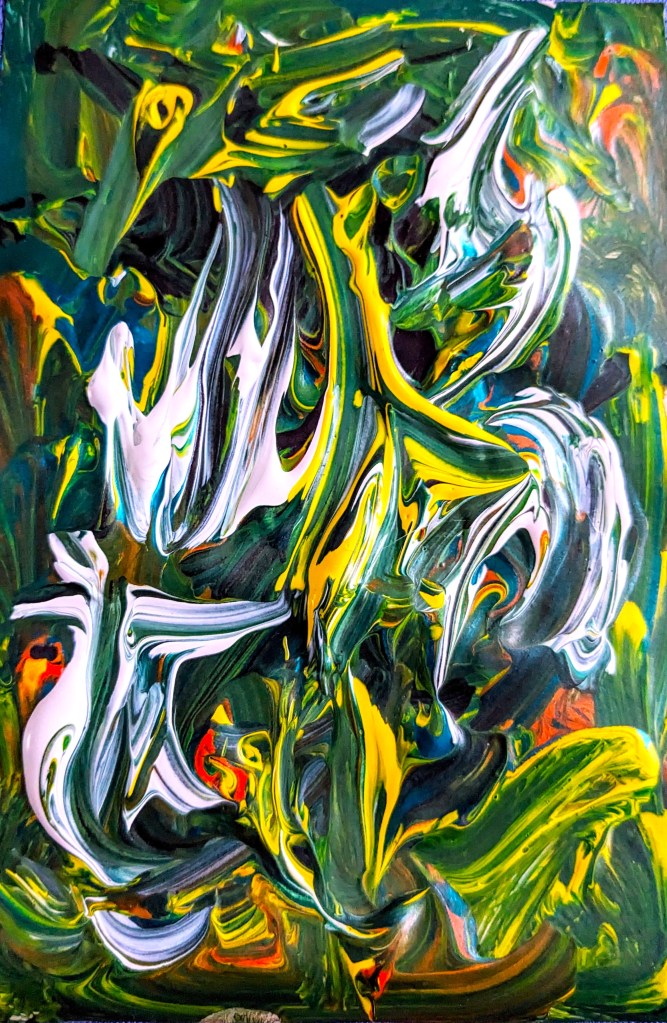
From these cartoons, I moved, with the encouragement of Geoff Slater, the Art Director at Kingsbrae International Residencies for Artists (I was the first writer in residence, June 2017), to actually painting, for the first time, with acrylics on canvas. This led me to my Pocket Paintings / Peintures de Poche, made with acrylics on 4″ x 6″ postcards. What fun. I now have well over a hundred of these and, guess what! – just like my books, I give them away to my friends for free.

These simple, linked acts – writing – painting – gifting – bring me great joy.
Long may it continue.
Pax amorque.

White Space

White Space

A place of silence,
          white space
at page edge,
          bearing witness
to the absence
          of words.

A place to pause,
          rest,
to think.

A place,
          like the white space
between lines of prose,
          where eye and mind
can pause and rest.

Bewildering
          the pounding
of earwig music,
          the advert repeated

again and again,
          the omnipresent
sound byte.

Everlasting,
          the loop, the loop,
the interminable loop
          that intrudes on
silence.

Words

Words emerge
          from the silence
of blood and bone.

They break
          that silence
the day they are born.

Silence,
          once broken,
cannot be repaired.

A word once spoken
          cannot be recalled.

The greatest gift –
           knowing how to be alone,
how to sink into silence.

A world of words
          smothered at birth
and that world,
          dismissed, forgotten,
sometimes still-born.

A lost world of words
          whirled on the silent wind
that fans the unborn fire within.

The spider web of the mind
          blown clear by the wind
that blows unspoken words.

The hush of the tadpole
          swimming
into its own metamorphosis.

The sultry oblivion
          of blood and bone.

Poetry that expresses the authenticity of being. Playful, yes, but packed with meaning. Taste it on the tongue. Savor it in the mind. Touch the words on the page. Indulge yourself in the white spaces between the words. Read and re-read each poem. Dive into its depths. Swim – but do not let yourself drown. When you surface again, return to the light and remember, all will be well.

Illumination

Two Poems to help you find your way in the dark!

1

Suit of Lights

I am a man of straw
          shivered by raw winds,
frosted by the cold
          enveloping this enigmatic body
with its rattle of drying bones.

I walk with two canes,
          not just a sick man,
but a stick man.

My broken body
          hangs on the coat hanger
of my battered bones,
          its worn-out sack
knitted from skin,
          bonded with blood.

The magic hour descends.

Earth glows
          with a different light,
my world is transformed,
          translucent, bright.

A touch of the almighty,
          this beauty surrounding me,
blessing me.

I wear a sudden clarity
          with this suit of lights.

2

Illumination

You must find it for yourself.
         Were I to tell you what it is
and where it dwells,
          the light it brings you
would be warped,
          untrue.

Only
          you can find
that light.

Only you
          can strike the match,
ignite that blaze,
          trap its warmth
in your own bone cage.

Enlightened,
          you must dig and dig,
deeper and deeper,
          until you lose yourself
in a bottomless pit.

When you are lost,
          look up.

In the dark above,
            you will find
a tiny pinhole of light,
          a star to guide,
a glow-worm
          to light your way
in the darkest night.

Silence

Silence

silence
          between words
tranquil movements
          the world
stands still
          suspended
in space

silent space
          between the stars

Aurora Borealis
          soundless night
drenched
          in silent light

listen –
          can you hear
your heart beat

can you hear
          the silence
of your house

time
          sifting silent
through an hour glass
         filled with light
drifting into
          night

Silent Light

Silent Light

Silent light,
          breaking soundless,
dispelling night’s mists,
          lighting up flowers,
so graceful,
          when decked out in light.

At night,
          the moon turns into a mirror,
a silver boat
          suspended in space.

Silent,
          its light enlightening
the heart’s dusky craters,
          the mind’s gloomy shafts,
where hidden treasures hide,
          waiting for the light.

The Value of Space

Space, round an object,
     reveals its aura,
its implicit innocence.

Consider the shimmer –
          a sunlit orange
basking in its basket.

Observe
          the pride of the cat,
nestled on cushions,
          its coat prickling
with sunlight.

Space
          surrounds us.
We walk within it,
          live because of it.

Space
           fills us.
Water
          in our body’s sponge
a part of us,
          as we become
a part of it.

Author’s Notes

We crave the space around us, the silence between words, but invasive noise destroys us, body and soul. We must seek the sanctity of silent light and space.