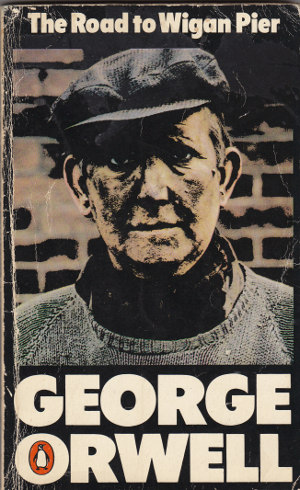
And every valley shall be filled with coal. And the miners will mine, growing old before their time, with pneumoconiosis a constant companion, and that dark spot on the grey slide of the sidewalk a mining souvenir coughed up from the depths of lungs that so seldom saw the sun and soaked themselves in the black dust that cluttered, clogged, bent and twisted those beautiful young bodies into ageing, pipe-cleaner shapes, yellowed and inked with nicotine and sorrows buried so deep, a thousand, two thousand feet deep down, and often so far out to sea that loved ones knew their loved ones would never see the white handkerchiefs waved, never in surrender but in a butterfly prayer, an offering, and a blessing that their men would survive the shift and come back to the surface and live again amidst family and friends and always the fear, the pinched -face, livid, living fear that such an ending might never be the one on offer, but rather the grimmer end of gas, or flame, or collapse, with the pit wheels stopped, and the sirens blaring, and the black crowds gathering, and no canaries, no miners, singing in their cages.
Blood and Whitewash A Thursday Thought 2-September-2021
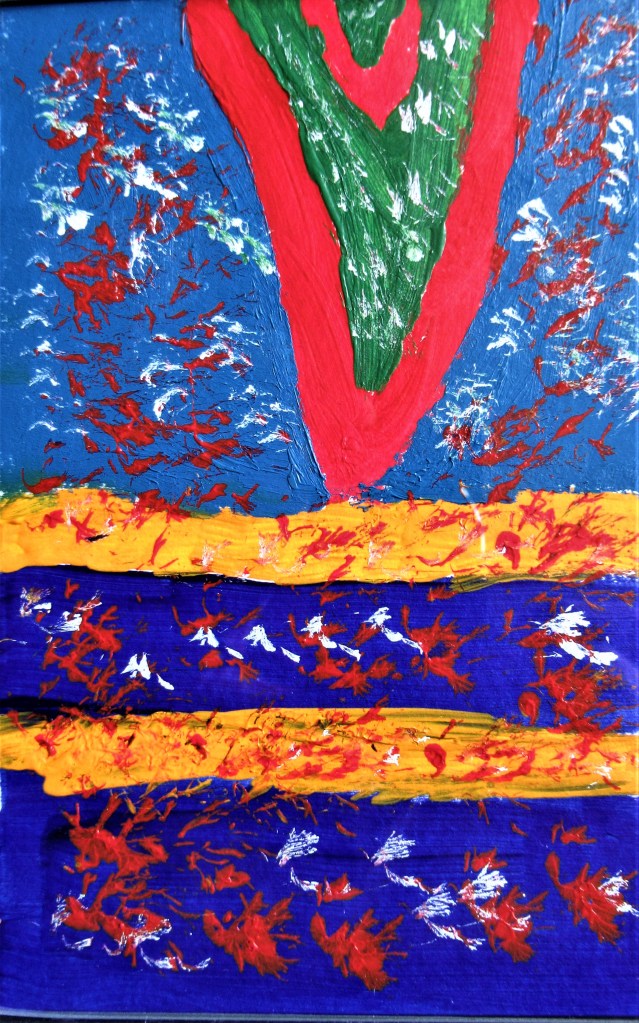
Blood and Whitewash is the title of this painting. It has a subtitle: My Plan of Attack.
The origins of the title, and hence of the painting, go back to the Goon Show, with Spike Milligan, Peter Sellers, and of course / wrth gwrs, Harry Secombe, the Swansea Comedian and Master Singer. Away in boarding school back in the late fifties, one of my greatest pleasures was listening to the Goon Show on one of the dormitory’s transistor radios. As a teenager, I found the jokes and the accents incredibly funny. Still do. That’s why I painted this painting. Alas, it is silent, and you cannot hear the accents.
The following snippet of dialog occurred on one such Goon Show, I cannot remember which.
“What are we going to do?” “Well, this is my plan of attack.” “That’s not a tack, it’s a nail.” “No it’s not. It’s a tack.”
So above you have my painting of My Plan of Attack, resurrected after all those years. I throw my mind back to the First World War.
The General: “He’s a cheerful Cove,” said Jimmy to Jack, as he walked to Arras with his pack on his back. But he did for them both, with his plan of attack.
And there in essence is the history of the painting. First, the plan of attack, then the failure and the blood-letting, and then the white-washing of the whole history, a white-washing that turns failure into success, defeat into victory, and loss into gain. But in WWI, it was the poor Tommies who bore the burden, and all the other front line troops who obeyed orders, went blindly over the top, and charged unbroken wire with fixed bayonets.
“If you want to find the sargent, I know where he is, I know where he is, If you want to find the sargent, I know where he is. He’s hanging on the old barbed wire.”
“If you want to find the chaplain, I know where he is, I know where he is, If you want to find the chaplain, I know where he is. He’s hanging on the old barbed wire.”
“If you want the whole battalion, I know where they are, I know where they are, If you want the whole battalion, I know where they are. They’re hanging on the old barbed wire.”
Singing as they marched to their deaths, obeying orders, like sheep, and nipped on by the eternal sheep dogs. Things were so bad at Verdun that instead of singing, the men marched, bleating, like sheep. “Sheep unto the slaughter.” There was so much ill-feeling and rebellion in the face of orders and certain slaughter, that French regiments were decimated, one man in ten shot for mutiny, as they marched bleating, instead of singing, to their deaths.
“Oh, we’ll hang out our washing on the Siegfried Line, have you any dirty washing, Mother dear?”
“Those who do not learn from history are condemned to repeat it.” So, tell me, “where have all the young men gone, gone to graveyards everyone, when will they ever learn, when will they ever learn?”
And that, dear friends, is my thought for today: The History of My Plan of Attack. When, indeed, will we ever learn?
A duck, in cricket, means the batter has been dismissed without scoring. The 0 resembles a duck’s egg, and hence score of naught is known as a duck! A golden duck means the batter has been dismissed first ball, without scoring, a sad fate indeed. A King Pair is first ball in each innings of a four innings match (two per side).
My cartoon shows an English cricketing duck carrying his bat through a golden shower of life’s purple patches. There are several clichés and double entendres in this title. First, of course, the ignominious duck. Carrying his bat: this has a double meaning (a) to literally carry a cricket bat, as this duck is doing, and (b) to open the batting and carry your bat throughout the innings, un-dismissed, although the other ten wickets have fallen around you. To carry your bat for a duck is as near as impossible as it can possibly be. A golden shower: alas, we are all now familiar with the pornographic version. Some will be familiar with the myth of Jupiter descending as a shower of gold. The golden shower here also represents the shower of golden ducks that has currently descended upon the English cricketing team. Purple patches can be good. However, a purple patch of golden ducks is only good for the opposition bowlers, if you are on the batting side.
England top order quacking and creaking into history of the duck: this article in Tuesday’s Manchester Guardian cricketing section will explain the makings of current duck history for all who are interested. Equally interesting are the double meanings (a) within the verbals of the above cartoon and (b) within the visuals of the drawing itself. For example, the golden duck holes / eggs pecked in the bat, the mingling of gold and purple in the shower falling, the duck eggs woven into the batter’s shirt…
So, here we go, swinging low, swinging to miss, and swinging into history, where batter itself is a neologism replacing batsman as a non-generic term for those who bat, much as bowler, the man, not the hat, is a non-generic term for those who bowl, or fielder for those who field. Now, what on earth are we going to do with ‘gloveman’? Glover, perhaps, or wicket-person, or a return to wicket-keeper, or just a limited keeper? Language is so lovely and the mixture of language and cartoon is is doubly good, as long as everyone is bilingual and can entendre.
Thursday is thought day, but what on earth am I thinking about? Well, yesterday I talked about open and closed imagery in poetry. I also talked about direct meaning and indirect meaning. So today’s thought is in Spanish and I have taken it from a poem of Federico García Lorca (1898-1936). “En la noche, platinoche, noche que noche nochera.” Sense and nonsense: what on earth does this mean? A literal translation gives us “in the night, silver-night, night which en-night-ens (more?) night”. Sense or nonsense? We shall find out. First, I would like you to read this article: https://moore.lib.unb.ca/Scholteach/platinoche.htm
Quite simply, the article discusses the difference between plain speech and poetic language. However, language has a tendency to simplify itself, to reduce itself downwards. Sentences become shorter. Ideas are simplified. Slogans replace thought. Emotion replaces reason. How and why this happens is a mystery, but I can assure you that it has happened throughout history. Just think of the breakdown from Classical Latin to Vulgar Latin to the various Romance Languages and Dialects that have replaced Latin in the areas where it used to be spoken. Break down, eliminate, simplify.
Thursday’s thoughts: why does this happen? How does it happen? Is it accidental? Is it deliberate? Should we follow meekly along and reduce our own thought and verbal processes? Should we just go gentle into that dark, but simplified, night? Should we resist? How can we resist? The answers to those questions will vary considerably. Each person who takes the time to read this will have a different set of reflections. That said, those answers are important, not just to each one of us as an individual, but also to us human beings as an inter-linked chain in society. All poets, all philosophers, all those who care about language, must reflect deeply on how they can preserve it, care for it, and make it mirror the depths, not of their own education, because not all of us privileged enough to be deeply educated, but our own intelligence. I have lived in places where people neither read nor write. It is so easy to dismiss them as ‘stupid’. I can assure you that they are not ‘stupid’ and to think of them is such is to ignore totally the oral tradition, the wisdom tradition, the cultural traditions from which these people come. We underestimate them at our peril.
What can we do? As poets, we can preserve the traditions and dignity of the depths of meaning, logical, emotional, sub-conscious, that is included in poetry. As writers, we can concentrate on using words with care and attention, of making our meaning clear, of elaborating our thoughts in such a way that others can follow them. As readers, we can look at inner structures, the deeper meaning of words, the emotional forces that try to persuade us, sometimes dishonestly, that this or that is best for us. As human beings we can extend our vocabularies, pay attention to words and their effects, and we can stand up for the linguistic and cultural traditions into which we were born, or in which we have chosen to live.
Now, always with your consent and permission, I will offer you the link to yesterday’s blog post https://rogermoorepoet.com/2021/07/28/22862/ Here you will find, if you choose to click on it, and it is always your choice, a discussion on meaning in language that will run parallel to this one.
23 April 1616 > 23 April 2021 International Book Day.
Today we celebrate the anniversary of the deaths of three great writers: el Inca Garcilasso de la Vega (Comentarios Reales, Peru), William Shakespeare (poetry and plays, England), and Miguel de Cervantes (Don Quixote and so much more, Spain).
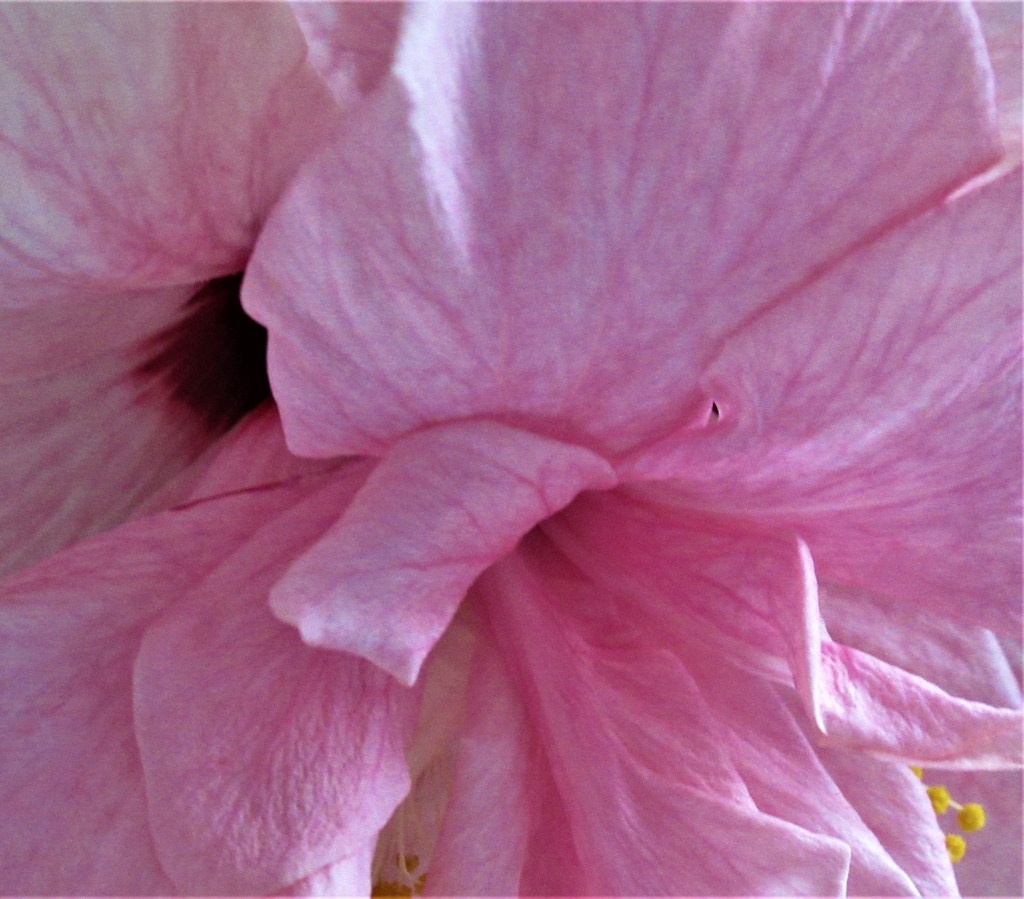
Our hibiscus decided to issue its first official blossom of the year, just to help us all celebrate this day.
Was that where my life went, a spent candle trailing dark studies among the packed lines of your poems?
And you, was your life gutted by that same guttering candle by whose light you scrawled your tight black spider rhymes?
Were they all meaningless, your insights and my words? So few now know who you were and what you represented and I, your scholar, a mere shadow of your shadow struggling in the straggling light of a far-off continent, far from content at knowing so much about you. Intent I was on spreading light and the word to a world that thinks the two of us absurd.
Our world is spinning on its edge, placed on the perimeter of space, and going nowhere. Specks of dust we sit and contemplate the vastness of what exactly: our fortunes, our spirits, our houses, our power, our lands? Out there, in the vastness that surrounds us, worlds without end will never know we existed.
Bleak and blank our names, our deeds, our status, the statues they raise in our praise. And what of our thoughts, those sparks of electricity that link us lip to ear and mind to action and each of our actions transformed by a dance performed by circling planets that shape our wills?
Who programs that universe now? Who plays what trivial games of snakes and ladders in which we are the dots and dashes, pinballs among a million trillion strings of flashing lights?
Codes and Coding Where’s Home? (4) A continuing open letter to Jan Hull.
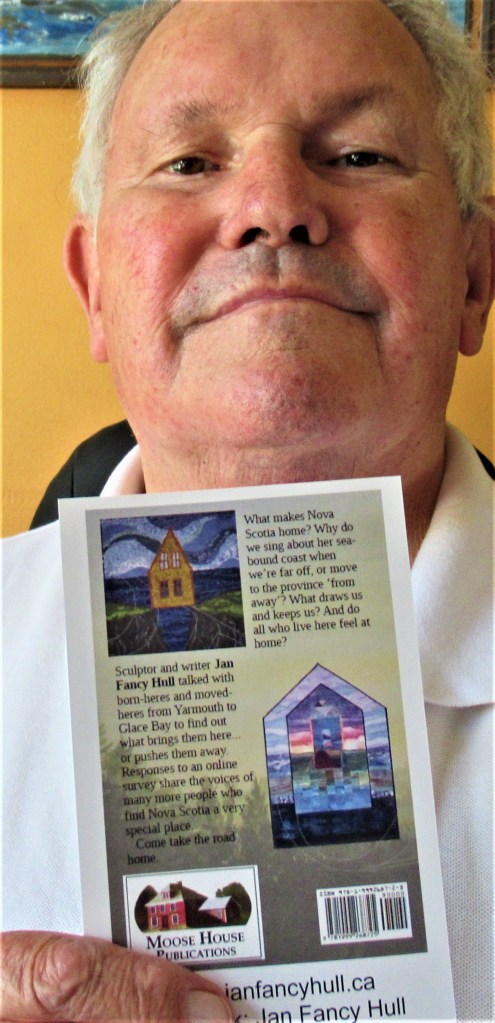
“Languages: they say that to learn another language is to gain another soul and another set of eyes through which to view the world.” I wrote these words on March 23, 2020, on the 22nd day of our Covid-19 lockdown. Why recall this article now? Because Jan Hull talks about Nova Scotian conversational language codes in her book Where’s Home? and her ideas rang a bell and tugged at my memories. CFA, for example, and CBC, and my own invention WAH. Then there are her coffee shop codes of Tim Horton’s and her Burger codes of MacDonald’s, and I mustn’t forget her other small town talking codes of former times and newly named places, must of which are bewildering to the outsider, aka CFA.
Why codes and coding? A rhetorical question, of course. But codes and coding are the basic elements through which language transfers thought, our thoughts. What is a code? Well, we know all about Morse Code and the elaborate codes through which spies from all countries communicate their needs. A code is a way of converting language, changing it, making it available to those initiated in the code and unavailable to those who have not received such initiation. Sounds simple, doesn’t it?
When I was travelling regularly to Spain for research in Spanish libraries, my first port of call was always the local barber shop. I did this for several reasons. In the first place, my Canadian haircut gave me away as a foreigner. This is the hairdresser’s code. The barber’s shop was always the centre of local gossip. Here, buzz words changed hands, politicians were discussed, all the local news was immediately available. Each of these items was a code, a code that made an insider (acceptable) versus an outsider (not to be spoken to). I remember, one summer in Madrid, not getting served in any bar or restaurant. Check haircut: okay. Check shoes: bought new Spanish pair. Check shirt, jacket, tie: all up to date. Inspect lucky customers who are being served … ah … they are all wearing a shiny brass pin showing the symbol of Madrid: El Oso y el Madroño, the bear and the strawberry tree, as seen in La Puerta del Sol.
The next bar I entered saw me sporting El Oso y el Madroño in my lapel. Qué quiere el señor? Immediate service and with a smile. These are social codes, the codes that include the winks and nudges of the upper class, the secret handshakes and foot positions, the names dropped so gently and quietly that they never shatter when they hit the floor. There are also language codes. Northrop Frye wrote The Great Code: The Bible and Literature, a study of the mythology and structure of the Bible, and it was published in 1982. In this wonderful study, Frye showed how themes and language from the bible have influenced the structure of Western Literature, particularly that written in English. Within this code, names, themes, miracles, parables, psalms form a body of common knowledge available to all readers who are christian and whose first language is English.
But there are other codes. Think Courtly Love. Think Petracharism. Petrarch’s poetry, originally written in Italian, was widely imitated throughout Europe. Italian literature, Spanish, French, English, all dip into that code, as does Shakespeare among so many others. Think the Great Chain of Being. Shakespeare is incomprehensible in places unless you unlock this particular code. Think Platonism, Neo–Platonism, Stoicism, Existentialism … okay, so all this is academic, and I do not want to lose you in a sea of academia. So think NFL, think NBA, think NHL, think baseball, think cricket, think rugby, think darts, think all of the things we manipulate on a daily basis in our lives and think how they include some people (those who know and share our codes) and exclude others (those who are unaware of them). LBW, c&b, c. A, b. B, st. A b. B, w, W, b, lb, lbw, dec., RSP … and think of the hand gestures that accompany them! You would have to be an ardent follower of the mysterious game of cricket, as I am, to immediately understand all those letters and signs.
This is a wonderful line of discussion. It follows along the lines of micro-language and macro-language. Macro-language is accessible to all who happen to speak that language. Micro-language in its multidinous forms incarnadine belongs ONLY to those who share the micro community, be it family, household, village, town, county, region … all that is closest and dearest to our micro-hearts.
When I was in Moncton (2015), at the Auberge Msgr. Henri Cormier, I spoke French on a daily basis. Being an academic and a linguist, I was fascinated by the levels of French that were spoken in that small community. Here are the levels I identified: (1) LFI, Le francais international, the central French language that I spoke and everyone understood. (2) Acadian, a beautiful language with regional variations, a different accent and rhythm, and some very different words and phrases. (3) Chiac, the mixed English-French used by the citizens of Moncton, whose wonderful poets are trying to get it established as a literary language. (4) Community French, five families from Paquetville were there and when they spoke among themselves about their home town, references, history, culture were all barriers to those who did not come from Paquetville. (5) Family Groups, and this is easy to understand, for all families have their in-jokes, their coded speech, their conversations that keep the outsider outside of the family group.
It is a fascinating study, that of coded languages, and I thank you, Jan, for re- opening it and reminding me of it.
Right from the address on the envelope where you gifted me a knighthood, calling me Sir Roger, I was captivated by this package.
I opened it at the Beaver Pond in Mactaquac and started to read as Clare did her daily walk, widdershins round the pond. Alas, I missed the great blue heron flying. Ditto, the osprey and the kingfisher. I heard all about them later.
Only you, Jan, only you. You are truly unique. Your words jump off the page, lean across the table to me, and offer me bread and wine. I do hope that this book is the first of many. Your words brought tears to my eyes and hope to my heart.
So many themes that touched me deeply. The loss of language and culture: in this case, French and Gaelic, in my own case Welsh, a forbidden language when I was growing up. It is only now, at an advanced age, that I have started to learn it. What memories it brings back.
The sending of indigenous children to residential schools: in my own case, starting at age six, I was sent away to a series of boarding schools and never escaped until I was 18 years old. Good-bye family and culture: hello loneliness and solitude.
The enforcement of religion, top down, with the vicious punishments that accompanied doubt, unbelief, or non-acceptance. The brutal separation from family, with the whole experience of reintegration into a now-become-foreign world, relocation, loss of roots and culture, the difficulties of not belonging to the new communities.
There is a brighter side too, and I will get to that another day. Meanwhile, congratulations on this book, Jan. May it be the first of many and a delight and revelation to all.
Golden in the starlight, moon carved mountains and valleys, taut the skin, treacherous to the touch. Heavy he is, glowing. He and his children. We carry them to the dark beneath the trees. Locate the secret, sacred place. Dig deep, bury him with the hoard.
We all know the place. Have measured it with footsteps. None will reveal it. Not under torture. Rather our lives than darkness eternal.
My mother limps beside me. Back-bent and broken. A crone in the moonlight. She’s been here before. Much too often. That’s how she bore me. Caught by the heathen. Captured and taken and twenty times taken.
Me, the blond son. Son of sea-raiders. Not black like my brothers. But never forsaken.
Head of the household, her man rejected her. Called for the Druids with mistletoe and magic, herbs and fragrance, scourging their medicine.
She would not drink them. Said she would keep me. Her biggest baby. Blond. To take vengeance.
Behind us, the villa in flames, there in the distance. Smoke rises heavenwards. Blots out the stars. “We should have fought,” my brothers say. “You would be dead,” my mother replies.
Brân, the white crow. King Arthur revenant. I fly the land, my brothers behind me. Black-haired, black-feathered. Strong as the crow flies. We travel at night. Fast now and furious.
My long bow penetrates. Shatters oak shields. Kills at a distance. None can withstand it. Daylight finds us grouped in the forest. Close to the place where the dragon lies buried. Close to my mother, the place where she sleeps.
Oh yes, they hunt us. But they don’t dare find us. Swift is their fate if they come close. Frightened they are, feared by the finding, wordless and dumb at the swift ending.
Comment: It’s an ill-wind, they say, blows nobody any good. So, ipso facto, some good must come from even the worst of things. Maybe, like Charles Dickens, I should write: ‘These were the worst of times, these were the best of times.’ The worst, because we have been under lock down, first voluntary, then involuntary, and now voluntary again, for 83 days. The worst, because we know that many people are dying and that many, many more are suffering. The worst, because we see some people, who think they are above the law, flouting the law and getting away with it while putting other innocent people at risk. The best, because we have seen extraordinary sacrifices made by the humblest people, many of whom, shop clerks, garbage collectors, street cleaners, bus drivers, taxi drivers, nurses, care-workers, house cleaners, were seen, if they were seen at all, as cheap labor to be exploited. However, thanks to CV, we now see them for what they are: the keys to making our lives and our economies function. The best, because where precautions have been taken the death toll has dropped and so have the infections. The best, because once again, we are free to move around so much more. However, many of us, after so long, no longer want to.
For me, safely distanced among the trees in my ivory tower, these have also been the best of times. I have made many new friends online. I have restructured the ordering of my acquaintances. I have gone into my computer files and found things that I cannot even remember having written. One such is Brân, the white crow, who is said to be King Arthur, still alive, and flying everywhere, ready to protect his from the evils that beset them. I do not know when I wrote this piece. Nor do I remember where the ideas came from. In what secret fold of the mind were they born? I do not know. But I do know that I have seventeen manuscripts, many of them rediscovered during this Dickensian ‘best of times / worst of times’, and all of them awaiting publication. This one is from a 67 page manuscript called A Cambrian Chronicle. 67 pages … and I don’t remember writing any of them.
All that I hear
around me:
the mixing and matching
of shingle and stone,
waves hissing,
grinding the beach down
as they move in and out.
Comment: We are surrounded by news, fake news, false news, and systematic deception. What can we now trust? I no longer know. But I do know that the above poem is not nihilistic. It expresses the reduction of applause and insubstantial glory to the minutiae of the daily doings of the natural world, in comparison to which we humans are nothing. “Look on my works ye mighty and despair” … hand gestures, smiles, thunderous applause from the chosen gathered to bear witness and paid to applaud, whatever the event. Alas, I cannot say it as well as Shelley. Here’s his Ozymandias (11 January 1818).
I met a traveler from an antique land
who said: “Two vast and trunkless legs of stone
stand in the desert . . . Near them, on the sand,
half sunk, a shattered visage lies, whose frown,
and wrinkled lip, and sneer of cold command,
tell that its sculptor well those passions read
which yet survive, stamped on these lifeless things,
the hand that mocked them, and the heart that fed:
and on the pedestal these words appear:
‘My name is Ozymandias, king of kings:
look on my works, ye Mighty, and despair!’
Nothing beside remains. Round the decay
of that colossal wreck, boundless and bare
the lone and level sands stretch far away.”