Cooler nights have brought a touch of frost to higher ground.
At night, temperatures fall. By day, they build.
I watch as Autumn, finger on lips, tiptoes through the garden.
2
With a wave of its wand, winter threatens.
A gust of wind swirls the leaves, bears tufts of snow dancing round the tree.
I watch as my grandchild grows, my child grows older.
She has a gentle touch of frost, a grey fringe at the curl’s roots.
When I glance in the mirror, I see the full effects – drifts of snow gathered on my head.
I look at my beloved. Her hair – a crab apple tree in full spring bloom.
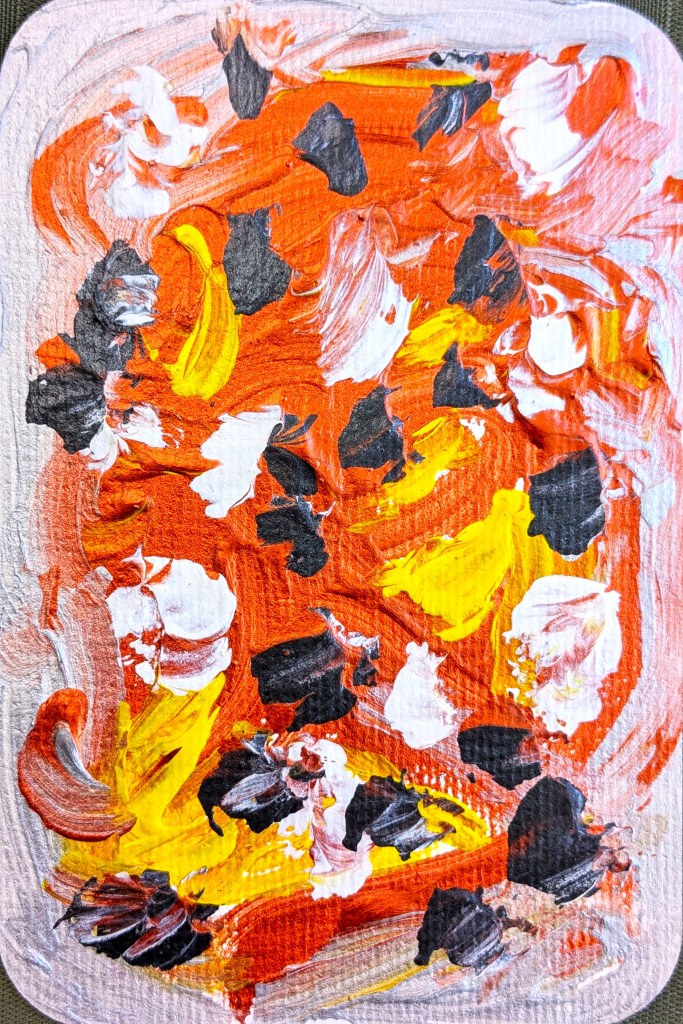
Comment: Nice to add a new poem of my own to this poetry page. Today’s poem came as a result of discovering Moo’s painting – A Touch of Frost. Painting and poem, painter and poet – a great collaboration.
When Covid struck in Avila, Spain, a small walled city, the abulenses (the Spanish name for people who live there) were confined to their houses and apartments. They got their exercise by walking on their balconies, or walking around their living quarters, however small, again and again.
When I was young, I traveled regularly to Bristol Zoo. The lions and tigers paced restlessly in their cages, or else just lay there, soporific. Maybe their food contained the drugs that curbed their violence. I never asked. But I do remember that relentless padding from one side to another. In the aquarium, the fish swam around and around going nowhere. The same with the seals and the penguins. Alas, they were only animated by feeding time, when the attendants appeared with their buckets of fish. Then the animals came alive and dived, jump, swam, and responded to the food thrown to them to entertain the watchers.
And it was somewhat similar in Avila – the restless pacing, the circuit of the room, the movement to the kitchen or the fridge. Some people lost weight, but many put it on. They got up from the chairs in which they were sitting, walked to the fridge, opened the door, took out a beer or two, and returned to their chairs in front of their tv sets. Language is always renewing itself and, in times of difference and stress, we invent new words. This routine became known as El Paseo de la Nevera– The Stroll to the Fridge.
Now, as my age increases and my energy grows less, a similar thing is happening to me. I count my steps as I limp around the house, hobbling from room to room. I aim for 2,000 steps a day, but sometime manage more than that. I go out, in good weather – not raining, not too hot, not too humid – and time my walks around the garden. I am unable to count my steps when I lean on my Rollator as my hands do not move and they must be in motion, if I am to keep a record on my watch. When walking, I stay as close as possible to the shade and try to keep cool. Each day, I try to walk two or three times in this fashion. Sometimes I even manage four outings at 15 minutes apiece. Occasionally, especially if I go shopping as well, leaning on my shopping cart, I may even manage an hour’s walk or more. When I achieve my targets, I feel fulfilled and satisfied.
While walking in the garden, I do one of two things. (a) I concentrate on the flowers, the ants beneath my feet, the weeds, the moss, the birds, the way nature grows and blesses me. Or (b), I pretend I am back in Avila, or Santander, or Brandy Cove, or Pwll Ddu, or Bishopston Valley, and as I walk, I visit my favorite bars and talk to the family and friends that I miss so much and haven’t seen for so long, most of whom I never hear from nor will ever see again.
And these are my travel plans – to continue doing this for as long as possible. To walk regularly. To continue to dream as I walk. To rejoice in the sunshine of my garden. To survive – and to enjoy each moment that I am permitted to do so.
Good question. A better one might have been – “Did you have your own bedroom as a child?” The answer is “No, I didn’t. Not that I can remember.” As a war baby, I was moved around quite a bit in my childhood. I remember sleeping in three different bedrooms in our first house. Then we moved in with my maternal grandparents, and I slept in three more bedrooms, often in the same bed with one or other of the grandparents, sometimes on a makeshift bed on the floor. Later, or it may be around the same time, those early childhood memories are so hazy, I went to live with my parental grandparents – three more bedrooms there – same conditions. The family also had a bungalow close to the beach on the Gower peninsula. It had three bedrooms and I slept in all of them, under similar conditions, and seldom alone, until my later years.
I was bundled off to boarding school while I was still a child. Two dormitories at the first boarding school. I was between six and eight years old, and the memories of that school are not sharp, though I recall with total clarity the canings and the shaming of myself and the other young children. It was a religious school. And I need say no more on that subject.
My second boarding school , a preparatory school, saw me inhabiting four dormitories that I can remember. My clearest memory of that place is running away one night, only to be brought kicking and screaming back to the place. Both my parents worked. During the holidays, I was shipped around to various members of the family – aunts, uncles, and grandparents. When I left that school, for the last time, age eleven, my grandparents drove me to my new forever home in a city far from my birthday place. There, three bedrooms witnessed my sleeping habits.
My third boarding school, the Junior School of a larger college, provided me with two dormitories, one per year while I was there. This was the time at which I started to travel with my mother during the vacations. A coach tour on the continent once saw us visiting six countries in two weeks, and that wasn’t the only coach tur I did with her. A succession of hotel bedrooms, then, and no nocturnal stability at all.
I stayed in my fourth boarding school, the Senior School of that Junior School, for five years and received a new dormitory each year. From there I went to study in Paris – more bedrooms – then down to Spain for the summer courses at the International University in Santander, but by now, age eighteen, my childhood was over.
So, a quick count shows that I slept in at least twenty-five bedrooms during my child. And that’s without counting holiday hotels, flats, apartments, and other forms of lodgings, including Youth Hostels.
So, remind me – what was the question? Ah yes, I remember now. “Do You still sleep in your childhood bedroom?” Well, my friends and readers, the answer is a very loud “NO!” Think about it – how could I have? I am not sure that I even had a childhood bedroom!
Which food, when you eat it, instantly transports you to childhood?
That’s an easy one – diolch yn fawr / thank you very much – and the answer is Bara Lawr / laverbread of course.
What does laverbread taste like? I must thank Wikipedia for the answer below.
Welsh Laverbread is made from cooked laver (seaweed) which has been plucked by hand from the Welsh coastline. It has a unique texture and salty flavour which provides a taste of the fresh, Welsh sea. Laver or Laver porphyra umbilicalis is the only seaweed which is only one cell thick.
Laverbread could be found all around the Gower Peninsula in my childhood. When I was very young, you could buy it at Swansea Market for three pence a pound. Later, the price went up to sixpence a pound. When I lived in Cardiff, back in the early sixties, it sold at a pound per pound. Later, as the coast around Wales became more and more polluted, the sea weed had to be imported from the West of Ireland, and that certainly drove the price up – five pound a pound in the eighties.
But laverbread has two histories – the scientific / culinary one, and the personal one. Laverbread, on the plate, looks suspiciously like a cowpat. So much so, that when the cows visited the bungalow field where we had our summer home, the cowpats were called laverbread. “Don’t step in the laverbread, dear.”
Field rolling was a childhood joy. Start at the top of the slope and roll all the way down to the bottom. Born and bred in a laverbread field, we would plot our route between the patties before we rolled. Alas, our London cousins, with their cockney accents, were city and street wise, but not laver bread wise. Down the field they rolled, without looking, right through the laverbread patches. I leave the ensuing scene to you imaginations – and remember that the bungalow had no electricity in those early days, and no running water.
I remember the first day my beloved came to visit us at home. My mother served her fresh hot laverbread. Of course, she had never seen anything like it, except genuine Somerset cowpats. She picked around her food, left the laverbread on her plate until it cooled and – “Hold on a moment,” said my mother, “your laverbread’s cold. Here – I’ll warm it up for you.” Poor Clare. I am ashamed to say, I ate her helping while my mother was looking elsewhere – just devoured the extra portion, enjoying every moment, and Clare was so happy to see it disappear.
Here, in New Brunswick, while Clare was away one weekend, Becky and I decided to make laverbread from dulse. We followed the recipes and they worked. The laverbread was delicious – but – ah yes, there’s always a but – but the house stank of the sea shore at low tide and the first thing Clare said when she got home was – “What is that awful smell?”
I remember, opening a closet to get a clean shirt, about six weeks later, and that familiar whiff of the seashore immediately assaulted my nostrils. Alas, Becky and I love our laverbread, but -there’s that word again – but making it in our house long been banned.
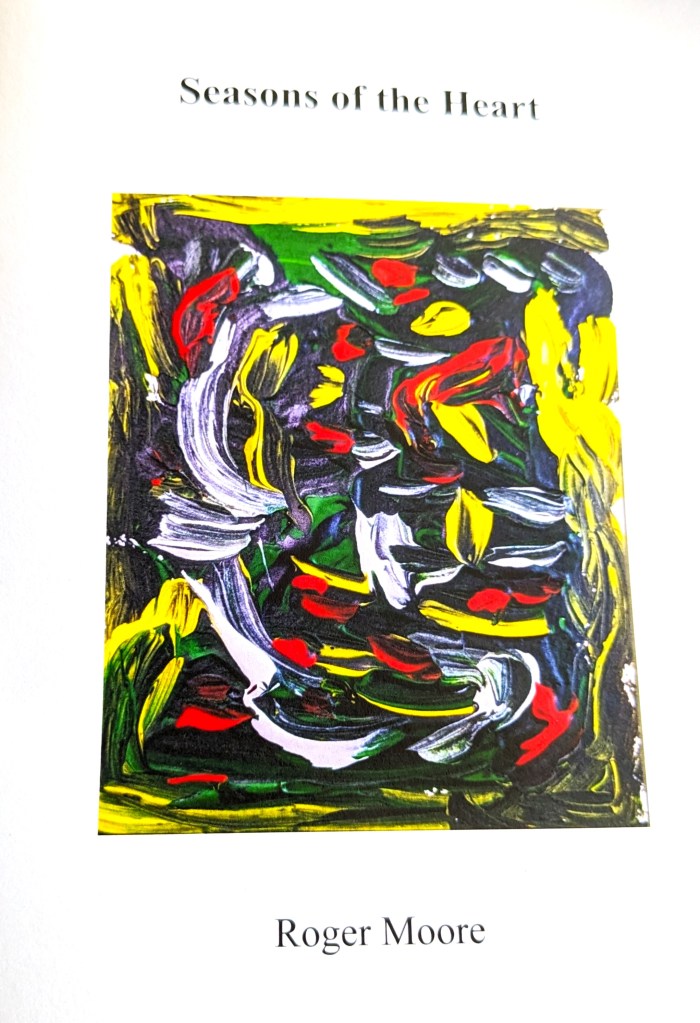
I don’t have a favorite season of the year, nor do I have a favorite Season of the Heart. The book came out today. Hot off the press, it waits to be gifted to my friends and faithful readers.
The heart has multiple seasons, many more than the four with which we endow the earth. The seasons of the heart may occur in any order, for all them may be experienced in a single day. Many will be gifted to us in the brief moments when our modern society allows us the time to meditate and find the inner silence that generates the deepest and most sincere thoughts.
Each heart season – joy, sorrow, remembrance of the past, the dark night of the soul, despair, hope, and there are many more – will recur, some with persistence, others with less frequency.
I enjoy all of them, for different reasons. As Antonio Machado might have written – “In my heart I felt passion’s thorn. When I plucked it out, I was all forlorn for I couldn’t feel my heart at all. Now I’d rather replant that thorn. The pain was better after all.” Remember, wherever there are roses, there are also thorns.
A double meaning of course / wrth gwrs. (a) to be in a place of grief and (b) to do something in place of grief i.e. instead of grief. Take your pick. One of my close friends immediately called it Chains. I replied – Ray Charles – “Take these chains from my heart and set me free.” Sometimes, with a great effort, we can do that ourselves. But, if the hole we have dug for ourselves, or that has been dug for us, is too deep, then we may need help.
Creativity is always a help. Painting and poetry, for me. And sometimes the hand of friendship, reaching out from the anonymity of hyperspace – the space beyond the space in which I live and with which I hold my Bakhtinian Dialog what he calls my chronotopos – my dialog with my time and place. Alas, sometimes it is a monolog – and then, when I get not reply, either from time nor from place, I feel an existential grief.
Door
A door slammed shut in my heart.
That closed door left me outside, shivering in the cold.
Now I no longer know who or what I am.
The shadow of nothingness wraps its black shroud around my shoulders.
Dark night of the heart, and me alone, walking an unlit road with no end in sight.
(a) The shadow of nothingness is Meister Eickhard’s Umbra Nihili. A reference to the medieval philosopher.
(b) The dark night of the heart is a reference to St. John of the Cross’s dark night of the soul, part of the Via Purgativa, the mysterious road walked by the Mystics.
After a two-week lay-off, the Dance of Colors returns. What caused the lay-off? Absolutely nothing. I grew tired of posting, of writing, of throwing my paint on the waters of the web and waiting to see what, if anything, happened. Well – nothing happened.
Steven King, On Writing, says “Paper your walls with rejections.” And I have done, pages and pages of them. The secret is ‘never surrender’ – ‘never give up’ – or, in the language of the WWII Prisoner of War Camps – Nil carborundum illegitimi. You can Google the meaning, if you can’t read Latin. It is a euphemism for ‘never despair’.
Rejection is one thing. Silence is something else. When I check my notebooks I find submissions, some sent several years ago, that are still unanswered. There is simply no response. It is as if the writer – submitter – does not exist, is not even worthy of a form letter.
I ran into that wall of silence during this two week lay-off. Does it matter? Probably not. The creation of art is as much a monologue as it is a dialogue. Bakhtin calls it ‘a creative artist’s dialogue with his time and place.’ I think of it as ‘this creative artist’s monologue with his time and place.’
Footsteps – I leave them here, I leave them there, you can find those footsteps anywhere. But beware the footsteps left on the beach at low tide. You will not find them on the beach the day after you leave them. The tide will have risen and washed them all away. In spite of that, some footprints are here to stay.
Winter-low sun in my eyes, I sit at the breakfast table blinking back rainbows.
Light quivers into fragments. Too much light and my world turns dark. I can no longer see the computer screen, nor am I able to write in the old-fashioned way with pen, ink, and paper.
To continue working, I must lower the blinds or move to the other room away from the sunlight.
Another option: to forget deadlines and schedules to lay down my pen, to close my eyes, to bask in early morning pleasures, purring like an ageing cat enjoying the sun.
Comment: A Golden Oldie that suddenly surfaced from “among my souvenirs”, as Connie Francis once sang. Or was it twice? Sunshine is certainly a magic balm for old bones. Only now am I starting to understand the wisdom of animals, that old dog, lying in the sun, the ageing cat curled up in a sunny window, the ancient donkey, seeking warmth, away from the shade. Such joy in the small things that make life so much better.










 rogermoorepoet