Monkey’s Clockwork Universe

Monkey’s Clockwork Universe

Some days, monkey winds himself up
like a clockwork mouse.
Other days he rolls over and over
with a key in his back like a clockwork cat.

Monkey is growing old and forgetful.
He forgets where he has hidden the key,
pats his pockets, and slows right down
before he eventually finds it
and winds himself up again.

One day, monkey leaves the key
between his shoulder blades
in the middle of his back.

All day long, the temple monkeys
play with the key, turning it round and round,
and winding monkey’s clockwork,
tighter and tighter, until suddenly
the mainspring breaks

and monkey slumps at the table
no energy, no strength,
no stars, no planets, no moon at night,
the sun broken fatally down,
the clockwork of his universe sapped,
and snapped.

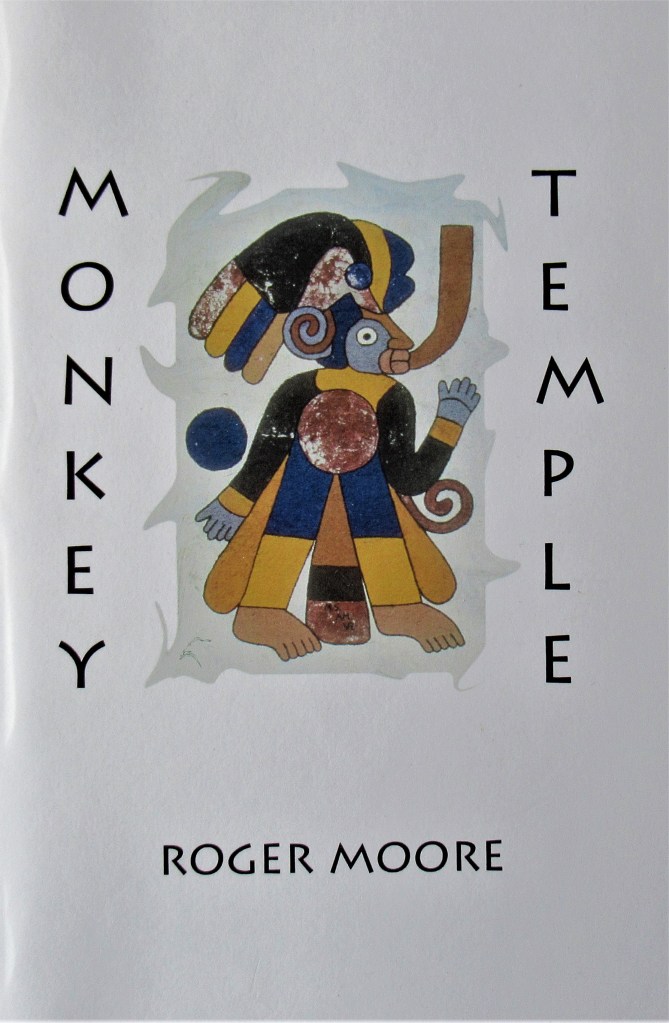
Comment: a big thank you to all who have reminded that yes, I did write this book, and yes, it is one of my favorites. Oh those naughty little monkeys. For those of you who have read the book or heard me reading poems from Monkey Temple, all is well in Monkey Land and the King of Harlem, with a wooden spoon, still gouges out the crocodile’s eyeballs and beats the monkeys on their backsides, with a wooden spoon. I thank my old friend, Federico Garcia Lorca, for that wonderful vision from his own book, Poet in New York.

Flight

Flight

Such a miracle: those first steps to flight
taken by the cormorant over water.
That first one heavy, creating ripples,
the second one lighter, and the third one
scarcely touching the water.

The need to take flight lies deep within me.
Fleeing from what? Flying towards what?
Who knows? All I know is that the future
lies ahead where my bird’s beak points and
the past, a rippling wake, lies behind me.

That white water, trailing its kite’s tail,
tells me where I have been. Machado’s
voice calls out from the past: “Traveler,
there is no road, just a wake across life’s sea.”

Comment: The photo is a golden oldie, one of the first I ever posted on this blog. The poem is part old, part new. In reality, it is a revision, completed today, of the earlier poem associated with that old blog post. It is interesting to compare the two visions – with those seven extra years of creative experience between them. Let me know what you think!

A special thank you to my long-time friend, Dale Estey, for commenting and suggesting an improvement for the fourth line. Spot if if you can!

The Rover’s Return

The Rover’s Return

The eternal return to The Rover’s Return,
renovated, again and again, but filled
with the ghosts of Ena Sharples and others
who walked this cobbled street before,
and every episode more or less the same,
though décor, characters, accents change
and life becomes ever more complicated
from episode to episode, the street slang
changing slightly, and ageing characters
ageing more and more as time goes by,
and yet the trumpet’s martial sound,
the rhythms of the northern brass bands,
the first of those accents to break the plum
in the mouth snobbery of Oxford English
and the BBC’s domination of the language,
and ‘hey, Mr. Oxford Don, me no graduate,
me immigrate,’ echoing round the abandoned
buildings where the working class once worked,
and the elderly were cared for by their friends
and neighbors, not tossed into care homes,
and abandoned to their fate, as they have been
so often of late, and all things change, in time
with the clocks that tick-tock forward, their clock
work everlasting, and the pigeons still there,
and those crazy chimney pots, and that cat,
slithering down the roof, and the rovers still roving,
then returning, once again to the Rover’s Return.

Click here for Roger’s reading.

Comment: For more than sixty years I have listened to Coronation Street and some things have never changed, the trumpeter from the Brass Band, the rain on the cobbles, the memories and ghosts that linger among brickwork and paint. It takes me back to my childhood, when ITV was the upstart channel that dared to challenge the might of the mighty, one might almost say, the almighty BBC. And now, here in Island View, I turn away from the color and recall the old black and white sets, with their selection of two channels, one of them advert free, and their scheduled times of programs, not the TV blaring twenty four hours a day and two hundred channels available at the touch of a button.

It’s all one sentence, though I had to stop and take a couple of breaths while reading it. My good friend and fellow poet, Jane Tims, has called me ‘the master of the long sentence,” and I do love long sentences, especially when I am in rant mode, like now. But I am also very much aware of other friends that warn me that “your sentences are too long. They are too complicated. I don’t understand them. Write shorter sentences.” OMG, FFS. LMA* – 4 – UAW** – IMHO.

Translation of unusual terms: LMA* = Leave Me Alone. UAW** = You aRe Wrong.

Acknowledgements: My quote from the poem, inaccurate, and from memory, is from John Agard, whose poetry I love. I acknowledge now his poem and its influence upon me. I too am no Oxford don, and I too am an immigrant. His wonderful reading of the full poem can be found here. John Agard, Oxford Don.
White Wolf

White Wolf

The white wolf of winter
exits her den-warmth and
shakes snow from her coat. Flakes
fly, whitening the world.

She points her nose skywards,
clears her throat, howls until
cold winds blow their chorus
of crystals, crunchy crisp.

We cower behind wooden walls,
peer out through frosted glass.
The white wolf draws near and she huffs
and she puffs until door frames rattle.

The snow drifts climb higher,
blotting out the light. Night
falls, an all-embracing
Arctic night of endless
snow snakes slithering on
ice-bound, frost-glass highways,
side roads and city streets.

Outside, in the street lights’
flicker, snow flies gather.
Thicker than summer moths,
they drop to the ground, form
ever-deepening drifts.

Our dreams become nightmares:
endless, sleepless nights, filled
with the white wolf’s winter
call for snow and even more snow.

Click here to hear Roger’s reading.

A book is a book is a book

A book is a book is a book

“If one cannot enjoy reading a book over and over again, there is no use in reading it at all.” Oscar Wilde

A good friend of mine once told me that her creative writing writing prof in the MFA program told the class: “We are not writers. We are re-writers.” Our mission in life, then, is not just to rewrite, but to think and to revise. The art of writing lies in analysis, research, thought, and thinking carefully about (a) what we are about to write and (b) what we have just written. As a great Spanish writer once said “I write as I speak and when writing I count my syllables.”

So can the same principle be applied to reading? In my undergraduate poetry courses, one of my wiser profs announced that “It is better to read one poem a hundred times, than a hundred poems once.” Is re-reading better than reading? Good question. But it is what I call a swimming pool question: it has shallow ends and deep ends. Joke – it depends, you see, upon the quality of the material one is reading. For example, does a single reading of the Bible suffice? I read it through, page by page, when I was twelve years old. Was that it? No, I still return to it – the good book – from time to time, selecting, remembering, checking, looking for comfort, advice, or sometimes, pure joy in the sound of the language – King James version, of course.

What other books have I read and re-read? Lazarillo de Tormes, Don Quixote, The Hobbit, The Lord of the Rings, The first book in the Harry Potter series – it reminded me of elements of my own childhood, especially the cupboard under the stairs. Been there, done that, got the tee shirt. The Wind in the Willows, Gongora’s Polifemo, Quevedo’s Metaphysical Poems and his Cycle to Lisi. Octavio Paz’s Sunstone / Piedra de Sol, Lorca’s Romancero Gitano, his Poet in New York, and his plays. Platero y yo. Charlotte’s Web. Several of Shakespeare’s plays, including McBeth, Henry V, King Lear, and a couple more. Rudyard Kipling’s Kim and Stalky and Co. Mary Gentle’s Golden Witchbreed. Robert Bly’s Morning Poems, Iron John, The Sibling Society. Unamuno’s The Tragic Sense of Life and his Niebla. Enough, no more. It is not as sweet now as it was before. And there are so many more to which I have returned, again and again.

So, think about all the time wasted on trivial books, books that remained unfinished, books that have never been opened. One person’s vegetarian or vegan’s fare is a carnivore’s poison [sick]. Sometimes a book mirrors our thoughts. Sometimes it challenges us to rethink our lives and our philosophies. Sometimes it comforts us or takes us back into our childhood. And sometimes it just bores us and we cannot finish it.

A rose is a rose is a rose. A book is a book is a book. Or is it? We are not readers – we are re-readers. And if we aren’t, we ought to be. Think about that. Carefully.

Loss

Loss

By the time I remembered your name
I had forgotten your face,
and then I couldn’t recall
why I wanted to talk to you
in the first place.

Words and phrases bounce,
water off a duck’s back.
They sparkle like a high tide
rejected by the retriever
as he shakes his coat dry
on emerging from the sea.

This book I read is a word parcel,
a clepsydra of droplets,
a rainbow strung with colored beads,
each scouring a bull’s eye
on the world’s taut literary hide.

Mapa mundi of forgotten lands,
I trace dark landmarks
on the back of scarred hands
and wonder why I have never visited
faraway places with strange-sounding names.

Tourist guide to a failing memory,
I track the trails of drifting ships
as their white sails vanish,
blank butterflies from a distant summer,
floating over a darkening horizon.

Click here for Roger’s reading on Anchor.
Loss

To be a writer (Revised)

To be a writer
revised version

To be a writer ….

Those who would true valor see,
let them come hither.
One here will constant be,
through foul or fair weather.
There’s no discouragement
will make her once relent
her first avowed intent,
to be a writer.

Those who beset her round
with dismal stories,
do but themselves confound:
her strength the more is.
No blank page can her fright,
she’ll with a sentence fight,
and she will have a right,
to be a writer.

Rejections nor false friends
can daunt her spirit.
She knows she at the end
will a book inherit.
So critics fly away,
she’ll fear not what they say,
she’ll labor night and day
to be a writer.

Click here for Roger’s reading on Anchor.
To be a writer

revised version

Comment: I first wrote this poem in January 2021. It is, of course, a rewriting of John Bunyan’s hymn / poem, To be a pilgrim from Pilgrim’s Progress. In the original version, I kept the male pronouns. However, after collaborating as the only male participant in [Quick Brown Fox] Brian Henry’s Advanced Writing Group of 13 fantastic women writers, I realized that the female pronoun was, in so many cases, the most appropriate one. I therefore made the necessary adjustments. You can find the old poem at this link – personally, I prefer the new version! https://rogermoorepoet.com/2021/01/11/to-be-a-writer/

Sisyphus

Sisyphus

Long gone, those good old days, dead and gone,
their centers collapsed in on themselves
unable to hold on to time’s hands
circling the clock of ages, that timeless rock.

Beyond these days, long days when light will fail
to enlighten, eyes will be dimmed, the burden
will grow heavier and even more heavy
with life lying in wait, to weigh us down,
always lying, and the lies themselves
more rocks added to the pile we must carry.

Carrying them is one thing. Rolling them up
this endless hill only to have them roll down,
again and again, forcing us to stoop once more,
not to conquer, but merely to live our lives,
to journey onwards, relentlessly, to endure
from the beginning of the end until the last,
and we must endure, will endure to the last.

“Il faut imaginer Sisyphe heureux.”
Albert Camus

Click for Roger’s reading on Anchor.
Sisyphus


Starless Night

Starless Night

Night without moon, without stars.
Dark sand dropped filling my mouth.
I walked the lonely bed of a dried up river.
When I stumbled in my dream,
my feet left no marks on the sand.  

Colorless was my path
through shadow and shade
where a thousand figures of darkness
danced before me,
hollow their eyes,
their mouths black caverns.
No flesh decked their bones
and no night birds called.

Footless the earth worm
sighed a sibilant song.
Mindless he drew in a net
full of sorrows, silver fish
darkling losing their sparkle.

The dusky shawl of knitted dreams
wrapped itself around my shoulders
and I picked at knots of tangled memory
that bled like fresh wounds.

Click here for Roger’s reading on Anchor.
Starless Night

An Experiment Gone Wrong

An Experiment Gone Wrong

Not everything turns out the way you want it to, and some experiments are total failures. Just look at the poor snowman in these cartoons.

On the left – “I won’t believe in global warming until April or May.”

On the right – “April May be too late.”

Oh dear – all those crows and doggy dump time. How embarrassing.

As for me, I tried painting today with my paint and draw kit on my computer. What a disaster: I handle a mouse even more clumsily than I handle a paint-brush. I was going to publish the ‘first attempt’ as a warning to others. But it wouldn’t convert. So I looked for a better idea: no innovation and back to the tried and true.

Oh Moo of little faith.

This isn’t a poem, so there’ll be no sound track with this one. “Oh brothers and sisters I bid you beware – of giving your heart for a snowman to tear – especially when the sun is warming the air.”

“Do you like Kipling?”

“I don’t know, I’ve never kippled.”