Self-Portrait

Self-Portrait

I smell. I whiff. I gloriously stink.
My arms, my feet, my crotch, reek with beauty.
This is me. I am still alive. I’m rank.
The time has come, the Walrus said, to take
a shower. I strip. I weigh. I obey.

Hot water streams. Bathroom steams up. I draw
faces on grey glass, smiling, glum. Soft soap
works its miracle turning Japanese
nylon into a rough body cloth that
rubs and cajoles all putrid dirt away.

Butterfly from its chrysalis, I step
from the shower, sniff with caution, and stench
no more. I am clean. I no longer pong. 
My body has been taken over by
perfumes no longer mine. Who am I now?

I am no more myself. I am no more
my own gorgeous underarm muscular
ripeness. I have left my odor circling
in the soap suds and drifting down the drain. 
What a pain. It will take me a week or 
more to start smelling like myself again.

Clepsydra 6 & 7

Clepsydra 6 & 7

6

… I say I walked alone
     along a long lonely road

nobody could cross that threshold
     nor enter that inner sanctum
          where hungry metal monsters
               lay in silent ambush waiting

nobody could share that sacrificial altar
     the single bed with its iron frame
          on which I lay on my own waiting

uniformed attendants
     locked themselves
          behind their concrete defences
               away from the radiation
                    so dangerous

while I waited
     for those circling stars
          that would burn
               and scar me
                    to descend …

7

… and single beds
     were only meant for one
         
just me
     strapped in
          tied so tight
               lying motionless
                    as I waited for
                         the bed to rise …

upwards
     into that dark night of the soul
          and I the sole sufferer
               under a claustrophobic sky

behold my body
     a mass of red and green striations
          burned by pin-pricks of light
               walking across my body
                    follow the red map
                          painted on my body

burns and blisters
     body and mind scarred
          scared by knowing
               all this suffering
                    might be in vain

others walked this road before me
     some never returned
          empty places at breakfast
               hushed whispers
                    faces turned away

when the tide turns
     it brings with it
          the joy of life
               a spark of hope
                    life’s waters
                         resuming their flow …

Comment:
All that happened to me ten years ago – but the memories are still fresh in my mind. At night, I often watch those planets circling, closing in, those star ships, guns blazing, burning my skin. So many of us have walked that lonely path, lain on that bed, faced those demons. Holst’s Planets – it amazes me that the music still plays in my mind, the celestial dance still goes on in the ballroom of my head, and the memories refuse to fade, though the burns on the skin have vanished and are long gone.

Clepsydra 4 & 5

Clepsydra 4 & 5

4

… candles and the clepsydra
     marking time
          witnessing
               the transition
                    from day to night

drip-by-drop
     falling water
          flickering candle flames

less certain
     than the monotonous
          tick-tock
               of a pendulum clock
 
time and tide
     wait not
          for ship nor man

though time is marked
     on calendars
          and prison walls

days passing into weeks
     spring into summer into autumn

daylight lengthening
     shortening
          until bleak mid-winter
               comes again …

5

… black midnight
     all is lost
          who now can count the cost

stiff upper lips
     forget how to pray
          fingers clasping
               unclasping
                    never grasping
                         life’s simple flow

with silent steps
     planets and stars
          slowly turning
               writing out our lives

sun by day
     moon by night
               the sky alight
                    with shimmering fires

midnight curtains
     burning lights
          crazy curtains
               drawn in night’s sky

a lost dog hurls
     his coyote cry
          who on high
               now listens to his call

not the planets
     nor the Archer
          nor the dog star
               who never barks
                     anything
                          but summer’s flames

pity the poor dogs below
     bitches in heat
          waiting alone
               for their lover’s paws
                    their welcome snuffles

locked and bolted
    the door
          heightened
               the canicular heat …

Rock

Rock

You are the rock
on which I build
my life.

You are the fairy castle
planned in paradise
where the sun always shines
and stress is distant.

How often have I mapped
your inner islands,
traveled your well-known ways,
always discovering
new sacred spots
where I can immerse myself
in your inner serenity?

You are the fortress
within whose walls
I can forget my past
and create my future.

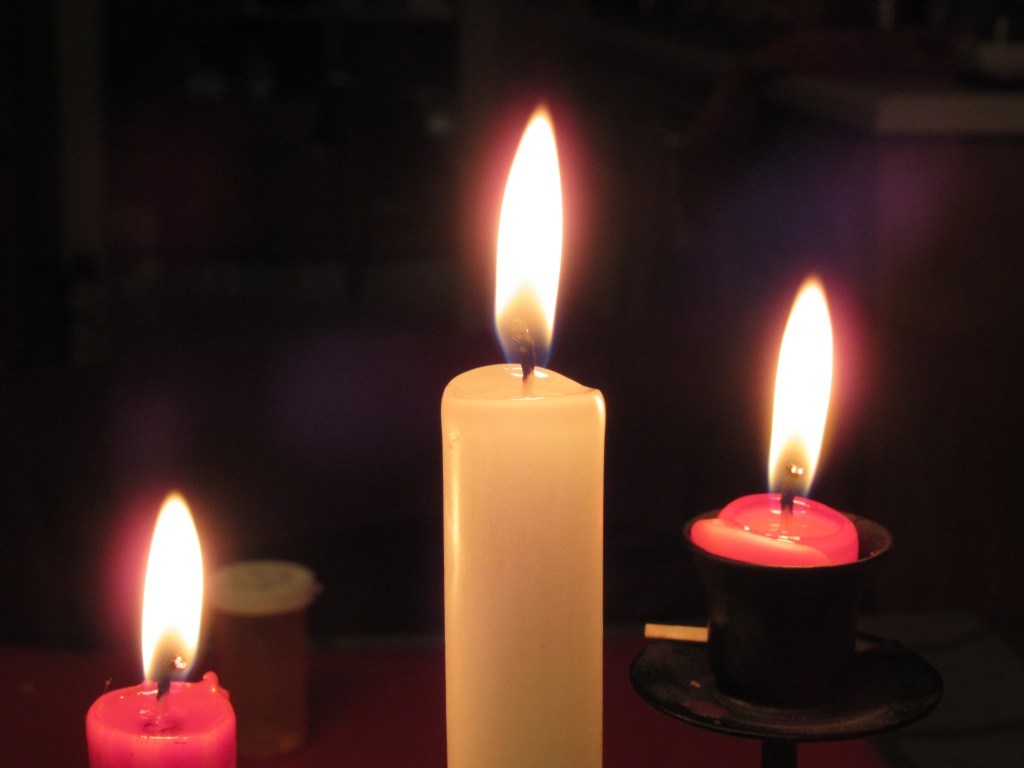
Candle Light

Candle Light

Candle light
softens your features
brings out the bone shape
makes me forget
the minor flaws
of ageing.

Bone shape,
rock shape,
land scape,
your face contours
traced by the flame,
counting the years,
like tree rings.

Beneath the surface
you are as you always were
and always will be.

When I look into your eyes,
I see your soul
dancing in the candle’s flame.

Great White Egret

Great White Egret

            The Great White Egret is Yolande Essiembre’s first chapbook of poetry. The title poem offers an image, a white egret, that is central to the whole collection. Summarized in this one poem are the concepts of pantheism, mindfulness, self-questioning, and receiving lessons and inspiration from the natural world that surrounds the narrator and her poetic voice.

            Pantheists often consider the universe, or nature, to be identical to the divinity. In simpler terms, it’s the old Greek idea of Gaia, the world spirit – spiritus mundi, in the Latin of Moncton’s Northrop Frye – that links nature and the divinity. Pantheism can be found in both religious and philosophical contexts, with some branches of pantheism rooted in traditional religious beliefs and others stemming from poetic perspectives. In the case of The Great White Egret, the narrative voice sees nature as an all-embracing poetic concept that makes possible a life, both physical and spiritual, in the immediate present.

            The lessons the narrator receives in the course of observing The Great White Egret are (1) to take one step at a time, (2) to be still, and (3) to be one’s own reflection. This third lesson reaches out to include the cover photograph. Verbal and visual blend when the egret, reflected in the water, parallels the reflection of the poet in the stillness of nature. This is further complicated by the double meaning of reflection as mirror image and of the thought process involved during the observation of the bird. The visual and mental images become reminiscent of the hymn “on the wings of a snow-white dove.”

Part of the beauty of Yolande Essiembre’s poetic meditations lies in the extension of image and metaphor beyond the page and into the mind of the reader where they create a mirror universe of reciprocal reminiscence and creativity. Other poems that reach out in similar fashion to explore the deity manifest within the natural world include A Force of Love in Our Universe, Breath of Life, Glimpses, and In the Sanctuary. This last poem works on the basis of repeated images that stand strong and clear, for example, “Life pressing through a blade of grass. / Leaves shimmering, dancing, waving. / Light flickering, casting shadows.” Life and movement, especially movement – pressing, shimmering, dancing, flickering, casting – create a sense of wonder in the natural setting where the poet finds sanctuary.

            Mindfulness is a mental state achieved by focusing one’s awareness on the present moment, while calmly acknowledging and accepting one’s feelings, thoughts, and bodily sensations. It is often used as a therapeutic technique and can be compared with the yoga techniques which our poet practices. This yoga technique is compounded in the poems where breathing is emphasized, as in Breath of Life, for example, where we read “Who are you breath of life / Who fills my lungs with air”. It can also be found in the poem In Your Presence “In the stillness of the morning / I breathe / I listen / I breathe”.         

This chapbook is more than a mere collection of poems. It is a compendium of personal feelings, inner thoughtfulness, and natural observations. It is the work of a thinker and feeler, in tune with the universe and continually seeking answers to some of life’s most important questions. Reading The Great White Egret, you too may start asking similar questions. More important, you may even find some meaningful answers.

The Great White Egret
Sitting, rocking, gazing upon a lake,
Pondering, reflecting, wondering.
How one can choose purpose over comfort?
How does one remain true to oneself?

On a wing span comes an answer.
A bird, a Great White Egret
Lands at the edge of the water.
Tall, magnificent, breathtaking.

Steps in slow motion, into the lake,
Advances one long leg at a time.
Proud, confident, in no hurry.
My first lesson: “Take one step at a time.”

The bird stops, remains still,
Listens, stretches its long neck,
So still that I hold my breath.
We wait.
Second lesson: “Be still.”

The majestic bird gracefully glides
In the calm clear water.
Its reflection a thing of beauty.
Like a mirror, reflects divinity.
Third lesson: “Be my own reflection.”             

Crystal Liturgy

Crystal Liturgy

Here, in the abyss,
where song-birds pluck their notes
and send them, feather-light,
floating through the air,
here, you’ll find no vale of tears,
no fears of shadow-hawks,
for all blackness is abandoned
in the interests of sunlight and song.

Here, the crystal liturgy surges,
upwards from the rejoicing heart,
ever upwards, into the realms of light,
where color and sound alike
brim over with the joy that, yes,
brings release to head and heart.

Here, seven-stringed rainbows reign,
the everlasting harp is tuned and plucked,
and an eternity of music cements
the foundations of earth and sky.

Here, the master musician conducts
his celestial choir, their voices rising,
higher and higher, until they reach
the highest sphere, and song and voice
inspire, then expire, passing from our eyes
and ears into unbounded realms of light.

Here, the seven trumpets will sound
their furious dance, a dance that will announce
the end of this singer, the end of his song,
but never the end of song itself.

Comment:

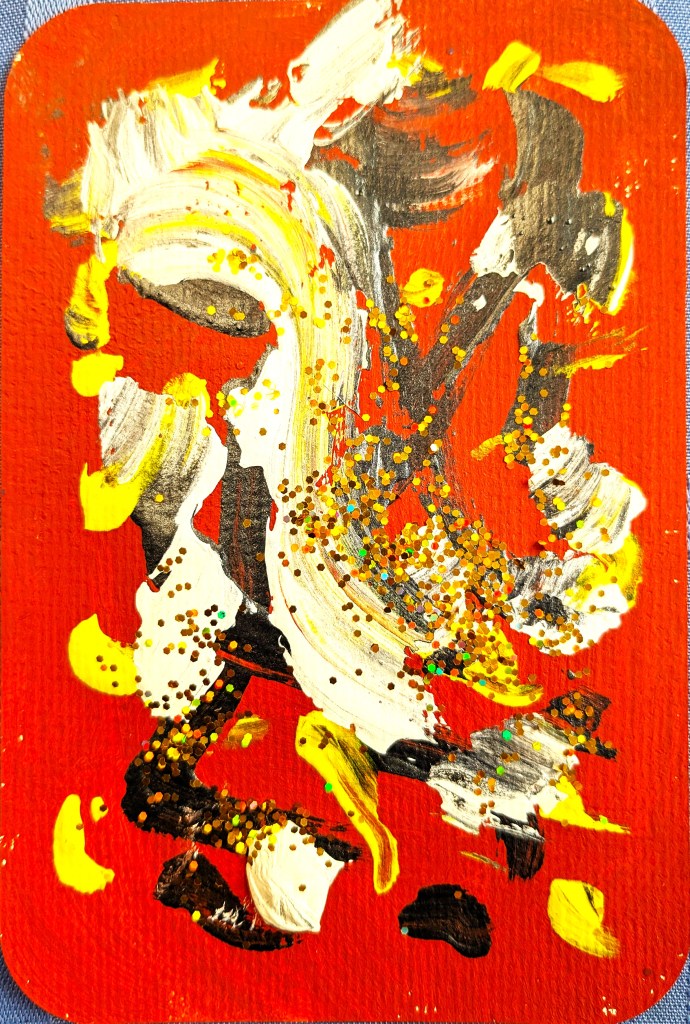
Crystal Liturgy is the first poem in the first sequence of my poetry book Septets for the End of Time. My friend Moo, the painter, supplies the paintings for the book covers. He and I have decided to hold a dialog on our views of how the painting and the poem relate to each other. Hopefully, we will continue this dialog throughout Septets for the End of Time.

“I have tried to join the ideas of sound, light, song, and voice to the idea of the Platonic Universe, where the planets dance to the music of the spheres. I wrote these poems listening to Messiaen’s Quartet for the End of Time. I allowed the music to flow through me and I responded, in words, to the images that came from the sounds, and the silences, of the music.”

“I see no sorrows here, no woes,” Moo told me. “I only see the the joy of light and existence. The shadows have been dispersed, and my painting contains a generous helping of sunshine and light. I find it very suitable for this particular poem. My painting’s starburst of energy enhances the poem’s sense of movement, strength, and light. It also contains the message that all will be well.”

What is your mission?

Daily writing prompt
What is your mission?

What is your mission?

Let us begin, as usual, by asking, what do we mean by ‘mission’? Here are some examples of the meaning of mission. (a) an important assignment carried out for political, religious, or commercial purposes, typically involving travel. (b) the vocation or calling of a religious organization, especially a Christian one, to go out into the world and spread its faith. (c) any important task or duty that is assigned, allotted, or self-imposed. (d) an important goal or purpose that is accompanied by strong conviction; a calling or vocation.

I can happily dismiss (a) and (b) from the start. I do not consider an assignment to be a mission, not in my case anyway. I am not one to wander the world, good book in hand, heart on sleeve, convincing people to believe what I believe. That said, I can work with (c) and (d) because, as a life-long teacher, who was offered, at various time, an array of other jobs, I am happy to say that I was a teacher by vocation, by calling. Teaching was my mission. My mission was accomplished.

I taught, in Canada, from 1966 to 2009. Then I reached retirement age. On June 30, 2009, I was a teacher. On July 1, 2009, I was nothing. The shock was enormous. It took me a long time to recover and discover that no, my life was not over, and yes, I had many other things to do. Thankfully they all involved teaching, in one way or another. I used my teaching / research experience to sit on the editorial boards of various learned journals. I even edited a couple of them. I also translated, usually from Spanish to English, and worked with the translations of other people. I also wrote articles on teaching and on creativity.

Creativity gradually took me over. I offered workshops on prose and poetry, wrote and edited books, penned introductions for other writers, and even published some books by other people, usually my family or close friends.

There was never much money in teaching or in creative writing. I always did it for love – love of the subject, love of learning, love of the students, love of watching them grow and develop. When I work one-on-one with another writer, or with a small group of writers, that love is still there. Alas, as I grow older (much older!), I feel the ability to motivate slipping away. The will, the vocation if you like, is still there, but body and mind are growing weak, and that, my friends, is the saddest thing of all.

Dark Angel

He will come to me, the dark angel,
and will meet me face to face.

He will take all that I own,
for my wealth is only temporary:
health, wealth, possessions are all on loan.

My house, my wife, my car,
my daughter, my grand-child,
 my garden, my trees, my flowers,
my poetry, my works of art.
I use the possessive adjective
knowing full well that these things
are only on loan. I will never be able
to preserve and possess them.

I even rent this aching heart,
these ageing, migrant bones,
this death that has walked beside me,
step by step, every day
since the day that I was born.

My death alone is mine.
It belongs to nobody else.
It will be my sole possession.
It will soon be the only thing
I have ever really owned.

Comment:

Dark Angel is from my poetry book – Septets for the End of Time / Poems for the end of Time. The lead painting in today’s blog is by my friend, Moo, and he calls it Storm-Me.

Do you play in your daily life? What does ‘playtime say to you?

Daily writing prompt
Do you play in your daily life? What says “playtime” to you?

Do you play in your daily life? What does ‘playtime say to you?

Poesía de juego y poesía que expresa la autenticidad del ser / poetry as play and poetry that expresses the authenticity of being. For me, poetry is play. However, it is far more than just ‘play‘ – because it is a play that expresses the authenticity of my being.

I write in my journal on a daily basis. As I write, I sometimes spot little gems, thoughts or word clusters that can be turned into poems. For me, playtime is when I start to elaborate the words (signifiers) and turn them into thoughts (signified). The meaning may be the message, but the words that carry the message are the building bricks of the poetry of play which sometimes, with a happy Midas touch, turns into the poetry of gold that expresses the authenticity of who and what I am.

But play is also what I do when I paint. And sometimes I sit beside my mirror image friend, Moo, and paint with him. While Moo is great with colours, he is sometimes at a loss for words. Then I help him by playing with words, shuffling them around, until he finds the title that he wishes for his poems. Sometimes I consult, on Moo’s behalf, with other friends, and they are the ones who join in the game, and settle the dispute by agreeing upon the name that Moo will finally choose for his painting.

But, speaking of painting, there is no play better than the game of making meaning out of color [does it really matter how you spell it? ] and shape while taking a line for a walk and turning it into something playful yet meaningful. Mix and match, and stitch and patch, and then add the lines and title that ease the metamorphosis of color into shape and meaning.

There are other games I play to help fill in the daily gaps that have entered my post-retirement life. Online games of patience, crosswords, chess games with their intricate patterns of red and white or light and dark. Then their [now it does matter how you spell there!!!] are mining games when I dig deep into other people’s poetry and search among the gems of Octavio Paz, Antonio Machado, Dylan Thomas, John O’Donohue, Milton Acorn, Valverde, Quevedo, St. Teresa of Avila, Gongora, Sor Juana, Cervantes, or many other friends, their voices now silences, with whom I speak with my eyes, in order to find something that inspires me to play yet another game – hunt the symbol.

Re-reading Rudyard Kipling is a game too. “Do you like Kipling?” “No, I never Kipple.”And in books like Kim, the great game of life goes on and on, and Kipling’s signifiers (words) turn into a signified (meaning) that is warped by my creative mind and changed into my ideas of a new game in which hunt the symbol turns into the game of Brillig where the slithey troves of new words, fresh words, are reborn into my game-world and emerge from their game-whirled into my own word-play conversation with my own thyme and plaice [or should that be time and place?] And long may Moo and I play that game!