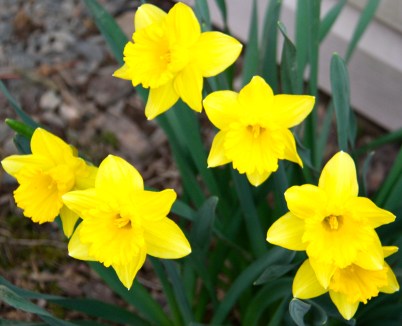
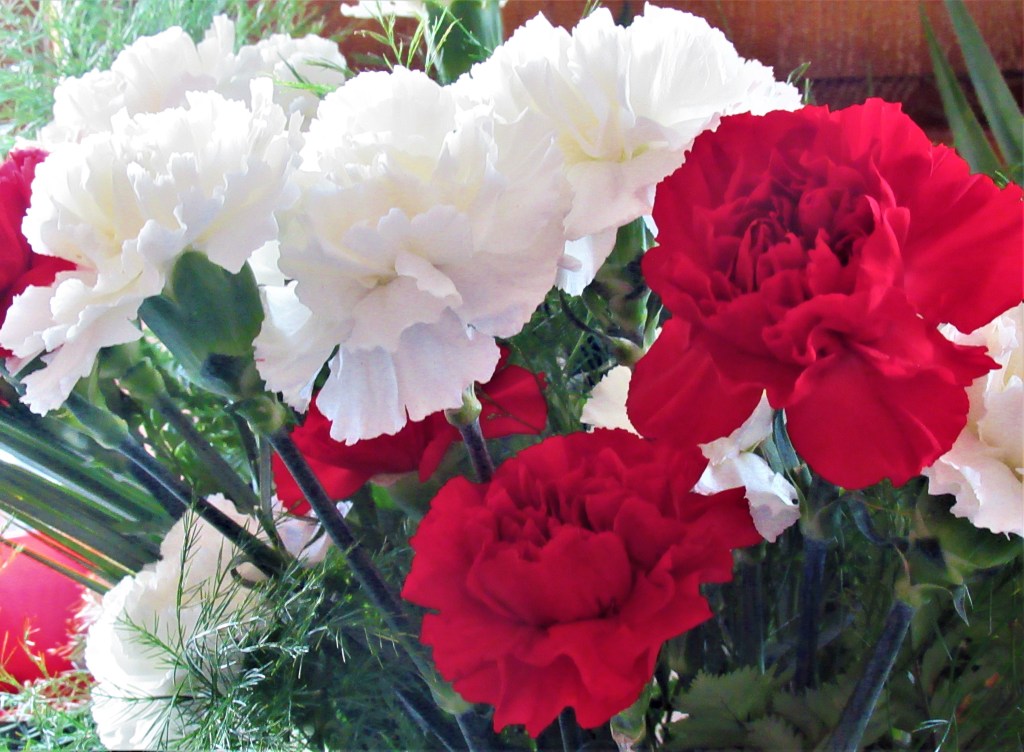
Daffodils A poem for the lady who brought some to us when Clare fell
Daffodils in our garden, last year in Island View. We won’t see the live ones until May, at the earliest. I dream of them at night, tossing their heads in sprightly dance’, in Roath Park and Blackweir Gardens, Cardiff. They will be out now, all ready to welcome Dydd Dewi Sant on March 1.
Daffodils
For ten long days the daffodils endured, bringing to vase and breakfast- table stored up sunshine and the silky softness of their golden gift.
Their scent grew stronger as they gathered strength from the sugar we placed in their water, but now they have withered and their day’s done.
Dry and shriveled they stand paper- thin and brown, crisp to the touch. They hang their heads: oncoming death weighs them down.
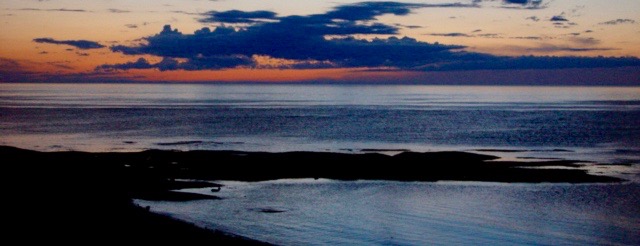
Sunset at Ste. Luce. We wait for the choir to arrive. Take a deep breath: it will soon be here.
Angel Choir (on seeing the Northern Lights at Ste. Luce-sur-mer) Sonnet
Listen to the choristers with their red and green voices. Light’s counterpoint flowering across this unexpected son et lumière, we tremble with the sky fire’s crackle and roar.
Once upon another time, twinned with our heavenly wings, we surely flew to those great heights and hovered in wonderment. Now, wingless, our earthbound feet are rooted to the concrete. If only our hearts could sprout new wings and soar upwards together.
The moon’s phosphorescent wake swims shimmering before us. The lighthouse’s finger tingles up and down our spines. Our bodies flow fire and blood till we crave light, and yet more light. We fall silent, overwhelmed by the celestial response.
When the lights go out, hearts and souls are left empty. Leaving the divine presence is a gut-wrenching misery. Abandoned, hurt and grieving, we are left in darkness.
Comment: The Spanish mystics, St. John of the Cross, and St. Teresa of Avila, wrote, in the sixteenth-century, about the ‘dark night of the soul’. That dark night also arrives when the communion with the spiritual finishes and the communicants are left alone, in their loneliness, abandoned to their earthly selves. To leave the divine presence is a heart-breaking, gut-wrenching misery. To turn from the marvels of nature can produce lesser, but still deeply moving feelings of grief and sadness. The secret is to preserve that joy and to carry it with us always, warm, in our hearts. Doing so makes the pain of separation much more bearable.
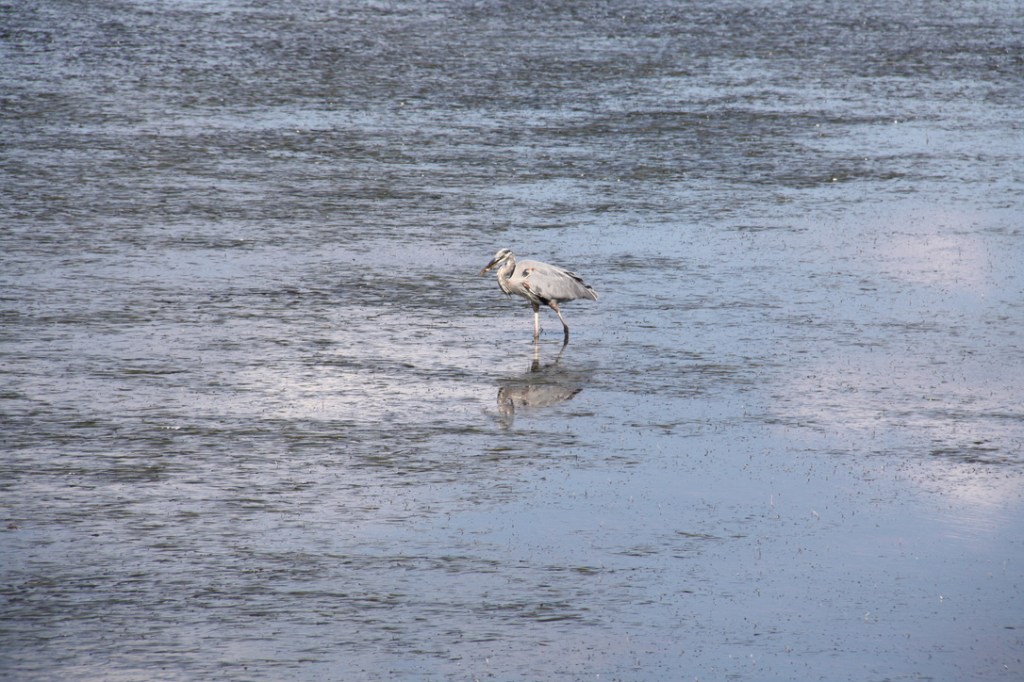
He knows the frogs are in there. He doesn’t need to hear them sing. But he loves to make them croak.
Croaking Angels
Their tunes are one note symphonies, croaks of joy that move their fellow frogs to ecstasy, exhorting them to share the splendors of ditch life, in a springtime bonding that will loft them skywards.
There’s an ancient magic in this calling: water and laughter, sunlight, warmth, and all those joyous things that fill the newborn spring.
Moonlight swings its cheerful love lamp. New leaves and buds are also known to sing.
Comment: This always makes me think of the croaking chorus from Aristophanes. I do hope all those wonderful ancient plays, songs, myths, and legends are not forgotten in our croaking frog chorus of modern jingoistic advertisements and propaganda. Ah well, what’s a source for the proper goose is probably a source for the proper gander. Who knows nowadays? What we do know is that spring is just around the corner. Warmth and the absence of snow will help change our lives. And yes, that croaking chorus will be back.
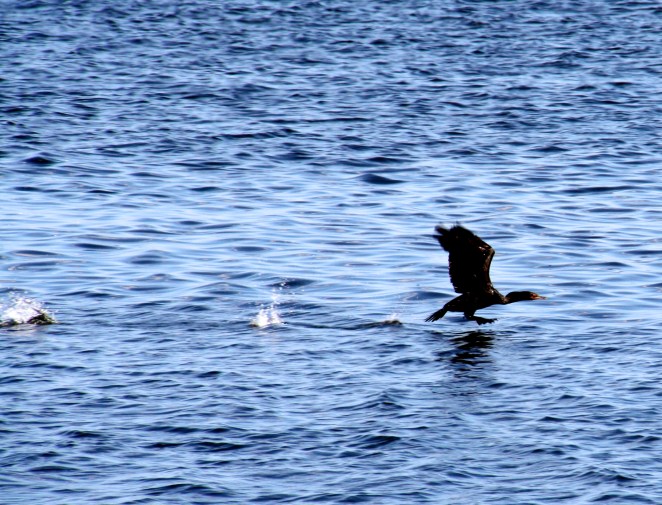
Luck, sometimes, just being in the right place at the right time. One step, two steps, and up he went and look at those footsteps. His flight, a step of faith, two steps of faith, and away he goes, fait accompli.Another golden oldie. I do love rediscovering them. The photos, too.
Flight of Fancy
Just by chance, I caught this cormorant. “Behind you, quick,” said Clare. I turned and ‘Click!’
Such a miracle: the first steps of flight taken over water. That first step heavy, the second one lighter, and the third one scarcely a paint brush pocking the waves.
The need to take flight lies deep within me. Fleeing from what? Running towards what? Who knows?
All I know is that the future lies to the right of this photo and the past lies to the left, and I don’t know the meaning of either.
But I do remember the words of Antonio Machado: ‘Caminante, no hay camino, sólo hay estela sobre la mar.’ “traveler, there is no road, just a wake across life’s sea.”
Comment: I revised this poem a few minutes ago and cut it down to its essentials. If you want to read the original and check the revisions, click on this link to the earlier poem. Any comments on the rewrite and the revision process would be welcome.
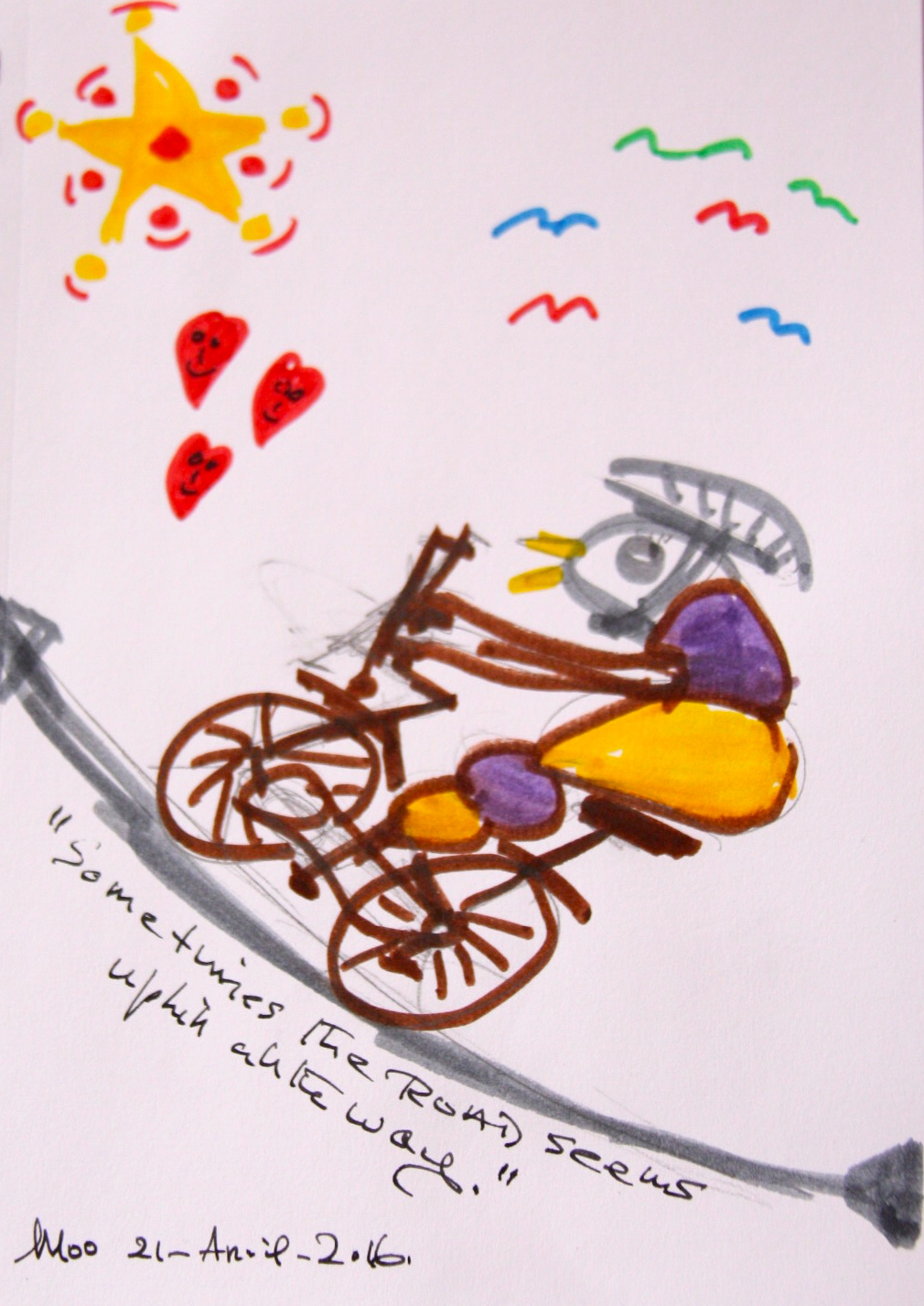
Another golden oldieand, with the snow fallen and my back aching, it does sometimes feel like it’s an uphill battle. There are always angels at the roadside, though, and some have called and offered to help. Thank you, special angels.
Sometimes the road seems uphill all the way. Lungs burn. Breath comes hot and hard and chunky in the throat. Legs hang heavy, muscles will not obey the owner’s instructions.
Consult the operating manual: “Take a break,” it says. “Rest now. Don’t push too hard.” But to rest is to give in, to come to an abrupt halt, or to drift backwards down the hill.
What stubborn streak is painted so deep in us that it shouts ‘never surrender’ when our most urgent need seems to be to throw in the towel? Is it the urge to get to the top, to see the lower lands stretched out below us? Or is it the mantra of fight the good fight?
Many things can drive us on: a need, a desire, a whim, an urge, or merely a refusal to stop fighting. Some of us will never give up. We will never lie down and curl up in a corner, a dead leaf to be blown hither and thither by the cold night wind.
Look carefully: there are no drugs, no needles, in the biker’s uniform. There is no small accessory motor hidden in the back wheel to help when times get hard.
The mouth is open, the eyes are set on the target, the legs still move, the sun still shines, and three smiling heart-shaped faces cheer the cyclist on.
Who can they be, these three angels at the road side, who can they be? Yet they are there and we are here and the bike is there and the hill is there and sometimes … yes, sometimes, the road IS uphill all the way.
But we keep the pedals turning and we don’t get off our bikes … and that’s life.
Not Oaxaca, but Avila, with una tromba, a meseta rainstorm, about to descend upon us. And when it descends, there is water, water, everywhere, as you can imagine from the clouds. In Oaxaca, water is precious. Tap water is to be avoided. Bottled water is to be preferred. We used to wash our vegetables in water that was specially chlorinated, also the pots and pans!
Water Peragua Water seeks its final solution as it slips from cupped hands. Does it remember when the earth was without form and darkness was upon the face of the deep? The waters under heaven were gathered into one place and the firmament appeared.
Light was divided from darkness and with the beginning of light came The Word, and words, and the world … … the world of water in which I was carried until the waters broke and the life sustaining substance drained away throwing me from dark to light.
The valley’s parched throat longs for water, born free, yet everywhere imprisoned: in chains, in bottles, in tins, in jars, in frozen cubes, its captive essence staring out with grief filled eyes.
A young boy on a tricycle bears a dozen prison cells, each with forty captives: forty fresh clean litres of water. “¡Agua!¡Peragua!” he calls. “¡Super Agua!”
He holds out his hand for money and invites me to pay a ransom, to set these prisoners free.
Real water yearns to be released, to be set free from its captivity, to trickle out of the corner of your mouth, to drip from your chin, to seek sanctuary in the ground.
Real water slips through your hair and leaves you squeaky clean. It is a mirage of palm trees upon burning sand.
It is the hot sun dragging its blood red tongue across the sky and panting for water like a great big thirsty dog.
Comment: More and more competitions, publishers, and magazines are asking for ‘original material, not previously published, or self-published, even on your own blog.’ So what is a poet to do? Put up fresh material, and it is illegible for entry elsewhere. Recycle and revise old material? Now that might work. Click on the link above for the original version of this post! And yes, it has been previously published on these ages!
Where e’er she treads, the glossy flowers shall rise and light, like the light of flowers, will pierce any gloom and brighten the room.
Silence
When I wait for words to come and they refuse, I know that silence is golden and spreads its early morning sunlight across the breakfast table where yellow butter melts on hot toast.
Light from the rose window in Chartres once spread its spectrum over my hands and I bathed in its speckled glow.
My fingers stretched out before me and I was speechless, for in such glory, mortal things like words cease to flow.
So much can never be said even if it is sensed: fresh coffee, poutine à pain, bread baking, flowers bursting into bloom, the sense of immanent beauty that fills me each time my beloved enters the room.
I thought for a moment that, yes, I was an angel and I was dancing on a pinhead with so many other angels, and all of us butterflies spreading our wings with their peacock eyes radiant with joy and tears spark -ling in time to the music that wanders up and down and around with inscrutable figures held spell-bound in a magic moment … and I still feel that pulsing in my head, that swept up, heart stopping sensation when the heavens opened and the eternal choir raised us up from the earth, all earthbound connections severed and all of us held safe in an Almighty hand.
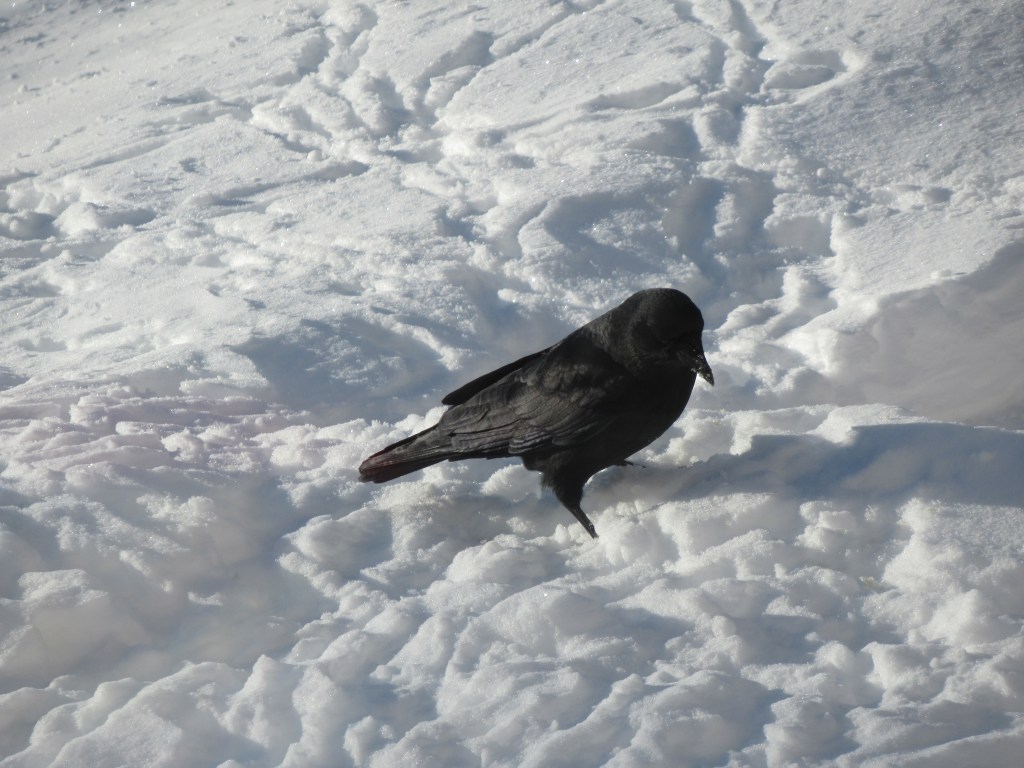
A crow, but not a beach. You’ll have to click on the link at the bottom of the page for the real beach photos.
Crow’s Feet
a convict’s arrows marking the eye’s corner and the beach at low tide with its crackle of wings as sea-birds fly their defensive patterns feathered sails on a canvas wind
how many crabs made in the image of their carapaced god hide in the sand half-buried waiting for the tide to turn and water to return and give them refuge
abandoned shells postage stamps glued in the top right-hand corner of a picture post card beach
who can decipher the sea’s hand writing this mess of letters stitched by sandpipers who thread the beach’s eye inscribing dark secrets with the sewing machine needles of their beaks
pregnant this noon tide silence this absence of waves where the quahaug lies buried secured by a belly button a lifeline to air and light surrounded by crow’s feet tugging at the beach’s dry skin
sand beneath my feet sand between my toes dry sand sandpapering
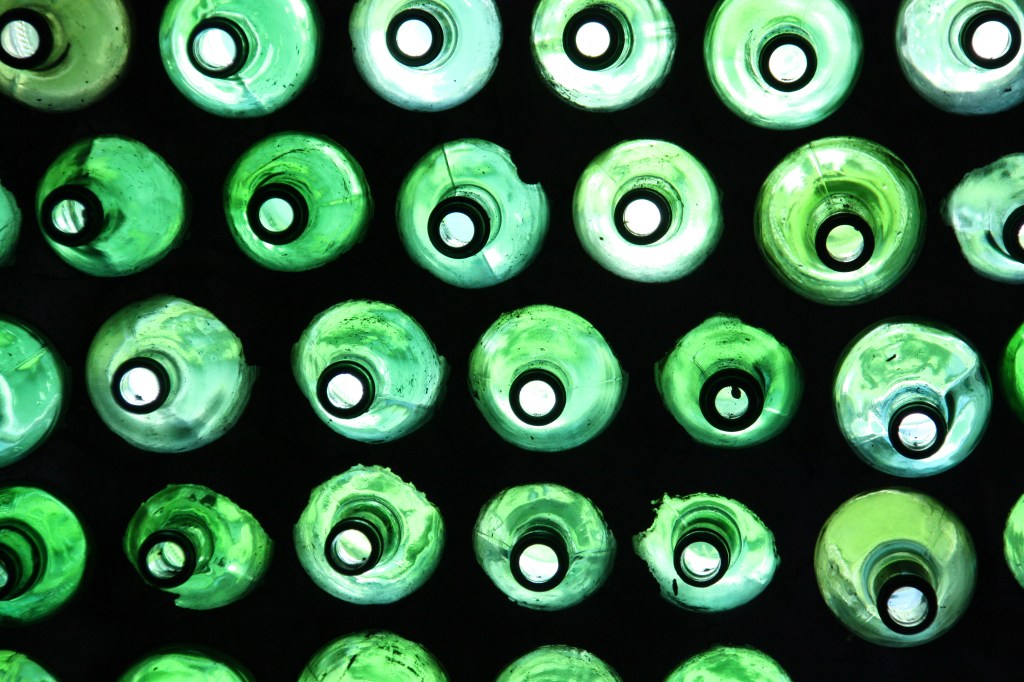
Light through glass, darkly: bottles set in one of the bottle house walls in PEI. The gardens are wonderful and well-worth a visit.
Bottle House, PEI The day begins with flowers: at the entrance, beneath the windows, flowers everywhere, a delicacy of scent. Beyond these flowers, even more flowers, then playthings in the garden: a child’s paradise, these sculptured faces, this glass among the trees, sun and shade, the fountain’s water, this dream of an old man, kept alive now by his children, a dream of health and sanity and peace out by the bay, where the mud red waters roll and the tide’s hand grasps at the land and pulls it down with watery fingers. Everywhere: faces and elements of faces: a nose, eyes, a mouth, open in surprise. Carved wooden faces, glass faces, pottery faces, flesh and blood faces, grandma’s face, grandpa’s face, then the grandchildren. Tourists travelling, old islanders returning to see family and friends, young islanders returning to visit the almost forgotten farms which their families worked a generation or three ago, before their exodus from the land. “This was grampy’s house!” they say or “that was my grandmother’s farm!” as if a life could be reborn in that pointed finger, those casual words. How many memories are snapped in each picture? How many lives are caught in this snapping of the fingers as the past is instantly summoned and perfection is bottled for a second or two in the magic of this house, this garden where the builder’s spirit roams. Sit still awhile. Be silent: you may hear him breathe, glimpse him, for a second, staking out the flowers, extracting a weed, checking the set of the concrete foundations, polishing a bottle, resting on a wooden seat, avoiding the slow snail on the path bejewelled by rain-drops from the trees or spray from the fountain. For where there are flowers, there must be water and rain and peace and happiness and all good things, glimpsed darkly through smoked glass yet grasped so smoothly in the sun’s bright light. This is the house of bottles, the glass house, where rough winds are shunned and the bottles are set in concrete. It is a museum of light and dark, the creation of sun and shadow as sunshine fails and the lighthouse’s flashlight beam reverberates from glass to stone and back again. Shapes, shadows, memories curved and carved in glass, set in glass, this shimmering beacon this glass house, this light house built as a heaven-haven for harboured ships and the soul’s refreshment, here, in these gardens, among these bottles, and at the chapel door, an angel-in-waiting.
Angel or fairy? It doesn’t matter. She was a gift one morning, when we visited. In this photo you can see how the bottles are set in the wall.