My Favourite Candies

My Favorite Candies

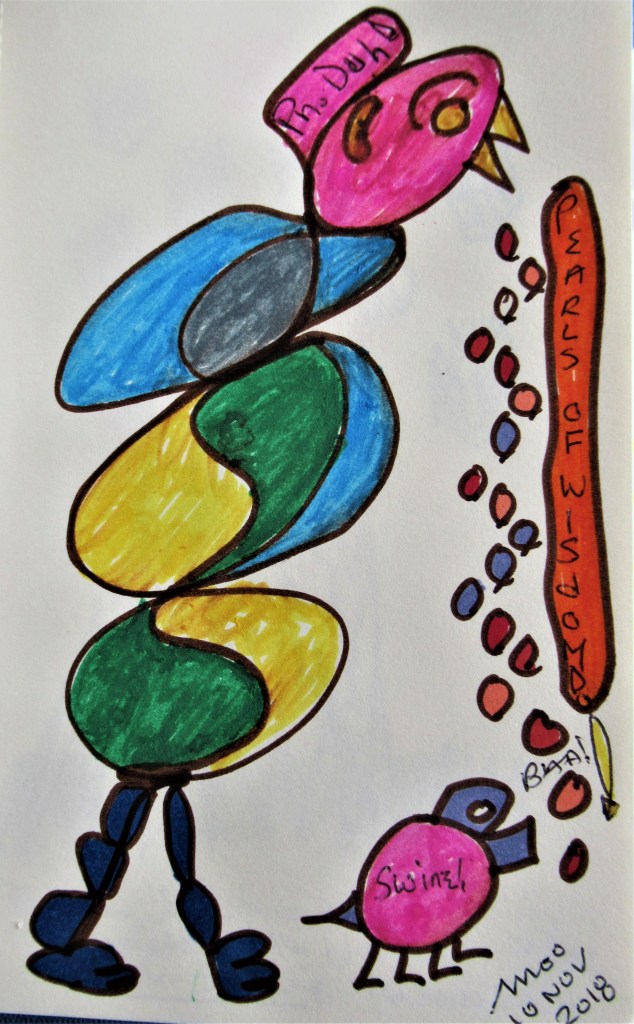
I searched for the blog prompt, but I couldn’t find it. Not by name and I don’t remember the number, nor do I know how to search for it. So – here I am, on the sea shore, stranded, looking for something I may never find. Yet an echo of it has found me.

I googled ‘candy’ to find out what it meant because when I think ‘candy’ I think of Candy Floss, that long, thinly-spun web of sticky pink sweetness sold at the fairgrounds and the ice-cream stalls of my childhood beaches, back in Gower. Barred and banned it was, and seen as a source of cavities and visits to those much-to-be-feared, brutal, ex-Armed Forces dentists who terrified our childhood while working in those days in the NHS.

Candies, in my Olde English language, were called sweets. In post-war Britain, where rationing was the unwelcome rule, sweets were rare, for they cost us coupons, and were therefore, very, very precious. In those days, my grandfather had many friends and his friends were priceless. On Saturday mornings he would take me to Swansea Market, the one that had been bombed during the war. It had been rebuilt but, in those days, remained roofless. There he would work a shift at Green’s Sweet Stall while someone took a break – and I helped him. We would take the orders, count and weigh the sweets, take the cash, count it, check it, place it in the till, and hand over the correct change along with small, white paper packets that contained the hand-made sweets.

We received no money for this pleasurable work. However, when our duty was done, I would be given my choice of hard-boiled sweets. My favourites were those red and white striped sweets, called winter warmers, laden with the lusty tang of cloves that lingered long in the mouth. We held competitions to see who could make their sweet last longest. And woe betide the losers who cracked them, or swallowed them whole, for they were mocked and forced to watch, minute by minute, the lucky ones whose sweets dwindled on and on, shown off, paper thin, on tongue tip, for all to see.

But better than any candies were the Cockle Women in their tall black hats and red Welsh shawls who came all the way from Penclawdd on Saturdays with their baskets of cockles and their buckets of laverbread – bara lawr – at thruppence a pound. Laverbread – Welsh Caviar, Richard Burton used to call it, a delicacy to be savoured for breakfast or lunch and sweeter to the enthusiast and devotee than any candied sweets, even winter warmers.

Snow falls – what if we fall…

Snow falls – what if we fall…

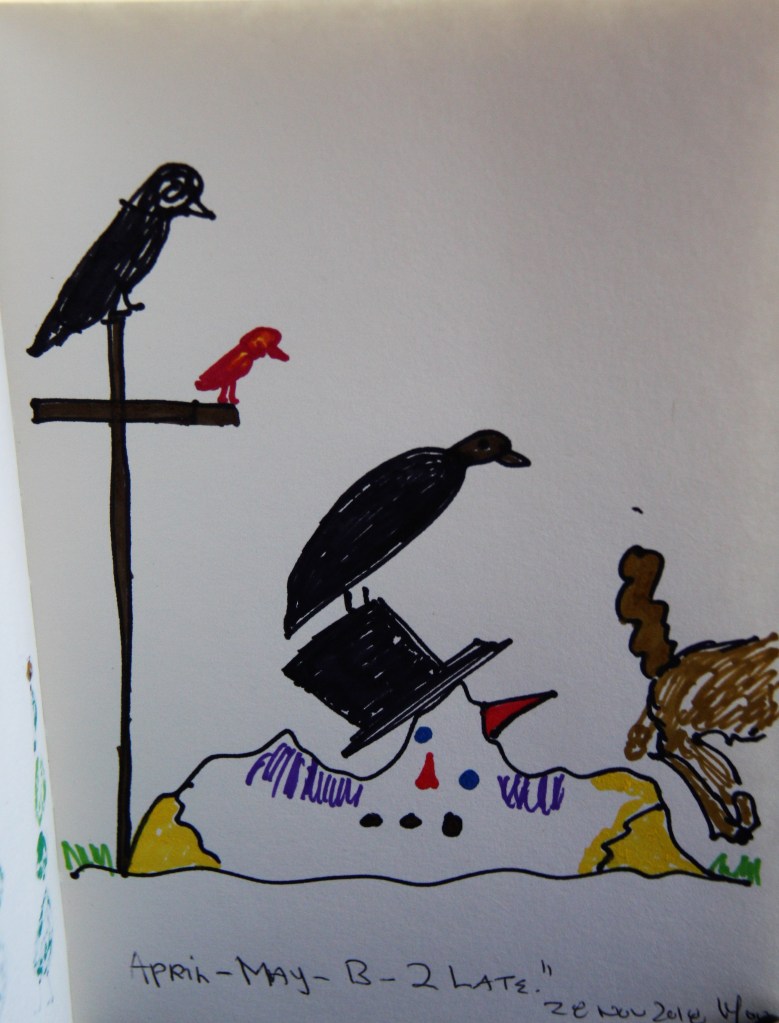
There I was – with my trusty snow-blower blowing the snow – and I shifted gear to go backwards – and my glove caught – and the snow-blower kept on coming – straight at me – and there wasn’t room to manoeuvre -manoeuver – maneuver – aka I couldn’t get out of the way – and the snow bank behind me caught me just at the back of the knees – and I sat down in the snow – oh dear – luckily I let go of the gear lever and the throttle lever – but the machine was almost on top of me – and I couldn’t get up – so I called for help – but no help came – and I tried to pull on the machine with one hand – and I put the other on an ice patch in the snow and that hand went through – so I am sitting there – can’t stop laughing – and then my beloved appears – and she brings me my walking stick – and she moves the snow blower forward – and then she gives me the stick – in my left hand – lifts me and pushes – while I lift with the left and pull with the right – and I have pulled a cork from a champagne bottle more easily than I pulled myself out of that snow – but together we did it – and oh was I wet – I had to finish the blowing – go inside – and change my jeans – and I am still laughing at the thought of myself – sitting there in that snow – and I needed to pee so badly – as the cold and damp crept in and – what if there had been nobody there to help – or what if it had been windy and my cries had not been heard – and what if we fall – as so many others have done before – fall to rise no more – and what if – “if – if – if – if – onions climbed a cliff – potatoes would rise – with watery eyes – if it wasn’t for if -” and that’s what my grandfather always sang to me when I asked him “what if…?” – so- what if … but don’t answer – because we’ll never know –

Parents

Parents

Today’s prompt – what were my parents doing at my age? Well, actually, they were both dead. We aren’t meant to mention death anymore, so let me say ‘they had passed’. Loads of cliches of course – pushing up the daisies – moved into higher society – or lower but I hope not – deceased – demised – expired (like my driver’s license) – extinct (like the Dodo) – passed on – recycled – enough – no more – it’s not as sweet now as it was before – nor do I like any potential answer when I look in the mirror and wonder – who am I? – What am I? Where am I going? Am I next?

My father being an excellent rugby player – on the wing – in the old days – I can imagine him running, and kicking and chasing – but I can’t imagine him passing. Or setting up a maul or a ruck. Dear Lord – times have changed – and the laws of rugby have changed – and the rules of etiquette have changed – and political correctness has put dark hands upon our throats and choked us -let us not contemplate the myth of freedom of speech – but consider the endless stupidity of senseless questions that changeth not and abide with all of us, on radio and tv and in the newspapers – all day and everyday.

Here’s anther prompt – Where have all the young men gone? Depends on which song you listen to – emigrated – gone down the mines – gone west – gone AWOL – gone astray – gone to graveyards, everyone. But will we – or they – ever learn – blydi hel – a good Welsh expression – I doubt it.

So – I ask myself – what are my parents doing today? – and the answer is – I really do not know. I would like to think they are happy – happy in the knowledge that they did their best for me – happy to know that I am still here – ar gwaetha pawb a phopeth rh’y n’i yma o hyd – I hope I spelled that right – I have seen several versions – and yes – in spite of everything, I am still here – I am well – and I would like to tell them that I love them – and I would like to thank them for all they did right – and forgive them for anything they did wrong – and yes, I loved them so much – and still do – and I miss them – and blydi hel – now you’ve got me crying.

On Death and Dying

On Death and Dying

I once asked my grandfather, a decorated soldier from WWI, if he was worried about dying. “No,” he replied. “Why not?” “Well, Roger, we’re all going to die. We just don’t know when. So, if I worry, I will die. If I don’t worry, I will die. So, why worry about it?” I was about five years old at the time and we were standing outside the Swansea Hospital, as was, by the seat where the old men used to sit and gossip. I didn’t realize it at the time, but that was my first lesson in Stoicism.

“The day I was born, I took my first step on the path to death.” Francisco de Quevedo (1580-1645), Spanish Neo-Stoic, among so many other things. Thinking like that tends to put things into perspective, for death walks with us every day. Death is our twin sibling, brother or sister. We face his shadow every time we look in the mirror and that shadow follows us around all day. “Death is a law, not a punishment, so why worry about it?” Also Quevedo. Dying is a different matter and yes, there are so many ways to go, some of them, especially nowadays, with the advent of life-preserving medicines, slow and unpleasant. Yet, mors omnia solvit – death solves everything. And it brings a release from all pain and suffering.

The lead photo shows a plaque in Avila (Spain). La Calle de la Cruz (1660) -The Street of the Cross. It is also known locally as La Calle de la Vida y de la Muerte – The Street of Life and Death. Why? It is rumored that here, turning left outside the main cathedral, duels were fought. Two men entered, but only one emerged alive. It is interesting to meditate on the close proximity of life and death, always there, side by side.

So, for the fun of it, let’s change the question: what is life? “What is life? A frenzy. What is life? An illusion, a shadow, a fiction. And the greatest good is small, for the whole of life is a dream, and dreams are nothing but dreams, after all.” Life is a Dream, Calderon (1600-1681). Looked at from this point of view, what is death? Is it the shutting down and the turning off of the cerebral computer or is it the great awakening from the sleep of life? You can think of it either way but, either way, it’s pointless worrying about it. As my grandfather also told me: “If there’s nothing afterwards, I’ll just fall asleep and that will be the end of it. But if death is the great awakening, then I will be very happy to wake up in a new reality.”

Robert Bly, in The Sibling Society, writes of the lateral movement that now embraces society with its grip of instant pleasure, instant gratification, instant happiness. As a result, we have strayed far from the vertical knowledge that sustained us for centuries. We have abandoned the wise words of our ancestors. Now the old are no longer the keepers of wisdom and the guardians of culture, the institutional memories of the race, if you like. Now they are foolish, clumsy, out of date with the world’s most rapid advances. Only the young, and their siblings, can keep up with the ever changing instants of life as presented to us.

But all is not lost. “What a peaceful life, that of the wise man who withdraws from this noisy world and follows the hidden path along which the world’s wisest people have always walked.” Fray Luis de Leon (1527-1591). We can move far from the madding crowd. We can construct our own realities. We can base them on the words of wisdom handed down to us over the generations. Switch off the TV. Watch the sun as it moves across the cathedral face (Monet) or the walls of your house (Moo). Live each moment of each day. Do not fall into despair. Above, don’t worry – it does no good at all.

I Can’t Complain!

I can’t complain!

Why not? Everybody else does.

Sun Absence Depression – People complain about the absence of the sun – and so do I. Five sun appearances between early December and the end of January. A sun glimpse, so to speak, pale coin between clouds, a sudden shadow that appears on the wall and vanishes before you can catch it. Do these count? Sun glimpses, mind you, and even less sunny days.

Snow, Sleet, Ice Pellets, Freezing Rain – Take your choice. The snow itself isn’t too bad. The snow blower takes care of that. But not when it rains on top of the snow, then freezes. Not when ice pellets weight it down and make it the consistency of wet sand on a wintry beach. My neighbor broke his snow blower trying to shift the mess. I was willing to risk the snow blower, but not my health. I couldn’t even get the blower out of the garage and into the mess that masqueraded as snow. I sat on the back bumper of the car, huffed and puffed, and decided not to risk it. And as for the freezing rain – my beloved had to put crampons on her shoes to be able to walk the ice and take the garbage to the end of the drive. As for blowing the ice that had fallen on the snow – the snow blower grunted, and groaned and complained as it slipped and slid all around – and so did I.

Rejection – Dejection – “Paper your walls with rejections.” Well, I won’t do that as we have just had the walls repainted. That said, when I checked my progress files this morning, out of 95 submissions, 93 had been rejected. Does the 2% make up for the 98%? Well, 5 more rejections and I’ll let you know.

Inflation – Gas. Luxury foods. Alcohol. You name, it and I will complain about it. And if I don’t, every day I go out shopping I see and hear someone complaining about the rising cost of just about everything out there. Being on a more or less fixed pension doesn’t help much either. Luckily, we don’t have to make choices yet, like some pensioners, and working people, are doing in the Untied Kingdom [sick]. Eat or heat? Food or medicine? Dog food or cat food? They have been staples for pensioners in the UK for a long, long time. Cheap and nourishing, though prices are rising, and taste disguised in a nice curry sauce. I kid you not.

Top Ten – well, I guess I could go on and on. But I won’t. Four reasons to cry are enough. Today, the sun is shining (positive). The overnight temperature was -25C / -13F, but it’s rising in the sunshine -15C / +5F as I type (positive), and I don’t have to go out in the cold (very positive), and I don’t have to snow blow today (very, very positive). So, may we all walk on the sunny side of life, find a silver lining to each and every cloud, and carry on regardless. It’s better than the alternative.

A book is a book is a book

A book is a book is a book

“If one cannot enjoy reading a book over and over again, there is no use in reading it at all.” Oscar Wilde

A good friend of mine once told me that her creative writing writing prof in the MFA program told the class: “We are not writers. We are re-writers.” Our mission in life, then, is not just to rewrite, but to think and to revise. The art of writing lies in analysis, research, thought, and thinking carefully about (a) what we are about to write and (b) what we have just written. As a great Spanish writer once said “I write as I speak and when writing I count my syllables.”

So can the same principle be applied to reading? In my undergraduate poetry courses, one of my wiser profs announced that “It is better to read one poem a hundred times, than a hundred poems once.” Is re-reading better than reading? Good question. But it is what I call a swimming pool question: it has shallow ends and deep ends. Joke – it depends, you see, upon the quality of the material one is reading. For example, does a single reading of the Bible suffice? I read it through, page by page, when I was twelve years old. Was that it? No, I still return to it – the good book – from time to time, selecting, remembering, checking, looking for comfort, advice, or sometimes, pure joy in the sound of the language – King James version, of course.

What other books have I read and re-read? Lazarillo de Tormes, Don Quixote, The Hobbit, The Lord of the Rings, The first book in the Harry Potter series – it reminded me of elements of my own childhood, especially the cupboard under the stairs. Been there, done that, got the tee shirt. The Wind in the Willows, Gongora’s Polifemo, Quevedo’s Metaphysical Poems and his Cycle to Lisi. Octavio Paz’s Sunstone / Piedra de Sol, Lorca’s Romancero Gitano, his Poet in New York, and his plays. Platero y yo. Charlotte’s Web. Several of Shakespeare’s plays, including McBeth, Henry V, King Lear, and a couple more. Rudyard Kipling’s Kim and Stalky and Co. Mary Gentle’s Golden Witchbreed. Robert Bly’s Morning Poems, Iron John, The Sibling Society. Unamuno’s The Tragic Sense of Life and his Niebla. Enough, no more. It is not as sweet now as it was before. And there are so many more to which I have returned, again and again.

So, think about all the time wasted on trivial books, books that remained unfinished, books that have never been opened. One person’s vegetarian or vegan’s fare is a carnivore’s poison [sick]. Sometimes a book mirrors our thoughts. Sometimes it challenges us to rethink our lives and our philosophies. Sometimes it comforts us or takes us back into our childhood. And sometimes it just bores us and we cannot finish it.

A rose is a rose is a rose. A book is a book is a book. Or is it? We are not readers – we are re-readers. And if we aren’t, we ought to be. Think about that. Carefully.

Looking at the Stars

Looking at the Stars

“We are all in the gutter, but some of us are looking at the stars.”  Oscar Wilde

Another beautiful quote from Oscar Wilde. I look at the world around me and I see two different spheres – the celestial one where, on a clear night, Orion patrols the winter skies, his faithful dog star at his heels. These are nights of great beauty, fields where mythical animals wander their ways, clothed in sparking suits of light.

Then I open the newspapers, read the news, and wonder what we are all up to. Up to? Down to, rather, for I have that sneaking feeling that so many of us are indeed lying in the gutter, somewhere, thrown out of a moving car, and abandoned, like some dead deer in a roadside ditch. Everywhere, the news is dark and dreary – wars, rumors of war, shootings, beatings, corruption, lies – or terminological inexactitudes, as Winston Churchill called them, the word ‘lies’ not being permitted in the Mother of Parliaments.

The Mother of Parliaments, indeed. And what a non-sensical mess that has become. To repeat the litanies of nonsense spouted in the English Parliament nowadays, I hesitate to call it ‘the British Parliament’, is to risk rusting and ruining my computer keyboard with the salt tears I shed.

So many of them, then, literally lying- the word has multiple meanings – in the gutter. So many of us dragged down with them. But, each night, when the skies are clear and the clouds move away, I find myself, once again, looking up at the stars. Per ardua ad astra – through hardship to the stars.

Breathe deep – keep the faith and believe.

A Very Spanish Omelet

A Very Spanish Omelet

Spanish Omelets – I learned how to cook them in Santander, Spain, when I was attending summer school at the Universidad Internacional Menéndez y Pelayo. No – I didn’t learn at the university. My landlady taught me. She always left me an egg and a potato for supper. The first night she showed me how to cook a tortilla española. She showed me how easy it was – and from then on, she left the ingredients out for me and allowed me to cook the nightly omelet for myself.

Ingredients: splash of olive oil, pinch of salt, 1 potato (peeled, diced, or sliced), 1 egg.

Preparation: heat frying pan, put in the olive oil, let it warm, add the diced potato, add pinch of salt (to taste), fry until golden brown (or to taste) stirring all the while. Beat egg in a bowl. Add beaten egg to fried potatoes to make omelet. Turn omelet over in pan to cook both sides.

Seems simple, eh? But not so fast. Olive oil: I prefer Spanish olive oil, of a good quality. Other national olive oils will serve just as well, but they will change the taste of your omelet. Pinch of salt: now that’s easy. Or is it? I prefer pure sea salt. However, check the chemicals listed on the side of your salt box. Some add iodine, others sugar. No two salts are the same. Your omelet will change taste with the salt you choose. Gets complex, doesn’t it? Nothing complex about a potato, is there? But kind of potato will you use? The Universidad de la Papa in Peru lists approximately 80 different kinds of potato. Each kind will change the taste, and the texture of your omelet. Dicing or slicing? The cut of the potato will also change the taste of the omelet. When we took omelets to the beach in Spain, we always knew who had made the omelet according to the way in which the potato was sliced. Thin slices or squarish chunks? Regular cut or cut in irregular fashion? Sliced then chopped smaller? And as to the potato prior to frying, par-boiled or uncooked? Both ways lend a different texture to your omelet. De gustibus non est disputandum – there is no arguing about taste. There is nothing as simple as an egg – really? White shell or brown? Pale yolk or dark? Free range or battery hen? Fresh or, well, just hw fresh are some fresh eggs – “Eggs from Australia, fresh as the morning” -? Guess what – you omelet will change in taste, texture, and color according to the type of eggs that you use and the chicken that laid them. I wrote Add beaten egg to fried potatoes to make omelet – very true. But the good cooks that I copy actually add the hot fried potatoes (with as little oil on them as possible) to the whipped egg, and allow them to settle and gel together before returning the mixture to the pan. Not so simple then, this omelet cooking. Experiment. Try different methods and different blends of the four basic ingredients. When you find the blend you like best, stick to it.

Cebollista o anti-cebollista – the annual tortilla cooking competition in Galicia permits only four ingredients, as listed above, in their omelet entries. They do not permit the use of onions / cebollas. If you do wish to add an onion to the potato mix as it fries, you may most certainly do so. But the same cautions apply to onions as to potatoes. Be aware of what you are using and how you are using it. And whether you choose to use onions, or not, remember you have chosen a side in an ongoing war – cebollistas contra anticebollistas! Most people are one side or the other, rarely both.

Other things often appear in Spanish Omelets, sometimes under one name, sometimes under another. Next time, if any interest is shown in these recipes of mine, I will elaborate more on The Very Spanish Omelet.

Luminescence

Luminescence

Our world can sometimes seem to be a very dark place. Early yesterday morning, sitting on the back bumper of my car, breathing heavily, unable to shift the weight of snow, rain, freezing rain, ice pellets that had accumulated in our drive, I was gripped by the cold hand of old age and despair.

I remembered the talk show quiz games in which one option was to call a friend. So I did. He turned up after work, started the snow blower and did for me what I was no longer able to do for myself. He cleaned the paths round our house, at the back, to the bird feeders, and down the front the heat pump at the side.

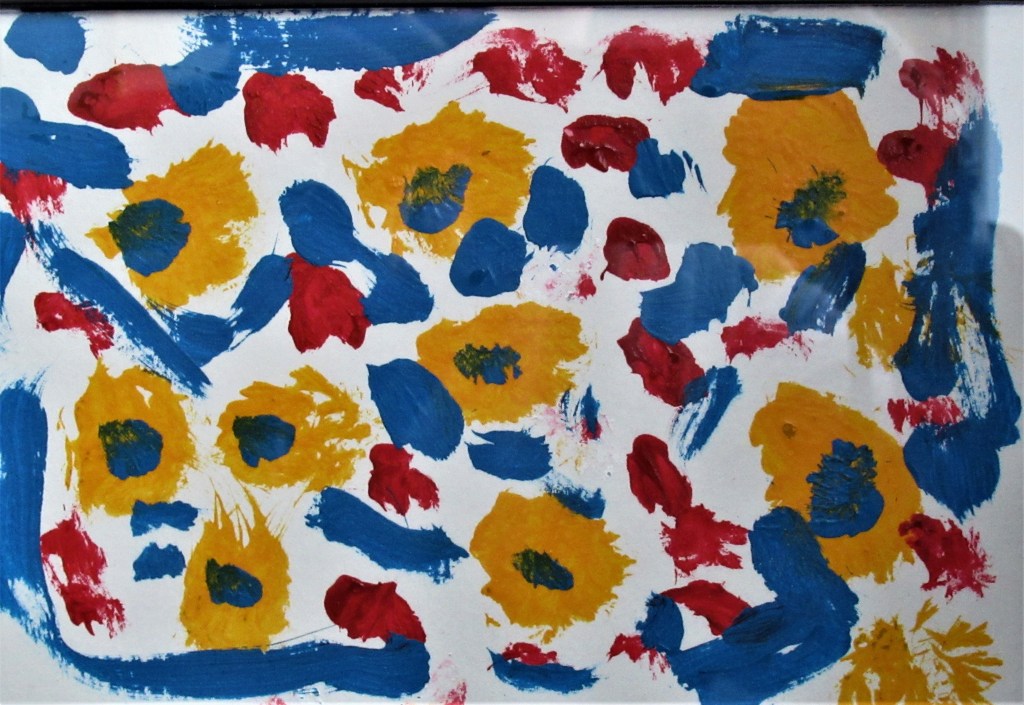
He brought light and joy back into my world, made me realize I was not alone, and I gave him, as a token of my gratitude, this painting: Luminescence.

Those of us who are still capable of bringing light and joy to others must continue to do so. Whatever we do, we must not let the dark side and the shadows take over.

My friend – you touched my heart. I thank you.

Warm in the Kitchen

Warm in the Kitchen

This early morning, the only warm place in the house is the kitchen, close to the fire, with all the doors closed. The black-out curtains from the Second World War are still in place and hang languidly over ill-fitting windows that let cold air into the house. They must be pulled back in preparation for that first glimpse of day-light. Your elders move in and out, letting in the cold air as they open and close the doors at either end of the warm space where the fire is just taking hold.

Your grandfather banked it overnight with black sea-coal and then he raked the fine, grey ash, with its still smouldering lumps of charcoal, into a warm mound, ready for paper, kindling, coal, and the match. He has also placed a newspaper over the fireplace to create a draft. If the fire doesn’t catch soon, he will throw some sugar onto the embers to aid the blaze. The fire will suddenly flare into life and the room will be quickly warmed. In the meantime, the kitchen, though warmer than anywhere else in the house, is still slightly chilly because the damp night cold has invaded and made everything wet and slick.

It’s great when you’re at your grandparents’ house, but when we are back in ours, my father and mother always leave early, to go to work.

When I was younger, they had to feed me, but I soon learned to make my own breakfast from whatever I found in the fridge. Now I can use a frying pan. I fry bacon first, and then, when I have plenty of bacon fat, I fry bread, eggs, sausage, black pudding, kidneys, tomatoes, mushrooms, and anything else I can find, including laver bread.*

Before I know it, I have become a latch-key kid and, when I am hungry at home, I fry myself an all-day breakfast: eggy-bread or fried egg-with-its-hat on doused in HP sauce for lunch, all washed down with tea to which I add condensed milk and sugar.

But this morning, they have made breakfast for me: porridge. “Porridge, porridge, skinny and brown, / waiting for breakfast when I come down.” And I hate porridge, especially burnt porridge, with a passion, and yes, they’ve burned the porridge again. I hold a cup of hot tea in my hands. I breathe in the steam and it loosens up my chest. The china cup warms my fingers. I prod at the porridge, feed some to the canine mouth that dwells unseen beneath the table, and stuff myself full of toast. Whatever I eat, when the food is inside me, I feel much, much warmer and now I am ready for the rest of the day.

*Laverbread Bara lawr in Welsh: edible Gower sea-weed, a delicacy often called Welsh Caviar.