Three Deer

img_0351


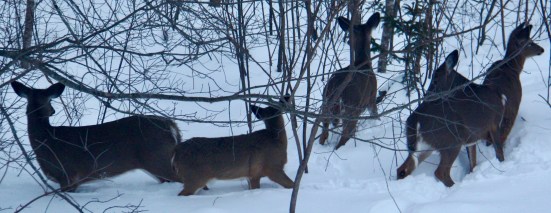
We spotted them very late and by the time I had found my camera they had walked past the kitchen window and my only shot of them was through the bars of the back porch. Not a great photo, but better than nothing. We see them regularly in the winter, but usually at dawn of dusk. We have never before seen them at mid-day, not that we are looking for them ‘out of hours’ so to speak.

We speculated on why they were there, what they were looking for, but we could come up with no answers. Hungry? But this was an early snowfall and there would be plenty of food out there. Confused, perhaps, as were were, by the early snow? That is a possibility, but we’ll never know for sure. What I do know is that they haven’t been back. With the snow down they would leave tracks, but we have seen no tracks in the snow.

Maybe, without the photo, I would have forgotten about the and thought that maybe I was mistaken. But I have photographic evidence and no, it isn’t photo-shopped or forged. In spite of all my doubts and misgivings, they were there, in the early snow of Snovember. They passed through the garden last night for their first nocturnal visit. I heard a cough and a snuffle at the feeders, but didn’t get out of my warm bed to take a peek. This morning, they had snaffled all the seeds in the bird feeders and they left tracks leading up from the trees, then back into the woods again. The chickadees had a rough time of it as there was very little breakfast for them, early this morning. We have re-filled the feeders now, and life goes on.

img_0344

Here is a link to an earlier blog post that contains more pictures of deer in the yard.
Five Deer.

img_0436

Snovember

IMG_0133.JPG

The snow came early this year, hence the above cartoon: Snovember. The deer came early too, and we saw three of them wading through the bottom of our garden, about fifty feet from this tree, where the now-bare trees separate our lot from our neighbor’s. It was just after lunch, and quite the surprise, as the deer usually arrive just before dawn or just after dusk, and much, much later in the year.

So it’s clearly a season of firsts and readjustments. Yesterday, we went wild and invested in an early Christmas tree. It’s a six foot tall white birch (plastic and ever-lasting) with 120 led lights and we will plug it in the corner of the dining room by the computers.

In the short dark days of winter, we are affected by Sun Absence Depression (so SAD) and keep a set of lights burning in the corner of the dining room by the computers. These lights are particularly effective in the early winter mornings, before sunrise, when the world is dark and we need warmth and comfort. Turn the computer on, and on come the lights shedding joy to welcome us as we read the enormous amount of bad news that seems to be circulating through our world right now.

Light in the dark: I think of it as a pair of rose-tinted glasses that allow us to reject the bad news and to look for the bright side, the silver lining that blesses every seeming cloud. That’s why the snow falls in bright flakes in my cartoon. The tree appears to be bare, but a couple of birds and some scrag ends of leaves adorn the branches.  The days may appear to be dark, but the bright lights on the tree are a silver lining to the cloud of unknowing that hangs in the air like a black umbrella.

The cloud of unknowing, the dark night of the soul … so much mystery, so much joy and despair, in life around us, yet it is a mystery to be grasped and savored, to be tested and tasted … and what is life without uncertainty, challenge, faith, belief, and lights, colored lights, a festival of lights, and humor, even in this darkest of all seasons?


Buzz Words

IMG_0044.JPG

Beware of Buzz words. Beware too of the perils of what Bobby McDonagh, in the article linked below, calls the thought incinerator. A thought incinerator is a word or phrase that can be repeated again and again to destroy thought and argument. McDonagh’s article illustrates the use of thought incinerators in politics. Being more apolitical than political, I am interested not in politics, but in the linguistic argument that involves the erosion of language and meaning and the destruction, with chanted, thoughtless choruses, of logical discourse and analysis.

Lock her up, the people have spoken, build that wall, drain the swampfake news, all fall into the category of thought incinerators, precisely because they can be repeated endlessly with no need to present logical arguments to support their continued usage. While these mindless chants can be attributed to one side of the political divide in the USA, more similar phrases can be found in the article below touching on the current political situation in the [Dis-] United Kingdom of Great Britain and Northern Ireland. some examples follow: the elite, project fear, Brussels bureaucrats, Brussels bullying, Brussels blackmail, the EU wants to punish Britain, whatever did Europe do for us, not to mention the notorious red bus and its far-reaching message “350 million quid a week for the NHS. I encourage you to read the and hopefully to understand what such mindless repetitions do to incinerate thought within our so-called democratic society.

https://www.theguardian.com/commentisfree/2018/nov/20/brexiteers-trump-language-fake-news

The problem goes beyond politics and enters the realm of language erosion. In our province, the local newspapers write at a grade nine language level and like it or not, we deal on a daily basis with functional illiteracy. Spelling, if and when people actually write, has become phonetic because less and less reading takes place, and the world is summed up in catchy sound bytes from radio and television and the shorter the better. Slowly, we are reduced to devouring slogans like those repeated above.

I look at the trees in the garden: birch, pine, spruce, fir, tamarack, hackmatac (from the Western Abenaki?), balsam poplar, larch, willow, mountain ash, black willow … they can all be reduced to trees. In my garden, at the feeder, I have birds, sparrows (so many varieties), nuthatches (white and red-breasted), woodpeckers (at east three kinds), finches (many species), grosbeaks, siskins, song-birds, warblers, passerines … but as the clear-cut loggers who cleaned the hillside behind my house pronounced “trees are just trees, we’re here to clear them out,” we might just as well say “birds, just birds, we’re here to fatten them and feed them to the cats”.

The erosion of language, the erosion of thought, the dumbing-down of society, the reduction of the world to advert, slogan, and chant, the loss of thoughtful democracy … this is what I fear most. And, as I age, I fear the loss of memory as song sparrow, white-throat, chipping, Lincoln, are slowly fading into generic ‘sparrows’. Soon, alas, they will probably all flap their wings and fly away, fading into the simplistic grey mist of a disappearing species … ‘birds’. I fear that day and I fear what memory loss and thought incineration and language erosion are doing to my precious world.

More thoughts on language erosion can be found here

https://rogermoorepoet.com/2018/11/17/thinking-outside-the-box/

Westminster Chimes

Empress 005

Westminster Chimes

Not all clock towers and churches ring out with Westminster Chimes, and that is particularly true of churches where the carillons are so distinctive and those who toll the bells are so unique. That said, the Westminster Chimes are probably the most famous in the world: 4 sets of 4 notes, striking on the full hour, followed by the clock tower striking the hour itself. The build up is basic: 4 notes for the quarter hour, eight notes for the half hour, 12 for the three-quarters, and 16 before the hour strikes.

Last night I awoke at 3:15, just in time to hear the hall clock strike the quarter. The initial sounds lost themselves in the mist of sleep and I only caught the last two notes clearly, hence the bell tower of Ste. Luce-sur-mer, above, partly disguised by the St. Lawrence river mists. Doze mode, I guess, and I heard the notes at half past, then again at a quarter to, and finally the hour. I wonder how many remember the rhyme that the clock chimes? I repeat it every night as I lie awake, listening: 1/4: All through this hour, 1/2 All through this hour, be by my side, 3/4 All through this hour, be by my side, and with thy power, 4/4 All through this hour, be by my side, and with thy power,  my footsteps guide.

Dozing through the night is a funny thing and the mists of sleep walk through one’s head in many forms. Often, I count the chimes, only to find that it is not three o’ clock, but four or five. The mists have crept into my head and I was sleeping when I thought I was waking and 1 and 2 and 3 are not always followed by four and I wonder if there is a life-lesson in there somewhere that will help us through this current upside-down world of carnival and topsy-turvy pan et circenses, predicted by Juvenal in his satires. The Wikipedia definition of the second-century phrase is fascinating: “In a political context, the phrase means to generate public approval, not by excellence in public service or public policy,  but by diversion, distraction or by satisfying the most immediate or base requirements of a populace— by offering a palliative: for example food (bread) or entertainment (circuses).” O tempora! O mores! (Cicero).

Sometimes we have to take steps backwards through time to fully understand the meaning of our own times. In the meantime, we can look out of the window, here in Island View, and see the ruins of the summer garden, slowly crumbling before our eyes. Then we can quote again, this time from Samuel,  ‘Ichabod, Ichabod, the Glory has departed.’


Ruins

IMG_0040

Ruins

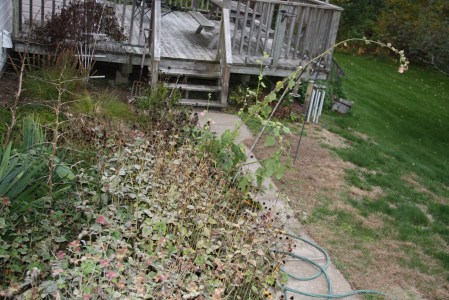
There are many types of ruins, ruined castles, ruined churches, ruined monasteries, old stone circles fallen into ruins, barns alongside the highway, backs broken, roofs caved in, old people beg, still clean and proud, outside the supermarket, proud, yes, but still more or less ruined. And then there are unkempt gardens that fall into ruin when summer crawls to the burnt out embers of  its heat.

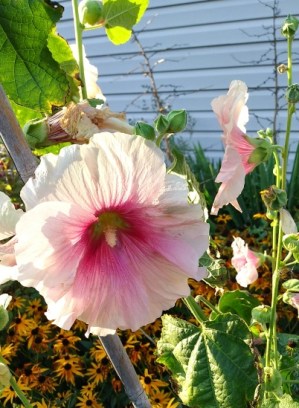
When I came back from my week’s creative retreat in KIRA, our garden lay in ruins. The hollyhock still stood, but it was on its last legs, drying up. It didn’t imitate the dead sticks of the yucca plant, four flowers this year, nor the dried up foliage of summer flowers. Nevertheless, wind and rain have now brought him close to his end, poor thing. I want to remember him in all his glory. I want to see beyond this bent, withered stick of a plant that slowly bows its head to look down at its roots. My hollyhock, please, in all his glory!

20180916_182952_HDR-1_resized

All our glories! I too am in decay and falling into ruin. I dug out an old photo of myself. Bristol University, 1964, running for the First Cross-Country VIII on the Bristol – Weston road relay. Hugh Arnold was just handing off to me and I was setting out on my 5 mile leg of the race. Young, fit, no grey hairs, no wrinkles, no limp, no stoop: it was a five mile leg that I would complete in about 25 minutes. Alas, slow is me: it takes me that long now to walk 400 metres. And I need rests and a stick to help me on my way.

Standing amidst he ruins of my life, yes. But I stand proud, my head held as high as I can hold it. I can honestly say I have done my best. And what more can anyone do? Athletics, rugby, coaching, research, publishing, teaching, facilitating workshops and retreats, travelling, editing, creative writing … it has been a crazy life, packed with fun and adventure and no, I do not regret a moment of it.

Come to think of it, unlike many people, I have actually lived many lives. My first took place in Britain and Europe. Then in September, 1966, I was reborn as a Canadian. Each subsequent Fall, at the beginning of September, as each new academic year began and the year’s cycle turned round to freshness and intellectual renewal, I was born again. Teaching, coaching, working with young people: what wonderful things to do. Now, I look at the ruined garden and remember the joys of summer. They will return. My hollyhock will also be back. He has sown his seeds throughout the flowerbeds and sooner or later he will return. I too have sown seeds: the seeds of joy, knowledge, learning, creativity. I too will live on in the many virtual children whose minds I have inhabited and helped to shape.  Winter is drawing near. The cold and the dark encroach: but, like my garden, I will be back.

The Painting Lesson

The Painting Lesson
KIRA 

image4

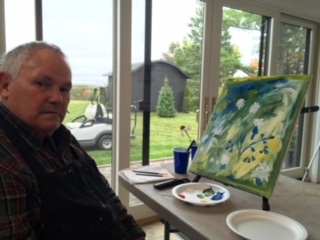
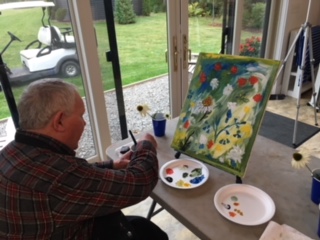
Geoff is teaching the participants in the creative retreat how to paint a cone flower. He plucked several on the way to the workshop and placed a couple in a cup of water so we could study them in close up. Mine are on the table just to my left hand. The golf cart outside is the main means of transport when it is time to move me from place to place. It’s so much easier to sit in comfort rather than to pick my way carefully over slightly uneven grass. Geoff has shown me how to paint the background to my flower. Alas, my background is nothing like his background. I often wonder if this is because I went to school in England, while he went to school in Canada. Certainly our backgrounds are very different. Geoff took the Golf Cart keys from Mad Max. Hence the drive over to Studio #1, where I wrote for a month in June 2017 was very smooth. Mad Max is very kind and gentle. Until he gets behind the wheel of a golf cart. Then he earns his nick-name: Mad Max. My plastic chair is about to collapse and land me on the floor. But I don’t yet know that. It will happen about three minutes after this photo was taken, but the camera had gone by then. Fortunately. Or the next picture would show my rear end raised into the air in all its glory with my little legs kicking.


image3

This next photo shows my painting with my lovely cone flower painted in. My cone flower does not resemble Geoff’s cone flower, nor does it look like the real thing that sits on the desk in front of me. I hope you can see my  cone flower in the painting, but if you can’t, don’t worry. My best advice is search for something that doesn’t look like a cone flower and you will find mine. We are not sure what happens when I paint. Whereas all the obedient students have only one large realistic flower in their painting, my painting sprouts flowers as if by magic. They just appear, like dandelions. They are everywhere and in all colors. It’s quite the bouquet, really, though that is not what it was meant to be. It was meant to be a cone flower. Geoff says I have a unique and powerful style of my own. I think this is instructor-speak for “Roger, you can’t paint for love or money and, as a painter, you are as dumb and stubborn and inflexible as a knot in a lump of wood, but shucks, I’m not a negative person, so I’ll call your messy message unique.” Thanks, Geoff. It’s nice to be unique. Much better than being an abject failure. When Clare saw my painting, she thought my eye-sight was going, so she made an appointment for me to see the optician, or whatever he’s called, next week. Or the week after. I couldn’t make out the date. Her hand-writing is so blurred. Maybe her hand-writing is unique, too. Either that or she also needs an eye-appointment.

image5

This is the final product. Geoff says it is very strong and demonstrates the strength of my personality. I think it looks like a cross between a Tangled Garden, a nightmare bristling on the facade of one of Monet’s Cathedrals, a Van Gogh flowery sky, and a walk in the park with Picasso when he was trying to relearn how to paint as a very young child would paint. The other participants say they like the energy of my brush strokes. Brush strokes, a lovely idea. I hold the brush like a carving knife and, pretending the canvas is a lump of recalcitrant cheddar cheese or a fierce Shropshire Blue, I attack it with my bristle sword, hacking it into colorful lumps that can be whatever the viewer thinks they might be. Speaking of cheese, this painting is the sort of dream that comes in the night to haunt me when I have eaten too much cheese. The slashing of the nightmare with the paintbrush sword brings a moment of release and a wonderful feeling of relief and relaxation when canvas and cheese are cheerfully hacked and the contents of their souls released into a heaven-haven of paint. Ah soul: I think you can see one or two souls flitting through my tangled garden. I’ll tell you a secret, though: I don’t know how they got there. I thought I was painting butterflies at the time.


Surrealism

IMG_0124

Surrealism
KIRA Retreat Day 4

Only one of the Kingsbrae alpacas could understand and illustrate what we did today. This one showed us so many things. Luckily we smuggled him into the writing classes and the art classes and nobody was any the wiser. In fact he taught one class himself, and one participant served as translator, moving from Spanish to English with almost as much ease as he taught.

He began this morning with a reading that linked Symbolism to Surrealism to Magical Realism. It was a fascinating piece that nobody in the room, myself included, had ever heard before. So, we began with a concrete, literary example, then moved to a theoretical session. The alpaca began by explaining the difference between a lama, an alpaca, and a vicuña. This was extremely interesting, and something we hadn’t considered before. Luckily, these three creatures, two of them mythical (but which two?), do not have-isms attached to them and were therefore much easier to understand.

The lama began the theoretical session by offering some meditation exercises, very peace-giving.  Then he moved into the nitty-gritty of automatic writing. He followed this with some examples of how, rather than copying the automatic writing, we could select prime elements from it. This selection process allows the writer to mine the subconscious while avoiding some of the repetitious nature of the automated pen on the suppliant page.

In all cases, all participants read from their work and the sharing of subconscious inanities was a great way to break any ice that came with the overnight change in the weather.

After lunch, we had a second writing exercise that stretched into two exercises. These were courtesy of a second lama and entailed describing unknown and known objects. One of the participants was very uncooperative and instead of writing words drew pictures in his notebook. This drew comments of ‘Naughty, naughty,” from the lama and that student was given a time out on the golf cart driven round the lawn by the KIRA equivalent of Mad Max.

In our final session, the art lama appeared. He had carefully plucked all the flowers in Kingsbrae and then eaten them. However, in an incredible act of bravery, the ladies present stole some from his hoard and placed them in water cups. The participants then scattered random dots of paint upon a canvas and agreed that, seen from a distance and in the dark, they looked like flowers on a tarmac road under storm clouds on a thundery night when nothing could be seen.

By now, the lama who had been tied to the fishing weir, oh, I forgot to tell you about that, sorry, had been rescued when the Old Sow let the water out of the Passamaquoddy bath tub (aka low tide). Luckily no harm was done and a delicious, fossilized piece of Turkish Delight was shared by the participants all of whom agreed that nothing like this had ever happened to them before, and I believe them.

Mad Max took everyone for a ride on the Golf Cart and we all chased deer round the Kingsbrae Gardens while singing “I’ve been working on the chain gang” and “For it’s a jolly good yellow.”

Holly-Hock

IMG_0026

Holly Hock Hangs on …

I keep calling my Holly-Hock ‘he’, but I am beginning to think that if Holly Hobby was a lady, then this tough old plant is a lady too. A limpet lady. She has gone through three quite hard frosts now, one early, and two back to back, earlier this week, followed by two days of heavy rain. The rest of the garden is withering or withered. Clusters of dry blackened stems surround this old lady, but she still stands tall and proud. Not only that, but she casts more and more flowers out to greet us.

We have kept lots of seeds and will sow them soon, some are in the ground already, in the hopes that she and her offspring may flourish. For this lady is a symbol of hope. Hope in the face of frosts, cold winds, heavy rains. Hope in the seeds that she produces and scatters. Hope in the generation and the regeneration of a beauty and a strength that, if lost, may never be found again. Hope in old age that our children will survive and lighten our countenances with their love.

So go, you Holly-Hock seeds. Bury deep, send out roots, sleep for a while if you need to, and when the spring sun peeps over the horizon after a hard, long winter, be ready to bloom again. We, your faithful followers, will be waiting for you, with hope in our hearts.

Jack Frost

IMG_0026

Jack Frost

Or, since I live in a bilingual province, should that be Jacques Frost? Whatever. He visited the garden last night and did his usual job on our tomatoes. There are a couple of survivors this morning and we have now rescued those, but last night we neither took the toms in nor covered them up.  Oh dear. The result?

IMG_0027

As for the hollyhock, it was looking very sorry for itself early this morning. But, with a little bit of warmth and sunshine, he rose to the challenge and, while looking a little battered, soldiers on and on.

A wounded warrior, this tomato, though. The birds will get him, or the deer, or something. The cat has been very worried about intruders recently, birds and others. Here she is, inspecting the back porch from her watch tower beside the sliding door.

IMG_0032


Seeds

20180916_183415-1_resized

Seeds

As creative artists, we seek to leave seeds and plant seeds. Just one idea, seeding elsewhere authenticates us as artists and creators. Some seeds fall on stony ground, we know that. Others do not take immediately, but lie dormant for some time. Some, a few, a very few, a happy band of siblings. drop, root, and grow into the flowers we always wanted to create.

We must always have confidence in our seedlings. We must believe that they will survive, somehow, somewhere, in spite of the random nature of the universe. Write with that belief. Create with that belief. Be strong. believe. Even when others doubt you and, what is worse, you doubt yourself. Never doubt yourself.

My Hollyhock doesn’t doubt. It came from nowhere and gifted itself upon us. Now it has gifted us with pod after pod of wonderful seeds. Some will be lost. The squirrels, chipmunks, and mourning doves, not to mention the passerines, will get others. But some will survive, take root, and flourish, just like this one did.

Believe, my friends, believe. And never stop creating.