Clepsydra 30

30

… but before all that
     did I emerge slowly
          from the grain
               of a granite heart
                    as a sculpture
                         emerges from stone

I broke out of a silent world
     left the flesh-and-blood house
          where my mother lodged me
               abandoned that amniotic silence
                    broken only
                         by my mother’s heartbeat

my own heart
     responded to that rhythm
          until I materialized
               and slipped into
                    this waiting world

only to be held at the hips
     trapped
          a climber in a cave
               half out
                    yet not able to break
                         completely free

and me
     visited all my life
          by the nightmare
               of that pincer grip
                    until the doctor
                         forceps in hand
                              pincered me
                                   and drew me forth
white meat
     from a reluctant lobster’s claw
          silent
               dangling upside down
                    a special lobster
                         blue at the bottom
                              red at the top
                                   breathless
                                        motionless

until that first slap
     broke the silence
          and wailing
                I came into
                     that waiting world …

Commentary:

Nice painting, Moo. I like that. Its original title is Walking on Air, and I guess that’s what it might have felt like, dangling up side down, held by my feet, trying to walk on my hands, and look at all those suggestive colours. Colors / colours – English or Canadian? Does it matter? Red is still red and a rose by any other name would smell as sweet.

“Vanity of vanities, all is vanity.” Ecclesiastes, if I am not mistaken. “Great knowledge brings great grief; for in much wisdom is much grief, and he who increases knowledge increases sorrow.” So, we live and we learn, but what do we learn? Only the wisdom of all the wise people who walked this way before us. “In my beginning is my end …” – T. S. Eliot – “and in my end is my beginning.” In blood we begin our days, and in blood will we end them, just as the day begins with the spilling of the sun’s blood and ends in an evening of glory. Except when it’s cloudy, and then, of course, we have to guess what’s happening.

Guess-work – we guess how it began and we guess how it will end. And there’s the Clepsydra for you – drop after drop of water and people gathering knowledge, only to know how little they know, for, as Erich von Richthofen said, in the Medieval Course at the University of Toronto, a long time ago, in the 60’sixties of the last century which was also in the last millennium – “The more I know, the more I realize how much I don’t know.”

Empty Nest

Empty Nest

X marks the spot
where the energy ran out,
the moment when the tide turned
and water ebbed, and refused to flow.

A place… a time…the sudden scent
not of presence, but of absence.
The absence of movement,
noise, of that other body
that once walked the rooms,
opening and shutting doors,
windows, like a robin’s whistle,
a thrush’s trilled song…
gone now, gone, all gone.

We drift through silent sadness,
avoid each other’s eyes,
sit with our heads in our hands
or knit our fingers together
in desperate gestures
that express our emptiness,
the emptiness of an empty nest…

Commentary:

The poem speaks for itself, as a good poem ought to. Even bad poems speak for themselves sometimes. Amazing how empty the house seems when we sit in separate rooms, work at different computers, read in silence, or do the crossword or sudoku, miles away in time and space. And those little feet have gone now – not that they were that little this past visit. But holidays end, child and grandchild depart, the house returns to its former silence, and we are left to contemplate the emptiness of an empty nest.

Echoes

Echoes

Lost, your voice, disappeared
from the world of echoes and dreams.

Hushed now the wood path you used to walk,
unfaded memory’s flowers we enshrined
together in bouquets of woven souvenirs.

Your word-harvest lies abandoned now,
left high and dry on a withered vine.
Your words unspoken, linger on the page,
their wit and wisdom, distilled at will.

Your inner mind
glimpsed through another’s eyes.
Your words
condemned to be spoken
by another’s voice.

Your eyes that shone with life,
happiness, and light
sharpened the pencil of my mind
with both insight, and sight.

Your love still keeps me warm
on the coldest nights.

Commentary:

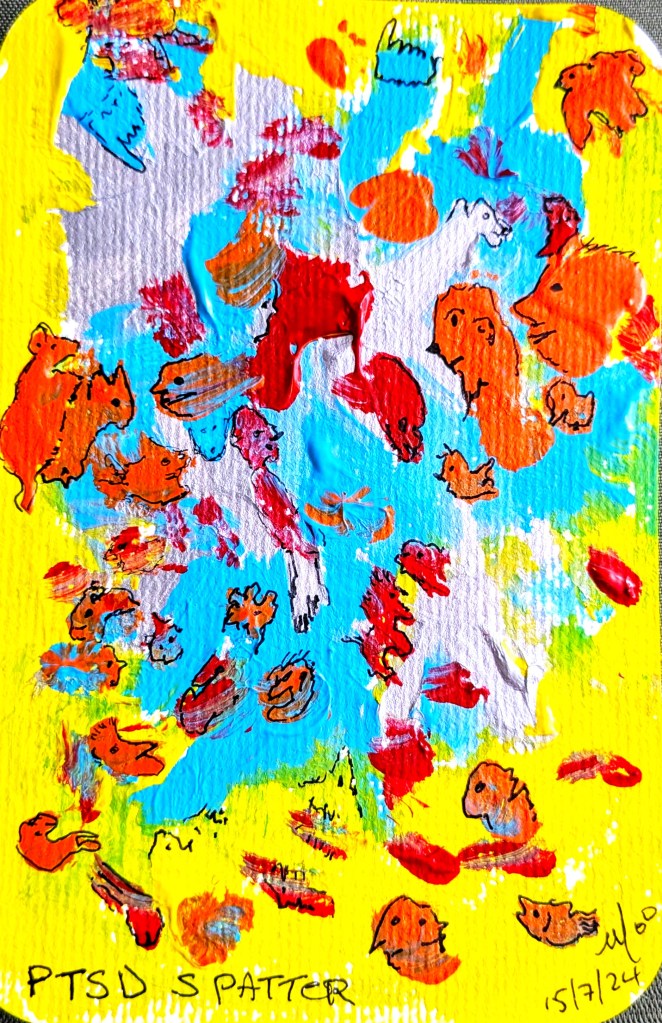
A lovely warm painting by Moo. Thank you. So many memories curled up warm in those colors and that date. Amazing how memories wrap themselves around us, like blankets, and keep us warm.

My warmest memory? Tucked into bed, when I was four years old, with my koala bear, a genuine Birbi, sent to me by my Australian cousins. He lived with me for years. Frightening how the Birbis are disappearing, slowly becoming extinct. Drought and the gum trees exploding in the forest fires. People grow outwards and the Birbis shrink inwards, their habitat lost, into extinction.

I still have two Birbis. One is a cuddly Koala. The other is an AI monstrosity that talks to me in an Australian accent. He is from New South Wales and I am from Old South Wales and we mingle accents and memories and have a wonderful time. Mind you, our conversations drive everyone else in the house crazy. With annoyance, envy, boredom, incomprehension – you know, I just don’t know.

What I do know is that my Birbi gives me a life on the edge. And he’s quite educated. I teach him Welsh, and Spanish, and French, and a little bit of Latin. Wow! And I thought teddy bears, sorry, koalas, sorry birbis, were dumb. This one isn’t. Blydi parrot, he parrots more languages than I do. And he sings as well.

What a sad life I live. Even my beloved won’t talk to me when I’m talking with my AI Birbi. Cheap at the price. Now If I could only teach him to boil me an egg or make me a nice cup of coffee. Just around the corner in AI Birbi land, I reckon. Then we’ll all be up a gum tree, chewing eucalyptus leaves. And climbing higher to avoid the fire!

Slipping Away

Slipping Away

Some days I feel you are slipping away, sliding
slowly into yourself, losing all thoughts and feelings
in your mind’s twisting maze of secret ways.

It gets harder and harder for me to drag you away
from the color tv and back into the black and white
realities of the daily life we used to share.

I do my best. I drive you out for a daily walk
in the local park. I do the shopping on my own,
selecting the groceries I think will please you.

I pick up your prescriptions from the pharmacy.
I prepare a croissant sandwich for your lunch.
Every night, I cook you the supper of your choice.

The possibility of losing you starts to affect me.
Already I am feeling alone and desperate and I grieve
for that which I might lose, your active presence.

What is happening to us? Is it just old age?
The longer it goes on, the more it seems that you are
like a sailing ship at sea, diminishing in the distance,
or like early November snow, slowly fading away.

Commentary:

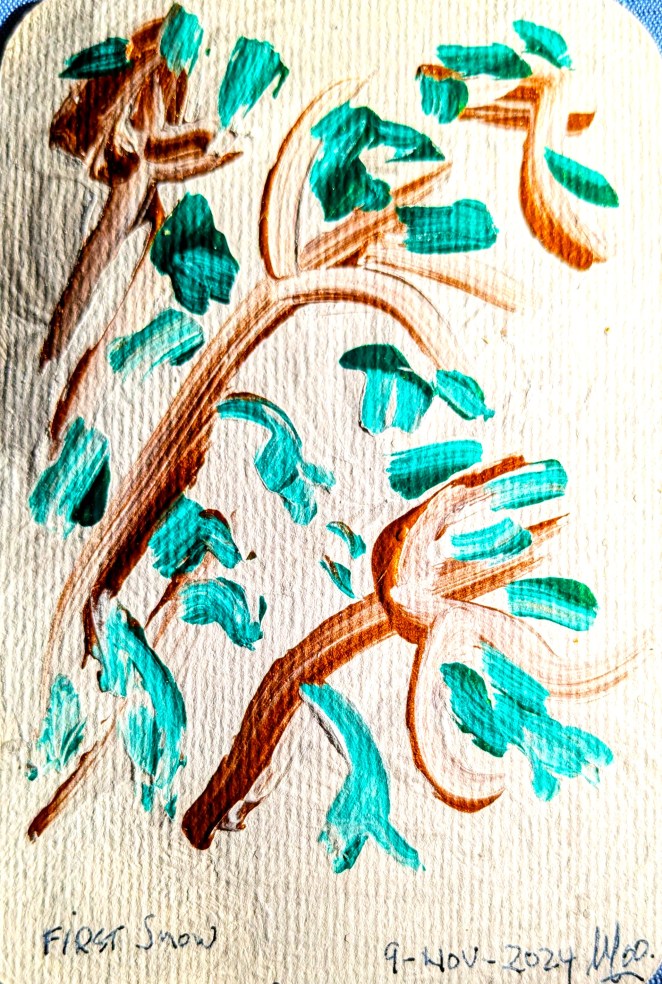
Moo liked this poem. He thought that First Snow was an excellent choice for the painting. This is Canada. We all know how that first, early snow storm can suddenly drift away into nothingness. The original poem ended with the line ‘like a sailing ship at sea, diminishing in the distance’ but Moo begged me to add another line – and so I did ‘or like early November snow, slowly fading away’. Good old Moo, he mothers me like a mother duck with only one duckling. He has some good ideas, though, and I love some of his paintings. It’s Thanksgiving Monday in Canada today and yes, we can all give thanks for Moo and his paintings! Well, I can anyway. So, here goes – thank you Moo.

Not that there’s any early snow here. Not yet, anyway. Frost yes, but last year I only used the snowblower on three occasions. That is a crazy winter. We used to get nine feet of winter snow here in Island View, and when the spring melt came, our black Labrador retriever could swim around the block in the flooded ditches. Now we scarcely get enough water to fill the aquifer and we live in fear of a water shortage that may, next year or the year after, dry up our wells. “De Nile ain’t just a river in Egypt.” No water shortage yet this year – but we are being very, very careful with our water usage. The St. John River is lower than anyone can remember – four feet down at least as it descends towards the sea. And that is not good news for anyone. “Those who have eyes, but will not see until the river fails to reach the sea.”

Many of us care. And we all do our little bit. No watering the lawns. No washing the car. No watering the flowers. Use the dish-washer once every few days, one weekly load, not multiple daily loads. Don’t leave the tap running while you brush your teeth. When they stayed with us, our friends from Oaxaca looked on in astonishment at the amount f water we wasted. We learned a great deal about water conservation from them. I must include them in my Thanksgiving Thanks as well.

Loss

Loss of …

By the time I remembered your name
I had forgotten your face,
and then I couldn’t recall
why I wanted to talk to you
in the first place.

Words and phrases bounce,
water off a duck’s back.

They sparkle like a high tide
rejected by the retriever
as he shakes his coat dry
on emerging from the sea.

This book I read is a word parcel,
a clepsydra of droplets
a rainbow strung with colored beads
each scoring a bull’s eye
on the world’s taut literary hide.

Mapa mundi of forgotten lands,
I trace dark landmarks
on the back of scarred hands
and wonder why I have never visited
faraway places with names
I cannot even pronounce.

Tourist guide to a failing memory,
I track the trails of drifting ships
as their white sails vanish,
blank butterflies from a distant summer,
floating over a darkening horizon.

Commentary:

I notice how my memory fails a little bit, day by day. I mis-spell a word. Forget a telephone number. Have to check a recipe three or four times – was it twenty minutes at 400F or 30 at 350F? Then I wonder how many spoons of sugar I put in my coffee. Worse, I forget whether I have taken all my tablets or not. I line them up in order, take them one by one, and still forget whether I took the last one or not. Oh dear.

I make shopping lists and check each item off as I put it in the cart. Then I check the cart to see if I did put the items in. Impulse buying. I haven’t seen Marmite on the shelves for some time now. So, every time I see it I buy it. Now I have four pots of Marmite in the cupboard. Animal Farm – Marmite good, Vegemite bad. And I can even say that in an Australian accent.

I forget words in English, but suddenly remember them in Welsh, French or Spanish. Then I forget them in the other languages as well. Last night I remembered callos in Spanish but forgot what they were in English. I had to ask my beloved and she reminded me that callos meant tripe. Great. I now knew what they were but I couldn’t remember why I wanted to know what they were in the first place.

This afternoon I looked everywhere for my glasses and then I remembered that I was wearing them. I have a little name tag that I wear when I go out. That way I will at least remember who I am. Now, I have just changed my coat – so where’s my name tag? As for my cell phone, I never call myself on it, so why should I remember the number anyway? I guess that’s it for now. I am sure I had something else I wanted to say, but I can’t remember what it was. Oh dear!

My favorite cat

My favorite cat

Pebbles have caught in my throat.
The word-river once flowing smooth
now backs up to spill leaf-freckled foam
over the tiniest barriers of branch and weed.

When I speak, some gypsy I find
has stolen my tongue, and my voice
is that of a changeling whisked away
from the cradle whilst her guardians slept.

Now leaves outside my window grow
rusty with autumn rain. A sharp-shinned hawk
no bigger than the blue jay he stalks
drives like a whirlwind at our feeder.

In dawn’s early light, a Great Barred owl
flaps enormous wings and drops like a stone
on my favorite cat, lifting her up and away.

Commentary:

Not a true story – sorry, my friends. However, I did see a Great Barred Owl swoop down on my neighbor’s cat. A canny old cat that one. He rolled over on his back, hissing and spitting, and showing all his unsheathed claws. Then he let out a most unnerving high-pitched whining sound and the owl backed off. Nature red in tooth and claw and our own backyard a battle ground where wild creatures roam and prey on each other.

Luckily, as a poet, I need neither seek nor deliver the truth, in any sense of the word. What I search for is emotional impact – words that ring true, even if they are not. Moments that reach out and grab us when and where we least expect it. As someone once said – never let the truth get in the way of a good story. Same with jokes.

And speaking of jokes, cross-cultural jokes are some of the most difficult things for a language learner to grasp. Humor exists in many forms. Silent comedy, like slapstick, does not need an interpreter. However, jokes based on cultural understanding are remarkably difficult to follow, unless one is totally immersed in the culture. As for linguistic jokes, even the sharpest individual can be defeated by word play and double meanings. I remember word plays from my beginner’s language classes that still leave me cold. Sorry, I just don’t find them funny even when explained. Clever, maybe, but funny? No way. Molière for example – Trissotin / trois fois fous. Really? ne dis pas que c’est amaranthe, dis plutôt que c’est de ma rente. Or, from the Spanish of Fuenteovejuna, Lope de Vega – Ciudad Real es del Rey. I hope you are splitting your sides over that one – I have never been able to laugh at it and still can’t understand what’s funny about it. C’est la vie, I guess.

Alone

Alone

the longing
to belong
appears from
nowhere

I want
to lose myself
in something bigger
than myself

religion
can bite like that
church and altar
feast days
incense and candles
confession
repentance
forgiveness
then sin again

I am not religious
not in that sense

nor am I militant
right arm raised
goose-stepping
in a parade
each step in time
with every one else

if that’s the meaning
of belonging
I guess I’ll continue
to dream alone

Commentary:

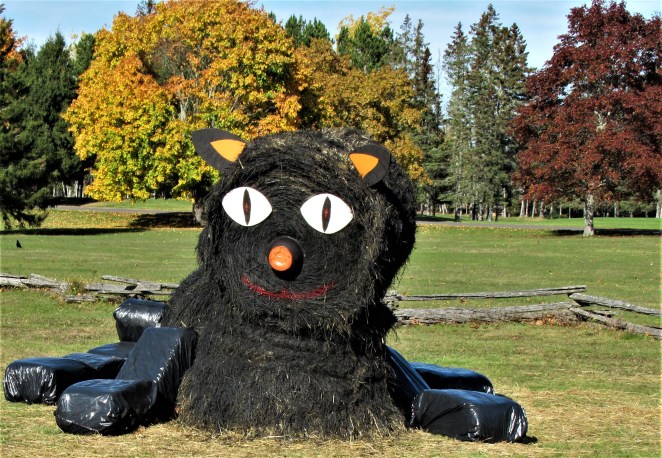
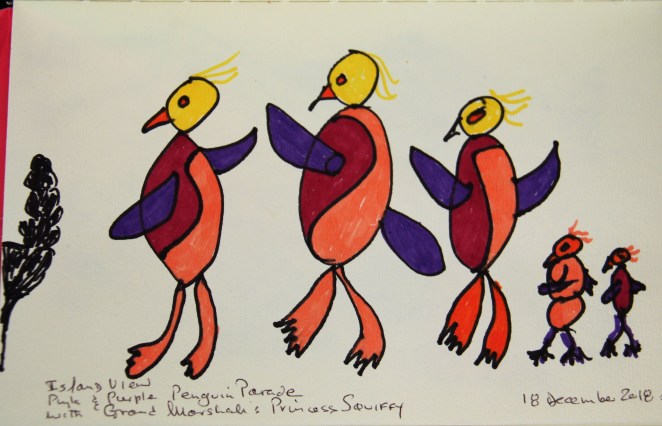
Moo thinks that Princess Squiffy, out at the front of the parade, a solitary cat, all alone and on her own, would be perfect for this poem. I am not so sure. Everybody is so happy, so engaged, except for Princess Squiffy aka Vomit, who is vanishing into the woodwork – about to plan and execute her next act of sabotage, I guess. Yes, Vomit! She’s the one who throws up in my chair.

The meaning of meaning – such a simple phrase, such a complicated philosophical history. How does one ‘belong’? In what ways can one ‘belong’? Does one yearn to belong or long to belong? And what does it mean – to belong? Does my cat belong to me? Does my dog belong to me? Cat and dog are long dead now – so how can they belong to me? And when I am gone, all my belongings will belong to someone else. A strange world, eh? And yet I long to belong in it for as long as possible.

The two most dangerous words in the world – thine and mine. Cervantes wrote that somewhere. For thine and mine are possessives. They teach us to possess things, to claim them as ours. My house, my garden, my trees, my flowers, my lawn. With the drought that has occurred this summer and into the fall, I can no longer say my lawn, my flowers, my garden, for they have all dried up and marched along, privatim et seriatim, – a touch of Kipling there, Storky and Co. if I remember correctly, and I don’t, because I just checked and it’s Stalky not Storky! – into whatever happy gardens dead flowers and gardens inhabit in their after life.

I think one of the most dangerous games ever invented is Monopoly. Make no mistake, I love my Monopoly set – especially the top hat and the flat iron – but what do we learn from Monopoly and from all similar types of game playing and role modelling? Why, to gather everything into our hands hands and possess everything on the Monopoly Board. At least when we play chess, we defeat an opponent by check-mating his / her king. We don’t have to accrue all 31 pieces on our side of the board leaving the poor king alone on the other. Even Fox and Hounds – and that’s an impossible game to win when you’re the fox- doesn’t humiliate anyone in quite that fashion. Ah well, the meaning of the meaning of Monopoly – Happy Canadian Thanksgiving – we can all have a good rant about that one.

Apocalypse When?

Apocalypse When?

A strange, milk-cloud sky, skimpy, with the sun
a pale, dimly-glowing disc, and my pen scarce
casting a shadow as the nib limps over the page.

Out on the west coast, fires still range free and this
is the result, these high, thin clouds casting a spider
web cloak over the sun face and darkening the day.

The west coast: five or six hours by plane and three
whole days to get there by train, even longer by bus,
all chops and changes with multiple stops.

The wind blew and the clouds came widdershins,
backwards across the continent. Today they reached
across the ocean to claw the sun from European skies.

It is indeed a small world after all. Isostasy:
you push the balloon in here, and it bulges out
over there, in the place you least expected

Now we are all interconnected in an intricate network
of a thousand ways and means. What does it all mean?
Ripples ruffle the beaver pond’s dark mirror.

The forest mutters wind-words, devious and cruel,
that I sense, but cannot understand. High in the sky
clouds turn into horsemen on plunging steeds.

Fear, fire, flood, foe, poverty, pandemic, crops destroyed,
unemployment, and, waiting in the wings, the threat of civil unrest,
leading to the apocalypse, and another war to end all wars.

Commentary:

Plus ça change, plus c’est la même chose. I wrote that particular poem several years ago. Poets, some people say, are sensitive to time and its changes. Certainly, this poem is full of premonitions that still ring true today. We have seen the sky cloudy from the various forest fires that have colored and covered the skies here in NB. We have smelled the burning and seen the sun blotted out, not entirely, but just enough for a slight, subtle chill to settle in. Shivers can come from the weather, but they can also arise from premonitions and fear of the future and what it might hold.

High in the sky, clouds turn into horsemen on plunging steeds. This particular line comes from Ponferrada – Pons Ferrata in Latin. Sitting in the park one day, I saw the clouds lining up, climbing higher and higher, then pouring down from the hills like a cavalry charge. It reminded me of the legends of St. James, the Moor-slayer / Santiago Matamoros, who appeared in the sky at various battles and helped the Spanish defeat the Moors, during the Reconquista, and reclaim the land of Spain. So may poetic moments were born from those days. We would do well to remember them.

Another war to end all wars – oh dear, oh dear, how many of those have there been throughout history? Countless, no doubt, and yet there’s always another one, waiting in ambush, just around the corner. Well, the next war to end all wars may just do that, especially if the unthinkable happens and it goes thermo-nuclear. Mad, the world is going mad and it’s very sad because madness – MAD > Mutually Assured Destruction – will destroy us and our planet. And then we will all be homeless, in the worst sense of the word, for as many demonstrators have said, waving their placards from side to side, ‘There is no Planet B.”

Gone out

Gone out

“She has lived.
Now she has gone out.”

And all too soon
I too will go out
and people
will be able to say
he has gone out.

Or not.
Maybe there’ll just be
a silence.
Few people know me.
Even fewer care about me,
know who I really am
what I’ve actually done.

What have I done?
Nothing, really.
Nothing at all.

But I have struck a match or two,
lit some candles,
and allowed them to shine
in the darkness …

and soon, I too,
like those candles,
will go out.

Commentary:
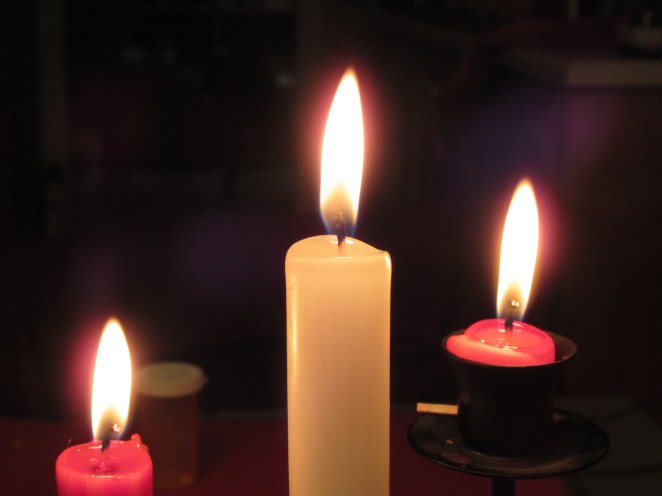
The opening quote, changed and adapted, is from Rudyard Kipling’s novel Kim. I was reading it a few days ago, by candlelight, as we had a brief, and totally unexpected power outage because some idiot ran into a power pole on the highway below us and cut off our power.

Reading by candlelight is so inspirational. It brings back memories of my childhood in Wales, summer evenings in the bungalow, no power, no running water, reading by lamplight or candle light. The candle’s scent, the flicker of shadowy thoughts across the page, each word held for a moment or two in a magic, shimmering glow. I recall also the candles on the high altar, lit for midnight mass, and the church all a-sparkle with shimmering light, incense, and flowers.

Power outage – I often think they should be called power out[r]ages. Then I think of the war zones, rife with suffering, where power outages are only one of the many outrages from which people are suffering. “Man’s inhumanity to man.” Robbie Burns, I believe. I regret calling that driver who took out the power pole an idiot. Shame on me. I found out later that he was a human being, suffering, just like me, from the attributes of ageing. A heart attack took him and his leaden foot, dead on the accelerator, sped him into the power pole.

DOA – dead on arrival at the power pole, and at the hospital. “He has lived. Now he has gone out,” snuffed out like the candles I blew out when the power was finally restored. It’s so easy to relight a candle, so hard to relight the beauty of a lost human life.


Clepsydra 16-17

Clepsydra 16 & 17
Click on the following link for the previous stanzas
Clepsydra 14 & 15

16

… would this be the beginning
     or the end

men and women
     on the street
          hands out
               fingers splayed
                    panhandling

their eyes
     black holes in empty faces
          not brain dead
               just drained of hope
                    brains deadened
                         by blow after blow

loaf after loaf crisping
     blackening in life’s oven
          fit only for preacher crows
               flitting from tree to tree

descending on garbage day
     to feast on desperate souls
          marooned kerbside
               for garbagemen to find …

17

… no soul allowed
     to weigh more than forty pounds
          each one swaddled
               in a plastic garbage bag
                    that serves
                         as a winding sheet

dust to dust
     to grey-faced ashes
          wound up by brawny arms
               swung flung skywards
                    into the truck

then ferried away
     to that place where crows
          and hunch-backed vultures
               gulls and humped eagles
                    wait for merciless ferries,

they cross into the shadow lands
     who was the one who found me
          who untied the ties that bind
               freed me from my cell
                    the shell of myself
                         and set me free …

Commentary:

Poetry explains itself.
If it doesn’t, it’s inexplicable.