Good Friday

Good Friday

Crucifixion and Death

1

Now is the hour of his parting,
such sweet sorrow, they say,
but not on this day.
Yet we’ll meet again, sang Vera Lynn,
don’t know where, don’t know when.

There he lies, helpless, on the street.
Why is that man in blue
kneeling on his neck?
“I can’t breathe.”
Can’t anyone hear his cries?
Is there anybody out there listening?

Watchers stand round and watch.
Someone makes a video on a cell phone.

Who gifted him this gift,
this parting gift he never chose.
Everyone who follows him
and tries to walk in his shoes
knows he had no choice.
They know he didn’t choose.

2

Do you feel the baton stab into the guts?
The plastic shield’s edge slash into the face?
The knee come up, no ifs, no buts?

Eyes water from tear gas and pepper spray.
Thunder flashes crack and roll, deafening
ears, taking years from marchers’ lives.

Did you follow him through Jerusalem?
Did you walk in his footsteps, step by step?
There is a green hill far away, or so they say.

The cameras rolled as they cuffed him
to his pavement cross, men in blue smiled,
winked at each other, watched him fade.

His loss was not their family’s loss.
Just another loser tossed beneath the bus.
The watchers watched and nobody made a fuss.

They stood and stared and nobody cared
until cell phone videos hit the tv screens.
 Now it’s fake news, whatever that means.

The believers will believe what they’re told.
You can’t put a price on what he was losing,
on the many things that others have already lost.

3

Leg-irons and chains:
that’s what remains from his journey here.

Iron, cold iron, splintered, burning wood.
A death bed on the sidewalk
his last will and testament.

A flaming cross lifted him to the skies,
that cross burning before his eyes.

Before he goes, we must double-check:
whose is that knee upon his neck?

“Let me breathe, let me breathe.
Take away your knee.
Justice, why hast thou forsaken me?”

Commissioner, forgive them.
They didn’t know what they did,
when all around the dying man
men closed their eyes and ears,
buried their heads, and hid.

4

Good Friday in Island View:
a foot of snow fills the streets,
empties the churches.
The Easter Weekend lurches
towards its predestined end.

But how do you end
two thousand years of hurt,
four hundred years of persecution,
of cruelty and neglect?

How do you end
eight minutes and forty-six seconds,
with that black man lying there,
choking, a white man’s knee on his neck.

He died in the shade
of orders that were given and obeyed,
orders that should never have been made.

Dissolution

Dissolution

When I am no more myself,
will I know what I have become?
What last breath in the mirror
will reflect my passing from this self
to the next, if there be another one?
Does it matter? No, to most of us,
yes, to the lusting soul that seeks,
but what does it seek, I ask myself?

I watch the deer crossing the yard.
Muted, dark against winter trees,
I can scarcely make them out,
let alone understand their wanderings.
If they scare, they raise white flags of tails,
then run, dancing down their tracks,
as light as thistle-down, though the snow
be deep beyond their walk-ways.

I want to see them as they really are,
the original inhabitants of this land that
a scrap of paper, drawn up by a lawyer,
says I own. Nobody owns this land.
It was here before me and will be here
long after me and mine are gone.

Only the deer truly belong, passing
through, each generation similar
to the one before, knowing no lawyers,
holding no legal papers, but aware
instinctively that we are the intruders,
that the forest is their heart and home,
and that they are sole owners of this land.

Click here for Roger’s reading.

Comment: from a poem by Guillaume Apollinaire: “I am no more myself. I have become the fifth of the twelfth.” I bought a book of his poetry (Livre de Poche) from les bouquinistes in September, 1962, when I started the school year in Paris. I picked it up last night, and started reading it again. The result – this little poem and a host of memories that came flooding back as the deer walked through the garden and all was right with the world.

Spider Web

Spider Web

for
Ginger and Michael Marcinkowski

I do love long and complicated sentences,
stuffed with clauses and dependent clauses,
 and all strung together like a spider’s web,
an enormous web with silvery threads that glisten
 with dew drops in the early morning sun that
blanches them, turning them white, and look,
there’s a little fly caught in this one, trapped
by his own struggles, and struggling even more
as the spider emerges, advances towards his prey,
soon to be his breakfast, or lunch, if he lets his victim
stew in the poisons soon to be injected, and look,
dew drops are falling as web shakes, and threads
tremble, and the dark and seamier side of life
emerges with its stark, black lines, from beneath
the advertising mask of glorious beauty that distorts
reality, as the spider turns into an assassin and the fly
into his victim, and yes, each of us must choose whether
to be an assassin or a victim, meurtrier ou victime,
as Camus phrases it in one of his books, L’Étranger,
though I read it so long ago, when I was a teenager,
studying French in school, and that was one of the books
I chose to read, but I was never labelled, meurtrier or
victime, just trouble-maker, first class, because I didn’t,
wouldn’t, couldn’t tow the official line and kow-tow
to a rigid authority, that walked set lines, like this spider,
the meurtrier, who turned that fly into his victime, and I,
I who could so easily become either, became neither,
but merely the observer, who stands on the outside,
looking in, and watching as the show goes on and on,
year after year, seculae seculorum, world without end,
and yes, the English Master told me never to mix
metaphors, nor to add foreign languages to my poems,
but what if they are not foreign to me, but a part of my being,
as part of the spider’s being is to be a meurtrier, and as for
that fly, well, he is the victime, in whichever language you use,
and yes, this poem is only one sentence, and I love it, amen.

Click here for Roger’s reading.

Erratic

Erratic
Four Elements pp. 156-159

Plucked before my time
by some glacial hand,
that tore me from my land
and deposited me on
this foreign shore.

Long did I languish,
worn slowly down
by wind, rain, ice, snow.
Now I am carved anew
and learning to grow.

The old land rejected me,
wouldn’t let me back.
This land had no choice,
but I found I had lost all
notion of a distinctive voice.

Now I belong nowhere, a stranded
immigrant, I cannot return.
Neither can I call this place home,
and yet I have sent my roots
deep into its landscape.

I have grown into it,
become one with its seasons,
accepting its long hours
of silence, with white snow
falling upon darkening trees.

World Within

World Within
Anam Cara, p. 15

I have rediscovered a world within me,
a secret world where I walked as a child,
a world that nobody else has ever seen.

When I was young, that world absorbed me.
In it, I went round and round on roundabouts,
and travelled high and low on swings and
swing boats, with their rough ropes.

Alas, as always, there were rainy days.
Then the sun would wear his hat but I knew
he would come out later and join my play.

Sometimes, in the summer, thunderstorms
would roll around and rattle our corrugated roof.
Dai Jones’ cows would rush through the field,
seeking shelter from the wind and rain.

In those days, every cloud had a silver lining.
I weathered tough times, waiting patiently
for the sun to return and light up the world.

One day, I don’t remember when, someone,
I don’t know who, slammed the door and shut
me out from that world. I spent my whole life
searching for it. At last, I have found it again.

Click here for Roger’s reading.

Sound of Silence

Sound of Silence
Cara Anam, p. xv

Where do the deer go
when they leave their tracks
behind them and pass out of our sight?

We lose them when, like school children,
they scale the snow bank,
stop at the roadside, and look left,
right, and left again, then walk sedately,
one by one, across the road, and blend
into the dark woods opposite our house.

Too many friends have walked a similar way,
crossed the great divide, and lost themselves
in the unknown that lies there, out of sight.

All too soon, we will be faced by that same
decision, whether or not to cross.
Our paths already tell us where we’ll go,
but the hands of our body clocks don’t yet
point to how, or when.

Click here to listen to Roger’s reading.

True Names

True Names
Iron John, p. 236

No one will know our true names
until after we have left this place.

Like that elusive moon in tonight’s sky,
our paths will be visible, seen, but not heard.

Orion herds the stars, steering them westwards,
away from the sunrise, to moon’s golden circlet.

So much has been lost, so many of us have gone,
leaving us to mourn unspoken thoughts, silent words.

In spring, sometimes, we can hear voices whispering
to us among burgeoning blossoms and leaves.

Who will bear witness to lovers’ wishes and desires
when the great separation springs upon them?

Who will sing songs, give speech to the little children
taken before their time and lost in the silent night?

Click here for Roger’s reading.

Time and Tide

Time and Tide

Sitting, waiting patiently for
whatever may come along,
that is all I have left,
save for impatience, anger,
and frustration.

These canes that help me walk
will sometimes slide on the ice,
or catch in a crack and tumble me
forwards, into a stumble or fall.

I can only sit for so long
before a screen or an empty page.
Anguish gets the better of me
and I rise to my feet and lumber
round the house, avoiding
the loose ends of carpets
and the skittering cat.

A dropped plate that I can’t pick up,
the table shaken so that liquids spill,
such events are more frequent now.

I sometimes think I am sitting,
enthroned on time’s sea-side sand,
trying to hold back the rising tide,
that cares not, nor listens, nor obeys.

Waiting for Godots

Waiting for Godots

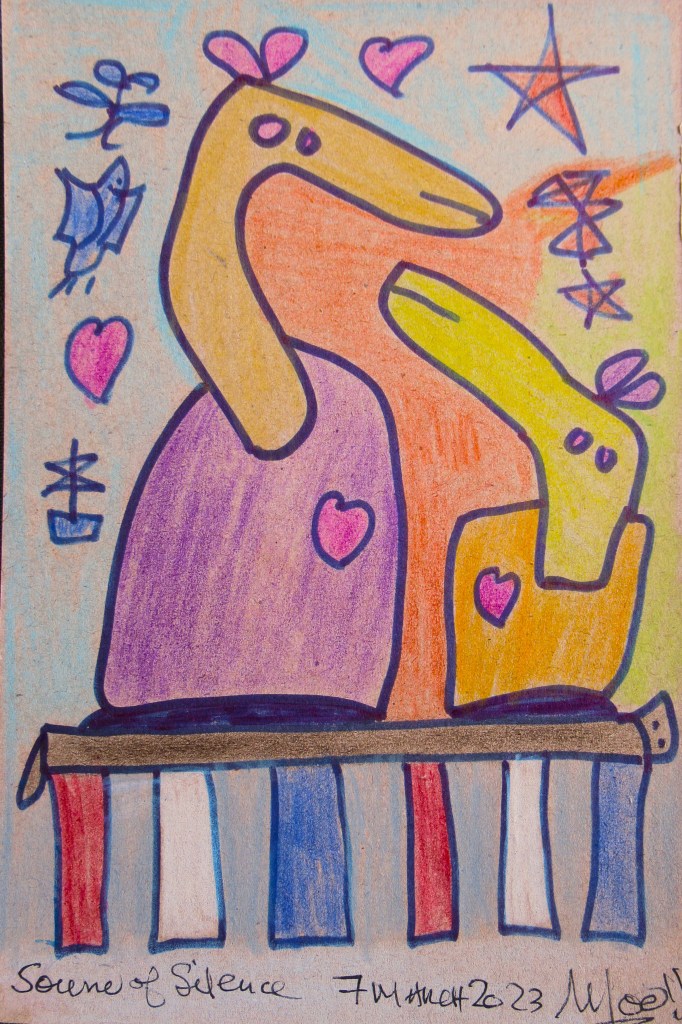
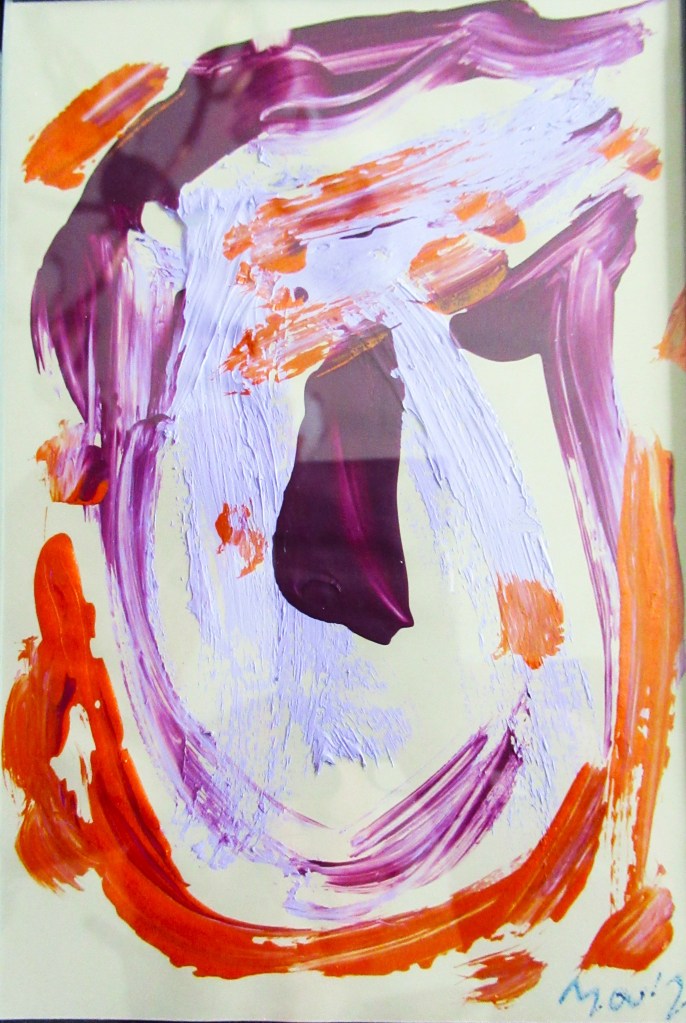
What do authors do when they send manuscripts to agents or presses? They have several choices. For example, they can listen to the sound of silence. Listen carefully to the paining above. What does it say to you? Absolutely nothing. Quite. It doesn’t communicate. It’s the sound of silence.

Another choice, they can read and re-read Beckett’s Waiting for Godot. Alas, in this case there are many Godots out there and all of them are super-busy gazing at their navels – and I don’t mean oranges. Some indulge in the wonderful world of “Mirror, mirror, on the wall…” and we all know what the answer is to that question. And we know what happened to Narcissus when he saw himself in the river water. Or have we forgotten? Our failure to share cultures is also a sound of silence – two solitudes, gazing at each other, neither one having anything in common with the other one, except maybe the weather. And we can’t always agree on that.

A third choice, they can climb into their dustbins, Queen’s English for garbage cans, and stand there waiting for someone to put the lid on so they can go back to sleep. Allusion / elusion – you don’t know what I am talking about? Well, maybe we are living in two separate solitudes. It wouldn’t surprise me in the least.

A fourth choice, they can take up painting, and scribbling, and drawing, and doing all sorts of things. But, if the phone rings and you don’t recognize the number – don’t pick up the phone. It’s probably a fraudulent scam call. And if you don’t know the e-mail address, put it in Spam and then block it. It’s probably some bot from another country trying to trap you into giving them your bank account details and signing your savings away. Whoever it is or they are , I doubt if it’s an agent or an editor!

Tell us about yourself

Tell us about yourself

That is one of the questions I most hate to be asked. What on earth is there to tell? One direction is the Muhamad Ali route – “I am the greatest!” Some people take that route and walk you down the highway of their lives, everything from winning the egg and spoon race (age seven), to coming second in the three-legged race (age 9), to finishing third in the slow bicycle race (age 11). And that’s just the start. A similar route is the 007 route – license to kill – shoot from the lip – a blast from the past – history, herstory, my-story – by me!

No way. My history is a mystery and long may it remain so. There are many magic moments (thank you Perry Como – my mother’s favorite singer) and many tragic moments. Some might be worth mentioning, most I’d rather keep quiet about. I think sometimes of the famous examination question – write down everything you know – except I can’t remember who was examining who, nor why they were being examined. Sounds a bit like the Civil Service to me, before they ask you to swear the Official Secrets Act.

On the other hand, if a person asks me a direct question, I will try to answer it to the best of my limited ability. Who is Lisi? I don’t know. Her identity has baffled the literary critics for close to 400 years and I certainly haven’t been able to solve it. Why did Cervantes write the Quixote? Try asking him yourself – but I guess if he’s been silent since 1616, he will remain silent for a lot longer. Not everyone is – or wants to be – the Memory Man – “We know Easter is a Moveable Feast, when did Easter Sunday last fall on Boxing Day?”

Trick question – Easter Sunday is a race horse, not a holy holiday. Boxing Day, in Britain, used to be the day for point to points and obstacle races for horses. But the Memory Man knew that. He also knew the name of every jockey, every horse, their weights, their odds, the order in which they finished, and the name of the fence which caused Easter Sunday to fall on Boxing Day.

So, tell us about yourself. No. I won’t. I am not the memory man and I will reveal as little as I can. Remember the old song – “Yesterday is history, today is still a mystery, but what a day it’s going to be tomorrow.” Right – now I am ready to tell you about myself. I am not yesterday’s man, I am today’s man, and today is still a mystery. Sorry, I can’t do better than that!