Poisoned Pawn

Poisoned Paw

Openings are so important.
They should be magnets
drawing the opposition in,
but sometimes they’re whirl-pools
dragging you down.

You try to hold your breath,
but you must breathe deep, let go,
go with the flow and prepare for
whatever awaits you in the deep.
Down there, it’s a different world.

Light breaks its black and white bishops,
and the knights walk a forked path
when not pinned down. When you lose
do you mourn for the simplicity of draughts,
or Fox and Hounds or do you strive
to establish, once more, your light in the dark,
down there, where no sun shines.

You are the glow-worm,
glowing where no light glows.
You are the line, the sinker, the hook,
the bait, the temptation that encourages
your opponents to sacrifice their own peace,
 to join you, and together, to swim, or drown.

Commentary:

My family didn’t play much chess. I bought my first chess set when I was ten years old, at Boot’s the Chemist, down by the market, in Swansea. I also bought Harry Golembek’s book The Game of Chess. I still have both the set and the book, seventy years later. Descriptive notation. Absolutely bewildering. I stared at the chart that gave the code names of every square and remained totally confused. I had to look up each square, from its notation, locate it on the chart, then move the piece on my board into the appropriate position. And remember, each side had exactly the same format – QR1, QKt1, QB1, Q1, K1, KB1, KKt1, KR1. Not quite a mirror image as the squares reversed themselves on the other side of the board.

I remember clearly the day that ‘Light broke where no light shone.’ I looked at the maze of numbers, and suddenly the pattern clicked into shape in my mind and I understood the whole idea of descriptive notation. Boundary Knowledge – you cross a boundary after days of bewilderment, and enter a new phase of enlightenment ‘light breaks where no light shines’. When I watched the film, The Poisoned Pawn, I remembered my own learning days in chess. Great fun, that particular opening. Do we take the poisoned pawn, or do we leave it? I will leave you to decide. But remember, it’s not called the poisoned pawn for nothing, damned if you do and damned if you don’t!

I used descriptive notation throughout my school days. I had one particular friend in boarding school who also played chess. We slept in the same dormitory, two beds apart. After lights out, no talking, no reading. Prefects prowled at night to enforce the rules. After lights out, one of us would call out ‘P-K4’ and thus the game started. We weren’t exactly talking, so it wasn’t easy to catch us. Every night, we played the game in our heads. A great memory trainer. Occasionally we managed to finish a game – not often – we were both too wary of Fool’s Mate and the simple early traps! Each day, during one of the school breaks, we would restart the game of the night before, from memory, and then play it to its end. We very rarely forgot the moves we had made and we virtually never disagreed on the board position.

This was totally unlike chess with my family. The grown-ups would all gather round the board. Their object was to distract me, to move pieces when I wasn’t looking, to remove (MY) pieces and leave me in a desperate situation. “‘Knock, knock!’ ‘Who’s that at the door? Go and look.” And off I would go to return to a battlefield that had totally changed its shape and mood. I would carefully reconstruct it, piece by piece, square by square. But I have never forgotten the black looks, the accusations of cheating, the fury of the old ones being beaten by the younger generation. In the end, nobody within the family would play me, unless I gave them a handicap by removing a rook or one of the bishops.

I didn’t discover algebraic notation until I lived first in France, and then in Spain. Algebraic notation. Each of the 64 squares had its own letter and number and, as a result, there was no way to confuse the position of the pieces. Staunton chess sets in England became a variety of different piece shapes on the continent and I often lost games when I forgot that the pawn had one circle, the bishop two, and the queen three, but they all looked like. Many a time I gave up a bishop thinking it was a pawn – oh that poisoned pawn again.

Now, in my dotage, I play chess against the computer. I haven’t played a live opponent for years. But I do have a chess book collection and I have played Fisher’s best games, and Fisher vs Spassky, and I have studied the Russians and how they play and think – very differently from me. And so, in my old age, I sit at the chessboard of my life, and I move the pieces here and there, and remember old friends, and how we shifted across the shifting boards of our days. So many pieces have dropped from life’s chessboard, but a few of us are left, and we move more slowly, but we wander on and on.

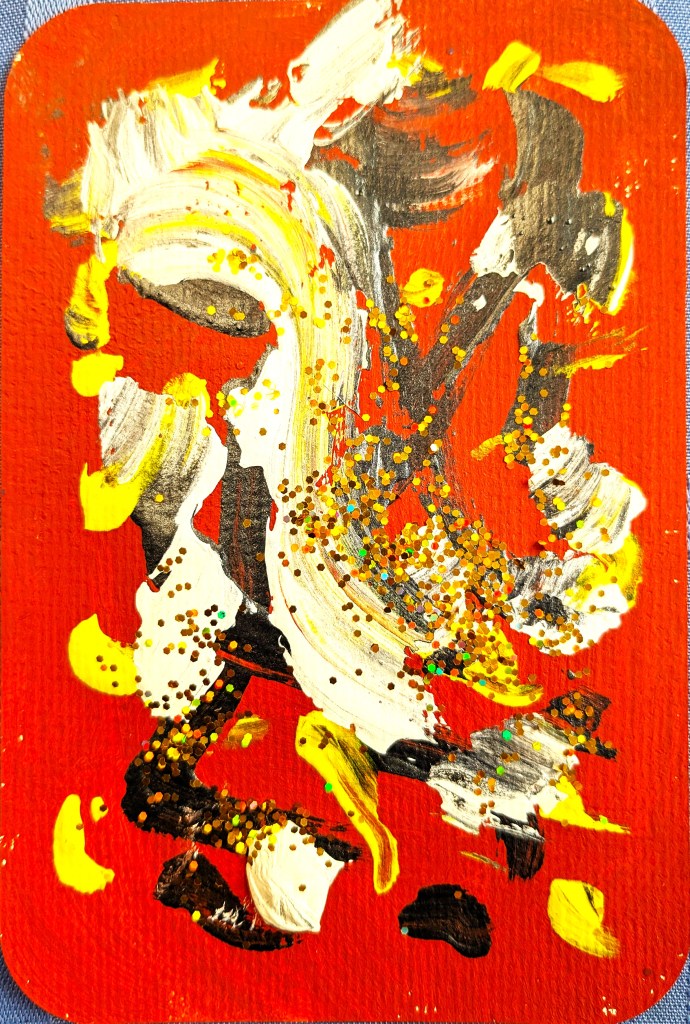
PS Moo, sometimes slow in understanding, offered me several paintings that suggested the aftermath of the Poisoned Prawn. When I explained the basics of chess to him, he said he didn’t have a chess painting he could recommend, so he suggested this painting – the correct way to teach. ‘You can’t teach chess,’ I said, ‘it is so instinctive.’ I took one look at the right way to teach and loved it. Here we go The Right Way to Teach! X – WRONG!

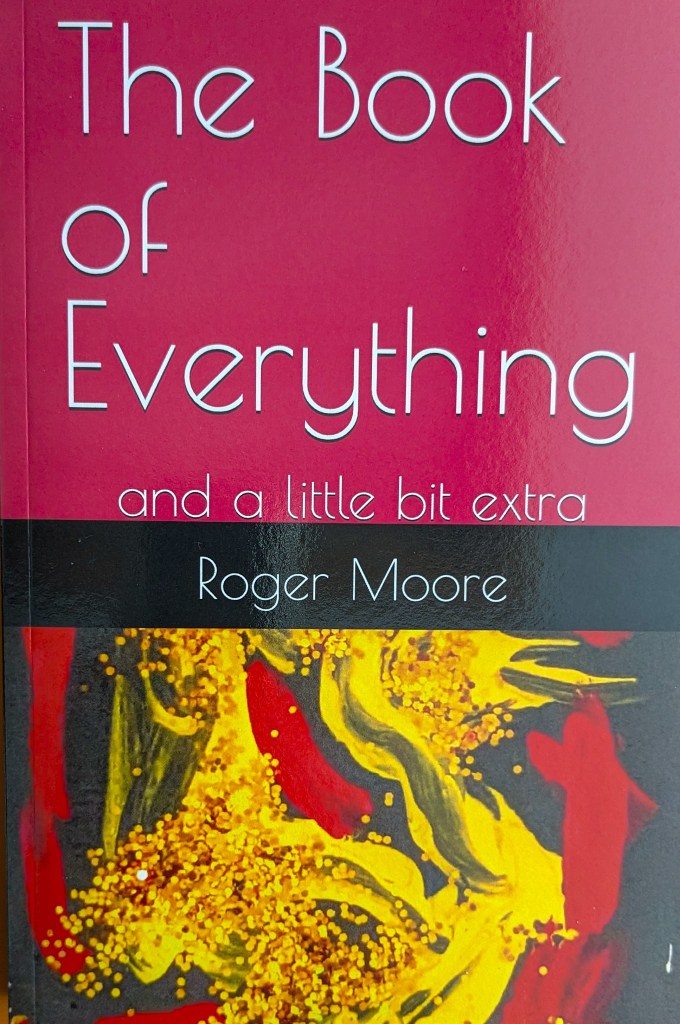
The Book of Everything

Discourse Analysis
and
The Meaning of Meaning

Words have dictionary definitions that allow us to agree on what they mean. In this fashion, when I say ‘my grandmother’, you automatically know that I am referring either to the mother of my mother (maternal grandmother) or the mother of my father (paternal grandmother). This is the dictionary meaning of the word ‘grandmother’.

But words have lives of their own, and their meaning changes when used by individuals. You, the reader, never knew my grandmothers. You never will. They both passed away a long time ago. I loved them both, but for very different reasons, and to me they were as different as different can be.

This means that when you, the reader of these words, reach the word ‘grandmother’, the faces you see, the emotions you feel, the memories conjured up by that word are totally different from mine. Same word, same dictionary definition, different personal memories, experiences, relationships. In addition, the role that our grandmother(s) played in our lives will be very different too. That role may vary from culture to culture, from language to language, and from the social structure of the changing society in which we live.

For example, when I first went to Santander, Spain, I visited a family who lived in a large, detached house that contained three generations of the family – grandmother and siblings, father and mother, grandchildren, and an assortment of aunts and uncles. No need for babysitters in that household. Everybody had a vested interest in the development of the young ones and the older ones received tender, loving care, twenty-four hours a day, every day of the week.

I lived from time to time in the same town as my own grandparents. I saw them regularly, but rarely on a daily basis. When my parents sent me to my first boarding school, age six (if I remember correctly), I lost contact with my family. My paternal grandfather died when I was away at school. My maternal grandmother died while I was away at school. My paternal grandmother died when I was living in Spain. My maternal grandfather died when I was living in Canada. Alas, after those early years, I scarcely knew them. My experience, then, was so different from that of other people.

When I moved to Canada, the Atlantic Ocean separated me from my parents. My daughter, born in Canada, grew up with no close knowledge of her grandparents. The word ‘grandmother’ did not mean the same to her as it did to the grandchildren in Santander, or to me. How could it? All those miles between the families, and visits limited to a couple of weeks every other year at best. Although the dictionary meaning is always the same, what a difference in the emotional meanings for each person using that word.

Discourse Analysis, the way I use it, builds not on the dictionary meanings of words, but on their emotional and personal resonance. I take the standard, dictionary meaning of words, twist it, look for meanings at different levels, and then build an alternative narrative on that changed meaning. I have great fun doing so.

Part of that verbal fun comes from my childhood. I listened to Radio Shows like The Goon Show and Beyond Our Ken. Giles’ Cartoons gave my names like Chalky White, the skeletal school teacher, or Mr. Dimwitty, a rather dense teacher in another school. These shows also twisted the meaning of words and drew their humor from such multiple meanings. The Goon Show – “Min, did you put the cat out?” “No, Henry, was it on fire?” Or on an escaped convict – “He fell into a wheelbarrow of cement and showed every sign of becoming a hardened criminal.” Or from Beyond Our Ken – “My ear was ringing. I picked it up and answered it. ‘Ken here, who am I speaking to?’ ‘Larry Choo.’ ‘Ah, Choo.’ ‘Bless you, Ken.’ Verbal scenes like these – it’s hard to get visual pictures from listening to the radio – remain engraved in my memory banks. More than engrained, they become part of the verbal system from within which I write.

This system includes Direct Discourse, Indirect Discourse, and the Twisted Discourse of an Inventive Mind that still wishes to create. It also comes from Francico de Quevedo’s Conceptismo, from Ramón del Valle-Inclán’s esperpento, and from certain aspects of Albert Camus’s Theory of the Absurd, all blended with the poetry of Jacques Prévert and the songs of Georges Brassens. This from the latter – “Tout le monde viendra me voir pendu, sauf les aveugles, bien entendu.” Everyone will come to see me hanged, except the blind of course.

This is not always easy humor, nor is it a comfortable way to see the world. But it is a traditional one with a long literary history. The title of my book goes back to Francisco de Quevedo, of course, who, in 1631, in Madrid, published El libro de todas las cosas y otras muchas más / The book of everything and a lot more things as well. Don Roger turns to his good friend Don Francisco whenever he needs a helping hand.

The pieces themselves were first published on my blog rogermoorepoet.com. They have been revised, and I have added some more pieces in a similar vein. Tolle, lege – Take and read.  Above all, enjoy this world of mine, with its subtle and not so subtle humor, its sly digs at many of our follies, and its many forms of creativity.

The Book of Everything
and
a little bit extra

Click on the title to purchase this book.

Why do you blog?

Why do you blog?

Good question. And there’s no easy answer. I guess, in my case, that my computer and my teaching (I have been retired for 16 years) were closely linked. I used programs like Blackboard and WebCT to teach hybrid courses, online and in the classroom. The online factors – chat groups, info sharing, course analysis – backed up the in-class material and gave students a space in what was, back then, late 20th Century, a new, but rapidly developing teaching space and style.

I found the development of a web page allowed me to preserve course notes, to construct class material, to allow students to access material (in their own time and space) and many found this useful. I also encouraged students to build their own web pages (and this was in the twentieth century, remember!). I also told them that they would probably, long term, find the web page building more important than the material that I was teaching them, for my material, like that of many other teachers, had a limited shelf life, and was not carved in stone and everlasting. This was particularly true as rapidly changing times, methodologies, and students – often from different cultures and with different styles of learning and levels of knowledge – spelled the end of the single course outline imposed, top down, on all members of the class.

When I retired from teaching, I kept the web pages I had built. Then, some five or six years after retirement, I decided to start a blog, rather than just have a webpage. Now, blogging has become a habit. Not an incurable one – just this year I missed four months ‘blog time and space’ on this web page / blog of mine.

But is this web page of mine a blog? Not really. I don’t sell anything on it, rather I give my books away to friends who wish to read them. I don’t charge for accessing my ideas, my thoughts, my creativity, my poetry, my photos, my paintings, my philosophy. My oh my, look at all those ‘my -s’!

At this point in time I am wondering whether to continue blogging or not. I have been approached by many people who wish to enrich themselves by enriching my webpage so I can then enrich myself. But I neither want nor need that. Rather, I follow the philosophy of Miguel de Unamuno, the great Spanish philosopher. “If I can reach out and help just one person,” he said, “I will not have lived in vain. And I guess that’s why I blog – to reach out on the off-chance that one or two of my words will touch someone in a meaningful fashion and help them to understand the world a little bit better and even, maybe, to help reshape their lives.

What is your mission?

Daily writing prompt
What is your mission?

What is your mission?

Let us begin, as usual, by asking, what do we mean by ‘mission’? Here are some examples of the meaning of mission. (a) an important assignment carried out for political, religious, or commercial purposes, typically involving travel. (b) the vocation or calling of a religious organization, especially a Christian one, to go out into the world and spread its faith. (c) any important task or duty that is assigned, allotted, or self-imposed. (d) an important goal or purpose that is accompanied by strong conviction; a calling or vocation.

I can happily dismiss (a) and (b) from the start. I do not consider an assignment to be a mission, not in my case anyway. I am not one to wander the world, good book in hand, heart on sleeve, convincing people to believe what I believe. That said, I can work with (c) and (d) because, as a life-long teacher, who was offered, at various time, an array of other jobs, I am happy to say that I was a teacher by vocation, by calling. Teaching was my mission. My mission was accomplished.

I taught, in Canada, from 1966 to 2009. Then I reached retirement age. On June 30, 2009, I was a teacher. On July 1, 2009, I was nothing. The shock was enormous. It took me a long time to recover and discover that no, my life was not over, and yes, I had many other things to do. Thankfully they all involved teaching, in one way or another. I used my teaching / research experience to sit on the editorial boards of various learned journals. I even edited a couple of them. I also translated, usually from Spanish to English, and worked with the translations of other people. I also wrote articles on teaching and on creativity.

Creativity gradually took me over. I offered workshops on prose and poetry, wrote and edited books, penned introductions for other writers, and even published some books by other people, usually my family or close friends.

There was never much money in teaching or in creative writing. I always did it for love – love of the subject, love of learning, love of the students, love of watching them grow and develop. When I work one-on-one with another writer, or with a small group of writers, that love is still there. Alas, as I grow older (much older!), I feel the ability to motivate slipping away. The will, the vocation if you like, is still there, but body and mind are growing weak, and that, my friends, is the saddest thing of all.

Dark Angel

He will come to me, the dark angel,
and will meet me face to face.

He will take all that I own,
for my wealth is only temporary:
health, wealth, possessions are all on loan.

My house, my wife, my car,
my daughter, my grand-child,
 my garden, my trees, my flowers,
my poetry, my works of art.
I use the possessive adjective
knowing full well that these things
are only on loan. I will never be able
to preserve and possess them.

I even rent this aching heart,
these ageing, migrant bones,
this death that has walked beside me,
step by step, every day
since the day that I was born.

My death alone is mine.
It belongs to nobody else.
It will be my sole possession.
It will soon be the only thing
I have ever really owned.

Comment:

Dark Angel is from my poetry book – Septets for the End of Time / Poems for the end of Time. The lead painting in today’s blog is by my friend, Moo, and he calls it Storm-Me.

What’s your favorite word?

Daily writing prompt
What’s your favorite word?

What’s your favorite word?
Seems like a daft question to me. Just one word?

Llanfairpwllgwyngylldrawbwlchllantisilioggogogoch – how’s that for a single word? And what’s wrong with married ones anyway. Or should I go for something like – home, health, morning (good or bad), night, how? -as in How! And what about the vast quantity of expletives that are found in so many languages? Many of them are single words, although many others are found in fertile and creative compound structures.

Of course, wrth gwrs, we are thinking of how many single words in how many languages? Or are we? I personally think that phrases might be more important than single words. Thank you becomes gracias (in Spanish) or te / se lo agradezco (more formally). It changes to merci (in French) or merci bien, or merci beaucoup, or grand merci, or merci mille fois, or je vous remercie. Then, in Welsh it becomes diolch, though many prefer diolch yn fawr.

Mind you, when living in Mexico, especially in some of the more isolated villages where food and water are not always the cleanest, bathroom may be a key word. Quick is also an important one. Put them together and you get bathroom quick! Help is also very useful when travelling alone and lost. As is Please! Por favor, in Spanish – two words of course!

Single words, in isolation, can be very dangerous. Especially when using a second language that one doesn’t dominate. Examples of embarrassing mistakes are multiple in the language-learning text-books. Speaking of which, it is interesting how infrequently they offer phrases like “Where is the bathroom?” or “I need the toilet. Now.” Alas, they also avoid the inevitable consequences like – “Too late!” “Sorry!” “Where is the nearest dry cleaners?”

A funny thing, language. And other people’s languages are equally funny. By funny, I mean weird, strange, and unpredictable, especially without a sharp cultural knowledge to permit the speaker to actually understand what he or she wants to say and how to phrase it correctly. Simple example – embarazada, in Spanish, does not mean embarrassed, it means pregnant. You would be surprised at how many young ladies, learning Spanish in Spain, have amazed their hosts and teachers by the simple announcement, often in class, that ‘estoy embarazada’ – ‘I am pregnant’ – and I have seen the looks of amazement adorning the sympathetic faces of the families gathered round the table or the looks on the faces of the classes being so addressed.

So, a little knowledge is a dangerous thing. I can think of very few words, single words, that I would use on their own. But I can think of many, many phrases, most short, that I would be happy to use, and many more that I would avoid at all costs. As the students in the lower grades of Spanish used to say – “Buenas Nachos” and “I only want to be able to ask for a beer.” “Can’t we watch the Smurfs?” Have you ever tried to understand humor in another language, another culture? It is one of the hardest things to master, especially when it depends on the double-meaning of words, words which, all too often, only have one meaning in the pocket dictionaries people carry around with them. Caveat emptor. Buyer beware. And tread carefully, for you may not know just whose toes you are treading on, nor why, nor how they will react – the people, not the toes. Dangerous things those pronouns.

On the other hand, we can always go religious and turn to the Bible for advice. There we find “Faith, hope, and charity, and the greatest of these is charity.” So. Problem solved. I have found my one word – Charity. That said, I do like the painting Moo offered me for this prompt. He calls it Hope. And remember, you can’t go wrong with any of those three words – Faith, Hope, and Charity. Tolle lege. Amen.

What are you doing this evening?

Daily writing prompt
What are you doing this evening?

What are you doing this evening?

This evening, I am thinking about how September is the month in which academics, thinkers, and philosophers, as well as everyday people, can be reborn. I wrote this article 25 years ago. Re-reading it now, I am amazed by its clairvoyance. Here are my thoughts from way back then.

“September Renaissance: The Annual Adventure of (Re)Creating the Individual.”

This address was delivered to faculty at MOUNT ALLISON UNIVERSITY on 07 September 1999. It is a revision (and an extension) of the adress I delivered to students at St. Thomas University during the inaugural speech delivered to the incoming class of students by the winner of the St. Thomas University Excellence in Teaching Award.

Tomorrow, 08 September, 1999, is a very special day for me, and I would like to share my Special Day with all of you.

“A Special Day?” you think. “It must be his birthday.”

But no, it’s not my birthday. Could it be my Saint’s Day then? If we were in class, and you were all students, I would see some puzzled faces. A hand would be raised: “Please Dr. Moore, what’s a Saint’s Day?”

I would smile at the student brave enough to ask that question. “Good question!” I would say. “When one person asks a question, class, there are twenty people in the room, perhaps more, who wanted to ask that question, but did not raise their hands because they were afraid to do so. Never be afraid to ask questions. Question everything. Question everyone. Ask questions all the time. That, in part, is what you are here for: to ask questions and to learn to ask the right questions.”

So: what is a Saint’s Day? Well, in Spain, people often have two celebrations a year: their birth day and their Saint’s Day. Their birthday is, of course, the day they are born; their Saint’s Day is the Feast Day of the Saint after whom they are named. That was a good question, class, and you have gained a little knowledge! But No! It is not my Saint’s Day.

Why is today such a special occasion for me? Again, if this were a classroom I might, at this stage, do one of several things:

  • I might divide you into groups and ask you to discuss the question;
  • I might turn on a video;
  • I might access the classroom computer and show you a multi-media presentation;
  • I might give you a lecture or a talk or a question and answer session, much as I am now doing;
  • I might send you to the library to find out the answer for yourselves;
  • I might send you to the computer room to surf the net in search of an answer;
  • I might ask you to work together on an interactive listserve and let others help you access the information;
  • I might send you home early with reading material for the next class;
  • I might send you home to watch a specific television program;
  • I might set you the question as a Problem Based Learning Group Research Project (written answers on my desk, tomorrow, by 3:15 pm!);
  • I might ask you to write your essay in a journal page or in a researched essay (due in six weeks time, with annotated bibliography!);
  • I might ask you to tap in to your subconscious and freewrite around the question for fifteen minutes;
  • I might tell you to do some thinking and asking around, because that specific question will be on the final examination;
  • I might ask you to design a poster or your own multi-media presentation demonstrating the meaning of the question and several possible answers …


… Clearly, there is no right or wrong approach and there are many ways of dealing with what is, on the surface, a relatively simple question. You are using many of these approaches in your own classes here at Mount Allison University and I do not presume to tell you that one way is right and another wrong. So much depends on the shifting relationships between teacher, learner, class size, class maturity, work capacity, research resources, and subject matter. At Mount Allison you have a national reputation for the excellence of your students and of your faculty. You have proved over a long period of time your ability to distinguish between the more important questions and the correct research and investigation procedures; above all, you know how to choose those that are most suitable to you and to your own students.

Since this is NOT a classroom, since you are not my students, and since I would have great difficulty in dividing you up into small groups so that you could discuss why tomorrow is such an important day for me, I will provide you with the required answer: TOMORROW, September 8, 1999, is my RE-BIRTH-Day! Tomorrow, I celebrate the day of my RE-BIRTH. Thirty-three years ago tomorrow, I was RE-BORN.

Permit me to share with you the matter of my RE-BIRTH!

It came about like this: On September 8, 1966, I got up at 4:00 am, ate a light breakfast, packed my suitcases into my father’s car, and headed for Heathrow Airport, London. There I boarded BOAC Flight 1040 and at 3:00 pm that afternoon I landed in Toronto, Ontario, Canada. By 3:15 pm, I was passing through Canadian Customs and Immigration and by 3:30 pm, I was RE-BORN as a Canadian.

This RE-BIRTH was not an easy process. It took me a long time to learn to act, think, and speak like a Canadian. It also took me a long time to realize that while the Canadian within me was growing stronger every day, other parts of me, even when they were rigorously maintained, were beginning to die. Thus, at the same time as I celebrate my RE-BIRTH as a Canadian, I mourn the gradual passing away of my Welshness, the slow disappearance of my Welsh family, the fading of my Welsh friends, some of whom I have not seen in more than thirty years.

Yes! I was RE-BORN 33 years ago tomorrow. But this is not the only RE-BIRTH that I have undertaken. There have been many other rebirths:

  • 28 years ago, I emigrated from Ontario and was RE-BORN as a New Brunswicker;
  • 27 years ago, I left the University of New Brunswick and was RE-BORN as a St. Thomas University professor;
  • 24 years ago, I was RE-BORN when I graduated with my PhD and was officially no longer a student;
  • 5 years ago, when I visited the Dominican Republic, I was RE-BORN as a conscious critic of certain neo-colonial policies and attitudes towards Developing Countries; in the DR, incidentally, I was also held up at gun-point — and surviving THAT little incident certainly guaranteed an instant RE-BIRTH which I celebrated in the closest bar!
  • 4 years ago, in December 1995, I was RE-BORN as a pseudo Professor of Education when I visited Oaxaca, Mexico, as part of what was later to be called the St. Thomas University – University of New Brunswick – Universidad Autónoma Benito Juárez de Oaxaca Faculty Exchange Program;
  • And tomorrow, on September 8, 1999, as I celebrate the 33rd anniversary of my being RE-BORN as a Canadian, I am in fact in the process of being RE-BORN yet again.


I will explain how in a moment. Meanwhile let me say that along with the pain and struggle for RE-BIRTH come various things:

  • PRIDE: in the fact that I, along with everyone else in this room, can achieve RE-BIRTH;
  • HUMILITY: in the knowledge of how fortunate I am, together with all of you gathered here in this room today, to be counted among those who are still capable of RECREATING their lives and of being RE-BORN;
  • RESPONSIBILITY: in the knowledge that when we are RE-BORN a new set of duties falls upon our shoulders;
  • ENERGY AND ENTHUSIASM: in the knowledge that I, like every one of you, am capable of sharing the secret of my RE-BIRTH with the students who come to my office and my class almost every day in search of the new selves which they wish to create for themselves.


This summer, to prepare myself for this Fall’s RE-BIRTH, I did the following:

• I revised all my courses;
• I attended the University of New Brunswick Multi-Media Institute for three weeks and completed my Certificate of Multi-Media Studies;
• I reconstructed, with the aid of Clare (without whom I would not be here today, but perhaps I’ll tell you more about that later), my web page;
• I (re)commenced my annual summer reading program to update my thinking.

I say all this to assure you that I know as well as you do that knowledge is not a solitary, self-contained unit which, once attained, stays with us forever. Knowledge is an ongoing process; learning is a lifetime commitment; you, as faculty, teach at Mount Allison University, as I teach at St. Thomas University, not just to earn a salary, but to continue a life-long commitment to teaching and learning. If you are like me, you love the sheer process of teaching and learning; you love the contact with young, developing minds.

I try always, as I am sure you do, to encourage my students to start their life studies with us at St. Thomas and to continue their life studies when they leave university. We do not say “Learn for four years and then you can stop learning for you will have all the knowledge you will need for the rest of your lives.” At least, I hope we don’t.

And it is the same thing for us, as faculty. For we, as faculty, are actively involved in our own ongoing research and scholarship, some of which we publish and some of which we use in our classes; research moreover, without which the knowledge we share with our students would be a dead package, taken from our notes, and handed over without thought or revision, or consideration, to the next generation, much as certain forms of knowledge were handed to me when I was an undergraduate by some of the teachers de cuyos nombres no quiero acordarme / by teachers whose names I do not wish to recall, to borrow the famous words with which Cervantes opened perhaps the world’s greatest novel: Don Quijote de la Mancha.


So what did I read this summer?

Amongst other things, I read about the RENAISSANCE — the RE-BIRTH of Western Civilization in the 15th and 16th Centuries; I also read about the REFORMATION that came about as a direct result of the challenges and questions posed by the RENAISSANCE; and I read about the COUNTER-REFORMATION that sprang up as a reaction to and dialogue with that first REFORMATION.

I also realized, not for the first time, the similarities between our own age and that of the RENAISSANCE. The RENAISSANCE, as Marshall MacLuhan pointed out in The Gutenberg Galaxy, was a time of new ideas and new technology; in addition, a radical change occurred in the paradigm of man’s learning and thinking. The known world was expanding with the voyages of discovery that set out to East and to West. Man’s view of the universe changed with the various discoveries in optics that allowed us to see objects in space larger and in more detail than ever before. This led, of course, to the concept of the heliocentric universe, where human beings were displaced, away from the centre of creation; a new concept for the Church, and one that they fought against bitterly at the time.

In the same period the printing press had an enormous influence on the dissemination of knowledge, and totally changed peoples’ ways of disseminating, creating, receiving and perceiving written information. It is very difficult for us to understand, even today — perhaps especially today — the impact of the printed word on a semi-literate society in which, again according to Cervantes, groups of people would gather in the evenings to have books read out loud to them by the one or two people in the village who could read. Walter Ong has described this process to us in Orality and Literacy, another book which I (re)read this summer. Suffice to say, that for us, as a television generation, it is difficult to understand the initial impact of radio upon our parents and grandparents. For the new generations of students emerging today, it is difficult to imagine life without the instant communication of television, telephone, email, and computer.

In many ways, the impact of print must have been similar to the impact of the electronic technological revolution which we are going through today. And one thing I know for certain, after completing my Certificate in MultiMedia Studies: none of us are aware, nor will we be fully aware for a long time yet, of the full impact of the electronic technological revolution upon the hearts, souls, intelligence, and minds (not to speak of the wrists and eyes) of those who use it and of those who are now growing up, many of whom know no other way of accessing information.

The paradigm of knowledge and technical skill is still changing and developing explosively; as a result, we are still unaware of exactly what can be achieved by the new media. Take computer chess, for example. Chessmaster 2000 had approximately 150 games programmed into its chess library; Chessmaster 4000 not only has 1500 games programmed in, but also presents us with games in which Karpov commentates in digital audio his own moves in his own matches!

Yet, in spite of this tremendous rate of progress, few of us who follow Chess would have dreamed that Deep Blue, programmed by a gentleman from Clare’s home town of Bournemouth, would thrash Karpov, the world chess champion from the Soviet Union, only a year or two down the road. Nor can we understand the extremely rapid progress that leads us in a matter of months, to see the memory banks in a pc clone expand from 1 gig of memory to 4 gigs of memory, to 6 gigs of memory, to the 10.6 gigs of memory that Dell is advertising in its latest computer sales. In some ways, it is like the 10, or 12, or 14 zeros that are now following the initial figures in the MEXICAN FOBAPROA SCANDAL: so many zeros that the concept of the magnitude of the debt is beyond the understanding of most of us.

In our day, then, as in the Renaissance, the paradigm of knowledge is expanding explosively. Knowledge in the Renaissance evolved so quickly that few individuals were capable of grasping the full meaning of the REVOLUTION, the RENAISSANCE, the REBIRTH which they were observing and in which they were involved. In fact, the RENAISSANCE BATTLE OF THE BOOKS or the continuing discussions between the ANCIENTS AND MODERNS were very similar in many regards to some of the discussions regarding the FUTURE OF EDUCATION that we are holding in all the Atlantic Provinces Universities right now. Authority or Innovation? The old ways or the new? Technology or Tradition? Whatever side we come down upon, these discussions are good for us all for they mean we are alive and thinking and that our knowledge is not a dead but a living thing.

This summer, I also (re)read Mikhail Bakhtin; I believe with him, that human beings can live in a DIALOGISTIC RELATIONSHIP WITH THEIR CHRONOTOPOS — that is to say, in less Bakhtinian language, that people can hold a dialogue with their time and their space, a dialogue which can bring about change, new directions, new commitments, in short, a RE-BIRTH.

And now, from Dialogue to Drama: Wayne C. Booth, in Freedom and the Individual (the Oxford University Amnesty International Lectures of 1992) wrote that we are all individuals, writing the drama of our own lives; each student’s entrance to Mount Allison University, in Wayne Boothian Theory, is a chance for that student to begin his or her play again; all students can rewrite their roles and their characters; as we can rewrite our lives and our roles. In short, each one of you can, like me, be RE-BORN. And believe me: September is the month in which this ANNUAL REBIRTH can and should take place.

I also read several books on the THEORY OF TIME: sidereal time, atomic time, linear time, instantaneous or contemporaneous time … many of the courses I teach at St. Thomas University are based on linear time: each term, they progress steadily from Day 1 to Day 36; however, our lives as teachers and learners are also based on seasonal or cyclical time. For teacher and student, the learning and teaching cycle begins anew every September; this is the time of the SEPTEMBER RENAISSANCE or RE-BIRTH. September then is the month for us ALL to be RE-BORN.

In some ways, the most important books I read this summer were all written on or about don Francisco de Quevedo. These books no longer have a single author. We are no longer dealing with one person’s ideas. Thus, although Pablo Jauraldo Pou’s name adorns the edition of the latest and best biography of don Francisco de Quevedo, Quevedo’s life has actually been researched by an extensive team of scholars, students, and friends, so large, that only the most important dozen or so can be acknowledged. The same is true of James O. Crosby’s edition of the Sueños, or of Ignacio Arellano and Lia Schwartz Lerner’s edition of the metaphysical poetry, or of Crosby and Jauralde’s edition of Quevedo y su familia en setecientos documentos notoriales, a compendium of legal documents concerning the Quevedo family which runs from 1572 to 1724.

In fact, when a single author, not a member of a team, writes on Quevedo nowadays, it is to offer a study of just a small portion of the author’s work. In this fashion, Josette Riandière de la Roche’s Nouveaux documents quévédiens: Une famille à Madrid au temps de Philippe II deals with a very short time period and only a selected aspect of the life of the poet. In similar fashion, Santiago Fernández Mosquera’s La poesía amorosa de Quevedo: disposición y estilo desde CANTA SOLA A LISI deals with only one aspect of Quevedo’s poetry, that of the love poems seen in the light of the sonnet sequence to Lisi.

TEAMWORK: it is becoming more and more necessary to work as a member of a team in order to keep up with the knowledge explosion with which we are confronted. I once said, tongue in cheek, that a TIER 2 CIDA GRANT APPLICATION demands the construction of a team. You need

  • a reader who specializes in how to read the AUCC / CIDA guidelines as they change from year to year;
  • an interpreter who specializes in what the current buzzwords are in government circles actually mean and how to use them in your documents;
  • an accountant who specializes in cash flow, international money transfer, and book balancing;
  • a manager who specializes in Results Based Management or whatever form of management system is the current government buzz word;
  • this manager must also have organizational skills to link the various parts of the application to the Results Based Management that is currently demanded by AUCC/CIDA.

Further, the manager must have people skills in order to hold the team together when things are going badly or well, for triumph and disaster, as we well know although both impostors are ever present when applying for Grants from Government Sources; you also need

  • a writer who specializes in writing up the final text so that it will convince the granting authorities that you, the applicant, another often forgotten member of the team, actually knows what you are doing;
  • finally you need what I call a people person or a wheeler – dealer who will get out there and make the appropriate contacts and find out who are the current movers and shakers and who will actually give you the internal promotion that your CIDA GRANT needs if the application is to be successful.

I would also suggest, perhaps not totally tongue in cheek, that a similar team approach to the writing of SSHRCC GRANTS FOR THE HUMANITIES would not be a bad idea.

TEAMWORK: As I said earlier, I completed my Certificate in MultiMedia Studies at the University of New Brunswick this summer. One of the things that I learned was the importance of teamwork in computing.

In our first SCENARIO FOR A CASE STUDY this summer, for example, we were required to design and build a commercial web site. Of course one person can build a website, and a pretty good one at that. But the studio team which we were given consisted of

  • a graphic artist,
  • a sound engineer,
  • a creative director,
  • a computer tech,
  • a multimedia specialist,
  • a photographer,
  • a specialist in digital photography,
  • a graphics designer, and
  • a colour specialist.

We did not have digital video capacity and were forced to contract digital video out. Costing was also a major part of the exercise: how many people, how many tasks, what order for the tasks, how many hours, how much time, how much money! I repeat: the new paradigms of knowledge that are developing around us will be demanding more and more teamwork from us.

I will end this brief presentation by reminding you that this fall, on Saturday October the Sixteenth, 1999, to be precise, the Atlantic Teaching Showcase will be coming to St. Thomas University, Fredericton. I hope to see some of you in St. Thomas, at that meeting. I am, as many of you know, the Chair of the Atlantic Association of Universities Teaching Showcase for this year.

However, I have not arranged the Showcase on my own. On the contrary: I have gathered a team of faculty and together we are working towards the Teaching Showcase. In fact, I have one person looking after finances, another looking after registration, another building a website, another looking after catering, another looking after audio visual equipment, another booking rooms, another organizing the program, another recruiting and organizing student help. We have planned and arranged the program between about eight of us.

An exercise in teamwork, no less.

I know that in all that I have said so far today, here at Mount Allison University, I am talking to people who know as much as I do, or more, about all these things: REBIRTH, RENAISSANCE, TEAM WORK, COLLABORATION. For a very long time, I have been impressed by the quality of Mount Allison’s teachers and by the quality of Mount Allison’s students.

In five weeks’ time, at the Atlantic Association of Universities Teaching Showcase, there will be a session entitled “WORKING TOGETHER: MODELS OF COLLABORATION INSIDE AND OUTSIDE THE CLASSROOM.” This particular session is a perfect example of the type of teamwork I have been talking about today. The session was presented to me in its entirety as a proposal for a single session incorporating 4 papers and some interactive discussion. The session will have a 90 minute slot and I very much hope to be present for what promises to be an exciting time. The session currently consists of a series of four papers, as follows:

  • “Mixing media: High Theory, Low Culture (or Inviting Popular Culture into the Classroom”;
  • “Collaborating with Students: Sharing Power over Syllabus Design”;
  • “Interdisciplinary Collaborative Project: A Model”;
  • “Beyond Discipline: Facilitating Collaborative Student Research”.

The session organizers are all associated with Mount Allison University and I would like to congratulate Professors Pat Saunders-Evans, Deborah Wills, Robert Lapp, Jeff and Ausra Burns on the hard work they have put in to an excellent integrated proposal.

Imitation, they say, is the best form of flattery. I have stood here today and spoken to you and you have kindly listened to my words. Tomorrow, I will spend part of my RE-BIRTH-DAY with you, here at Mount Allison. I have been invited to attend your Learning and Teaching Development Workshops, and I hope to take back to St. Thomas University some of the excellent ideas on which you are working here on campus. You are nationally and internationally recognized leaders in your field. Tomorrow, it will be my turn to listen to, and learn from, you!

Thank you for inviting me here.
And thank you for listening.

What profession do you admire most and why?

Daily writing prompt
What profession do you admire most and why?

What profession do you admire most and why?

Why admire a profession? I used to admire the fire-fighters when I was in Spain. Then I discovered that a small group of them were setting fires deliberately so that they could get double pay and danger money extinguishing the fires they had set. I used to admire politicians. Then I discovered that they weren’t always honest, had their hands in other people’s pockets, used their positions to entrench and enrich themselves, and pulled all sorts of tricks to stay in power. I used to admire priests. Then I started reading horror stories of child abuse, abuse of power, negligence of priestly duties. And these things aren’t new. In The Book of Good Love, (Spain, 1330-1343) written by Juan Ruiz, the Archpriest of Hita details how the celibate priests were ordered in a letter from the pope of the time to give up the ladies with whom they were living (and with whom they had children) to return to a life of celibacy. All fictitious, of course, but also based on a truthful reality, as was the Seller of Papal Bulls (as described in Lazarillo de Tormes – Spain 1554, and published anonymously because of its anti-clerical content).

I hope, with that short selection of potential professional felonies, I have made my point. In brief, to admire the ideal of a profession is one thing. But to admire the unprofessional conduct of certain individuals who ruin the reputation of their own profession is something else entirely.

Therefore, I would propose that we change the title of this prompt from What profession do you admire most and why?, to What professional do you admire most, and why? Now the question can be answered with ease. I most admire those professionals whose profession is a vocation. They do their jobs out of love and not just for money. They are dedicated individuals who put their profession and the people they serve before their own home comforts, wants and desires.

Such unsung heroes abound. The baker who gets u at 4:00 am, arrives at the bakery at 5:00 am, bakes, prepares, and wraps the goods, until 8:00 am when the customers arrive and the shop opens. This is done at minimum wage, autumn, winter, spring, and in the summer when the heat warnings go out and the bakery is a living hell, what with the ovens and the heat dome outside. The teacher whose work does not end in the classroom, but starts outside, when class has ended, and the students really need the TLC that comes from a teacher who puts them before his/her office schedule of 30 minutes student time a week. The general practitioner who does not retire at age 55 to bask in the sun on a Caribbean Island, but who continues his work, until at age 80, he can tend his flock of patients no more, and who then retires with grace, heartfelt thanks, and love from a job well done.

These are my heroes. These are the professionals that I most admire. Not the profession, but the person who performs that profession with skill, hope, love, commitment, and a dedication that reaches out to embrace that specific professional world, whatever it is, and the people who share it.

Do you still sleep in your childhood bedroom?

Do you still sleep in your childhood bedroom?

Good question. A better one might have been – “Did you have your own bedroom as a child?” The answer is “No, I didn’t. Not that I can remember.” As a war baby, I was moved around quite a bit in my childhood. I remember sleeping in three different bedrooms in our first house. Then we moved in with my maternal grandparents, and I slept in three more bedrooms, often in the same bed with one or other of the grandparents, sometimes on a makeshift bed on the floor. Later, or it may be around the same time, those early childhood memories are so hazy, I went to live with my parental grandparents – three more bedrooms there – same conditions. The family also had a bungalow close to the beach on the Gower peninsula. It had three bedrooms and I slept in all of them, under similar conditions, and seldom alone, until my later years.

I was bundled off to boarding school while I was still a child. Two dormitories at the first boarding school. I was between six and eight years old, and the memories of that school are not sharp, though I recall with total clarity the canings and the shaming of myself and the other young children. It was a religious school. And I need say no more on that subject.

My second boarding school , a preparatory school, saw me inhabiting four dormitories that I can remember. My clearest memory of that place is running away one night, only to be brought kicking and screaming back to the place. Both my parents worked. During the holidays, I was shipped around to various members of the family – aunts, uncles, and grandparents. When I left that school, for the last time, age eleven, my grandparents drove me to my new forever home in a city far from my birthday place. There, three bedrooms witnessed my sleeping habits.

My third boarding school, the Junior School of a larger college, provided me with two dormitories, one per year while I was there. This was the time at which I started to travel with my mother during the vacations. A coach tour on the continent once saw us visiting six countries in two weeks, and that wasn’t the only coach tur I did with her. A succession of hotel bedrooms, then, and no nocturnal stability at all.

I stayed in my fourth boarding school, the Senior School of that Junior School, for five years and received a new dormitory each year. From there I went to study in Paris – more bedrooms – then down to Spain for the summer courses at the International University in Santander, but by now, age eighteen, my childhood was over.

So, a quick count shows that I slept in at least twenty-five bedrooms during my child. And that’s without counting holiday hotels, flats, apartments, and other forms of lodgings, including Youth Hostels.

So, remind me – what was the question? Ah yes, I remember now. “Do You still sleep in your childhood bedroom?” Well, my friends and readers, the answer is a very loud “NO!” Think about it – how could I have? I am not sure that I even had a childhood bedroom!

On what subject(s) are you an authority?

Daily writing prompt
On what subject(s) are you an authority?

On what subject(s) are you an authority?

First, I would like a definition of an authority. Here’s what I found – 1. the power or right to give orders, make decisions, and enforce obedience – as in “he had absolute authority over his subordinates”. 2. a person or organization having power or control in a particular, typically political or administrative, sphere as in – “the health authorities”. Isolating the words enforcement, power, and control, I am delighted to say that no, I am not an authority on anything, and I have no control over anyone. Also, I am not a monarch, and I have no subjects.

What happens if we change the meaning of the words slightly and ask another question? Here is a suggestion from the online Cambridge Dictionary – searching for an answer to my question “What is an example of authority on the subject? – I found this – The phrase “authority on the subject” is correct and usable in written English. You can use this phrase to describe someone who has extensive knowledge or experience on a particular topic. For example, “Dr. Smith is considered an authority on the subject of modern psychology.”

Now this becomes a very interesting question and it can be answered from a variety of perspectives. In our two person household, I deem myself an authority on some forms of cooking. I regard my beloved wife, my better two-thirds as I call her – an authority on the forms of cooking that I have trouble with – for example, baking, cooking vegetables, boiling eggs. She does a wonderful boiled egg. I am hopeless at boiling eggs – either too hard or too soft, usually the former. But I am the authority on Spanish omelets and scrambled eggs. They are my specialities. She makes wonderful chowders. I specialize in gazpachos, sopa de quince minutos a very quick (15 minute) Spanish sea-food soup, and Cawl Mamgu and other Welsh stews.

Once we step outside our kitchen, the world changes. In a world (New Brunswick) where cricket is virtually unheard of (save in the minds and cultures of fellow immigrants) I am considered an authority on cricket. Not that I am an authority, but at least I know what it is and have a good idea of what is happening in a cricket match. Therefore, we must also consider ‘being an authority’ in the context of the audience that receives our words of wisdom. To my nine year old grand-daughter, I am an authority on several subjects. However, I have absolutely no control over her – how she thinks and what she does. I can suggest or persuade, but I cannot and will not enforce.

In the undergraduate classroom, in which I taught for 43 years, I was considered an authority on Spanish by my students. Outside the classroom (and sometimes inside it) I learned more from my students than they ever learned from me, especially in my formative years as a Canadian when I was learning to skate and to ski. Don’t go there – too many painful memories of falling only to rise again!

But when we moved from the classroom to the wider university, to the full Canadian Scene of the Learned Societies, as they used to be called, I became the learner and the authorities were to be found elsewhere, often on the podium, sometimes in the bar. Same thing when we move onto the international stage. There are very few world authorities, in my field. However, there are many wannabe’s, but for them, after careful analysis of their strengths and weaknesses, I have usually had very little respect.

So, today we have opened another can of worms and look at them, wriggling and crawling before our very eyes. Worms – one of my friends really is an authority on earth worms. She knows all about them. Another of my friends is an authority on worms in puppies and kittens. A world wide authority, known every where and often quoted? I doubt it. But certainly in my garden and the vet hospital where I take my pets, they are both authorities.

Ah, the joys of Discourse Analysis – maybe, one day, I can be an expert on that. But take my words, as always, with a large pinch of salt, and, whatever you do, don’t put salt on slugs, and snails, and puppy dog tails. On that point, we can all be authorities.

What makes a teacher great?

Daily writing prompt
What makes a teacher great?

What makes a teacher great?

When Moo descended from Mount Academia, he brought down with him the ten tenets to which great teachers, knowingly or unknowingly, commit. He asked me to transcribe them here, since they were in danger of being neglected and / or forgotten.

  1. Mastery of the subject – great teachers know their subjects inside out. They do not read their graduate school notes to their students, heads bowed, chins on chest, droning on in a low, boring mumble. They encourage questions and are open to debate with their students about the subject that they know so well and openly love.

    Master thy subject.

  2. Humility – great teachers are humble. They know that they are not omniscient. They also know that knowledge changes across time and that they too must change and follow new ideas. They also know, perhaps instinctively, that some of their students are as intelligent as they are. They never dismiss their young charges as idiots, fools, or lunatics to be beaten and forced into the required shape.

    Be humble.

  3. Flexibility – great teachers are flexible, not rigid. They can bend the rules, reshape the syllabus, change pace and tone to match the needs of their students. In addition, they ask their students about their needs and try to address those needs in a personal way, sometimes on a one on one basis.

    Be flexible.

  4. Reaching out – great teachers reach out to their students as a group and as individuals. They never paint themselves into the know-all corner where they alone know best, and they know, with absolute certainty, what’s best for their students. Great teachers know, above all, that one size, in great teaching, neither fits nor benefits all.

    Reach out.

  5. Equal treatment – great teachers treat their students equally. They do not fawn on the best and scorn the worst, nor do they teach by the WWII convoy system, teaching only at the speed of the slowest. By extension, great teachers try to create an atmosphere of love in learning and joy in the subject.

    Practice equality.

  6. Honesty – great teachers are honest, fiercely honest. They know their own strengths and weaknesses, their own limitations. They work on their weaknesses, striving to turn them into strengths. They also push the boundaries of their limitations, striving always to keep up with the ever-changing frontiers of knowledge.

    Be honest.

  7. Human beings – great teachers know that they are human beings and they recognize early on in their careers, that while they are teaching a subject, they are also preparing fellow humans for a life beyond the ivy-covered walls of academia. By extension, they emphasize the humanity of their students and try always to develop and sustain that humanity.

    Be human.

  8. The meaning of meaning – great teachers reach out beyond their subjects to teach the meaning of meaning. Why is the subject important? What can each individual use this hard-earned knowledge for, in their own lives? How can they reshape their own lives and create better ways of learning and living? This teams up with reaching out and enters the realm of learning for learning’s sake and love of learning and love of knowledge.

    Love thy learning.

  9. Creativity – great teachers are creative. They open their students’ minds to new ideas, fresh knowledge, better ways of doing things. They never use phrases like ‘thinking outside the box’ and they do not build better boxes, one or two sizes larger than current boxes, inside which their students must now sit, work, and think. Creative teachers tear down the walls of medieval academia and open their students’ minds to the winds of change and fresh knowledge.

    Be creative.

  10. Life long learning – great teachers teach students how to think for themselves, how to teach themselves, how to self-assess, how to check and double-check the knowledge (all too often nowadays, fake news and / or false knowledge) handed down to them from a multitude of sources, far too many of them unreliable. Great teachers teach their students to know themselves. They also teach them how to work out whether a source is a reliable fount of information, or not. In short, they teach life long learning and neither they, nor their students, ever give up hope.


    Teach Life Long Learning.