Beaver Pond

IMG_1304 (3).JPG

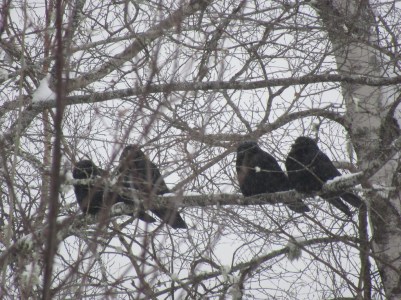
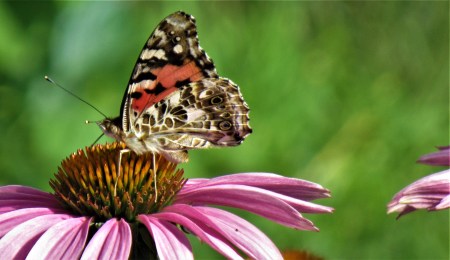
Beaver Pond at Mactaquac
for my beloved 

Beaver Pond, Mactaquac, on a fine spring day:
so sad to sit here knowing you can no longer
walk the trail. I remember the sun on your hair,
white, a flag of surrender to old age besieging
your mind and body. It cannot be seen on the board
walk where you stopped to commune with newts,
frogs, birds, fish, ducks, and the great blue heron
you disturbed. Remember? He rose from the reeds
with an anguished cry and a crack of mighty wings.

The wind in Island View is chill today, not a day
for walking in the wild. Monday: men arrive in a truck
and haul our garbage away. So much detritus,
such a mess at the roadside as winter ends and spring
brings thoughts of freedom to roam beyond spells
of ice and snow. Memories: I pack them into a green
green plastic bag and stuff them in the dustbin.

I want to be free. I want you to be free. I want to sit
and watch you wander, like you did last summer
contemplating the multiple meanings of grass, sun,
bird-song, herons, ospreys, beavers, their lodge,
this dam they constructed, this pond in which
they swim, nocturnal creatures, who live far away
from this lock-down and from our silent visits banned.

IMG_1318 (3)

Daffodils

IMG_0617

Daffodils

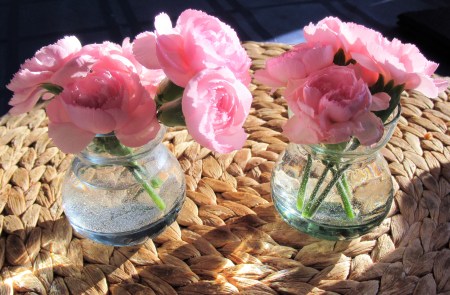
My daffodil day-dreams carry me back to Wales, that Land of Song where every valley conducts choirs of daffodils and their pale, brass voices are raised in an annual springtime hymn of hope. Beneath the trees, in Bishopston Valley, between Pyle Corner and Pwll Ddu, sheltered bluebells tinkle sweet tunes, lilies-of-the-valley bloom, and primroses raise their faces to the sky while hearkening to those springtime airs that sound where’er you walk. In Blackweir Gardens, the Feeder Brook flows into the castle moat and the castle’s central keep stands on the mound the Normans dug when they converted into a motte and bailey the old Roman camp that was built on an earthworks constructed by the Silures long before that countenance divine shone forth upon these clouded hills and long before the Roman came to Rye or out to Severn strode. Generation after generation, all those who witnessed the birth of these flowers and strove to be the first to hear the cuckoo’s call, come alive again in this floral tribute. Oh, Land of Song: the bluebells may have gone, the larks may sing no more, cuckoo and cowslip may have fled the valleys, but all is not lost, not while the daffodils still toss their heads in sprightly dance and spring breaks out its freckled sunshine.

Comment: Win some, lose some. Survival is all. At the same time as I mourn everything  that is lost, I also celebrate all that survive. The grosbeaks have left us, moving further north as the weather warms. They have left more room for cardinals and hummingbirds have moved in to replace them, as have turkey vultures. Turkey Vultures, Zopilote, The Trickster, in Oaxaca, the bird that flew high up into heaven, stole the fire of the gods, and brought it back on his wings, now flies over the St. John River Valley, having moved up here with the warmer air from the south.

“The olde order changeth lest one good custom should corrupt the world” … indeed it does. And we must mourn and celebrate the olde order while preparing for, and celebrating, the arrival of the new. For the world has changed and is changing as I sit here and type these words and it will have twitched and changed again by the time you read them. Who knows exactly what is coming? How do we prepare for the unknown? How do we open our arms and embrace an uncertain future? Good questions all. I cannot answer them for anyone but myself, but I must ask them. Many of them were discussed today by Suzanne Moore in an article entitled: The way we once lived is now redundant. We must reinvent ourselves. Read it and start thinking about how we can be strong, daring, caring, and best prepare ourselves, not for our own extinction, but for our own reinvention.


Sounds of Music

IMG_0147

Sounds of Music

Sounds of music everywhere, and in Cardiff now the black weir gurgles with laughter as you stride along. Gravel crunches in rhythm with your footsteps and the song birds invent new ways of singing their same old courting songs. Nesting birds pair up and sing about the joys of nesting. Beneath the trees, the Daffodils – Taffodils sway to the wood wind’s delicate fluting. A lace of golden lover’s hair, they curtain the sky above you as you climb the embankment, up and up, until the River Taff flows beneath you. Black and swift and deep and swollen with the last of the winter rains, the river surges along, its face freckled with sunshine.  The Taff, they say, cradles, as it murmurs its own sweet river song, the finest coal dust from the Rhondda Valleys and carries it out to be reborn in the sea. Here, in the river, fish and eels swim eyeless, so the fishermen say, as they gesticulate with brimming eyes and empty hands, weaving with hollow wind words mystical stories of the mythical salmon that were hooked, but lived to swim another day.

img_0146-3

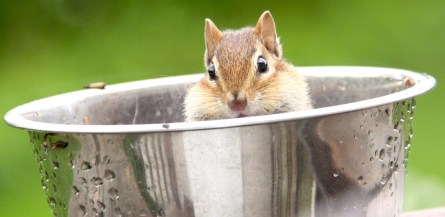
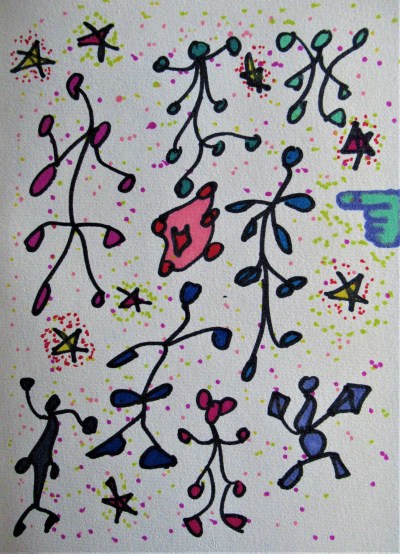
Comment: A crazy cartoon with a stick man dancing to music that occurs just off the screen at the side of the page. He dances unseen, unheard, as the deer dance at midnight, on their hind legs, reaching for bitter berries wintering on the mountain ash, as the sunlight dances when speckled trout rise to snap at flies, as my heart dances when my beloved walks into the room and lights my world with a smile. Spring in Wales: so far ahead of us as we languish here, on Canada’s East coast, hoping that last night’s minus temperatures will stagger to zero and then surge upwards into plus and double plus. Meanwhile, the grey squirrel chases away the red squirrel who frightened away the chipmunk, my beloved’s pet chipmunk for whom she put out the early morning seed to comfort him on this fresh frosty morning with its chill wind dancing between still-barren trees.

Scars

IMG_1095 (2)

Scars

It’s just a tiny splinter, lodged in my little finger. I take a needle from my sewing kit, put on my glasses, and break the skin around the small black spot in an effort to dig the splinter out.

Suddenly, the vision changes and I am back in my grandfather’s house. My father has bent me over his knee and is jabbing at the splinter in my thumb with a needle from my mother’s sewing kit.

“Hold still,” he pushes me down with the elbow of his left arm, then thrusts the needle again and again into the now bleeding spot on my thumb. “Hold still. Stop wriggling.”

“You’re hurting me.”

“Good.”

My mother comes into the room and inspects my thumb.

“Put your glasses on,” she tells my father. “At least you’ll be able to see what you’re doing.”

“Ow, ow!” I struggle with each piercing thrust of the needle but my father only holds me tighter.

Back in the present, I can hardly see this other splinter, let alone pull it out of my little pinky. I have broken the skin, so I place a band aid over the spot. Hopefully, the plaster will draw the splinter out, it usually does, quite painlessly. I put my sewing kit away and check my right thumb. My age-old splinter, still in there, winks its little black eye back at me from beneath the tear-filled eyelid of its tiny white scar.

We bear so many scars. Not all of them are visible.

Comment: So my granddaughter decided that she could polish up and improve my drawing notebook (top photo). And she did. Proof positive that a red pen in the hands of a young lady can work wonders. The thin red line of life, that link that joins us generation to generation, stretches back to times that only I can remember, stretches forward into times that I will never see. I wonder what my grandfather thought when he sat on his chair by the old Welsh fire and I climbed up, onto his knee. “Grandpa, tell me a story.” And he always did: “Once upon a time …  there was a thin red line …” And look, there’s my grandfather’s old chair down in my basement in Island View, New Brunswick, Canada. It’s a long way from my grandfather’s old home in Swansea. Just think, I used to climb up on the back of that chair, while he was sleeping, and blow on the bald spot on the back of his head … one long thin red line of inherited mischief …

18581930_1306791786107970_4016640231053970709_n-1

Limpet

fundy 05 mist+wolfepipers 081

Limpet

… like a limpet at the sea side
she clings to her inner rock
as the incoming tide
causes waters to rise,
threatening
to sweep her away.

A wind charges
over the bay,
brings a wave-surge,
white water urgent,
crashing against rocks.

Rock-face showered
and shocked,
the little limpet
clinging on,
knowing that this
is the way
limpets survive,
day after day,
generation
after generation.

Comment: We must also survive and we do so by hanging on as long as possible. The tides may rise, the mists come in, storms may send waves to come breaking over us … but they will not break us because we are limpets. So, imitate those limpets, cling to your rocks and hang on. However grim the situation might seem, the night will end, day will come, and we will survive. And remember that old Irish drinking song: “If Moonshine don’t kill me, I’ll live till I die.” And so will we all. And until then, enjoy the sunshine and the moonshine. This is your life, your planet, your set of circumstances. Hang in there and hang on, for as long as possible. Look for the good things in your life and when you find them, celebrate them and make the most of them. Remember the sundial: I count only the happy hours. Seek and you will find: for there is goodness all around you, even when the night seems to be at its darkest.

Purple


different kinf of doorway

Purple

 I write poems
in green ink,
but I prefer
purple.

Bruised clouds
on an evening sky,
dark depths
of a rainbow glow,
Northern Lights
singing at the deep
end of their scale …

… or just a desire
to be different …
slightly different …

as if that one thing,
the color of my ink,
might tip the scales
and turn me
from mediocrity
to celebrity

with a wave
of a violet wand,
or the click
of a pair
of ink-stained
fingers.

Comment: Juan Ramón Jiménez, Nobel Prize winner and author of Platero y yo, wrote a book entitled Almas de Violeta that was published in purple ink. He also wrote a book, printed in green ink. I used to have copies of them in my library, but alas, I gave my library away, so I cannot check for the title. I often wonder whether the color of the ink makes any difference to the quality of the writing. Same question with the keyboard or the pen. Some things seem to come more easily on keyboard or screen, but really, there is something about the smooth flow of pen and ink across the page that is enchanting just in itself. Now, back to my revisions for I am not just a writer, I am a re-writer. So off I go.

Writing a Poem Video


cropped-39948917_706398923049634_3046174897211441152_o-1.jpg

Writing a Poem

The KIRA artists (Roger Moore, June, 2017) were invited to make a video on the ways in which they worked. Here is my KIRA video. This is the first time I have ever made a video of myself. I am not into selfies (wrong generation) and had to be ‘persuaded’ to do this. The instructions were simple: something easy that anyone could do under lock down or in a home-schooling situation. I hope you enjoy the show!


Earth Bounty

IMG_1238 (2)

Earth Bounty
by
Victor Hendricken

 The paradox of life: in order to survive, we must consume; by consuming, we create waste; however, we do not see our waste as detritus, but as the product of living. 

Deep beneath earth’s surface, a miner drills a one and one-quarter inch hole eight to twelve feet deep into a rock face that is roughly twelve feet square. The miner repeats his task until the rock face resembles a block of Swiss cheese. Each hole is stuffed with explosive material. Then a blasting cap shaped like a metal matchhead, containing a fuse and trailing a wire pair sheathed in plastic, is gingerly inserted into each hole, buried up to twelve inches inside the explosive.

The miner and his partner (miners always work in pairs) connect the wires from each cap to a common grounded wire. The pair retreats to a safe area stringing out the grounded wire behind them, where they meet up with other pairs of miners waiting for permission from the mine captain to connect the trailing wires to an electrical junction box wired directly to a throw switch on surface. When all miners are assembled, they travel by hoist to daylight, where they hang their personal identification tags on the appropriate tag board confirming they are no longer in the deeps. The board is rechecked and the captain sirens a series of warning alarms and when certain that everyone is safe on surface closes the switch initiating the blast.  All drilled faces explode as one.

The miners hang their work clothes to dry, shower and change into street clothes. Some head home to family; some go to the bunkhouse kitchen; some seek out the comfort of a pub and the company of their workmates. No one is allowed to go underground again until the air is purged of dust and noxious gasses.

A miner drilling into rock containing copper in sulphide, oxide or elemental form is not thinking about copper pots for cooking, or copper wire for electrifying his house, or copper tubing to carry water from well to sink. He is fully engrossed in the task at hand: break the rock into manageable sized pieces and transport it from the deeps to the surface.  He is acutely aware of his dependence on number of feet advanced in the drift today, in the volume of ore bearing rock extracted from the stope.  He gives no thought to the growing piles of waste rock strewn about the nearby surface.

Out on the greenish grey ocean the fisher sets his traps. The location of each cage is identified by a floating coloured buoy.  The day is long and the sea rough.  In nearby locations, trawler lines and weighted nets are released to scavenge the ocean at various depths herding schools of many fish species to a common fate.  Some nets scrape the ocean floor to capture creatures succored there. Occasionally, fishers are forced to overnight on the ocean surface as their prey migrates below to nibble at the bait within the traps, to gather in large schools before the nets.

As each trap is hauled up, emptied and rebaited, the fisher is not thinking about lobster rolls. As he hauls in the bulging net and empties it into the ship’s hold, he is not thinking about blackened cod or fish cakes, sole adamantine or tender filet with baked potatoes and butter.  He is focused on hauling the catch from the deep ocean and filling the ship’s hold; delivering the dead and dying sea animals to the fish plant for processing into human and other food.  He does not count the discarded carcases of species that contaminate his daily catch.

The logger fells another tree, trims the branches and saws the tree into cordwood lengths. He inhales deeply while admiring his day’s work.  Chainsaw in hand, he does not think about houses or furniture.  He does not measure in board feet, nor does he envision dimensional lumber as he hews, stacks and hauls.  He focuses on cords piled, loads counted. Trees are objects to devour, not treasures to be taken.  He does not notice the acres of clear-cut whose topsoil will soon become prey to buffeting winds and torrential rain.

At the end of the day, perhaps on the empty street or in the local pub, the miner’s thoughts may wander to home, to sitting at his wooden table inside his wooden house, to eating a banquet of sautéed fish knowing only the supermarket as the meal’s origin.  At the end of the day, the fisher may walk the dark street from dock to home, peer down an alley dimly lit by doorways leading to cavernous public drinking places. He may wonder at the hidden resources protected by the alley, exposed by the alley. He will not wonder about the light’s source, the tungsten filament in the lamp, or the clinking glasses as he enters the pub.  At the end of the day, the logger will lay down his saw, turn in his axe, enter the pub from the street and take a seat near the alley door. He does not question the source of the fisherman’s platter he is served, nor does he think about the metal in the barroom tables and chairs, nor what goes into making a beer glass.  He marvels at the burnished wooden bar rail, harbours a fleeting image of his chainsaw.

When the three, the miner, the fisher and the logger, by happenstance meet, they do not tell secrets of their trade.  They speak instead of trivia and sports, avoid politics and talk of home. The angry metal teeth on the logger’s saw, the sharply honed edge of his axe, the height and girth of trees felled are no more in mind than the metal and wooden boat into which the fisher loads his catch, than the living, mineralized stope from which the miner draws his bonus.  Each protects his space as surely as a mother holds her child from nosy passers’ by.

Stories of mining pass only between miners; stories of fishing remain solely with fishers; stories of lumbering are wedged into spaces between lumberjacks.  No word is spoken of farmers plowing fields and harvesting crops.

And while we blithely drive our vehicles of iron, steel, copper and zinc, barbecue pink salmon and grey mackerel, slather slabs of butter on thick slices of homemade wheat bread, dance on decks of wood and nails and screws, the miner puts on his slickers and dons his hardhat and lamp; the fisher steps into his waterproof garb and rubber boots; and the logger twice ties his cork boots, sharpens his saw, and shoulders his axe.  The farmer quietly steps into his worn overalls, mounts his high-powered four-wheeled tractor and attacks worn out fields with plow and harrow.

Comment: This morning’s piece by my friend Victor. I publish it here with great pleasure. Victor has a sharp mind and an elegant pen. Hopefully, he will continue writing for me and, always with his permission, I will continue to publish his oeuvre.

Life is a Dream

cropped-img_0279-1.jpg

Life is a Dream

This life is nothing but a dream.
I cannot see the far side of the stream.

Life is a frenzy, a fiction, a story,
sometimes a romance filled with glory,
often a nightmare, bloody and gory.

We seek for answers, no confusion,
but all of our life is an  illusion.

We are but shadows in Plato’s Cave:
reality is what we crave,
but all we get is an early grave.

I’m not the first person who has said it,
but I’d love to take full credit.

Comment:  So many things here. My photo of Jan Hull’s carving that adorns my web page. It is carved in stone, Old Welsh red sandstone, unlike these ephemeral words. Thank you Jan. It links to Segismundo’s soliloquy from Calderón de la Barca’s La Vida es Sueño. I have adapted that piece to the current pandemic because Spain has instructed its people to wash their hands in time with this soliloquy.

¿Qué es la vida? Un frenesí.
¿Qué es la vida? Una ilusión,
una sombra, una ficción,
y el mayor bien es pequeño,
porque toda la vida es un sueño,
y los sueños, sueños son.

What is life? A frenzy.
What is life? An illusion,
a shadow, a fiction,
and the greatest good is small,
because life is a dream,
and dreams are nothing
but dreams, after all.


Day 23 CV-19

IMG_1652 (2)

Day 23 CV-19
Codes and Coding

“Languages: they say that to learn another language is to gain another soul and another set of eyes through which to view the world.” I wrote these words just yesterday [Day 22 CV-22]. The words are mine, but the idea belongs elsewhere. I have borrowed it and adopted it. I would willingly attribute it to a specific author, but I do not know who said it first. I offer my apologies to the to me unknown genius who first spoke these words.

Why codes and coding? A rhetorical question, of course. But codes and coding are the basic elements through which language transfers thought, our thoughts. What is a code? Well, we know all about Morse Code and the elaborate codes through which spies from all countries communicate their needs. A code is a way of converting language, changing it, making it available to those initiated in the code and unavailable to those who have not received such initiation. Sounds simple, doesn’t it?

When I was travelling regularly to Spain for research in Spanish libraries, my first port of call was always the local barber shop. I did this for several reasons. In the first place, my Canadian haircut gave me away as a foreigner. This is the hairdresser’s code. The barber’s shop was always the centre of local gossip. Here, buzz words changed hands, politicians were discussed, all the local news was immediately available. Each of these items was a code, a code that made an insider (acceptable) versus an outsider (not to be spoken to). I remember, one summer in Madrid, not getting served in any bar or restaurant. Check haircut: okay. Check shoes: bought new pair. Check shirt, jacket, tie: all up to date. Inspect lucky customers … ah … they are all wearing a shiny brass pin showing the symbol of Madrid: El Oso y el Madroño, the bear and the strawberry tree, as seen in La Puerta del Sol.

The next bar I entered saw me sporting El Oso y el Madroño in my lapel. Qué quiere el señor? Immediate service and with a smile. These are social codes, the codes that include the winks and nudges of the upper class, the secret handshakes and foot positions, the names dropped so gently and quietly that they never shatter when they hit the floor. There are also language codes. Northrop Frye wrote The Great Code: The Bible and Literature, a study of the mythology and structure of the Bible was published in 1982. In this wonderful study, Frye showed how themes and language from the bible have influenced the structure of Western Literature, particularly that written in English. Within this code, names, themes, miracles, parables, psalms form a body of are common knowledge available to all readers who are christian and whose first language is English.

But there are other codes. Think Petracharism. Petrarch’s poetry, originally written in Italian, was widely imitated throughout Europe. Italian literature, Spanish, French, English, all dip into that code, as does Shakespeare among so many others. Think the Great Chain of Being. Shakespeare is incomprehensible in places unless you unlock this particular code. Think Platonism, Neo-Platonism, Stoicism, Existentialism … okay, so all this is academic, and I do not want to lose you in a sea of academia. So think NFL, think NBA, think NHL, think baseball, think cricket, think rugby, think darts, think all of the things we manipulate on a daily basis in our lives and think how they include some people (those who know and share our codes) and exclude others (those who are unaware of them). LBW, c&b,  c. A, b. B, st. A b. B, w, W, b, lb, dec., rsp …

This is a wonderful line of discussion. It follows along the lines of micro-language and macro-language. Macro-language is accessible to all who happen to speak that language. Micro-language in its multidinous forms incarnadine belongs ONLY to those who share the micro community, be it family, household, village, town, county, region … all that is closest and dearest to our micro-hearts.