Dreamer

Dreamer

A once-upon-a-time god struts past the table where I drowse.
Once I stole his nose, breaking it from a sacred statue.
Now I watch it cross the square: a proud beak nailed to a face.

Casting shadows on the cobbles, zopilote flies over the square.
I caught him once, dozing on a local bus filled with love-birds:
he begged me to fold his wings and let him sleep forever.

The balloon lady sits in the square selling tins of liquid soap.
Released from school, the children charm my days
blowing colored bubbles that seek freedom in the skies.

Eight Deer, eight years old, sets out on his conquests.
Nine Wind gives birth to his people, releasing them
from their underworld prison by carving a door in a tree .

Faces crowd the trees above me, as long-dead friends
come back to life, chattering like sparrows in the branches.
Roosting time and their voices slip slowly into silence.

Sometimes, at midnight, they scratch at the window
in my head and tumble through my half-awake mind.
They need me, these dreams, for I bring them to life.
Without me, the dreamer, they would surely fade and die.

Striations

There are striations in my heart, so deep, a lizard could lie there, unseen, and wait for tomorrow’s sun. Timeless, the worm at the apple’s core waiting for its world to end. Seculae seculorum: the centuries rushing headlong. Matins: wide-eyed this owl hooting in the face of day. Somewhere, I remember a table spread for two. Breakfast. An open door. “Where are you going, dear?” Something bright has fled the world. The sun unfurls shadows. The blood whirls stars around the body. “It has gone.” she said. “The magic. I no longer tremble at your touch.” The silver birch wades at dawn’s bright edge. Somewhere, tight lips, a blaze of anger, a challenge spat in the wind’s taut face. High-pitched the rabbit’s grief in its silver snare. The midnight moon deep in a trance. If only I could kick away this death’s head, this sow’s bladder, this full moon drifting high in a cloudless sky.

Comment: This is the prose version, from Fundy Lines (2002). The prose version was based on an extract from a longer poem that first appeared in Though Lovers Be Lost (2000). Though Lovers Be Lost is also available on Amazon and Kindle.

Water

Water

Here, in Island View, my lawn’s parched grass
longs for water, long-promised but never drawing near.
Do my flowers remember when the earth slept without form
and darkness lay upon the face of the deep?

The waters under heaven gathered into one place.
When they separated, the firmament appeared.
Light sprang apart from darkness
and with the beginning of light came the word,
more words, and then the world …

… my own world of water in which my mother
carried me until her waters broke
and the life sustaining substance drained away
throwing me from dark to light.

In Oaxaca, water was born free, yet everywhere
lies imprisoned in bottles, in jars, in frozen cubes,
its captive essence staring out with grief-filled eyes.

A young boy on a tricycle pedals the streets
with a dozen prison cells, each with forty captives:
forty fresh clean litres of drinkable water. He holds
out his hand for money and invites the villagers
to pay a ransom, to set these prisoners free.

Real water yearns to be released, to be spontaneous,
to trickle out of the corner of your mouth,
to drip from your chin, and fall to the ground.

It is a mirage of palm trees upon burning sand.
It is the hot sun dragging its blood red tongue across the sky
and panting for water like a great big thirsty dog.

Sweet Dreams

Sweet Dreams

Amnesia fades in these amniotic
waters, moving in time to the water pump’s
heart beat. I close my eyes. Nothing is the same.

Do I drift dreamily or dreamily drift?
The tub’s rose-petals bring garden memories:
primrose, bluebells, cowslips, daffodils dancing

sprightly in Blackweir Gardens or Roath Park,
beside the lake or along the gravel paths
where we used to bike, so many years ago.

Photos float before me, pictures of moments
I alone recall. Spring in Paris, the trees
breaking buds along the Champs-Élysées.

Santander in summer, walking the Piquío,
Segunda Playa, beneath the jacarandas.
Winter in Wales, up in Snowdonia where,

on a Relay Run to Tipperary,
I ran down a valley between high hills,
on a freezing night, with only the stars

to keep me company along a ribbon
of road. Autumn in Mactaquac. An orgy
of gaudily painted trees, leaves floating

on this first chill wind, to perch like sparrows,
on my beloved’s hair. The look in her eyes
as I catch a falling leaf and put it in
her pocket to save it for another day.

This Vessel in Which I Sail

This Vessel in which I Sail

Trapped in this fragile vessel with the pandemic
a passenger waiting to board, I drift from port to port,
looking for a haven, safe, to have and to hold me.

No harbour will let me dock. “No room at this inn,”
they say. “No haven here.” They wave me away.

Now I have no destination. Aimless, I float and every
where I go the message is: “No vacancy: no room at all.”

Unwanted, abandoned, I wander with wind and waves,
my only friends seals, porpoises, and whales.
I walk the whale road, leaving a frail, white wake behind.

This vessel has become a gulag now, a prison
camp where I exist just to survive. Each hour of each day
endless, boundless, like this shadowy, haunted sea.

Today there is no motion, no goal. What is there to achieve
but survival? Each day’s journey is sufficient unto itself.

Going Back

Going Back

Nothing will ever be
as it was before.
Time, like water,
like these people marching,
constantly flows.

It trickles through my fingers,
uncatchable,
unstoppable sand
filtering through
the hour glass’ waist.

You cannot walk
in the same river twice.
Water flows, currents shift,
rocks wear down,
banks crumble and fall.

However hard I try
I cannot recapture
that first, fine, careless rapture,
the touch of that first
drop of river water.

Kneeling by the river bank,
like St. Kevin and the Blackbird,
I cannot recall
the river’s name.

Lamentations

El Cristo de Carrizo

“Contemplate this crucifixion.
Each of your sins is a thorn
driven into His brow.

Each misdemeanor spears
the sacred side,
draws water and blood
from the open wound.

Your sinful deeds
drive nails anew
into hand and foot.

Christ lives in you.
Your misdeeds nail him
daily to the cross
He bears for you.

He hangs there,
open-eyed.

No death,
no resurrection,
just an everlasting suffering
from these nails
you daily drive.”

Comment: This poem is a very golden oldie. I wrote it in 1979 while walking the Camino de Santiago / the Road to St. James. I should add that this was long before it became fashionable to do so. I walked alone and, save for my thoughts, I was indeed very lonely. In fact, the long days walking, the solitude, got to me. I needed to talk, to meet people, and so, after long discussions with sundry people along the route, I determined to take the bus or the train to the main pilgrimage centres and to walk out from them in either direction. This allowed me to meet people, explore the towns with their churches, traditions, and museums, and to learn much more about the nature and art traditionally associated with the pilgrimage. In this fashion, I spent five days in Leon, two days in Hospital de Orbigo, a week in Astorga, another week in Ponferrada, and nearly two weeks in Santiago itself.

I wrote a collection of poems while I was studying the cities and the landscape. This particular poem is a summary of the conversation I had with the old priest, determined to convert me to Catholicism, who introduced me to the Cristo de Carrizo, in Leon.

In 1613, Francisco de Quevedo, the Spanish poet on whom I wrote my doctoral thesis (Toronto, 1975) wrote a collection of heartfelt mea maxima culpa poems dedicated to his aunt. It bore the title of El Heráclito Cristiano / The Christian Heraclitus.  This in turn was based on an earlier cycle of poems, Lamentaciones de Semana Santa / Lamentations of Holy Week (1601), which Quevedo appears to have written following the Spiritual Exercises of Saint Ignatius of Loyola.

These spiritual exercises consist of a set of contemplations based on the Stations of the Cross, Via Crucis, in which the contemplator meditates on each of the moments of Christ’s torment and suffering leading up to his death by crucifixion at the end of Holy Week. The purpose of the exercises is to try and recreate in the mind of the contemplator the sufferings of Christ, to imagine his pain, and to feel his suffering at a personal level. This is an act not only of contemplation and contrition, but also of purification of mind and spirit.

This year, during Holy Week (from Palm Sunday to Easter Sunday and the Resurrection), I attempted to follow in the footsteps of Quevedo and to contemplate the current world situation and my own specific situation, as influenced by the lock down in New Brunswick instigated on account of the Corona Virus pandemic.

Lamentations for Holy Week, then, is my attempt to examine myself and my own conscience at a time of great personal stress, a stress that I share with all those who are infirm, frail, in ill health, alone, and getting on in years. These are the people most affected by loneliness and the threat of the pandemic to our lives.

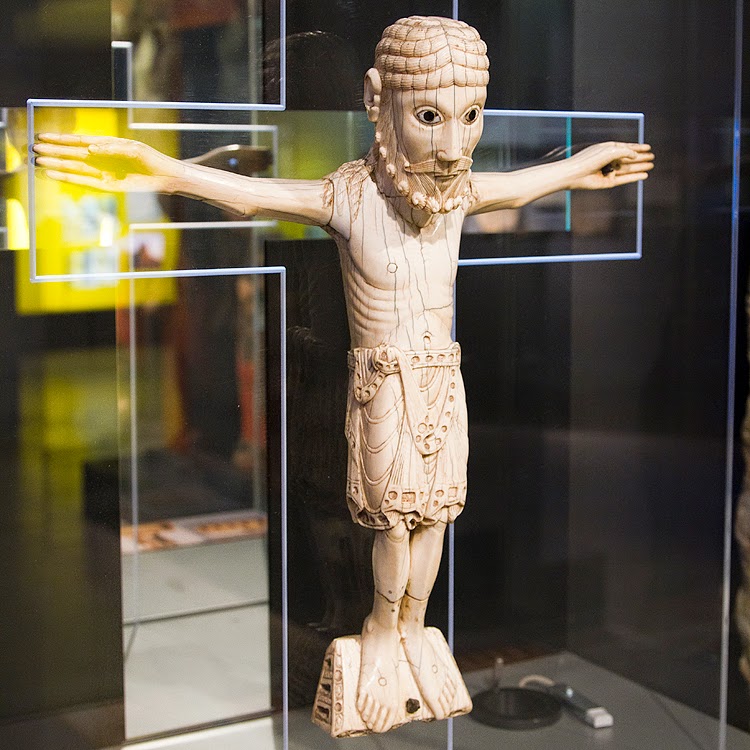
The Cristo de Carrizo is a hand-carved ivory cross, Mozarabic in origin. It shows Christ, on the cross, with his eyes open, looking at the viewer. Christ is not dead, in this crucifixion, but very much alive, and suffering. Image taken from Wikipedia.

Co-[vidi]-s

Co-[vidi]-s
17 March 2020

Time changed with the clocks
and my body clock
is no longer in sync
with the tick-tock chime
that denounces each hour.

Hours that used to wound
now threaten to kill.
They used to limp along,
but now they just rush by
and I, who used to run
from point to point,
now shuffle a step at a time.

Around us, the Covidis
thrives and flowers.
Wallflowers, violets,
we shrink into our homes,
board up the windows,
refuse to open doors.
We communicate by phone,
e-mail, messenger, Skype.

Give us enough rope
and we’ll survive a little while,
fearful, full of anguish,
yet also filled with hope.

Where’s Home?

Where’s Home?
by
Jan Fancy Hull

An Open Letter to Jan Hull

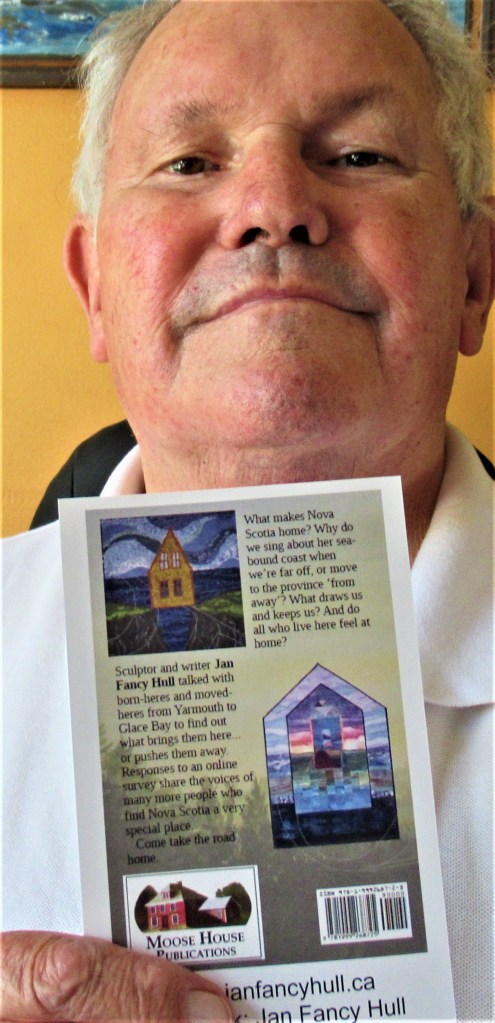
Right from the address on the envelope where you gifted me a knighthood, calling me Sir Roger, I was captivated by this package.

I opened it at the Beaver Pond in Mactaquac and started to read as Clare did her daily walk, widdershins round the pond. Alas, I missed the great blue heron flying. Ditto, the osprey and the kingfisher. I heard all about them later.

Only you, Jan, only you. You are truly unique. Your words jump off the page, lean across the table to me, and offer me bread and wine. I do hope that this book is the first of many. Your words brought tears to my eyes and hope to my heart.

So many themes that touched me deeply. The loss of language and culture: in this case, French and Gaelic, in my own case Welsh, a forbidden language when I was growing up. It is only now, at an advanced age, that I have started to learn it. What memories it brings back.

The sending of indigenous children to residential schools: in my own case, starting at age six, I was sent away to a series of boarding schools and never escaped until I was 18 years old. Good-bye family and culture: hello loneliness and solitude.

The enforcement of religion, top down, with the vicious punishments that accompanied doubt, unbelief, or non-acceptance. The brutal separation from family, with the whole experience of reintegration into a now-become-foreign world, relocation, loss of roots and culture, the difficulties of not belonging to the new communities.

There is a brighter side too, and I will get to that another day. Meanwhile, congratulations on this book, Jan. May it be the first of many and a delight and revelation to all.

Dreamcatcher

Dreamcatcher

In my dreams, I track the sails of drifting ships,
white moths fluttering before the wind.

I think I have caught them in overnight traps,
but they fly each morning in dawn’s forgiving light.

I give chase with pen and paper, fine butterfly nets
seeking wild thoughts waiting to be caught, then tamed.

I grasp at something just beyond my fingertips,
but I can’t quite remember what it is.

I wake up each morning unaware of where
I have been the night before.