I did the memory test today. It’s hard to believe that tomorrow I may not know where I am nor what is the day. Others have passed this way, none to my knowledge in my family. Sorrow gnaws the red bone of my heart. The lady at the doctor’s counter says she is seventy. Her bed-ridden mother, for whom she seeks medicinal solace is ninety-eight. Her mind, she says, is as sharp as a needle or a knife, or a blade of grass. What dreams, I wonder, flit through her head at night? Does she recall her child hood with its pigtails, the first young man she kissed, church on Sundays, the genders carefully segregated, driving there in the family horse and cart? Thunder rolls and shakes my world’s foundations; a storm watch, followed by storm warnings, walks across my tv screen. Lightning flashes. Aurora Borealis daubs the night sky north of Island View with its paint-box palette of light. Memories, according to the song, are they made of this. But what is this? Is it these shape-shifting, heart-stopping curtains of shimmering grace? Or is it those darker shadows cast by firelight on the smoky walls of a pre-historic Gower cave where my ancestors gnawed the half-cooked bones of the aurox and never ever dreamed of Jung’s racial memories as they communicate information from the unconscious to the conscious mind.
I have been a member of the Writers’ Foundation of New Brunswick for a long, long time. I am not a ‘founding member’, but I think I have been a member since around 1985, and I am sure I was a member in 1986, when Goose Lane Editions, Fredericton, published my second poetry collection, Broken Ghosts. I was most certainly a member in 1989 when my still-unpublished poetry manuscript Still Lives placed first in the Alfred G. Bailey poetry competition.
In the years between 1985-1986-1989 and 2020, I have never received a hand-written communication from any member of the WFNB Board, other than an official communication of one kind or another. Imagine, then, my surprise, when the above postcard, inserted in a hand-addressed envelope, arrived in my mail box yesterday. I was truly amazed and very grateful to the president who wrote these kind words to me. Amidst the panic and the pandemic, it is so nice to be remembered and in such a thoughtful way. Madam President: thank you so much for reaching out to me with this verbal gesture. And yes, you can count on my support for yourself and our Writers’ Federation, I hope for a long, long time to come.
I was in two minds whether to post this or not. However, I wish to emphasize several things: the importance of reaching out, the importance of continuing to believe in ourselves and our creative talents during these difficult times, the necessity of creating alternate communities and of supporting each other as much as possible, the need to avoid total isolation and to maintain human contact in different ways when the physical things — meeting, touching, holding, direct dialog — and the normal activities and relationships of healthy human beings are denied to us, and last, but by no means least, the need to encourage each other and to offer comfort and recognition whenever and wherever possible.
Seize the day. Squeeze this moment tight. Nothing before means anything. Everything afterwards is merely hope and dream.
A tiny child, you chased wind-blown leaves trying to catch them before they hit the ground Elf parachutes you called them and trod with care so as not to crush the fallen elves as they lay leaf-bound.
I stand here now, a scarecrow scarred with age, arms held out, palms up, in the hope that a leaf will descend, a fallen sparrow, and rest in my hand.
When one perches on my shoulder and another graces my gray hair, my old heart pumps with joy.
Comment:Autumn in the Garden was framed by Geoff Slater who gifted it to me this summer. Thank you Geoff. A double picture, it shows the flowers and the trees with that first touch of drifting snow. NB it snowed here in Island View early September this year while we still had flowers and leaves. The poem, Carpe Diem, is from a series of quasi-sonnets. Quasi, because they rarely have 14 lines! Oh Petrarch: shake in your shoes.
No Exit a line painting by Geoff for Andrea Slater
Where is the entry point, where the exit? This labyrinth of lines, straight, not circular, baffle the eye, confuse with a negative space that lightens colors and begs more darkness.
Mystery surrounds the sitter’s form: the board walk, no Dutch kitchen this, the chair on which she sits, the locket she wears, the landscape, seascape against which she is framed. White noise, perhaps,
but noise that turns to a single voice, a single line, that of the paint-brush tip-toeing, delicate its thread through interior, exterior meaning, just beyond
the viewer’s grasp. Yet walking past, each person stops, stands still, as the painting draws them in, ties them up, binds them with an ineffable thread, stronger than words,
mightier than the eye that traces its way along paths that deceive, disturb, throw us from the high-wire created by an artist who turns circular colors into linear space.
Comment:No Exit forms a part of my manuscript collection The Nature of Art and the Art of Nature that placed second in the WFNB’s Alfred G. Bailey Award (2020). This collection will soon be made available online at Amazon / KDP.
Geoff Slater the inventor of line-painting, gifted me this painting, one of my hollyhocks about two years ago. This is indeed a gift that keeps on giving.
worshipping Gaia before the great altar Santo Domingo
if the goddess is not carried in your heart like a warm loaf in a shopping bag you will never discover her hiding place
she does not sip ambrosia from these golden flowers nor does she mount this vine to her heavenly throne nor does she sit on this ceiling frowning down
in spite of the sunshine trapped in all this gold the church is cold and overwhelming tourists come with cameras not the faithful with their prayers
my only warmth and comfort not in this god who bids the lily gilded but in that quieter voice which speaks within me
and brings me light amidst all this darkness and brings me poverty amidst all this wealth
Comment: I was surprised to find this article on my poem Gaia while doing an online search for something else last night. It is an interesting interpretation of the poem. I would like to thank the writers and editors who put it together for their careful work and attention to detail. Sun and Moon is available on Amazon.
There are striations in my heart, so deep, a lizard could lie there, unseen, and wait for tomorrow’s sun. Timeless, the worm at the apple’s core waiting for its world to end. Seculae seculorum: the centuries rushing headlong. Matins: wide-eyed this owl hooting in the face of day. Somewhere, I remember a table spread for two. Breakfast. An open door. “Where are you going, dear?” Something bright has fled the world. The sun unfurls shadows. The blood whirls stars around the body. “It has gone.” she said. “The magic. I no longer tremble at your touch.” The silver birch wades at dawn’s bright edge. Somewhere, tight lips, a blaze of anger, a challenge spat in the wind’s taut face. High-pitched the rabbit’s grief in its silver snare. The midnight moon deep in a trance. If only I could kick away this death’s head, this sow’s bladder, this full moon drifting high in a cloudless sky.
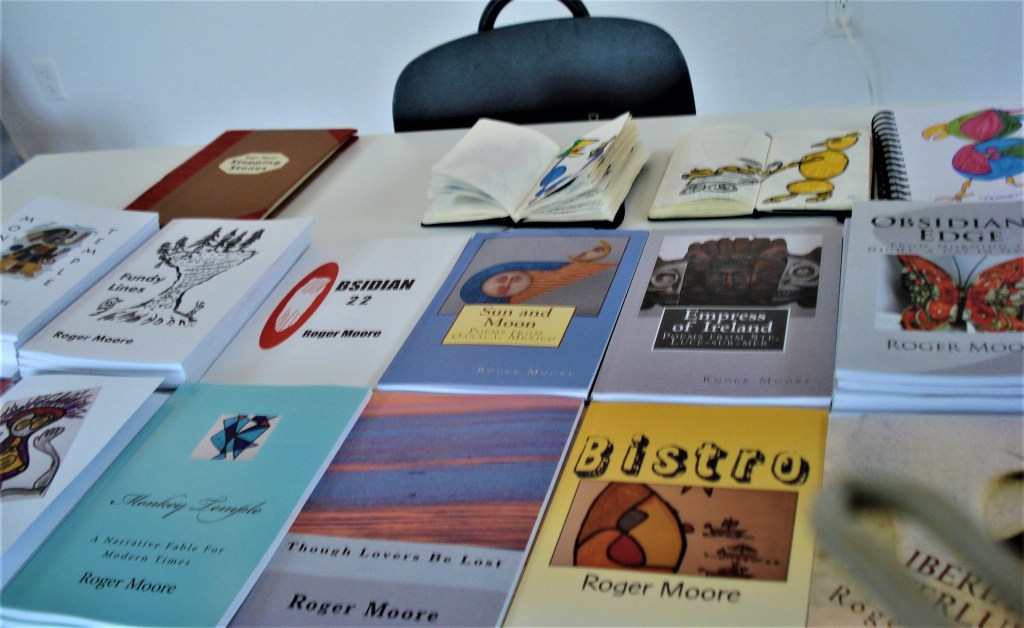
Comment: This is the prose version, from Fundy Lines (2002). The prose version was based on an extract from a longer poem that first appeared in Though Lovers Be Lost (2000).Though Lovers Be Lost is also available on Amazon and Kindle.
Between Two Places Dianne Fitzpatrick Where’s Home?
Where’s Home (3) Part III of an open letter to Jan Hull
The Little Things
In 1898, Spain fought and lost a war with America over possession of Cuba. Cuba was the last of Spain’s overseas Empire and when it went, the all conquering fatherland, upon whose empire the sun never set, was reduced to its original territory in the Spanish Peninsula. That same year, the literary Generation of 1898 started a new movement, one that made Spain itself central to its imagery and thought. Theirs was not the Spain of Imperial History, with its wars and treaties, battles and conquests. Theirs was the eternal countryside of Spain, the Spain of Old Castille that was rooted to the soil, and that had remained virtually unchanged in the small towns, fishing ports, and villages, for hundreds of years. This was the Spain of Miguel de Unamuno’s Intra-historia: the history of small things.
St. David, Dewi Sant, the patron saint of Wales, a historical figure flourishing circa 600 CE, is famous within Wales for his many sayings. But for me, one stands out. “Byddwch lawen a chadwch eich ffyd a’ch credd, a gwnewch y petheu bychainmewn bwywd” / Be joyful and keep your faith and creed and do the little things in life. In these times of stress and strain, faced by enormous changes brought about by the pandemic, to these prophetic words I turn.
Poets, creators, artists, stoneists, craft-workers of all kinds … we are the antennae of the people. We sense the directions in which life flows and will flow and we are ahead of our times, not behind them. We are the ones who ‘do the little things’, often abandoning larger, more financially rewarding projects in favor of smaller ones that spiritually enrich both us and the people around us. And that is what I am now reading in Jan Hull’s Where’s Home? People, real, live, flesh-and-blood people, many of them artists at heart, abandoning the big city’s rush and rock and roll to enjoy the quietude of small communities which they help to build with their own hands.
Troglodytes, cavemen, people living in the past, I have heard ‘so-called saner citizens’ mutter about some of our contemporary artists. They live off hand-outs and charity and welfare, and they live in the past. Grey-suited, working in concrete boxes, these well-heeled critics are all made out of ticky-tacky, as the old song says, and they work in little boxes, and they come out all the same. Fine fr some, but you certainly cannot say that of the characters who inhabit the small towns, villages, and ports, as Where’s Home? demonstrates so clearly, with quote after quote from contented people, all resident in Nova Scotia, some CFA (Come From Away), others CBC (Come By Choice), and yet others native to the province.
Living in the past … when Hurricane Arthur struck, we went without power for twelve days. No water, no warm food, no cooking, no refrigeration, no flush toilets, no showers, no air conditioning, no television, no Wifi, no internet … In 1928, my grandfather and my father built a summer home, a bungalow, in Gower. I remember, even in the late fifties, living there during the summer with my grandparents: wood stove, rain water barrels, no running water, outhouse, no electricity, no refrigeration, oil lamps … Hurricane Arthur … and Clare and I went back to bungalow living. Several of our neighbors did not know how to cope with the ‘problems’. A couple moved into hotels or stayed with family elsewhere until the crisis was over. As for us, this was the life I was used to as a child. We went into bungalow mode and had more fun than anyone could imagine… living in the past? … or preparing for the future? … Think about it, and don’t jump too quickly to the wrong conclusion.
Above all, Jan Hull’s book, Where’s Home?, has made me think. It has made me think deeply about my own life, my own memories, my own restless, rootless existence, my own attempts to settle and resettle. More, in light of the pandemic with so many working from home, so much home schooling, and so much online back and forth, maybe we, the artists, the returnees, the WAH (Work At Homers), maybe we are not stranded, forgotten, on the back-burners of modern life. Maybe, just maybe, we are the fore-tellers, the front-runners, the pioneers of how a better, more meaningful existence may be created and kept. Thank you, Jan, and please thank all your contributors on my behalf.
These daffodils were not painted by an unknown painter, but by a painter whose paintings are unknown. There is a subtle difference. There is also something sweet abut covering a blank space with color and shape, even if the hand is unsteady and the eye unsure. This painting is also unframed and belongs in a photograph album or a long-forgotten painting book.
“Fair daffodils, we weep to see thee.” Indeed we do, for they are so transient lasting but a week, or less, cut and placed on the table in a vase of water. So sad to watch them as they stiffen, turn slowly brown, dry up, and then hang their heads in the shame of old age. We are not so dissimilar, those daffodils and me. This photo will capture me forever, or until it is erased, because a photo isn’t a photo anymore. That painting will capture those daffodils too, for little while, until my subscription to the blog runs out and I forget to renew it.
“Poor daffodils, we weep to see you.” But weep not for us, they tell me. Our day is done. Our life is fulfilled. We have brought beauty and scent, however brief, and we have given light to enlighten your daysand joy to light up your heart. And that, I guess, is the message. “Gather you daffodils while you may, for Father Time is flying. And those sweet blooms you pluck today, tomorrow will be dying.”
Thus it is during the Corona Virus 19 pandemic, and thus it was during the Spanish Flu, the Black Death, and all the other plagues that have come to bring understanding and make us see reason. Our lives are as short as the lives of flowers. Seize your life, hold it in both hands, admire it, enjoy it, make the most of the mall things, for they are often, like the smiles of small children and the daffodil’s golden glow, the most important things of all.
“Ah, would some power thegiftie ge us / to see ourselves as others see us.” Robbie Burns, a Scottish Poet.
And sometimes I think the flowers would like to be seen as they see themselves, not as we see them with our imperfect eyes, not with the cataracts of the Elderly Monet, not with the blunted vision of many artists who have stopped, and sniffed, and bent their heads, and wondered at the colors that entered their paint brushes through the nostrils. Vision and reality: the photo versus the objects as we see and sense them. The reality versus our own version of it.
So who is this anonymous artist who delivers these visions to my blog and allows me to glimpse alternate realities that are so different to my realities. I think of Lorna Crozier, The Garden Going on Without Us. I think of Kingsbrae Gardens, at night, when the flowers are alone and talk only to themselves. I think of Monet at Giverny as his vision lessened and his instincts grew. Who are we? What are we? Do we see ourselves as others see us? Do others see what we see? Color, shade, light, hue … El ojo que ves no es ojo porque lo ves, es ojo porque te ve / the eye you see is not an eye because you see it, it is an eye because it sees you (Antonio Machado). Does the man or woman looking out at us from the television set see him or herself as we see them?
The night before last I sat alone in a hotel room. The television screen was much, much wider than it was high. All the facial images were greatly distorted. I didn’t recognize the people I saw, except by their voices. Who will distinguish the reality of the flowers, each by each and one by one, privatim et seriatim? Who will listen to their floral voices and call them by the names they have given themselves, rather than by their horticultural names?
Tell me, what reality do we see when we see the flowers? What reality do the flowers see when they see us? The anonymous painter who painted this picture that Geoff Slater, my anonymous friend, framed so nicely did not see those flowers the way that I saw those flowers. Why not? Why can’t I see like him (or her)? and why can’t she (or he) see like me?