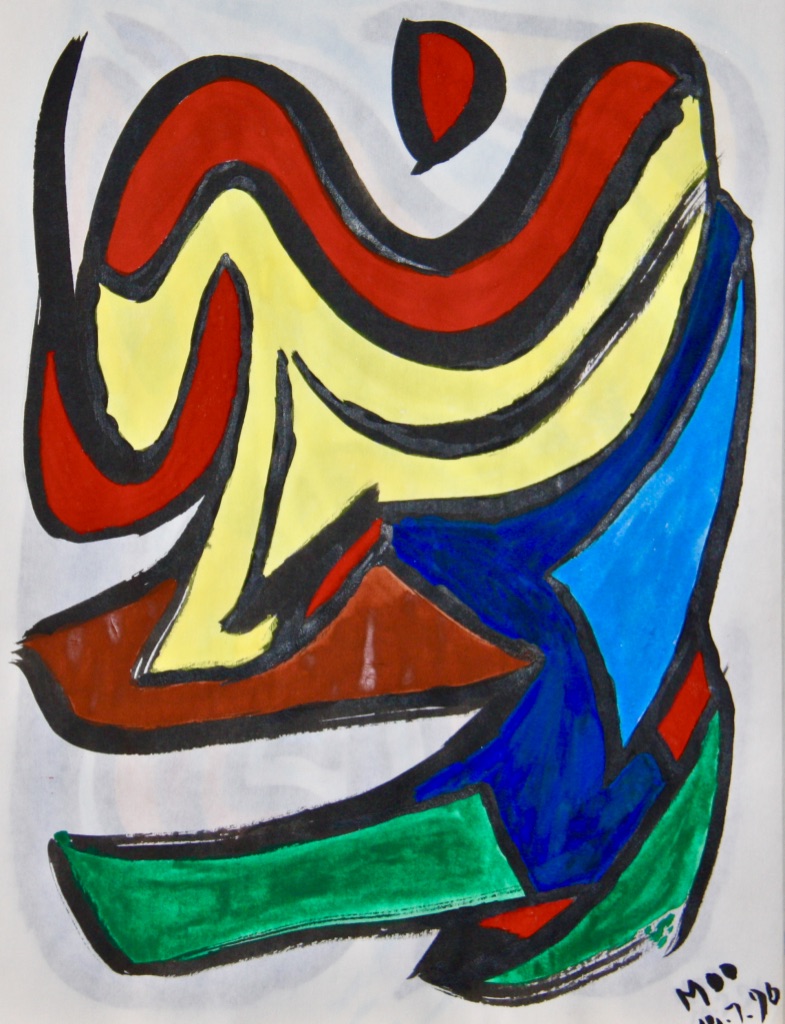
I guess this is the painting that helped change my views on reality. I can’r remember what I called it originally, but this is what I first imagined. But what about this?
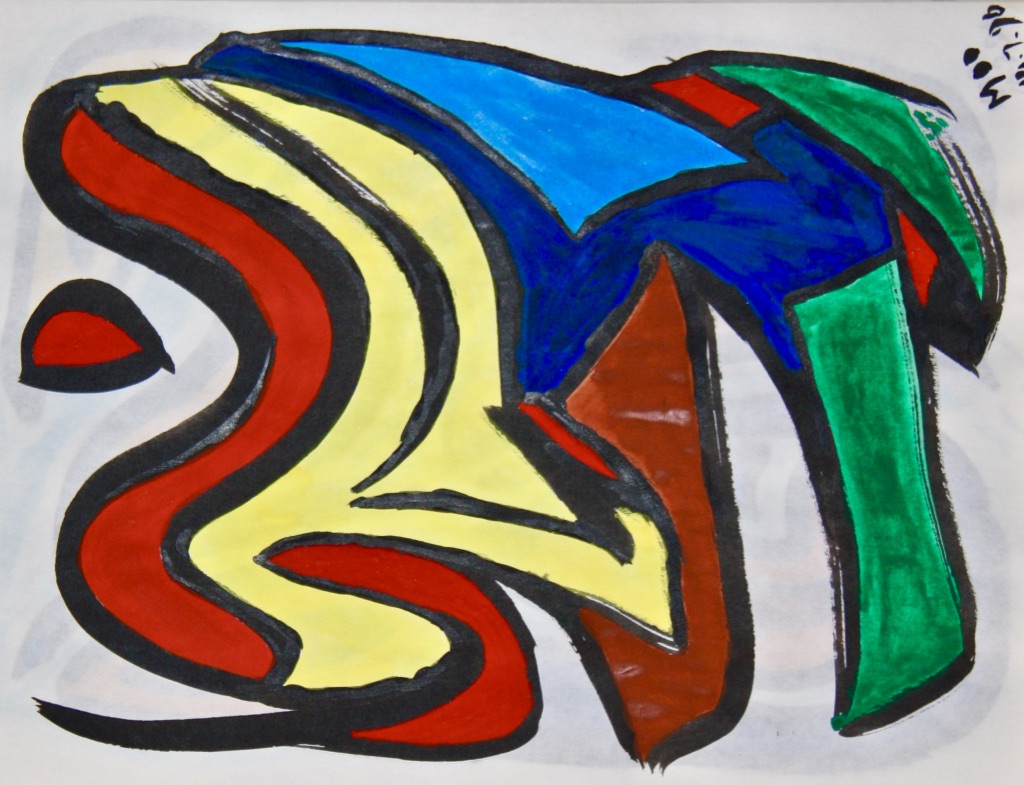
The signature, top right, suggests that the painting was conceived as in the initial photo. But, does it have to stay that way? Of course not. The creature, if creature it is, is a creature of my own creation. I can fit it into any form that I want. Ignore the signature. Concentrate on color, shape, and meaning. But remember that meaning is drawn from color and shape.
Dizzy yet? Disoriented? I remember doing this with some of Picasso’s paintings in the art and culture class. Turn the slide and change the title. Each angle is a new world and a new orientation upon the world. Oh me, oh my, oh Moo, whatever will you do? Next.
Twist again, I suppose. And now we have almost come full circle. Which one is preferable? Why? Can this be an objective decision? Is it totally subjective? I would love your opinions. And your suggestions for titles. Ludum Ludite – play the game.
And whatever game is that little red dot playing, or the bull’s head, or the open mouth? But now les jeux sont faits — the bets are made. Rien ne va plus. Nothing goes anymore. C’est fini, mon Kiki.
This from the days when I was a wannabe artist who thought he could actually be an artist. But no, it was not to be and the masks fell off and dropped to the ground. There was no Covid back then, so I didn’t have to pick them up and put them back on again. And I didn’t have to stay two metres – six -feet – away from the painting. If you paint with the Devil, you need a long brush. Also known s a Devil’s Paint Brush.
To paint or not to paint, that is the question. So, I chose the path of mindfulness, la escondida senda por donde han ido los pocos sabios que en el mundo han sido / the hidden path along which have walked the few wise men who have lived in the world. And yes, art, in all its forms, is mindfulness, being in yourself, being aware of the moment, being taken up by that split second when paint hits paper, canvas, or whatever, and being absorbed totally in that.
Gardening will do that for you. Also what I call hyperspace, that wonderful world between fingertips, and screen where the great ideas flow naturally, like paint, and words come tumbling out onto the page. Today’s theme: The Great Pretender. Not all the words are wonderful, nor all the ideas great. The greatest skill is to be able to differentiate between gems and dross. This comes with patience and practice. But when the words flow, and the paint settles, there are few joys like it.
One of my first cartoons. It always reminded me of Jerry Lee Lewis: “Goodness, gracious, great balls of fire.” What fun it was to paint and what a joy to rediscover it. I guess that’s the name of the game for a little while: rediscovery. Dig down into the dirt and the memoirs and the flashbacks and reproduce what’s in there. It reminds me too of the conjunction of Mars and Venus, a couple of years back. I would look out of the window, to the southern sky, and there they were, drawing closer together until, suddenly, one night, there they were. “Goodness, gracious, great balls of fire.”
I have never been able to draw or paint with any skill. Then, one day, I read Matisse and his commentaries on his own work: “Making meaning out of colour and shape.” So, there you are. I don’t know what it means, but, as Salvador Dali said “I don’t know what it means, but I know it means something.” And the moment means something: staying in the moment of creativity creates great joy. That joy, the joy in joie de vivre, is there to be rediscovered. So: share the joy. Laugh at the innocence. And, following Picasso, “paint the world as a child might see it.”
How could one not give thanks for the bounties of Thanksgiving? Listening to Cross Country Check Up, last night, as I have done for the last 55 years, I was amazed at how people, some of them in dire circumstances, were able to find things for which to be thankful. I haven’t made a list of the things for which I am thankful and I certainly didn’t call in to the talk show to give my opinion, but let me think…
I am thankful for the beauty of the natural world. Just look at that sunrise! Yesterday we walked in Mactaquac and admired the beauty of the changing leaves. Migrating geese put on a display, taking off from the waters of the head pond, flying, then settling down again. We: I am grateful for the presence of my beloved, still beside me after all these years. I am grateful that we are together and that we are both of us able to walk and indulge in this province’s autumnal beauties.
I am grateful for faithful friends. I will not name them all. If I did, this blog would never be finished. This morning, an e-mail from Geoff Slater, whose paintings and drawings have often appeared on the blog, spoke of the nature of ritual and how we use it. He spoke of external rituals and how, during times like these, when our normal lives are upside down, we lose the ability to follow our external rituals. This may cause dismay and a loss of stability to many. However, he also reminded me that we, as practicing artists, have established our own internal rituals. These keep us going in the difficult times, for they are always there to fall back on. Following his line of thought, I explored my own daily rituals, the ones that have kept me going throughout Covid-19. Thank you, Geoff, for those ideas and for your long-term friendship.
I am grateful for the initial offer, from the University of Toronto, to come to Canada to study all those years ago. Canada gave me a chance to challenge my established rituals and to build and shape new ones that were more suitable to my inner being, a being that I had kept well hidden from the Masters of the Universe who limited my creativity, and ruled the rituals of my Boarding schools and my undergraduate studies. Above all, I am grateful for that rich, inner world of creativity and dream and I am doubly grateful for those who have allowed me and encouraged me to express it and set it down for others to share.
So, Thanksgiving Day: a day on which to give thanks for all the blessings that are in our lives, large and small. Sure, times are tough. Sure, we could all do with more money. Sure, we could go on and on about our wants and needs. But today my want and my need is to give thanks for who, what, where, when and why I am. As my friend Norman Levine once wrote: Canada Made Me.
I woke up yesterday morning to find frost on the ground and a white layer over the green, green grass of home.
The sun rose, and emerald patches shone through while the frost stayed layered, icing on the lawn’s Thanksgiving cake.
Occasional leaves lay a scattered orange carpet. White threads seemed to move as the breeze blew, shadows shifted, and the sun warmed my world.
Then I saw them, the ghosts of summer’s butterflies, long gone the live ones, but their spirits drifting over the grass gifting me with warm, sunny memories to contrast with that first fall frost.
“The only difference between a madman and me is that I am not mad,” Salvador Dali. It is a great honor to borrow his words and to be able to make the same declaration: the only difference between a madman and me is that I am not mad.
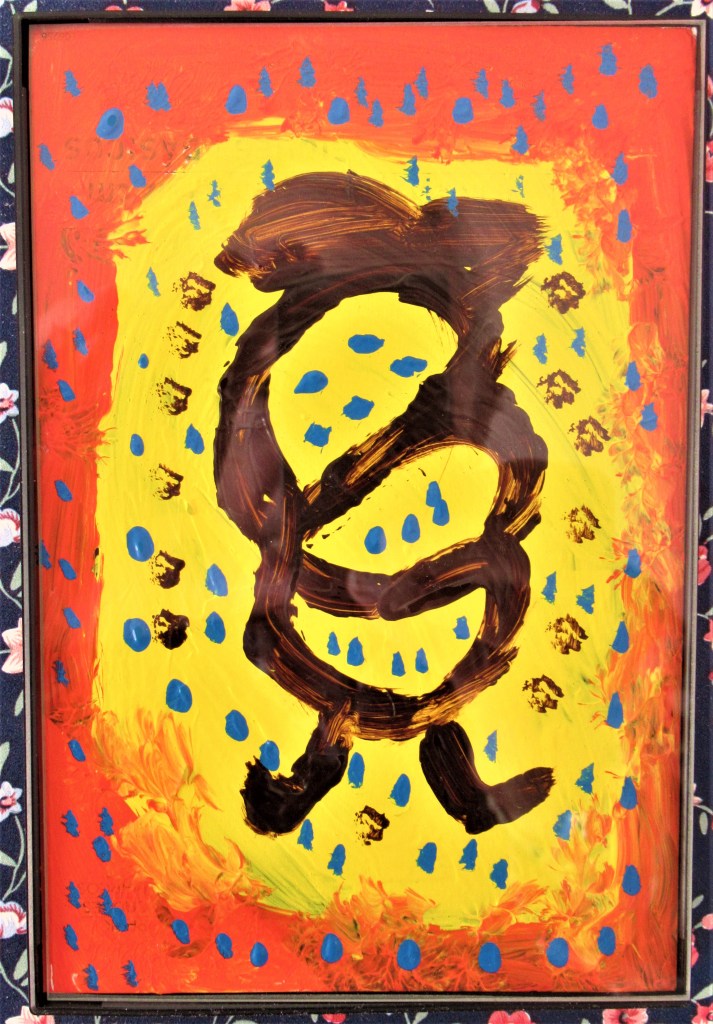
Mikhail Bakhtin: carnival, the world turned upside down, the world going bananas and those bananas dancing, as you can see in the painting above. It is a mad moment frozen in the still time of paint. And why shouldn’t bananas dance? Some one out there will remember Thunder Bay, 1981: ‘you just have to go bananas’ and the bananas duly appeared at half time instead of the oranges. Saint John, 1985: same thing.
And now the dancing bananas have emerged once more to fill your minds with pleasure and your hearts with joy. Go, bananas, go. Bananas-a-go-go. Way to go, bananas. And I tell you, given the current state of society, going bananas is the only way to go. So, in the next election, I shall form the Banana Party and we can all stand firmly, shoulder to shoulder and shout “Oh, Mighty Banana!” and “Go, Bananas!”
Ah yes, and my next painting? Maybe it will be Banana Custard or Banana Splits, not that I have ever done the splits!
So, the writing is back. I have reformatted The Nature of Art and the Art of Nature and am now checking it through one last time before I send it to the publishers. This feels good. I haven’t stopped painting though. Luckily the original, hanging on the wall, looks better than the photo. My angles are all wrong and the colours are definitely not as sharp as in the original. As I always said, when introducing Spanish Art via slides and photos: “Do not trust the imitations. Go back to the original.” Easier said than done, especially when the original may be tucked away in a foreign museum hidden in a small town. As Dylan Thomas once said of Swansea Museum: “it’s the sort of museum that ought to be in a museum.”
As for the Introduction of Art, and please note I do not write ‘the teaching of art’, here’s my article on my career as an art facilitator! ‘In the beginning was the picture and the picture was in the book.’ I guess my art career ran parallel to my career as a facilitator of Spanish literature, prose, theatre, and poetry. Some things you can present and introduce. But no, you cannot teach them, not unless you are completely without humility and understanding.
This is a painting inspired by one of Messiaen’s works: Visions from Beyond. His music inspired me to write the Meditations on Messiaen, and I have posted several of those poems on this page. For me, creativity is continuous: verbal and visual. The visual includes painting and photography, the verbal, short stories, poems, and short philosophical pieces on life and art. This is the link to the first poem from the sequence entitled Visions from Beyond. I should add that the audio reading is part of what I call creativity too: audio, visual, verbal. The complete package.
My Thursday thought: I feel that I have been blessed. To be able to see, speak, write, hear, and express some of the beauty of this world around me. I know there is ugliness out there, sickness, ill health, poverty and despair. So far, I have been spared. “Why me?” I think to myself, “Why me?” Then I cease to question and I just say “Thank you” to the Spiritus Mundi and to the Muse when she descends.
Every morning, when I wake, my mind runs through some of the hymns I used to sing as a child. “Songs of praises, I will ever give to Thee.” “Laud, bless, and praise Him all thy days, for it is seemly so to do.” “Good Shepherd may I sing Thy praise, within Thy house forever.” Meanwhile, until that time comes, I will do my best to celebrate and sing the beauties of this world in the oh-so-limited ways I know best, poetry and paint!
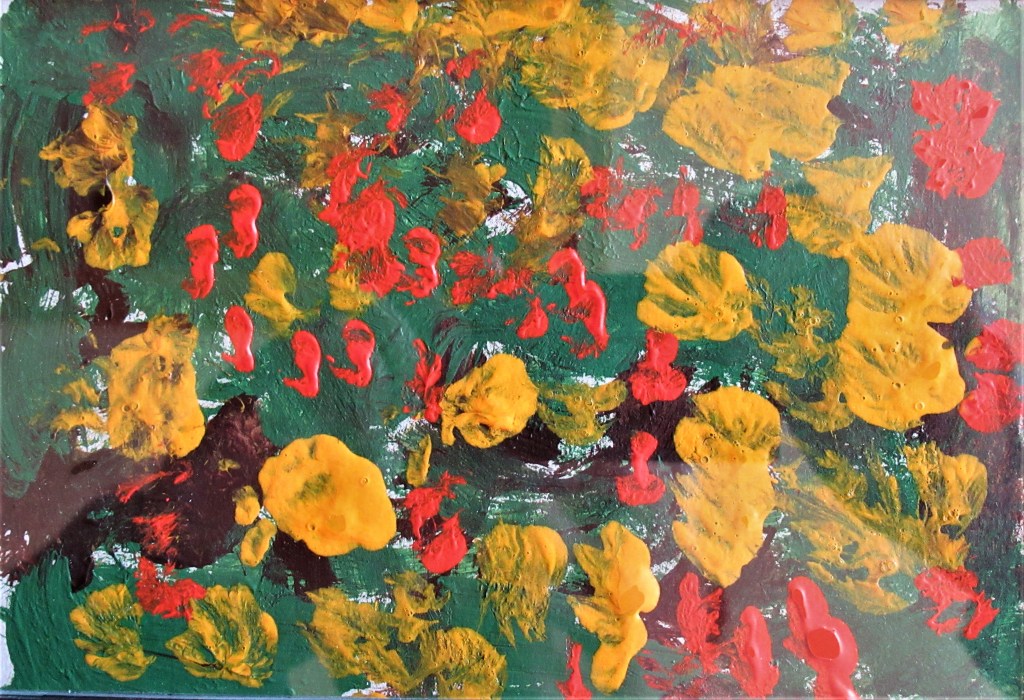
One of my good friends always greets me with the following phrase: “Still on the green side of the grass, then”. So, here’s my painting: Stay on the Green Side. Much better than the other side, from all that I am told by my more down-to-earth companions. I will not intrude upon the thoughts of some of my other friends, nor expose their beliefs. I’ll paint for them another day.
So, while you can, and while you may, Stay on the Green Side, my friends. Wake up each morning, smell the coffee, and gather ye rosebuds while ye may!