Bottle House, PEI

IMG_0251

Bottle House, PEI

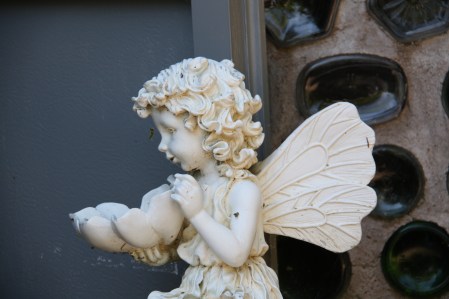
A house made entirely of bottles? Well, not quite: the bottles are set in concrete, but the light … the light is unbelievable. Fragmented, many-colored, a tribute to he man who thought of the idea and then turned it into reality. House and gardens are both well worth visiting and I will do two posts on the bottle houses. Houses, for in fact there is more than one house. There is also a tiny chapel and I visit it every time I go to Prince Edward Island.

Be brave. Play the game. Take a look for yourself by clicking on one of the links to the bottle house.

IMG_0257.JPG

Balloon Lady

Balloon lady.png

Commentary:

Nine o’clock in Oaxaca is the ‘witching hour’. That’s when the young children go home and the balloon lady packs her bags and walks with her balloons out of the square. She really does build a castle. She stacks her balloons around her and lives within its walls selling balloons to children. Each Oaxacan child receives a balloon on his or her birthday and name day. These balloons are cherished, held carefully by their strings, walked like aerial dogs through the square.

The State band practices most nights int he central square and the balloons are moved by the music, especially that of the wind instruments, and then they wander to and fro. Sometimes they take on a life of their own and escape, skip away, go absent with out leave, and seek the freedom of the open skies. Sometimes they get caught in the trees. Then the strings are jigged and older children, experts in the art, place sticky tape on their own balloons and send them upwards in rescue missions which can be surprisingly successful. Oh what joy when the errant balloon returns to earth, stuck to its new mate. Oh what wailing when a birthday balloon bursts and the deprived child must persuade its parents to purchase another!

I can see them now, those colored balloons, floating skywards, sailing freely into the freedom of those blue Oaxacan skies. Up and up, level with the cathedral roof, ascending the cathedral tower, up, up, and away  … soaring like souls into the innocence of a sky blue heaven.

Mannequins


IMG_0836

Mannequins
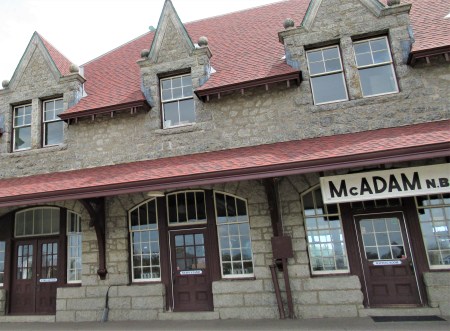
McAdam Railway Station #12

“He startles the unaware, that man by
the door, in uniform, with his youthful
looks and old-fashioned peaked cap,

fingers poised by his silver watch chain
ready to pull out his Waltham pocket watch
and check the time against the master-clock.

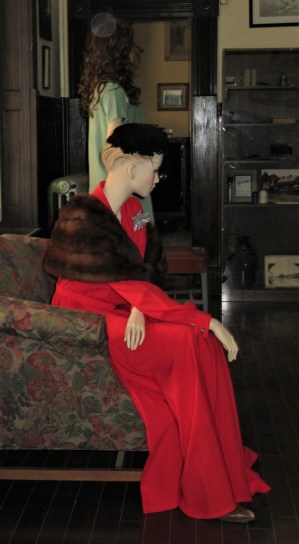
Two ladies wait in the waiting room.
One wears winter robes of red and black
while the other wears velvety green. Both

are motionless, one seated, one standing. Yet
if you watch them from a corner of one eye,
you will see shadowy gestures as their lips move.

Overnight they have changed into summer
clothes, gauzy, almost see-through, flowery
patterns, light-weight wedding boots, laced,

restful, cool, thin-soled. ‘Are you for real?’
I ask the standing one, for a joke. When she
nods and winks, a chill settles over the room.”

IMG_0676 (2).JPG


Faces

IMG_0258.JPG

Faces
McAdam Railway Station #10

“White at windows
when trains pass through
in June on their way
to summer and sand.

Wind-tousled, tanned
at summer’s end
returning home to
Boston and Montreal.

I remember them
waving their hands,
flickering white hankies
as they went by.

This station is a ghost train
that travels through time
instead of space. Stand
still as silent stone. Wait.

Look: there’s someone,
waving at us now
from that window
on the second floor.”


IMG_0782 (2).JPG


S.O.S

IMG_0678 (2).JPG


S. O .S.
McAdam Railway Station #8

“Dozing in the cab, I was.
Smelt a different smoke.
It wasn’t my engine’s.

Looked around.
Saw flames. One, two,
three houses on fire.

Steam was up. Yessir.
Three short hoots I gave.
Three long. Three short.

S.O.S. Mayday. Mayday.
S.O.S. S.O.S. Kept going
till house lights came on.

People running. Leaving homes.
Jumped out of the cab.
Ran out to help them.

They thanked me.
Said I had saved their lives.
What else could I have done?”

Comment: This is a third hand poem. It came to me from Geoff who heard the story from the hardware store owner who witnessed the fire. The narrator is the anonymous engine driver who raised the alarm. Of course I don’t know exactly what he did, said, or thought. Our knowledge of history can be divided into two great moments: the momentous events, recorded by expert historians via diligent research, and intra-historia, as Miguel de Unamuno, that great Spanish philosopher and rector of Salamanca University called it, referring to those small, individual moments when history is made by anonymous human beings who did what they had to do and then faded into the anonymity of a distant past, now wrapped in silence, as is the store-keeper and the driver of the train.

IMG_0678 (2).JPG

Joy & Love

IMG_0194

Joy & Love
(1936 – 1969 AD)

sunbathers sunbathe
swimmers don’t swim
except for one silly fool
in a clear patch of water
swept clean by the current
towed under by the undertow

swimmer fights back
goes against the flow
tires so swiftly
raises his arms
throws up goes under
comes up throws up

a beach ball thrown
misses the target
kicked with more accuracy
a soccer ball heavier
lands by his side
he grasps it hangs on
kicking more slowly

sun-bathers sprint
across sand to the shore
linked hands a life-line
reaching out through the waves
to rescue the swimmer
no longer fighting back

summer-sun kisses
resuscitation
sun-bathers victorious
this great chain of being
restoring humanity
sweet victory of man

Night Light


IMG_0535 (2).JPG

Night Light
(1578 -1591 AD)

quiet now the house
staircase winds up
that wooden hill
to Bedfordshire
down to drop
into darkness
wait in peace
starlight will break
its light-waves
over your eyes
into your heart

owls in the gloom
round eyes gleaming
a who-knows-what
what watches
a godsend now
this light house light
its lightning lightening
enlightening

sudden comfort
this hand on my shoulder
these fingers in my hair
this midnight witch
bewitching

Swans


IMG_0627 (2)

Swans
(at the Vetch Field)

(circa 1950 AD)

White
their plumage
fierce eyes
folded angels’ wings
black-booted feet
paddling urgent
driving them on

skilled and silky
swift lunge
capable of breaking
leg or arm

all white ghosts
those swans
bodies and spirits
earthly dance done
long since gone
flown to the sky

anonymous
constellations spread
milky feathers
winged like swans

Comment:

The Vetch Field is where Swansea Town (now Swansea City) used to play their soccer. My father took me regularly to see the Swans play and, when young, I preferred the round ball game to the oval ball game. Swansea Town were always known as the Swans and the rugby team were always called the All Whites. No Ospreys and colored uniforms in those days and also no money in the rugby: everything was amateur. The inter-relationship of images in the poem above changes when the reader learns that the Vetch Field is also where the shroud-wrapped bodies of those prisoners who were hanged in nearby Swansea Jail were rumored to be buried. This may or may not be true, but be it myth or legend or plain falsehood, it gives added dimensions  to the imagery in this poem.

Samaritan

IMG_0437 (4).JPG


Samaritan
(1890 AD)

I lived with him
he treated me well

to him
I was the other
yet he fed me
when I hungered
gave water
when I ran dry

I fell ill
he cared for me
nursed me back
to health

he taught me
his language
culture history
traditional skills

he loved me
never forced me
to forget myself
and be like him

he made me
what I am today
a discerner
between
light and dark
still the other


Mini-Mums

IMG_0161.JPG

Permit me to introduce you to my two Mexican mini-mums, in the market square in Oaxaca, with their mini-mums. They sell them at minimum price, a giveaway for tourists who arrive with the all-powerful dollar and yell and holler about how this year’s prices are so much higher than last year’s prices. The flower girls giggle and smile. They have heard it all before. They know where each of the prospective purchasers comes from. They now how they walk, talk, slur their words, cajole, bully, and offer absurd amounts of money, either much too much or much too little. Those tourists: they seem to know the price of everything and the value of nothing. Meanwhile, in spit of appearances to the contrary, the cakes are on sale and the flowers are on sale, but the flower girls, Mano y Petate, and no, those are not their names, those things are definitely not for sale.  “Everything,” the tourists say, “has its price.” True, perhaps, in some circumstances. But people are not things and it’s brutally cruel to put a price on people. Occasionally, a tourist will recognize these girls. They are the ones who decorate the altar in the main cathedral in the square. They have also been known to sing, in Spanish, Latin, and Mixtec, along with their mother, before the high altar in Santo Domingo. Santo Domingo, the church with more than six tons of gold and gold leaf layered throughout its magnificence, a true treasure of humanity and an internationally protected building. Once, though, a long time ago, God’s Dogs, as the Dominicans were then called, ran baying through the Valley of Oaxaca, gathering workers with promises of heaven and visions of paradise. The work, they said, was the Lord’s and the Lord wanted them, the people of the Valley of Oaxaca, to build this temple in his name. And here they would stay, under lock and key, until the Lord’s work was done. El Cristo de la Columna: Christ tied to the pillar, stripped to the waist, and flogged. This symbol stands in every church in Oaxaca, and all the People of the Valley of Oaxaca knows exactly what it means, fr it is the punishment meted out to those very people if they do not work hard enough, long enough, fast enough, at their vision of heaven, their taste of paradise, this building of the Church of a Lord who is not even theirs. The tourists marvel at the church, the gold, the paintings, the statues. They praise the mother and her children singing at the high altar: “what beautiful children, what beautiful voices.” But they know nothing about the blood, and the sweat, and the tears that went into the temple’s building.

IMG_0160.JPG