The kitchen – hearth and soul of the house. Here we gather, sit around the table and talk our hearts out. But here, in Island View, we have a kitchen, a gathering, but no hearth, and hence no real heart around which the household revolves.
In spite of that, old habits die hard. I remember the old coal fires in Swansea. My grandmother’s house in the Hafod, with a kitchen in a separate room from the stove, with a huge cast iron fire-place where cookpots and kettles could be hung or nestled into the coals. My grandfather’s house in Brynmill, where kitchen and hearth were separated, but the fire-place still held its magic. Banked in at night, those fires gave warmth and light ar hyd a nos and then they we resurrected the next morning.
We have a woodstove here in Island View, but we rarely light it as the fine particles make breathing difficult after a while. We keep it for emergencies. This winter we lit it when the temperatures dropped to -40C, with the wind chill factor, and heat pump and electric furnace needed assistance.
Warmth, comfort, the family gathered, the wisdom of the old folks shared with the young, and the passing on of traditional melodies. All the old memories and thoughts, the wishes and desires, the hiraeth too, handed down, from old to young. Everybody was welcome and everyone had his or her special place.
Such memories tug at the heart strings – hearth strings. Anyone who shares them with me will know what I mean.
To be Welsh in Swansea is to know each stop on the Mumbles Railway: the Slip, Singleton, Blackpill, the Mayals, West Cross, Oystermouth, the Mumbles Pier. It’s to remember that the single lines turn double by Green’s ice-cream stall, down by the Recreation Ground, where the trams fall silent, like dinosaurs, and wait, without grunting, for one to pass the other. It’s to read the family names on the War Memorial on the Prom. It’s to visit Frank Brangwyn in the Patti Pavilion and the Brangwyn Hall. It’s to talk to the old men playing bowls in Victoria Park. It’s to know that starfish stretch like a mysterious constellation, at low tide, when the fishnets glow with gold and silver, and the banana boats bob in the bay, waiting to enter harbour, and the young boys dive from the concrete pipes without worrying about pollution. But when the tide turns, the Mumbles Railway has been sold to a Texan, the brown and yellow busses no longer run to Pyle Corner, Bishopston, Pennard, Rhossili, sweet names of sand and tide, where my father’s ghost still fishes for salmon bass, casting its lines at the waves as they walk wet footprints up the beach to break down the sand-castle walls I built to last forever at Brandy Cove and by the Slip on Swansea sands.
What is the biggest challenge you will face in the next six months?
The months change but the challenge never does. How does one stay alive? How does one survive? How does one pass the time from one minute to the next, one hour to the next, one day to the next, one week to the the next, and one month to the next?
I faced a challenge this morning. I got to the shop and could not climb over the piled up ice to reach the slippery step that led to the salted sidewalk that led to the shop’s entrance. Fortunately a kind young man took my arm, and helped me upwards, onto the sidewalk. He waited while I shopped and brought me back down to the car, arm in arm, and carrying my shopping. I gave him a poetry book, Septets for the End of Time, as a reward.
What will be the next big challenge? I honestly don’t know. Starting the snow blower at -20C, perhaps? Blowing the snow and avoiding a slip, a fall, a sit down on a snow bank from which I cannot get up? Who knows? I don’t. I need more medicine – will my biggest challenge be finding that the pharmacy has again run low on my medication and I have to wait for my renewals? I have just had a blood test – three months late – and I don’t know what the results will be? Will that be my biggest challenge – coming face to face with a negative result that demands more action? I just don’t know. Driving out the other day, I met a speeding car on my side of the road, in my lane, coming straight towards me. The driver was staring at his cell phone, one hand on the wheel, eyes down, concentrating on something that certainly wasn’t the road. I swerved aside, towards the snow bank, honked the horn, and he looked up, eyes wide with shock, and swerved away. Brown trouser time, I guess, for that unfortunate individual.
It would be so nice to have a smart answer. My biggest challenge will be to find a solution to the chess problem that has puzzled me for years – how to defend Queen side openings when Black. My biggest challenge will be to draw the cards for a perfect hand of cribbage. My biggest challenge will be to pay the grocery bills as the prices rise. My biggest challenge will be to pay the dentist’s bills when I have no dental coverage and the savings dwindle every month. My biggest challenge will be how to avoid the pain in my teeth now that I can no longer afford the dentist. My biggest challenge will be to crawl to the telephone and get help if I manage to fall in the kitchen and cannot get up.
So, what is my greatest challenge over the next six months? Living from day to day, without falling downstairs and killing myself – how about that for an answer?
What advice would you give to your teenage self? In one word – grow up. Useless advice really, because it happens, whether we want it to or not. That said, I have lost so many young rugby players that I coached or played with, to driving accidents and other misfortunes, sometimes self-inflicted via alcohol or drugs, that to say grow up – please! – is so important.
Each morning I read the obituaries in the local newspaper. Afterwards, I look back over the path I have journeyed. If I had perished at the age of the current ‘missing person’ – say, 45 – 50 – 55 – 60 – I think of all that I would have missed in those intervening years. Then I grieve for all that they will have missed in the life that should have lain ahead of them.
“Don’t cry over spilt milk” – Old Welsh Proverb. And no, we mustn’t cry over what is lost. We must celebrate what has been achieved, Dylan Thomas (1914-1953), one of Wales’s greatest Anglo-Welsh poets, dead at 39 – what other glory may have lain ahead of him? Garcilaso de la Vega (1501-1536), one of Spain’s purest and most innovative poets, dead at 35. What more might he have written in an extended lifetime? Federico Garcia Lorca (1898-1936), executed, many say tortured and murdered, at the age of 38. Think of the theatre, the poetry, the Gypsy Ballads, the songs of a dark love – what more did he have, hidden inside him, that was never allowed to spread its wings and fly out into the light of day?
So, I would give to my teenage self, the same advice that I would give to any teenager – grow up – please, grow up, don’t go too soon, – and please grow into that unique and wonderful being that you have the potential to be.
I have had a snow blower for some time now. It means that I don’t have to dig the snow. I just get the machine to blow it. But what if the blower doesn’t work?
This winter the local radio station has been filled with stories about snow blowers breaking down, snow blowers catching on fire, snow blowers not starting, snow blowers breaking their shearing pins. All of this has been caused by the weight of the snow, its depth, the compilation of snow on snow, ice pellets on snow, icy rain on snow.
The other day, I went out to blow the snow. It was so heavy that I likened it to wet quick sands on the beach. I could hardly get the blower out of the garage. When I did, I couldn’t move it, forwards or backwards, without enormous effort. I sat on the back of my car and cried. Here is the related post https://rogermoorepoet.com/2023/01/18/luminescence/
For many people of my age, and younger, this is heart attack time. Blowing snow, digging snow, clearing snow, shoveling snow. I know the song – “let it snow, let it snow, let it snow.” But who clears it? Who digs it? Do you dig that snow? Hey, man, dig that snow. Cool, eh? Chill, man, chill.
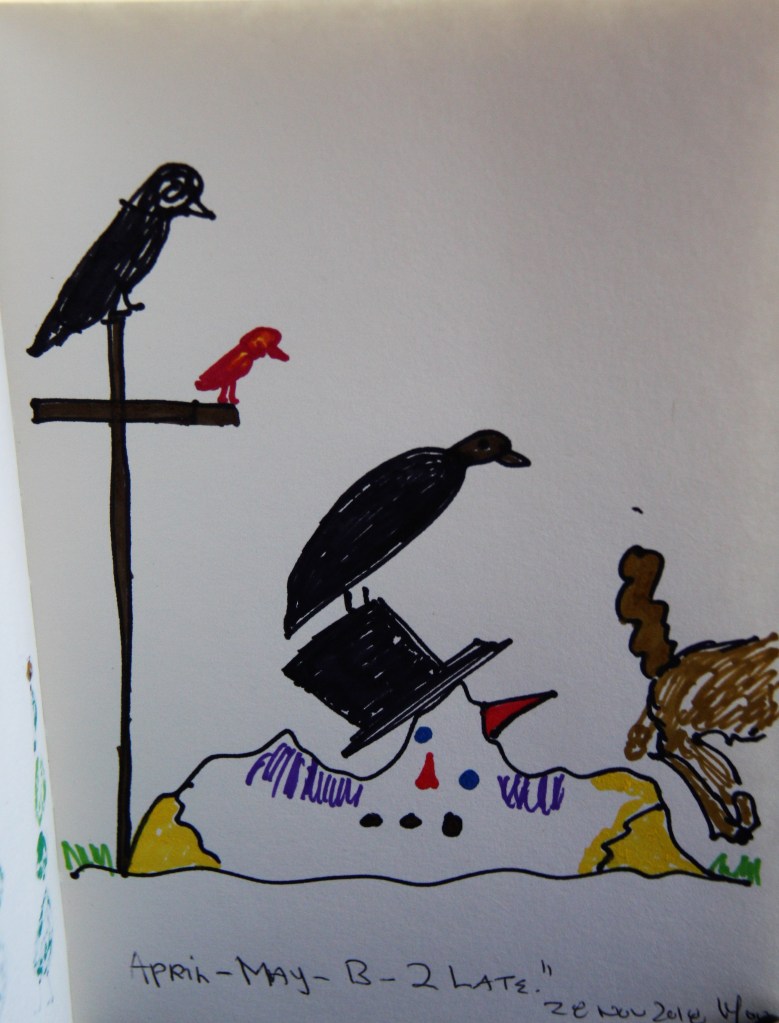
So where did the snowman go? To the hospital with a heart attack? Who knows? But one thing I do know: digging snow has become one of the things that I fear. And why shouldn’t I? I am at that age when things happen. And here’s what I mean – https://rogermoorepoet.com/2023/02/10/and-if-we-fall/
No. I don’t want to become a fatality on the statistics page. I don’t want to ‘fall to rise no more, as many others have done before’ – a tribute to Over the hills and far away, that one. So, let it snow, yes. But not too much and let us avoid that bleak mid-winter when ‘snow had fallen, snow on snow, snow on snow on snow’. Christmas Card whiteness I can take – but not the chest wracking heave of heavy snow, weighing my shovel down, puling me down, burying me.
There I was – with my trusty snow-blower blowing the snow – and I shifted gear to go backwards – and my glove caught – and the snow-blower kept on coming – straight at me – and there wasn’t room to manoeuvre -manoeuver – maneuver – aka I couldn’t get out of the way – and the snow bank behind me caught me just at the back of the knees – and I sat down in the snow – oh dear – luckily I let go of the gear lever and the throttle lever – but the machine was almost on top of me – and I couldn’t get up – so I called for help – but no help came – and I tried to pull on the machine with one hand – and I put the other on an ice patch in the snow and that hand went through – so I am sitting there – can’t stop laughing – and then my beloved appears – and she brings me my walking stick – and she moves the snow blower forward – and then she gives me the stick – in my left hand – lifts me and pushes – while I lift with the left and pull with the right – and I have pulled a cork from a champagne bottle more easily than I pulled myself out of that snow – but together we did it – and oh was I wet – I had to finish the blowing – go inside – and change my jeans – and I am still laughing at the thought of myself – sitting there in that snow – and I needed to pee so badly – as the cold and damp crept in and – what if there had been nobody there to help – or what if it had been windy and my cries had not been heard – and what if we fall – as so many others have done before – fall to rise no more – and what if – “if – if – if – if – onions climbed a cliff – potatoes would rise – with watery eyes – if it wasn’t for if -” and that’s what my grandfather always sang to me when I asked him “what if…?” – so- what if … but don’t answer – because we’ll never know –
Today’s prompt – what were my parents doing at my age? Well, actually, they were both dead. We aren’t meant to mention death anymore, so let me say ‘they had passed’. Loads of cliches of course – pushing up the daisies – moved into higher society – or lower but I hope not – deceased – demised – expired (like my driver’s license) – extinct (like the Dodo) – passed on – recycled – enough – no more – it’s not as sweet now as it was before – nor do I like any potential answer when I look in the mirror and wonder – who am I? – What am I? Where am I going? Am I next?
My father being an excellent rugby player – on the wing – in the old days – I can imagine him running, and kicking and chasing – but I can’t imagine him passing. Or setting up a maul or a ruck. Dear Lord – times have changed – and the laws of rugby have changed – and the rules of etiquette have changed – and political correctness has put dark hands upon our throats and choked us -let us not contemplate the myth of freedom of speech – but consider the endless stupidity of senseless questions that changeth not and abide with all of us, on radio and tv and in the newspapers – all day and everyday.
Here’s anther prompt – Where have all the young men gone? Depends on which song you listen to – emigrated – gone down the mines – gone west – gone AWOL – gone astray – gone to graveyards, everyone. But will we – or they – ever learn – blydi hel – a good Welsh expression – I doubt it.
So – I ask myself – what are my parents doing today? – and the answer is – I really do not know. I would like to think they are happy – happy in the knowledge that they did their best for me – happy to know that I am still here – ar gwaetha pawb a phopeth rh’y n’i yma o hyd – I hope I spelled that right – I have seen several versions – and yes – in spite of everything, I am still here – I am well – and I would like to tell them that I love them – and I would like to thank them for all they did right – and forgive them for anything they did wrong – and yes, I loved them so much – and still do – and I miss them – and blydi hel – now you’ve got me crying.
I once asked my grandfather, a decorated soldier from WWI, if he was worried about dying. “No,” he replied. “Why not?” “Well, Roger, we’re all going to die. We just don’t know when. So, if I worry, I will die. If I don’t worry, I will die. So, why worry about it?” I was about five years old at the time and we were standing outside the Swansea Hospital, as was, by the seat where the old men used to sit and gossip. I didn’t realize it at the time, but that was my first lesson in Stoicism.
“The day I was born, I took my first step on the path to death.” Francisco de Quevedo (1580-1645), Spanish Neo-Stoic, among so many other things. Thinking like that tends to put things into perspective, for death walks with us every day. Death is our twin sibling, brother or sister. We face his shadow every time we look in the mirror and that shadow follows us around all day. “Death is a law, not a punishment, so why worry about it?” Also Quevedo. Dying is a different matter and yes, there are so many ways to go, some of them, especially nowadays, with the advent of life-preserving medicines, slow and unpleasant. Yet, mors omnia solvit – death solves everything. And it brings a release from all pain and suffering.
The lead photo shows a plaque in Avila (Spain). La Calle de la Cruz (1660) -The Street of the Cross. It is also known locally as La Calle de la Vida y de la Muerte – The Street of Life and Death. Why? It is rumored that here, turning left outside the main cathedral, duels were fought. Two men entered, but only one emerged alive. It is interesting to meditate on the close proximity of life and death, always there, side by side.
So, for the fun of it, let’s change the question: what is life? “What is life? A frenzy. What is life? An illusion, a shadow, a fiction. And the greatest good is small, for the whole of life is a dream, and dreams are nothing but dreams, after all.” Life is a Dream, Calderon (1600-1681). Looked at from this point of view, what is death? Is it the shutting down and the turning off of the cerebral computer or is it the great awakening from the sleep of life? You can think of it either way but, either way, it’s pointless worrying about it. As my grandfather also told me: “If there’s nothing afterwards, I’ll just fall asleep and that will be the end of it. But if death is the great awakening, then I will be very happy to wake up in a new reality.”
Robert Bly, in The Sibling Society, writes of the lateral movement that now embraces society with its grip of instant pleasure, instant gratification, instant happiness. As a result, we have strayed far from the vertical knowledge that sustained us for centuries. We have abandoned the wise words of our ancestors. Now the old are no longer the keepers of wisdom and the guardians of culture, the institutional memories of the race, if you like. Now they are foolish, clumsy, out of date with the world’s most rapid advances. Only the young, and their siblings, can keep up with the ever changing instants of life as presented to us.
But all is not lost. “What a peaceful life, that of the wise man who withdraws from this noisy world and follows the hidden path along which the world’s wisest people have always walked.” Fray Luis de Leon (1527-1591). We can move far from the madding crowd. We can construct our own realities. We can base them on the words of wisdom handed down to us over the generations. Switch off the TV. Watch the sun as it moves across the cathedral face (Monet) or the walls of your house (Moo). Live each moment of each day. Do not fall into despair. Above, don’t worry – it does no good at all.
Sun Absence Depression – People complain about the absence of the sun – and so do I. Five sun appearances between early December and the end of January. A sun glimpse, so to speak, pale coin between clouds, a sudden shadow that appears on the wall and vanishes before you can catch it. Do these count? Sun glimpses, mind you, and even less sunny days.
Snow, Sleet, Ice Pellets, Freezing Rain – Take your choice. The snow itself isn’t too bad. The snow blower takes care of that. But not when it rains on top of the snow, then freezes. Not when ice pellets weight it down and make it the consistency of wet sand on a wintry beach. My neighbor broke his snow blower trying to shift the mess. I was willing to risk the snow blower, but not my health. I couldn’t even get the blower out of the garage and into the mess that masqueraded as snow. I sat on the back bumper of the car, huffed and puffed, and decided not to risk it. And as for the freezing rain – my beloved had to put crampons on her shoes to be able to walk the ice and take the garbage to the end of the drive. As for blowing the ice that had fallen on the snow – the snow blower grunted, and groaned and complained as it slipped and slid all around – and so did I.
Rejection – Dejection – “Paper your walls with rejections.” Well, I won’t do that as we have just had the walls repainted. That said, when I checked my progress files this morning, out of 95 submissions, 93 had been rejected. Does the 2% make up for the 98%? Well, 5 more rejections and I’ll let you know.
Inflation – Gas. Luxury foods. Alcohol. You name, it and I will complain about it. And if I don’t, every day I go out shopping I see and hear someone complaining about the rising cost of just about everything out there. Being on a more or less fixed pension doesn’t help much either. Luckily, we don’t have to make choices yet, like some pensioners, and working people, are doing in the Untied Kingdom [sick]. Eat or heat? Food or medicine? Dog food or cat food? They have been staples for pensioners in the UK for a long, long time. Cheap and nourishing, though prices are rising, and taste disguised in a nice curry sauce. I kid you not.
Top Ten – well, I guess I could go on and on. But I won’t. Four reasons to cry are enough. Today, the sun is shining (positive). The overnight temperature was -25C / -13F, but it’s rising in the sunshine -15C / +5F as I type (positive), and I don’t have to go out in the cold (very positive), and I don’t have to snow blow today (very, very positive). So, may we all walk on the sunny side of life, find a silver lining to each and every cloud, and carry on regardless. It’s better than the alternative.
Our world can sometimes seem to be a very dark place. Early yesterday morning, sitting on the back bumper of my car, breathing heavily, unable to shift the weight of snow, rain, freezing rain, ice pellets that had accumulated in our drive, I was gripped by the cold hand of old age and despair.
I remembered the talk show quiz games in which one option was to call a friend. So I did. He turned up after work, started the snow blower and did for me what I was no longer able to do for myself. He cleaned the paths round our house, at the back, to the bird feeders, and down the front the heat pump at the side.
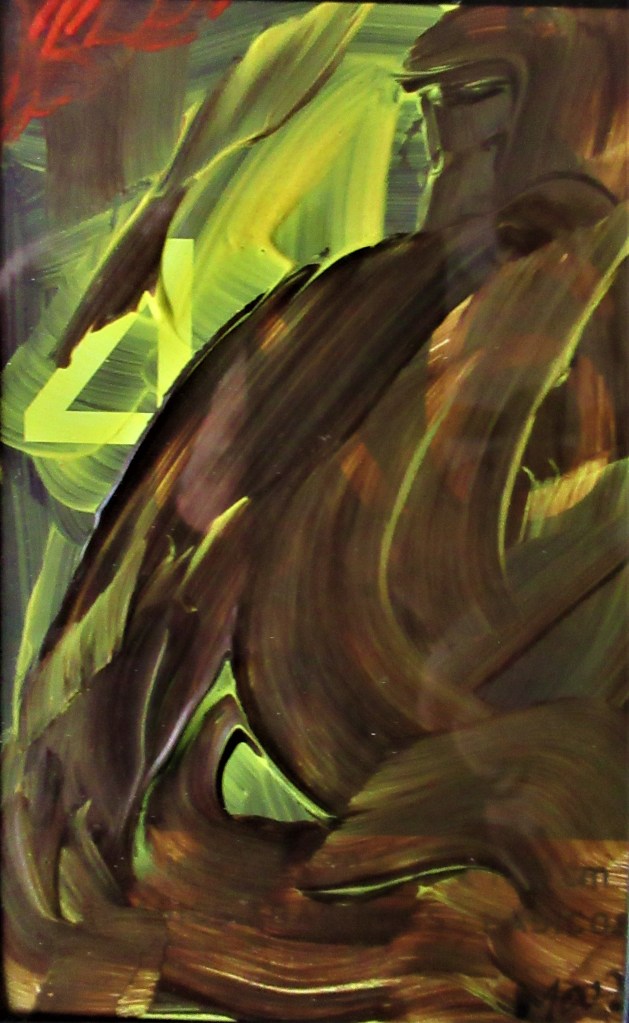
He brought light and joy back into my world, made me realize I was not alone, and I gave him, as a token of my gratitude, this painting: Luminescence.
Those of us who are still capable of bringing light and joy to others must continue to do so. Whatever we do, we must not let the dark side and the shadows take over.







 rogermoorepoet