Clepsydra 14-15 – Clowns clowning around

Clepsydra 14-15
Clowns clowning around

14

… walking life’s walk
     grey jays in the ash tree
          fresh snow on the ground

at night
     deer track out of the woods
          moon’s dead skull
               chalking its slow path
                    westwards

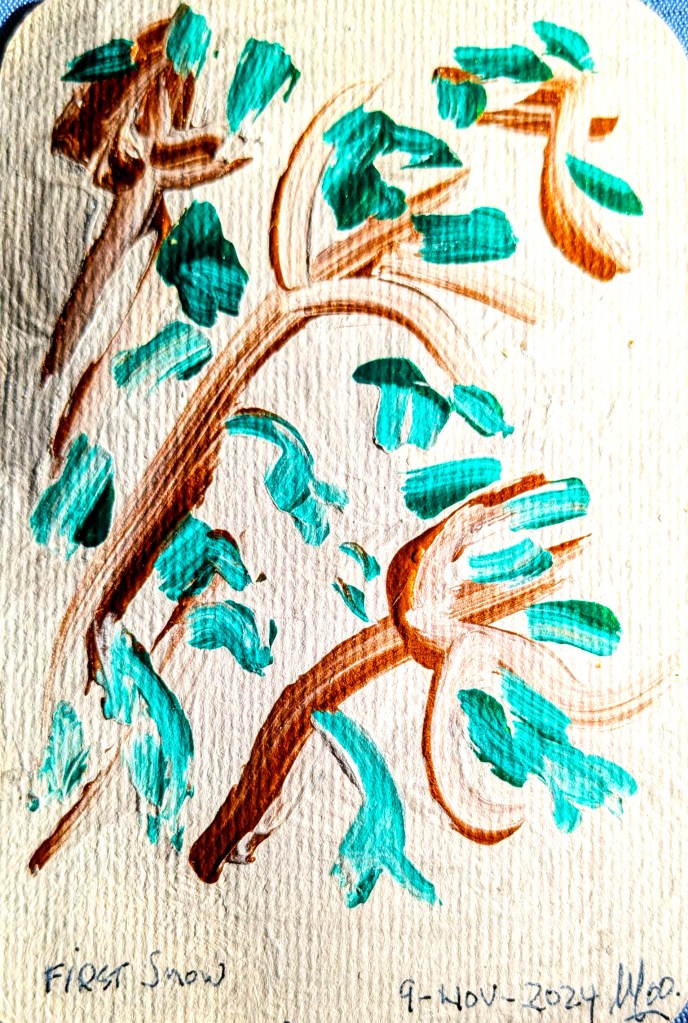
snow falls
     white upon white
          whirling our world
               back to its cratered life

nothing needed
     other than moonlight on snow
          to ignite us

a white wall of water cascades
     earthwards from the moon
          waters of renewal
               waters of life
                    waters that restore us
and save us
     from the moonbeam’s slicing knife
          that amputates all life …


15

… it is scary tonight
     inside the topsy-turvy
          big-top of my circus world

carnival time
     clowns clowning around
          turning my life
               upside down

is my mind
     a spider-web
          spun by worry and doubt

I remember how
     they pushed me around
          kicked me out
               always the anonymous they

they abandoned me
     told me I was unwanted
          surplus to purpose
               forced me to exit

they told me to forget
     those amniotic waters
          that water world of comfort
               that illusion of reality
                     they had created
                          then threw me onto the street

    I left behind
          their stultified personalities
               with all their stupid rules
                    and blinkered minds
                         that stopped them
                              from seeing straight …
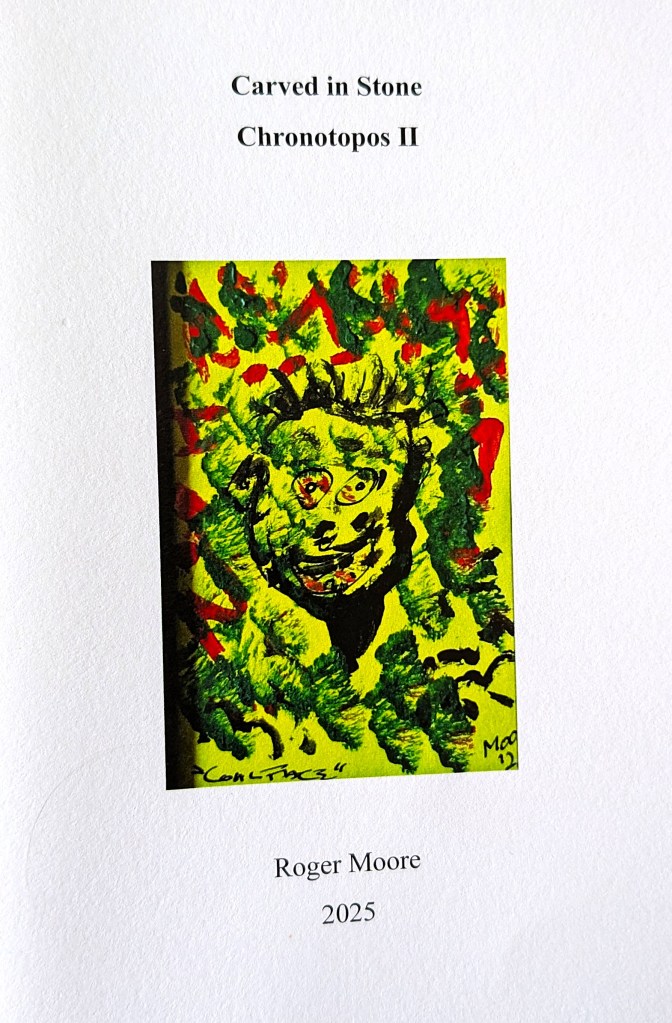
Carved In Stone

Carved in Stone

Brief Introduction

“Poetry explains itself. If it doesn’t, it’s inexplicable.” Pedro Salinas.

I entered this collection of poems for the Alfred G. Bailey Awad (poetry manuscript), WFNB, 2025. Alas, it did not win an award, but the judge, Kathy Mac, made some excellent suggestions as to how I might improve the manuscript. I have followed her advice to the best of my ability.

Carved in Stone is the second dialog (Chronotopos II) in my Bakhtinian Dialogs with my time and my place. Clepsydra, Chronotopos I, won third place in the Bailey Award (2025) and has already been published. I have one, possibly two, more Dialogs planned.

Reception Theory – I write, you read. Any meaning that you extract from my poetry will depend on your own culture and background. Tolle, Lege – Take and read. Read slowly, and with care.

I am a poet, a dreamer, if you will. These are my dreams. When you enter my world, you mingle your dreams with mine. The result, I hope, will be an interesting intellectual blend of new creativity. Pax amorque.

1

Behold me here,
filled with a sort of shallow,
hollowed-out wisdom
accumulated over decades
while listening with my eyes
to the words and thoughts
of writers, long-dead.

Imprisoned in book pages,
do they bang their heads
against walls that bind,
or hammer with their fists
at the barred lines
of their printed cages?

These spirits long to break free,
but they choke on library dust
and pollen from verbal flowers
that bloom unseen.

Those old ones avoided
the traps of temporal power,
or, once trapped,
gnawed off a precious limb
to limp into freedom.

Comment:
The cover painting, painted for me by my friend Moo when he read the manuscript of this book, is called Coal Face. It refers to the young Welsh boys in the Rhondda coal fields, aged 8-12 years old, who went down the mines to work at the coal face. This happened when the coal seams grew thin and only small children had the ability to work at the coal face and carve and mine the coal. Here are the relevant verses (44 – 45).

44

The old man, withered,
last house on the left,
leaning on his garden wall,
coughing, spitting up
coal dust and blood.

He’s not old, when you get close,
just grown old, underground,
where emphysema
and pneumoconiosis
devour men and boys.

He spits on the side walk.
Mining souvenirs,
Max Boyce calls them,
and they appear
every time the young man,
turned suddenly old,
starts to cough.

He can’t walk far,
wearing carpet slippers,
soft and furry,
just leans on the wall.

He fell, or was pushed,
into the trap at an early age,
when the coal seams
had grown so thin,
that only a small boy
could kneel at the coal face
before the black altar
of the underground god.

There, with a pick and shovel
he learned to carve and shape
those seams.

45

No candles burned at that altar.
A single match, let alone
a candle flame,
would spell the end,
if gas leaked from the seam.

Only the canaries,
confined in their cages,
sang songs.

Doomed,
like the blind pit ponies,
never to see the light of day,
they lived out their lives
down there.

So many died underground,
unable to get out,
buried alive,
before they were even dead.

Dark Angel

Dark Angel

He will come to me, the dark angel,
and will meet me face to face.

He will take all that I own,
for my wealth is only temporary:
health, wealth, possessions are all on loan.

My house, my wife, my car,
my daughter, my grand-child,
 my garden, my trees, my flowers,
my poetry, my works of art.
I use the possessive adjective
knowing full well that these things
are only on loan. I will never be able
to preserve and possess them.

I even rent this aching heart,
these ageing, migrant bones,
this death that has walked beside me,
step by step, every day
since the day that I was born.

My death alone is mine.
It belongs to nobody else.
It will be my sole possession.
It will soon be the only thing
I have ever really owned.

Comment:

Dark Angel is the third poem in the first sequence (Crystal Liturgy) of my poetry book Septets for the End of Time. The painting, by my friend Moo, expresses his impressions of how he reacts, in paint, to my poem, in words.

“Well,” I said to Moo, “you’ve gone and done it this time. Do you think that painting really represents my poem? I see no darkness in it and certainly no angel.”

Moo gave me a long, strange look. I felt like I was looking in the mirror and seeing parts of my own soul fragmenting and falling away, like scales from my eyes.

“It’s not what the poem says,” he replied. “It’s what I think you feel as you’re writing that poem. I see the tension, the cry from the heart, the struggle to accept, and the realization that, in the end, everything is inevitable and must turn out as it will. That said, more than anything, it is the cry, de profundis, from the depth of your self that I feel. My painting depicts that cry and your suffering.”

“What if it’s not my suffering? What if it’s the suffering of Messiaen and his musicians as they play the soul music that keeps them alive?”

“But surely,” Moo replied, “that’s the whole point. Orde Amoris, according to the recent Pope who has just passed away, is love felt for the person suffering, no matter who he or she is. Pope Francis spoke in praise of the parable of the Good Samaritan. When you see someone suffering at the wayside, you stop and help that person. You don’t just walk on by. Your suffering is my suffering. When I paint your suffering I also paint my own suffering and when you grieve, then I grieve with you.”

“And when that happens, when we all grieve together, we do not grieve alone and in vain.”

“Exactly.”

What was the last thing you did for play or fun?

Daily writing prompt
What was the last thing you did for play or fun?

What was the last thing you did for play or fun?

I guess it depends on how you define ‘play’ and ‘fun’. The first snow storm of the winter left us without power for 39.5 hours. That should have been horrible – the temperature outside dropped to -7C overnight, and the temperature inside fell to 58F. Rather than sit and suffer, we turned it into a fun time. A candlelight supper, a bright log fire burning in the grate, reading by torchlight and candlelight. The flames flickering across my beloved’s face and making her countenance softer and more beautiful than ever.

When we lose power, we lose everything, except our fireplace and our cell phones. Recharging them was fun. We have a portable charger, and we also recharged them in the car while driving around. The roads were good – and driving was warm – so that was fun as well.

When the power came back, we called the local tree company (Treecological) and they took down the trees, young, bendy birches, that had bent onto our power lines. When we lost power, a second time, exactly a week later, it was a much shorter power loss. While the first was a power out[r]age, the second was a power outage. Both times, when the power came back on, that first buzz of energy renewed really made us happy.

In between the two storms, we had some warmer, sunnier weather and cleaning the snow with our trusty snowblower was much easier than we expected. Mind you, it is always difficult the first time, when the body is unaccustomed to the machine and all the old tricks must be learned once more. Luckily, you can teach new tricks to an old dog, well, to this one anyway, and I managed to cut a few corners and had fun doing so.

After four consecutive days of snow blowing – one does it bit by bit when one is eighty years old – otherwise no, it isn’t much fun. But bit by bit, step by step, and the job gets done. So there we were, playing in the snow and having fun. Mind you – once in a while isn’t too bad. But for this to happen every day, over a series of years, that would not be fun. And doubly not in winter, with the cold outside and supplies inside running out or down.

Change

1

Change

Waters rise, tides get higher,
streams wash roads away.
grey, rainy skies, day after day.

Temperatures drop down at night.
Water turns to ice. Northern Lights
burn bright, set the sky alight.

I forget my gloves. Fingers, cold,
fumble at buttons, and my zip
is not the easy zip of old.

My life cries out for change,
but change is out of reach.
I change the things I can arrange.

Some days I’m weary and sore.
Most days I can do no more.

2

Change

Waters rise, tides get higher,
streams wash roads away.
Grey, rainy skies, day after day.

Temperatures drop down at night.
Water turns to ice. Northern Lights
burn bright, setting the sky alight.

I forget my gloves. Fingers, cold,
fumble at buttons, and my zip
is not the easy zipper of old.

Some days I’m weary and sore.
Most days I can do no more.

My life cries out for change,
but most changes are out of reach.
I change the things I can arrange.

Comment:

I decided to change my format today and go back to the left margin alignment, rather than the central alignment that I usually use for poetry. Your comments on the adjustment would be welcome. I have included both formats so you can see how the poem flows in each one. As for this poem – a rhyming sonnet, wow!

Moo’s painting, executed late last night, is his way of showing how rage can suddenly build and, like a runaway river, suddenly and unstoppably break out. It is extraordinary how his paintings so often mirror my moods and word flows.

What will your life be like in three years?

Daily writing prompt
What will your life be like in three years?

What will your life be like in three years?
Well now, that depends on several things. I love the fall. Who doesn’t love the fall in New Brunswick? The trees changing color, warm by day and cool at night, then the leaves falling off the trees and blowing here and there with the wind. I stood in the garage yesterday and listened as the north wind herded rustling, complaining Maple leaves down the roadway past my house. The sound of dry leaves bouncing and skittering. Pure fall magic.

But when I fell on Thursday night, it was a different kind of fall. One moment I was a tree, standing free on my own two feet, the next I was a sawn-off log, tumbled to the ground. When trees fall, they often bleed bark or sawdust, if they are sawed. I just bled blood. On the floor boards, on the carpet, on my shirt. I had just painted the painting above – Prelapsarian – and there I was, lying on the floor, having fallen myself.

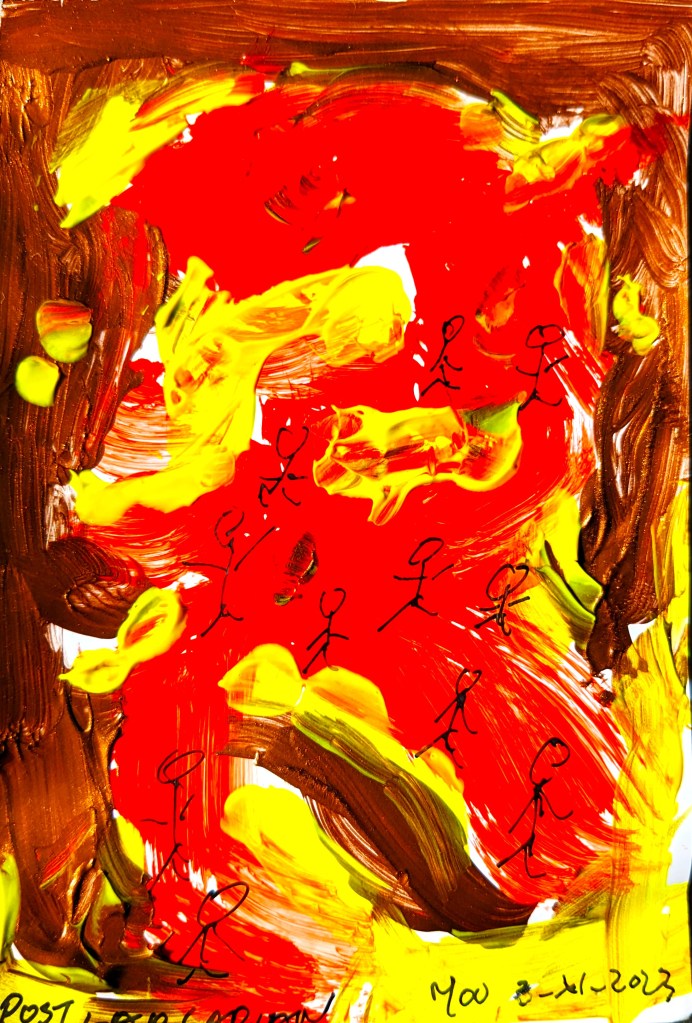
And there I lay, fulfilling my own prophecy – Postlapsarian – lying bleeding on the ground. The fall was stunning and I was stunned. I managed first to roll over onto my tummy. Next I managed to get into the push-up position and from there I was able to draw my knees up. Kneeling, I reached out to the spare bed and started to try and haul myself to my feet. But I was spent and exhausted and drained.

I called out and Clare, dear woman, came to my rescue. She helped me to my feet, staunched the bleeding, mopped up the floor, and the carpets, and me. Then she went to the medical chest and bandaged me up so I would heal and wouldn’t bleed all over the bed and my pajamas. What a mess. What a bloody mess – and no, I am not swearing, I am only telling you what I saw. Blood everywhere.

So, what will my life be like in three years? I hesitate to think about it. Maybe I’ll be in a garden somewhere, helping the trees to grow their leaves, so that the life cycle may continue. And maybe not. Right now, I feel very, very fragile. I just don’t want to think beyond the current moment.

What historical event fascinates you the most?

Daily writing prompt
What historical event fascinates you the most?

What historical event fascinates you the most?

First, let us define ‘historical’. Here’s what I found – (1) of or concerning history. (2) concerning past events. (3) The historical background to such studies. (4) Belonging to the past, not the present. (5) Famous historical figures.

Now let us think of the number of times we hear on the TV sports shows that such and such an event is making history “right before our eyes”. Wow! In a boxing match, almost ever punch thrown is “an historical event”. Ditto rugby – with every try scored, every penalty missed, and every tackle made. Ditto soccer, basketball, baseball, athletics. So, from the battery of past events that adorn my life, I am being asked to choose “which historical event fascinates me most”. Double wow.

My answer – the day of my birth, about which I know absolutely nothing. Or, to be more specific, the actual action of being born, about which I know even less. So, how do I study the historical background, when no eye witnesses are left alive to assist me? More important, nobody in my family wanted to talk about such an important – for me at any rate – event.

I do have some factual memories – tales told to me later. I was born at exactly 8:00 pm. I know this because my parents’ dog had been left at a neighbor’s house while my home-birth was taking place. As the clock struck eight, Paddy, the dog, jumped straight through their window, and ran up the road towards the house that was now to be our house, barking. “Ah,” said our wise neighbor, “there goes the dog. That means the baby’s been born.”

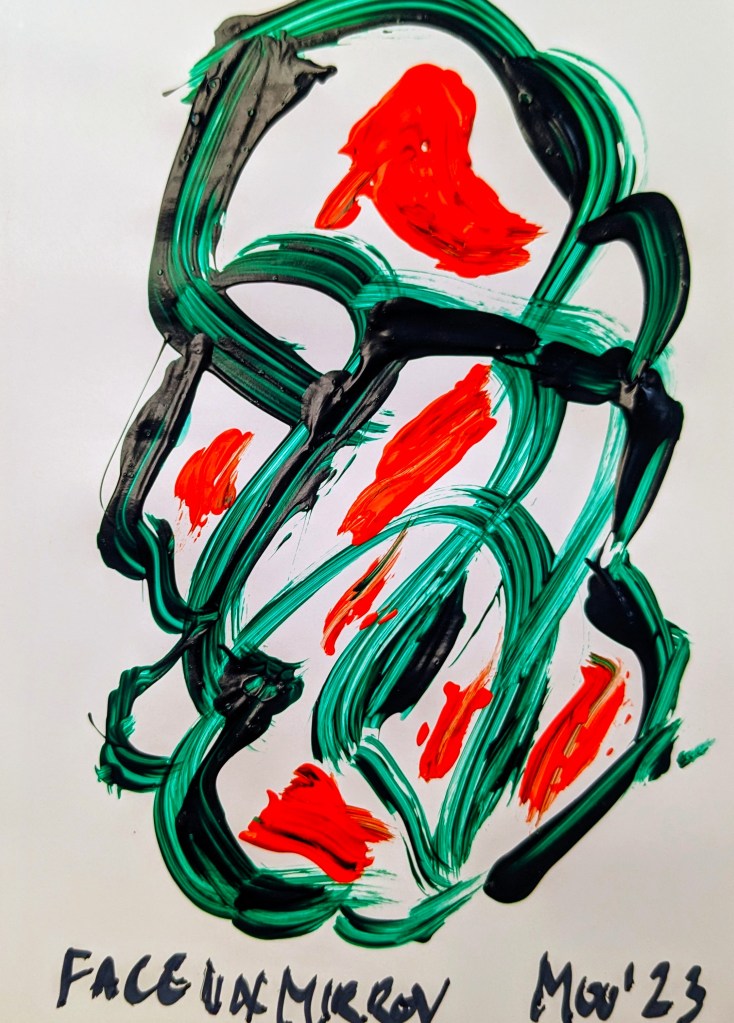
That is one version of the tale. My own version is the squawking of the stork who carried me, a sudden screech as he dropped me, a slow descent from a bright blue sky, a tumble down the chimney into the fireplace. And there I was. All covered in soot and ashes. I needed washing, of course. But baby, just look at me now. [See self-portrait above – Face in a Mirror].

My maternal grandfather swore that I had not been born at all, but found under a gooseberry bush. That would account for the green tinges in the painting. Apparently, all babies in South Wales were found under gooseberry bushes at that time. Unless they were delivered by the milkman.

And there’s many a tale about merry milkmen for, as they say in Wales, “It’s a wise man who knows his own father.” And I guess that is also a hysterical historical event about which I know nothing. But perhaps that’s why when the milkman who delivered the morning milk used to say “Good morning, son” when I met him at the the doorstep.

Come to think of it, the mailman also used to call me “Son” when he delivered the mail. Hmmmm – so did the butcher, the baker, and the candle-stick maker. Oh dear, so many historical events to choose from.

What makes a good neighbor?

Daily writing prompt
What makes a good neighbor?

What makes a good neighbor?

I am not sure what makes a good neighbor, but I am learning what makes a bad one. This cheeky little fellow has taken a liking to my garage. When he finds the garage doors closed, he gnaws and nibbles at the outside woodwork and tries to chew his way in. Not a nice neighbor.

Earlier this summer, I had problems with my windshield wiper liquid. The right side squirted well, and cleaned the passenger side nicely. The left side slowed down to a dribble, and then stopped. The rear window wiper, on the other hand worked well. No problems at all. One day, both the windshield wipers stopped squirting. Press the button – no liquid at all. I checked the reservoir – half full – and topped it up. Then I tried a pin in the tiny nozzles beneath the windshield. Sometimes they clog up with dust and block the flow. Nothing.

I decided to take my problem to a professional. He raised the hood, looked inside, took one sniff and said “Mice. I can smell the piss.” He told me to leave the car with him, at his garage, and that he’d call me later. He called and drove to the house to pick me up. On the way, I asked him “Well?” “Wait and see,” he told me. “You won’t believe this.”

When we got to his garage he showed me the evidence – a huge red squirrel nest, complete with a winter supply of food, nestled beneath the hood of my car, between the hood lining and the actual engine. The squirrel had chewed his way through the plastic tubing that linked the washer fluid to the wipers. He was shaking with laughter. I was devastated. Cost to me to repair my naughty neighbor’s activities? Well, I won’t tell you – because I don’t want to shock you – but it was quite a bit of money, not enough to be covered by my insurance.

When I got back home, the naughty neighbor was sitting on the roof rafters, inside the garage, chittering at me, chattering away, and scolding me. “I’ll get you, you little varmint,” I said. But he only chattered more loudly. I saw him coming in early one morning and he fled into the woodpile along the wall. “I’ll get you,” I said, beating at the spots behind the logs where I could hear him.

I went online and sought some solutions. One suggestion was to use cinnamon. So, I dug out a packet of cinnamon powder, spread it on the garage floor, across the doorway, and waited. Within minutes, a chattering began in the trees, outside the garage. An angry, nervous chittering and chattering. Then the garden went silent.

I keep renewing the cinnamon. The garage smells lovely. I haven’t seen or heard a squirrel for days. Has this actually worked, I wonder? Watch this page if you want to know the answer to that question.

What’s your #1 priority tomorrow?

Daily writing prompt
What’s your #1 priority tomorrow?

What’s your #1 priority tomorrow?

I have a couple of priorities, of course. I am not sure which is #1. Maybe I’ll ask the readers to tell me which one my top priority should be.

I guess my first priority is to wake up. That is very important at my age. A couple of my friends went to bed and never woke up. So, I guess an important priority, perhaps #1, is to actually wake up.

Having woken up, my next priority is to roll over, sit up, pull back the blankets, and actually attempt to get out of bed. This isn’t always easy. My back sometimes stiffens up overnight. Or else my hips don’t want to function. Then there’s the gammy knee I hurt playing rugby all those years ago. Then there’s the quality of the light – do I need a light on? If I do, I must reach for it without cramping up. Early morning cramp is not a good thing and really complicates the next step.

If I am in the high bed, then lowering legs, touching the floor with toes, and using arms to push up the rest of the way is relatively easy. But if I am in the low bed, I must turn sideways towards my bad knee, place my feet at an angle, and do a one handed pushup in order to find the right balance to get to my feet. That means watching out for slippery carpets. I do not want to fall. Sometimes I call on the aid of my faithful teddy bear and, by half throttling him, I manage to get that extra leverage.

Oh dear, I forgot another priority – condition of ageing bladder. All of the above activities are dependent upon the state of the union. If that is a problem, then I must call for assistance – and I hate doing that.

Next priority – the trip to the bathroom. I wish I hadn’t said ‘trip’, because sometimes I do. The effects of that can be a sudden grasp at something solid, a stubbed toe, a twisted something or other, or, worst of all, another fall. We certainly don’t want that to happen, especially if we are suffering from what Max Boyce [remember him?] once called ‘twisted legs and tails’.

Other priorities follow when we have reached the bathroom. I won’t go into those. Nor will I mention the perils of the return journey, the difficulties of getting dressed, the embarrassment when I fail with the patented sock-pull machine and have to wiggle my socks off, one by one, and then put them on again.

So, here I am, fully dressed, standing at the top of the stairs… one hand on the hand-rail, one hand on my trusty walking-stick, and down I go, hopefully one step at a time.

So: What’s my #1 priority tomorrow? You tell me. Which would you choose? And before you answer, just remember Dylan Thomas’s words ‘for whether we last the night or no, is surely only touch and go’. Touch and go, tip and run – I remember them well. And luckily I remember waking up this morning. I would hate to face the alternative – not waking up.

How often do you walk or run?

Daily writing prompt
How often do you walk or run?

How often do you walk or run?

The painting above tells the whole story (thank you, Moo). On the left, the deer head (or is it a sheep’s head? Moo didn’t tell me) represents my hip and knee joints. On the right, the wolf’s head (or is it a bear’s head, look at those teeth) represents the osteo-arthritis that is sinking its own teeth into me and removing much of my movement. So, how often do I walk or run?

Walking, every day. I use two sticks in the outside world, or one stick and the furniture at home. The sticks are fun. I use them like chop-sticks to pick up fallen objects. And I have discovered that if I drop one of the sticks, I can stand on its rubber tip and raise the handle enough either to grasp it, or to secure it with the other stick. Wow!

Some days it is a positive circus act. Yesterday, the very thoughtful grocery store had placed the 1% milk on the top shelf, where I couldn’t reach it. I held on to my trusty shopping cart with one hand, reversed my stick and, with the handle, pulled a carton of milk to the edge of the shelf. I let go of the cart, flicked the stick, and sent the milk carton tumbling into my other hand. It took some concentration and I was surprised by the applause that came from several watchers, none of whom offered to help me. I do the same with out of reach beer cans, too. Bags of sugar on the lower shelf are much more difficult. my chopsticks aren’t designed to pick up a 3lb bulky bag of sugar.

As for running, well, my nose runs, my eyes water and run, my tummy rumbles and runs, and I move at a slowly increasing four-legged plod to the bath room, hoping against hope to get there in time. I usually do. My premonitions have become very accurate over the last few months. However, do nose, eyes, and tummy runs count? If not, well then, running rarely happens nowadays.

With the walking, though, in spite of everything, I aim for 2000 steps a day. I usually make it to 3,000, especially when I go shopping, and occasionally make it to 4,000. And that, ladies and gentlemen, is the best I can do.