Bone Fire Night

Bone Fire Night

Sometimes the sun’s too bright
and we are best, at night, by moonlight,
when shadows flicker and we seize,
in the shimmering half-light,
half-truths glowing in the dark.

In the full light of day, these ideas
take forms, flesh themselves out,
grow skin and bone, flesh and blood,
their skeletal beings standing,
fully-clothed, beside us.

They take on match-stick bodies,
twisted, pipe-cleaner shapes,
or stick their stakes into the ground,
hold out their arms, and turn into
scarecrows that scare away the truth

Do they bring us release from our
darkest yearnings, or are they those
self-same cravings, hankering after
their day of glory, that precious moment
when they stand upright in the sun?

With the advent of bone fire night,
we stack them into wheelbarrows,
place them on the gathering pile
of outmoded thoughts and ideas,
light a match, and watch them burn.

Lac Megantic – 10 years on

Lac Megantic
ten years on

Fire on the water, the waves ablaze,
and the sound, a monster, indestructible,
a dragon descending, breathing fire,
so swift, so powerful, come sudden
from nowhere, yet another disaster,
one of the many that torment us
now and then with its ravage and roar.

It refused to move on until sated – but
who could satisfy the monster’s hunger,
destroy its will, defeat its power?
Not us with our pitiful sacrifices,
homes, friends, family, devoured.

In spite of our efforts to rebuild,
nothing can ever be the same.
Ten years later, memories, grief,
and our tears are all that remain.
Yes, it has left, but what can we do
to stop it, if, and when, it comes again?


Comment: I wrote this poem on July 6, 2023, while listening to the CBC radio commentary on the tenth anniversary of the Lac Megantic disaster. A terrible event, it still haunts so many people, and yes, the fears, tears, grief, and memories linger on. How could they not?

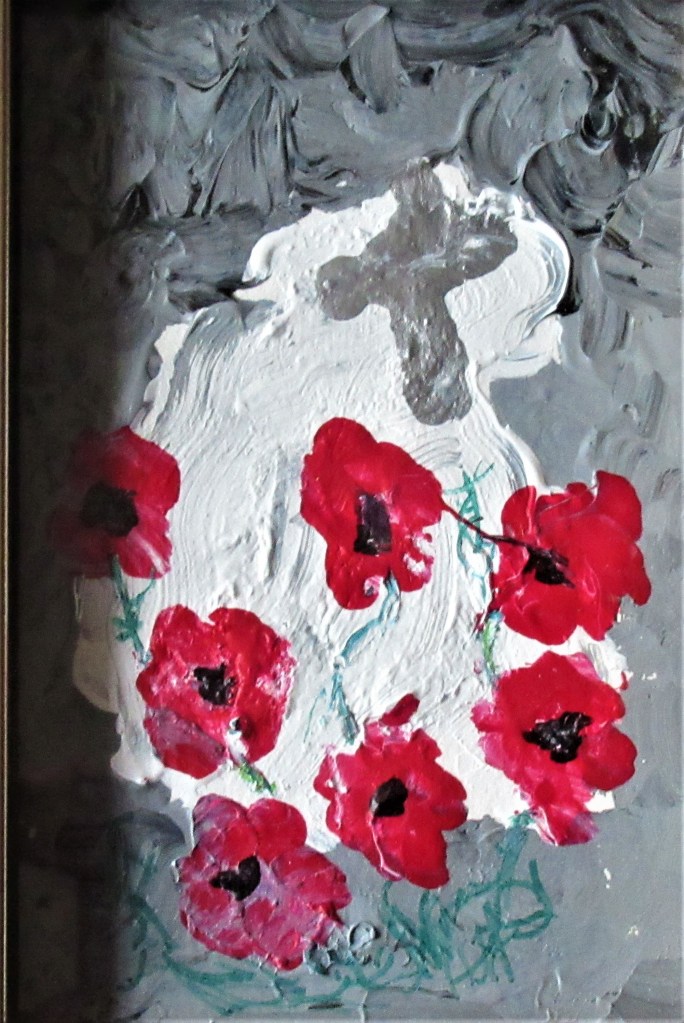
Painting – Poppies – by Clare Moore.

Magician

Magician

I stand on a tiny platform, high above
the upturned faces of the clamouring crowd.
Before me, the high-wire stretches across
the diameter of the circus tent.

Clad in the enormous shoes of a clumsy clown,
I grip the wire with the toes of one foot.
Now I must choose – umbrella or pole?

The spotlight outlines my face’s whiteness,
the bulbous nose, the fixed, painted smile.
My jaws clamp tight in concentration.

Clutching the brolly, a good old gamp, I walk
the thin wire plank of my current destiny.
One step, two steps, tickle you under the chin,
and I pretend to fall, grasp the wire, and raised
by the crowd’s gasp of despair, swing back up.

Then, a yard from the finish line, I swallow dive,
turn a somersault in the air, and land on my back
in the middle of the safety net as the crowd goes wild.

“The magician works on the threshold that runs between light and dark, visible and invisible.” John O’Donohue, Anam Cara, p. 145.

“The most difficult role in the play is that of the fool – for he who would play the fool must never be one.” Don Quixote.

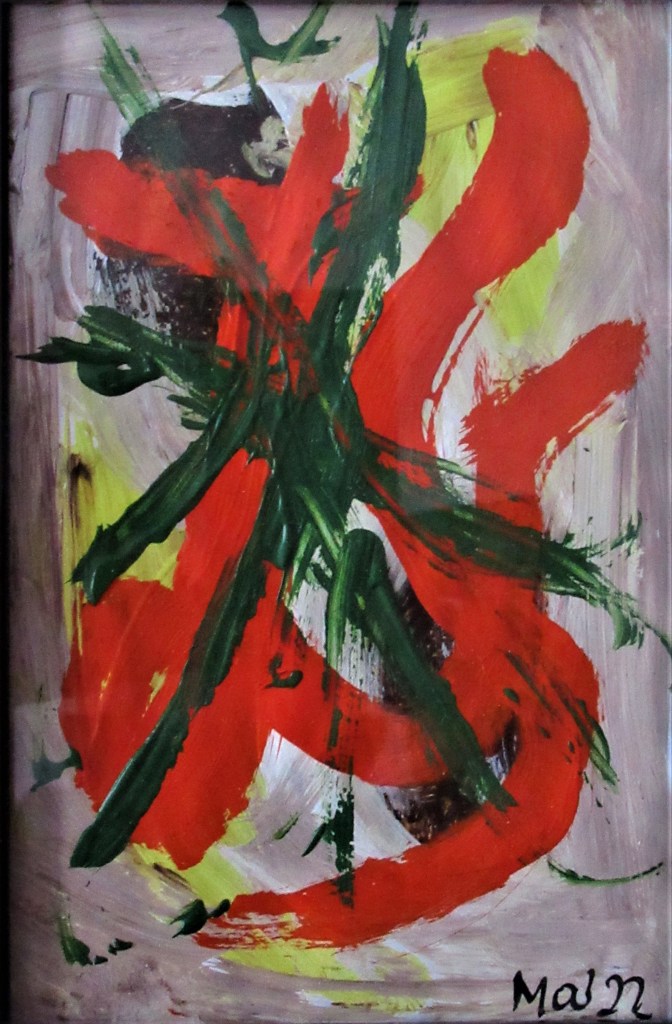
Painting: Fire Sky by Moo.

Lost

Lost

Where can it be? I put it
somewhere safe, but I
can’t remember where.

So many things grow legs,
go absent without leave,
walk out of my world.

I am slowly losing control.
My life will soon be left
in somebody else’s hands.

They will control my wants
needs, and necessities.
Then I too will be lost.

Placed somewhere safe,
perhaps, there to lie forgotten,
abandoned, secure, perhaps,
but who knows at what cost.

Time and Tide

Time and Tide

Sitting, waiting, patiently,
it’s all I have left, except
for impatience and anger.
They sometimes take control
in an explosion of bitterness.

I can only sit here for so long and
then anguish gets the better of me.
A dropped plate, a spilt glass,
a cup of coffee slithering over
the tablecloth, and I explode.

Such events are becoming
more frequent and much fiercer.
I try to withstand them, to hold them
back, but they rise like the tide
that lifts the Fundy fishing boats
from their beds in the mud,
moon tides, planetary upheavals,
that swell again in spring and fall.

Like the boats in the bay,
I am powerless to stop them.

Black Paintings

Black Paintings
pinturas negras
Goya

Wrapped in his blanket of silence, the painter paints.
He pays no attention to the shrieks, screams, prayers,
curses, doesn’t even hear them. He sees their staring eyes
as the bull’s eyes at which anonymous soldiers, heads down,
backs to his easel, fire. He sees their mouths as black holes,
slashed across their faces. He sees the priest with his rosary,
but never hears the rattle of the beads or the firing squad’s guns
going off, filling the canvas with smoke, the square with blood.

Back home, in the Quinta del Sordo, his deaf man’s house,
he sits at the supper table, dwarfed by his painting of Saturn,
devouring one of his children. Beside him, old women,
hags themselves, suck soup silently from wooden spoons,
or fly soundless, black bats in the starless sky,
 on the back of goats or on their witches’ brooms.

The great, open wounds of his paintings speak to us
of his hushed suffering, of the calamitous world that spawned
such violence, plague, famine, and fear. Plundering armies,
guerrilla warfare in back street and alley, torture, pillage,
rape, and suffering, pits filled with the dead and dying,
famine walking the streets, and all of it inaudible,
the nightmares of a little child, seen, but never heard.
His paintings speak to us, and they allow us to reconstruct
in our imagination, the many things that the painter, deaf,
but never dumb, could never hear, yet reproduced
using his paintbrush and his taciturn palette as a tongue.

Click here for Roger’s reading.

“It is said that deafness is worse than blindness because you are isolated in an inner world of terrible silence.” John O’Donohue, Anam Cara, p. 71.

The Appointment

The Appointment

“We have room tomorrow,” she said.
“But only between 7 and 9 am.
Shall I book you in for 8:15?”
“Sure,” I replied, not realizing
that I had forgotten to remember
the joys of rush hour traffic,
and the crush of crossing
the only bridge downtown.

I left home early only to find
chaos at the end of my road.
School busses, cars nose to tail,
trucks, cyclists, you name it,
it was all there, flowing, slow
but steady, with scarcely room
to insert a razor blade between
bumper and bumper. But that
was only the beginning.

The bridge downtown: it was
like threading a four wheeled camel
through the eye of a very small needle.
Crawlers, creepers, slugs and snails,
racing demons, speedsters, all of them
hustling, impatient, bustling, yielding
not an inch of space. My car became
a shuttle, weaving a thread of progress,
inch by inch, through the maze
that confronted and confounded.

I got to my journey’s end at last.
“You’re late,” said the girl at reception.
“You’ve missed your appointment.
Shall I book you in again?
Tomorrow at the same time?”

Click here for Roger’s reading.

Black Saturday

Black Saturday

Doubt and Despair

1

This is the day we go into ourselves
to work out who we really are.

It is the teeter-totter day
when the world balances on a knife-edge:
Yesterday, the dark deed was done.
Today the body is in the morgue,
far from the crime scene
where black and yellow ticker-tapes,
keep sight-seers seeking thrills at bay.

Today, there is no centre to hold.
Things gyre and gimble in the wake
of troubling scenes misinterpreted,
called fake, and deliberately misunderstood.

The unfortunate lie chained so they can’t
escape. Take these chains from our hearts,
the watchers say. Take these irons from
our wrists, your knees from our necks.
Forsake your vicious choke holds.
Go away and leave us alone.

2

A birch tree lies on my power lines,
and I am powerless.

No phone, no radio, no tv,
and all because of a snow-laden tree.
Why did this happen to me?

“It’s a day, man, a day.
It’s nothing but a day.”
“Imagine,” says my wife, “being
without power all your life.”

I clench my fist and pump the air.
Nobody sees me. No one seems to care.

A ghost’s voice echoes in my head:
“Stop moaning, bro,
at least you ain’t dead.”

Sun, wind, melting snow.
The lame tree rising, slow.
Then, at last, the lines are free.
Power is back again.
I breathe more easily.

3

For forty days
I have wandered in this wilderness,
walking from room to room,
climbing stairs,
descending to the basement,
sitting at the computer,
sitting at the table,
writing in my journal.

I have watched the minutes
as they turn into hours,
the hours turning into days,
days into weeks, then months.

How long, I ask, oh lord, how long
before peace and love, friendship and joy,
return to this world
where they used to belong?

4

A turkey-vulture flew
over the house this afternoon,
hungering for who knows what,
as I too hunger for things
I have forgotten
and no longer know.

Freedom to walk
in now forbidden places,
freedom to shop for groceries,
to stop at the liquor store,
to buy wine and beer,
other things that I adore.

For forty days
I have sailed in this Noah’s
Ark of a house.
Like John the Baptist
I have lingered here for forty days.

Strange and wonderful are thy ways,
oh lord, in heaven, where souls and angels
admire your beauty and sing your praise.

Sound of Silence

Sound of Silence
Cara Anam, p. xv

Where do the deer go
when they leave their tracks
behind them and pass out of our sight?

We lose them when, like school children,
they scale the snow bank,
stop at the roadside, and look left,
right, and left again, then walk sedately,
one by one, across the road, and blend
into the dark woods opposite our house.

Too many friends have walked a similar way,
crossed the great divide, and lost themselves
in the unknown that lies there, out of sight.

All too soon, we will be faced by that same
decision, whether or not to cross.
Our paths already tell us where we’ll go,
but the hands of our body clocks don’t yet
point to how, or when.

Click here to listen to Roger’s reading.

Waiting for Godots

Waiting for Godots

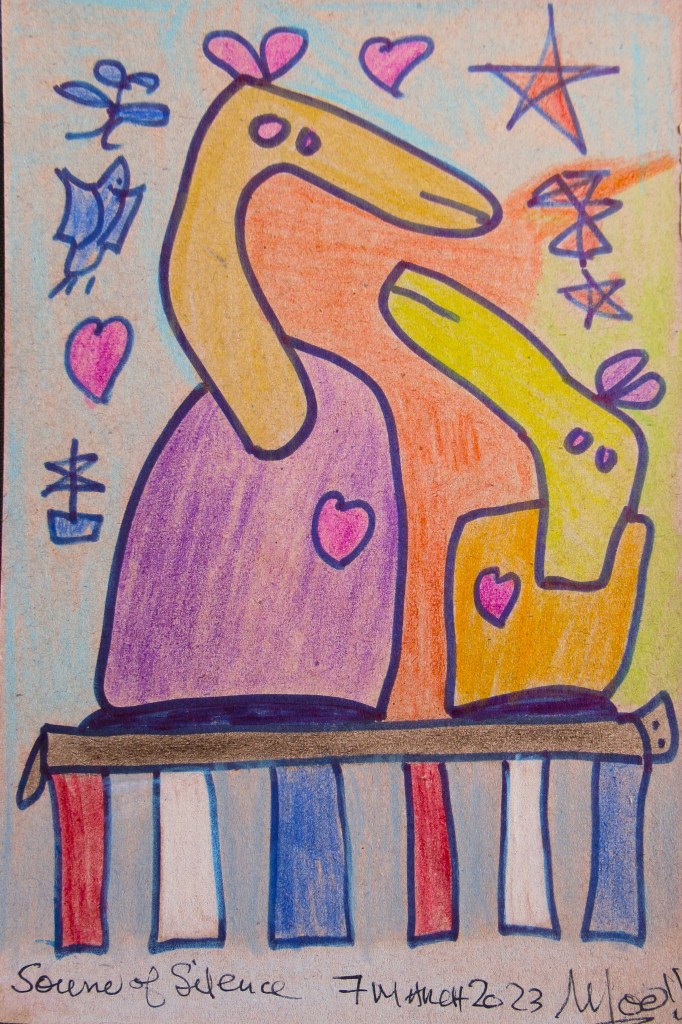
What do authors do when they send manuscripts to agents or presses? They have several choices. For example, they can listen to the sound of silence. Listen carefully to the paining above. What does it say to you? Absolutely nothing. Quite. It doesn’t communicate. It’s the sound of silence.

Another choice, they can read and re-read Beckett’s Waiting for Godot. Alas, in this case there are many Godots out there and all of them are super-busy gazing at their navels – and I don’t mean oranges. Some indulge in the wonderful world of “Mirror, mirror, on the wall…” and we all know what the answer is to that question. And we know what happened to Narcissus when he saw himself in the river water. Or have we forgotten? Our failure to share cultures is also a sound of silence – two solitudes, gazing at each other, neither one having anything in common with the other one, except maybe the weather. And we can’t always agree on that.

A third choice, they can climb into their dustbins, Queen’s English for garbage cans, and stand there waiting for someone to put the lid on so they can go back to sleep. Allusion / elusion – you don’t know what I am talking about? Well, maybe we are living in two separate solitudes. It wouldn’t surprise me in the least.

A fourth choice, they can take up painting, and scribbling, and drawing, and doing all sorts of things. But, if the phone rings and you don’t recognize the number – don’t pick up the phone. It’s probably a fraudulent scam call. And if you don’t know the e-mail address, put it in Spam and then block it. It’s probably some bot from another country trying to trap you into giving them your bank account details and signing your savings away. Whoever it is or they are , I doubt if it’s an agent or an editor!