Sunday in Wales

IMG_0795.JPG

Sunday in Wales

To be Welsh on Sunday in a dry area of Wales
is to wish, for the only time in your life,
that you were English and civilized,
and that you had a car or a bike and could drive or pedal
to your heart’s desire, the county next door, wet on Sundays,
where the pubs never shut and the bar is a paradise
of elbows in your face and ribs and the dark liquids flow,
not warm, not cold, just right, and family and friends
are there beside you elbow to elbow, shoulder to shoulder,
and the old ones sitting indoors by the fire in winter
or outdoors in summer, at a picnic table under the trees
or beneath an umbrella that says Seven Up and Pepsi
(though nobody drinks them) and it serves as a sunshade
on this Sunday evening when the sun is still high
in the summer sky and the little kids tumble on the grass
playing soccer and cricket and it’s “Watch your beer, Da!”
and the gymnasts tumble over and over the family dog
who hides beneath the table and snores and twitches until
“Time, Gentlemen, please!” and the nightmare is upon us
as the old school bell, ship’s bell, rings out its brass warning
and people leave the Travellers’ Rest, the Ffynnon Wen,
the Woodville, the Antelope, the Butcher’s, the Deri,
the White Rose, the Con Club, the Plough and Harrow,
the Flora, the Pant Mawr, The Cow and Snuffers,
the Villiers Arms, the Cricketers, the Mexico Fountain,
the Church (the one with handles on the prayer books),
God Bless them all, I knew them in my prime.

Comment: In the old days, when there were twelve counties in Wales, each county voted whether or not to permit the consumption of alcohol in public houses (pubs) on Sunday. Those counties who forbade Sunday drinking were called ‘dry’ and the others, who permitted it, were called ‘wet’. I remember hearing about the rush from Sunday Chapel Services in dry counties as the church-goers headed over the border into the wet counties where they could fill up in the proper fashion. The pubs listed at the end of the poem are all in the Swansea or Cardiff area, and yes, I have visited them all. The poem was designed to be read in a single breath … at quite high speed and in a Welsh accent. Alas, it takes me more than one breath now and I, like the ageing church-goers, must stop a couple of times as I wend my way down Memory Lane, from the dry to the wet.

Mannequins


IMG_0836

Mannequins
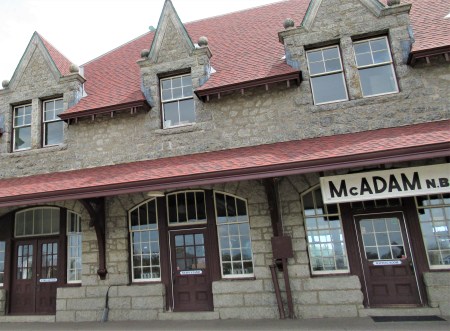
McAdam Railway Station #12

“He startles the unaware, that man by
the door, in uniform, with his youthful
looks and old-fashioned peaked cap,

fingers poised by his silver watch chain
ready to pull out his Waltham pocket watch
and check the time against the master-clock.

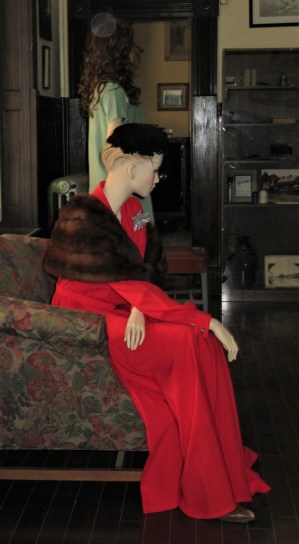
Two ladies wait in the waiting room.
One wears winter robes of red and black
while the other wears velvety green. Both

are motionless, one seated, one standing. Yet
if you watch them from a corner of one eye,
you will see shadowy gestures as their lips move.

Overnight they have changed into summer
clothes, gauzy, almost see-through, flowery
patterns, light-weight wedding boots, laced,

restful, cool, thin-soled. ‘Are you for real?’
I ask the standing one, for a joke. When she
nods and winks, a chill settles over the room.”

IMG_0676 (2).JPG


Tracks

IMG_0777

Tracks
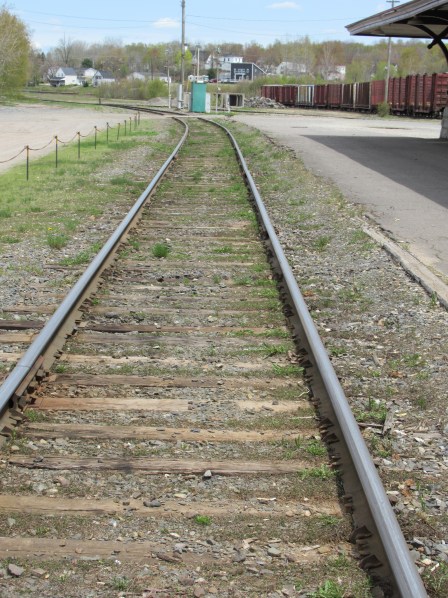
McAdam Railway Station #12

“Put your fingertips on the rail,
see if you can feel its pulsing beat.

No heart rail rhythm now. No tremble.
Put your ear on cold metal:

nothing but silence. No murmur,
however distant. Black fly whine.

No-see-ums flit. The train track’s
buzz of harmony is lost and gone,

replaced by careless nature. Listen
to the wind whistling in the woods,

hark to spring sounds, so subtle,
grass growing, rust accumulating,

sleepers turning over in their graves,
silent, rotting beneath forgotten rails.”

Comment: Nothing so lonely as an abandoned railway track, rusting beneath snow and rain, the wooden sleepers rotting into oblivion. That said, the Southern New Brunswick Railway still carries freight trains through McAdam, and it is the railway station that suffered, with the loss of passenger traffic, rather than the rails themselves. What a pleasure, incidentally, to hear the hoot of the approaching diesel, to count the wagons as the train came to a halt outside the station. Then came the joy of watching the engine separate wagons from the main train, shunt them into sidings, return, and take the freight train, slow at first, but rapidly gathering speed, out of the station and away into the distance. Such memories. So many ghost trains riding those rails. So many ghosts bewitching the windmills of the child’s mind that still inhabits the ageing brain.

IMG_0780


Faces

IMG_0258.JPG

Faces
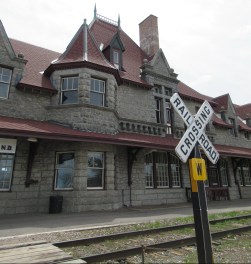
McAdam Railway Station #10

“White at windows
when trains pass through
in June on their way
to summer and sand.

Wind-tousled, tanned
at summer’s end
returning home to
Boston and Montreal.

I remember them
waving their hands,
flickering white hankies
as they went by.

This station is a ghost train
that travels through time
instead of space. Stand
still as silent stone. Wait.

Look: there’s someone,
waving at us now
from that window
on the second floor.”


IMG_0782 (2).JPG


Hospital

IMG_0811 (2).JPG

Hospital
McAdam Railway Station #9

“I was here the day they
took the hospital away.
I gave some writing workshops.
Teachers upset, students in tears,

everywhere, fear and despair.
‘I was born in that hospital.’
‘My grandfather died there.’
‘Where will my child be born?’

I helped them write down
their memories and fears,
their hopes and dreams.
My lesson plans vanished.

How could they survive
when life’s rising tide
broke all bulwarks,
flooded open hearts.

A wounded community,
diminished by its loss,
they took me into their hearts.
Their loneliness wrapped me.

They wrote down memories.
Tears stained every page.”

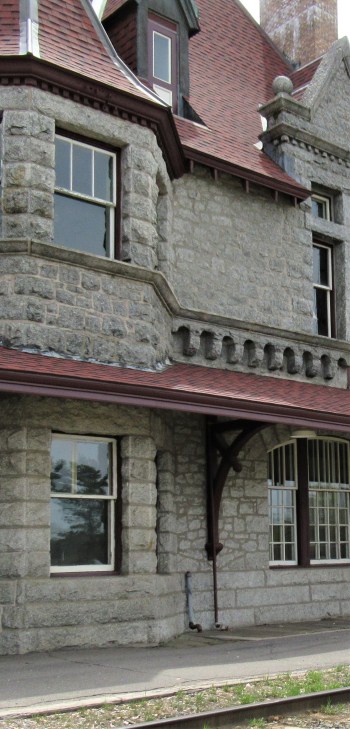
Comment: This is one of my memories of being in McAdam. I was invited to run a series of writing workshops there, under the Writers’ Federation of New Brunswick  (WFNB) WiSP (Writers in Schools Program). I arrived there the week the announcement was made that the local hospital would close. I remember all too well the effect that this announcement had on the local community and I have tried to express that anger, sorrow, despair, fear, resentment in the above poem. More than anything, I felt the sorrow and despair of students and teachers. It is so easy to make an executive decision, at a distance, to rip the beating heart out of a living community on financial grounds. It is so difficult to revive the patient after the act of removal. What amazes me about McAdam is the effort hat volunteers are making to rebuild their town. Their words and deeds are truly impressive: as impressive as their magnificent railway station, now declared a national heritage site.

S.O.S

IMG_0678 (2).JPG


S. O .S.
McAdam Railway Station #8

“Dozing in the cab, I was.
Smelt a different smoke.
It wasn’t my engine’s.

Looked around.
Saw flames. One, two,
three houses on fire.

Steam was up. Yessir.
Three short hoots I gave.
Three long. Three short.

S.O.S. Mayday. Mayday.
S.O.S. S.O.S. Kept going
till house lights came on.

People running. Leaving homes.
Jumped out of the cab.
Ran out to help them.

They thanked me.
Said I had saved their lives.
What else could I have done?”

Comment: This is a third hand poem. It came to me from Geoff who heard the story from the hardware store owner who witnessed the fire. The narrator is the anonymous engine driver who raised the alarm. Of course I don’t know exactly what he did, said, or thought. Our knowledge of history can be divided into two great moments: the momentous events, recorded by expert historians via diligent research, and intra-historia, as Miguel de Unamuno, that great Spanish philosopher and rector of Salamanca University called it, referring to those small, individual moments when history is made by anonymous human beings who did what they had to do and then faded into the anonymity of a distant past, now wrapped in silence, as is the store-keeper and the driver of the train.

IMG_0678 (2).JPG

Shunting

IMG_0777.JPG

Shunting
McAdam Railway Station # 7

So many memories
cling like hobos
to freight trains.

Tracks as always,
sleepers, steel rails
an optical illusion,

joining in the distance
where the miles
between now and then

knit themselves together
and we are young once more,
riding the rails,

dreaming of towns
beyond this town,
dreaming of the future,
not the past.

Comment: This is one of my own memories. We lived by the railway yards in Swansea and again in Cardiff. The trains were a regular part of my dreams. I lay awake one night waiting for the 3:20 to London, but it never came. I couldn’t sleep, waiting for that train. Next day I learned that there had been a railway accident. When I returned to boarding school after the holidays, I would lie awake at night waiting for trains that never arrived. We had a track close to the school, but we called it the Beetle Crusher because it was old and rusty and used so rarely that the beetles, who never knew when it was coming, would get crushed when it arrived. I have written a book about that train and that school, but I have yet to publish it. When I was very young and we travelled to London on the Great Western Railway (GWR) train from Swansea High Street, we had to go up to the engine driver and say ‘hello’. And then we had to thank the engine before we set off. Iron, steam, coal, inanimate to many perhaps, but live living animated beings young children who sat, like our ancestors in Gower caves, and watched the pictures the sea-coal flames painted in the fire.

Master Clock

IMG_0687 (3).JPG

Master Clock
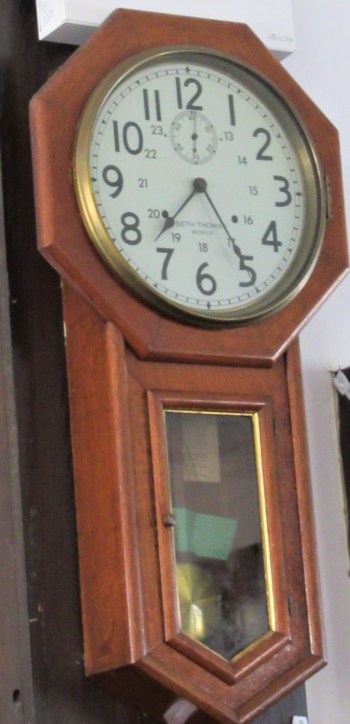
McAdam Railway Station 4

“It came from the Empress,
in Victoria. It won’t work here,
I’m afraid. It’s the clock
that runs all the clocks
and keeps them on time.

It needs a network.
ten, twenty, thirty clocks
that it can control
from its central circuit,
keeping them all on time.

Just like the railway.
The trains were always on time.
Except, just like this clock,
they don’t run anymore.”

Comment: I don’t have a picture of the Master Clock at McAdam Railway Station. I guess I’ll have to take one next time I visit McAdam. This clock can be found in the dining room. Like the Master Clock, it too has stopped. Known in Wales as Grandmother Clocks, these pendulum clocks are designed to hang on the wall rather than to stand on the floor like Grandfather Clocks. Can a Grandmother Clock be a Master Clock? I’ll leave that semantic conundrum to the experts in linguistics. While they are all arguing about it, I will just say that Elsie, who else, told the story of the Master Clock to a group of tourists from Nova Scotia while I was listening.

Defenestration


IMG_0781 (2).JPG

Defenestration
McAdam Railway Station 4

“When I first walked
by that tiny window,
right up there,
on the third floor,
I wanted to go up to it,
to stand there, to look out.

There was a young girl,
went up there one morning,
opened the window,
and threw herself out.

She must have been desperate.
Rejected by her lover,
who knows what state she was in.”

Defenestration?
It’s a funny word,
I had to look it up.

It’s from the Latin:
de means out from,
fenestra is the window,
fenêtre in French.

“She just opened the window
and threw herself out.”

Comment:  Geoff, in his role as tour guide, took Clare up to the third floor, showed her this window, and told her the story of the young girl who had jumped out, killing herself in the process. Clare said she was fascinated by the story and felt an urgent desire to stand there, and look out of the window. I am so glad she didn’t feel the need to throw herself out. Oral tradition: I love the way stories are passed from mouth to mouth, changing slightly all the while. Why did the young woman kill herself? Was she pregnant? We can only speculate and I guess we’ll never know for certain.

A Three Year Old Girl

img_0181

A Three-Year Old Girl
McAdam Railway Station #3

“I often see her, walking around,
standing in a doorway,
looking into a room.

She’s very curious
but never says a word.
Doesn’t ask questions.

She’s not scary at all,
like some of the others.

There are rooms here
where people won’t go
if they’re alone.

But they mean no harm,
these broken ghosts.

They’re lost, nowhere
else to go, I guess.
Just missed the last train”

Comment: Another story from Elsie, who says she often sees this young child in one room or another. The station is indeed filled with many memories and you can feel warm and cold presences throughout the building. Some rooms are filled with foreboding, while others are warm and comforting. Many old buildings have these qualities as do the old iron age walled camps scattered around the south of England. Maiden Castle and Badbury Rings spring to mind, as do Westbury White Horse, Corfe Castle and parts of Brownsea Island in Poole Harbour. Do I believe in ghosts? I echo the words of my mentor and fellow-countryman, Dylan Thomas: “I’d be a fool if I didn’t.”