Growing Up

IMG_0817 (4).JPG

Growing Up
in Brynmill

They drag the kids kicking and squealing
from childhood’s universe into an older
world of smoking and drinking, forbidden
fruits stolen after Christmas dinner when
drowsy grown-ups’ eyes are turned away.

Why do bigger boys follow smaller ones,
buying their sisters’ kisses then thrusting
their fingers into little girls’ knickers, or
invading Woolworth’s and tucking stolen
goods in shirts with their buttons undone?

The games they play: offering a little girl
a cigarette  or a sweet while two boys
wait behind the garden gate with a sharp
knife to  press against the victim’s throat.

Time-Spirits

IMG_0868.JPG

Time-Spirits

Zeitgeist

Zeitgeist is a concept from 18th- to 19th-century German philosophy, translated as “spirit of the age” or “spirit of the times”. It refers to an invisible agent or force dominating the characteristics of a given epoch.
Wikipedia

Those who cannot learn from history are doomed to repeat it.

“Plus ça change, plus c’est la même chose.”

Poems for troubled times.

Introduction

Our world finds itself in an incredible mess right now. Somehow, we have to sort it out. Images and metaphors tie past, present, and future together. We must pick our ways through the difficulties of these troubled times, as you must pick your way through the intricacies of these poems. Many of you will give up. Some of you, the chosen few, will make your way to the heart of each poem.

These poems are deliberately cryptic. Each one is a mind game I am playing with you. I do not underestimate you. I have placed clues throughout each poem and if you follow the clues you will arrive at many of the poem’s hidden meanings. Some poems are more difficult than others, their meaning more recondite. Others seem very straightforward, yet still contain secrets.

            This style of poetry has a long history going back to Anglo-Saxon riddles and way beyond, back into the mists of time. Luis de Góngora (1561-1627) and Francisco de Quevedo (1580-1645) specialized in similar forms of recondite poetry, often based on metaphor and the juego alusivo-elusivo, the game of alluding to something while eluding the act of saying what it is. Jorge Guillén (1893-1984) and Federico García Lorca (1898-1936) also played this game, as did Octavio Paz (1914-1998). In the works of all of these poets, the clues may rest in the poem or they may be found in a generic knowledge of the mythology of the poem’s exterior world.

             Always remember that “those who cannot learn from history are doomed to repeat it” (George Santayana). Otherwise expressed, in the words of T. S. Eliot: “Time present and time past / are both perhaps present in time future / and time future contained in time past” (Burnt Norton). The seeming anachronisms in these poems suggest that all time is ever-present and that each new day presents us with events that have already occurred on many occasions.

Commentary: The idea for Time-Spirits aka Zeitgeist was born around the kitchen table in Island View on Saturday, 22 December 2018, during a literary conversation between Gwen, Victor, and Roger. A poem at a time, one after another, grew from that table top chat. The result: 70 poems, not easy to read, deliberately difficult, that reflect our troubled times. My thanks to Geoff Slater, line-painter, who drew the cover picture: Robin Red in Claw and Breast, a symbol of nature ‘red in tooth and claw’. So are we in the words of Albert Camus who writes ‘nous sommes ou les meurtriers ou les victimes’ . Is it the early bird that catches the worm? Or is it the late worm that gets caught by the bird? Whichever: it’s the worm that gets eaten, until the robin bites the dust, when he is eaten in his turn. Just think of it as nature doing its regular recycling …


IMG_0865 (2).JPG


Tracks

IMG_0777

Tracks
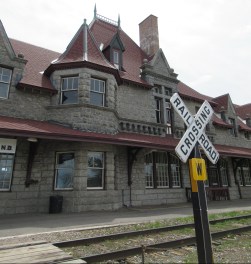
McAdam Railway Station #12

“Put your fingertips on the rail,
see if you can feel its pulsing beat.

No heart rail rhythm now. No tremble.
Put your ear on cold metal:

nothing but silence. No murmur,
however distant. Black fly whine.

No-see-ums flit. The train track’s
buzz of harmony is lost and gone,

replaced by careless nature. Listen
to the wind whistling in the woods,

hark to spring sounds, so subtle,
grass growing, rust accumulating,

sleepers turning over in their graves,
silent, rotting beneath forgotten rails.”

Comment: Nothing so lonely as an abandoned railway track, rusting beneath snow and rain, the wooden sleepers rotting into oblivion. That said, the Southern New Brunswick Railway still carries freight trains through McAdam, and it is the railway station that suffered, with the loss of passenger traffic, rather than the rails themselves. What a pleasure, incidentally, to hear the hoot of the approaching diesel, to count the wagons as the train came to a halt outside the station. Then came the joy of watching the engine separate wagons from the main train, shunt them into sidings, return, and take the freight train, slow at first, but rapidly gathering speed, out of the station and away into the distance. Such memories. So many ghost trains riding those rails. So many ghosts bewitching the windmills of the child’s mind that still inhabits the ageing brain.

IMG_0780


Elevator Pitch

IMG_0627 (2)


Elevator Pitch
Jean Chrétien

His enormous presence filled that tiny
space. His corkscrew smile, well-known tic,
semi-frozen face, that trick of wild speech

butchering language, misunderstood in
both English and French. “Bonjour,” he said. “Good
day.” I nodded, didn’t know what to say,

just shuffled my feet. I remember he
talked on the radio about our land,
how, in winter, with car stuck in snow,

we spin our wheels, forward and back, a bit
at a time until we emerge, content,
victorious. Time and the floors slipped by.

I thought of the elevator pitches
I had written for my films. Should I pitch
him about my latest film or should I

just keep quiet. The elevator stopped.
Jean Chrétien got out. “You’ll be back,” I
said. “Damn right,” he grinned, lop-sided.

Renaissance Hotel. Toronto. Nine-teen
eighty-five. Tongue-tied I had stood there.
Later I thought of all I might have said.

Volunteers


IMG_0765 (2).JPG

Volunteers
McAdam Railway Station 6

Only the old in body
and young at heart know
how to cook like this.

The soda fountain stools,
the horseshoe bar
from the old Royal York,

they merit only the best.
Simplicity rules. Stews
like grandma made them,

lining the ribs,
defying damp and cold.
Railway Pie, recipes

a hundred years old, or more.
bread rolls that melt
into the butter knife,

coffee to kill for. No wonder
the old ghosts walk around
feeding off cooking smells,

sad, gentle eyes, watching us
as we eat, refusing to leave.

Comment: That’s the end of the Railway Pie, I’m afraid. The soup has already vanished. Three lucky people, arriving on cooking day, and receiving a free lunch. What joy, what delight. The volunteers were cooking for another event, outside the station, which was not yet open. Old ghosts watched from quiet corners as we ate. I am sure those spirits survive on the wonderful cooking smells that emerge. I should add how impressed I am at the knowledge displayed by the volunteers at McAdam Railway Station. They now only have their facts at their fingertips, but hey are able to express those facts in a way that draws the audience in and makes every visit a genuine pleasure. Volunteers: thank you for being there. You do a great job.

IMG_0765 (2).JPG

Carpe Diem

IMG_0790 (2).JPG

Carpe Diem

This tube of toothpaste,
nearing its end,
folded over, again and again,
doubled into itself.

Squeeze it tight.
It’s all you’ve got.
Spread it on
the worst teeth.

Brush as you always did,
with hope, up and down,
not sideways. Nothing
before means anything.

Everything afterwards
is merely hope or dream.
A child, you chased
wind-blown leaves

catching them before
they hit the ground.
A scarecrow now, scarred
with age, arms held out,

palms up, hoping a leaf
will descend, a sparrow
rest in your hand,
or on your shoulder.

Call Girl

IMG_0783 (2)

Call Girl
McAdam Railway Station 1

“She came down from Montreal
to look after all the railway workers.
We called her the Call Girl.”
The men in the room sit up
and pay attention. The women
look rather expectant.

“She was a great worker,
performed her duties willingly.
Up at four in the morning,
out into the streets,
knocking on the men’s doors,
waking them up for work
with her morning call.

We called her the Call Girl
because it was her vocation.
she was called to call.”

Comment:
I visited McAdam Railway Station last week, a Canadian National Heritage Site. The guides who were there, many of them members of the local historical society, were well-versed in tales of the station and the people who used to pass through there. I listened to their words with great care, admiring the quality of their images and speech, the terseness and accuracy of their words. This sequence of poems is based upon those people, excellent guides and raconteurs in the best sense of the word. These are their words, not mine, and with their permission, I am posting their stories here. The first poem was spoken by Elsie. Thank you so much, Elsie, for allowing me to share your words. Click this link to the McAdam Railway Station site if you want to see some great photos and read about the history of the McAdam Railway Station.


Murals

IMG_0664

Murals

Painting a mural,
inside, interior
wall, knowing it will
stand time’s test.

Viaduct broken,
a tumbled engine,
Canadian workers,
railwaymen all,

some from Macadam,
pebbled the floor,
handrail, radiator
camouflaged for war,

part of the painting.
Depart from the station.
Turn right. Straight ahead,
flaked peeling paint.

So sad, this outside
mural, exposed to winter’s
snow, frost, winds, and ice.
So vulnerable

and so ephemeral.
Butterfly on a rock.
Such a short-lived
summer, over in a day.

Comment:

My friend, Geoff Slater, inventor of line painting and a renowned muralist, is painting a mural at Macadam Railway Station celebrating the role of Canadian railway engineers in WWI. Here are two fragments  from his unfinished mural. The poem above is based on his lamentation that his outdoor murals, subject to the slings and arrows of outrageous Canadian winter weather, are ephemeral, like butterflies, and cannot endure.

IMG_0692 (2)

A Chill Wind

IMG_0192

A Chill Wind

computer programs
no longer function
buy a new app

word files
no longer
accessible
without a new app

photos that vanish
leaving a blank space
a new app
will bring them back

memory blinks
goes blank
brain farts
friends say

forgetting
phone numbers,
words misplaced
Freudian slips

“What day is it today?”
she asks
for the second
or third time.

“I’m sure
I know you,” she says,
“but I can’t remember
your name.”

Butterflies

img_0189

Butterflies

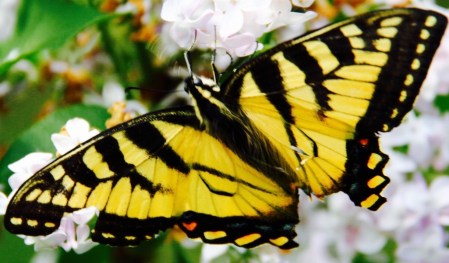
butterflies
their ephemeral forms
flutter by
flickering
brief their sweet sway

they spread
paint-daubed
fanciful wings
fan flowers
flourish

eternity
perched briefly
on flowering bees’ balm

robin puffs out
his red breast
hauls down
tomorrow’s sun

white-throat sings
an evening elegy

Comment: 

“Poetry gives permanence to the temporal forms of the self.”
Miguel de Unamuno.