Yours

Some flowers don’t fade
even after 55 years

Yours

Yours are the hands that raise me up,
that rescue me from dark depression,
that haul me from life’s whirlpool,
that clench around the jaws that bite,
that save me from the claws that snatch.

Yours are the hands that move the pieces
on the chess board of my days and nights,
that break my breakfast eggs and bread,
that bake my birthday cake and count
the candles that you place and light.

You are the icing on that cake, and yours
is the beauty that strips the scales
from my eyes, then blinds me with light.

Lament

Lament
for three brothers
dead before him

“Eric, Phillip, Peter:
why did you leave me?
Why did you,
where did you go?

Eric, Phillip, Peter:
you went out
through the door,
so silent,
didn’t even slam it,
why did you go?

Eric, Phillip, Peter:
I hardly even knew you,
the house, my life,  
so empty without you,
shadows so scary,
why did you leave me,
where did you go?

Eric, Phillip, Peter:
vacant and silent,
lonely the house,
such a big world
without you,
so full of menace,
so full of woe,
why did you leave me,
why did you go?”

Can you tell me …

Painting by the very talented
line-painter, Geoff Slater

Can you tell me …

… why an incoming wave
is a flash of a handkerchief
an invasion of white water,
a hand at dockside waving good-bye?

… why each wave separates,
thrives for a little while,
then dies on the beach,
wrapped up in its lacy
shroud of foam?

… why errant stars fall,
leaving their constellations
to wander the world alone,
each shooting star, a child?

… why a mother abandons that child,
turns her back on her husband,
and looks silent at the wall?

… why, one night, that husband
walks out of his house,
and never returns?

Kite

Kite Flying

So light, the kite,
a butterfly in flight.

Breeze battered,
sky-blue shattered.

Children stare
seeing the wing-shape
fluttering there
rising on flimsy air.

Diving, dipping,
nylon cord slipping,
finger-flesh ripping.

Here come others,
children and mothers.

Butterflies, bright,
ready for flight,
fighting wind-might:
a child’s delight.

I didn’t have photos of a kite.
I offer some humming birds instead.
Listen closely:
you can hear them hum.

Blue and Green

“Blue and green
should not be seen
without a color
in between,”
thus spoke my mother.

What did she know
of the Peace Park grass
sweeping spring-clean
to head pond waters?

Didn’t she sense the frail
brown fringe of rock
scarfing between green
grass and head pond blue
or the white caps lacing
cow parsley on the stones?

I know she knew nothing
of yellow and red leaves,
brown spotted like an old
man’s hands, freckling waters,
fretting at the fragility
of nature’s delicate balance.

A Sacrifice to Mithras

F1040022

A Sacrifice to Mithras

“What is this sound?”
“It is your own death sighing,
groaning, growing
while you wait for it
to devour you.”

“What is this feeling”
“It is the itch of your own skin
wrinkling and shrinking,
preparing to wrap you
in the last clothes you’ll wear.”

“What is this taste?”
“It is the taste of your life,
bottled like summer wine
once sweet tasting,
now turning to vinegar.”

“What is this smell?”
“It is waste and decay,
the loss of all you knew
and of all that knew you.

“That carriage outside?”
It is the dark hearse
come to carry you
to your everlasting home.”

“Look on us in our darkness,
help us to seek and see the light.
Keep us strong, keep us brave.
Mithras, always a soldier,
help us to die aright.”
F1010019

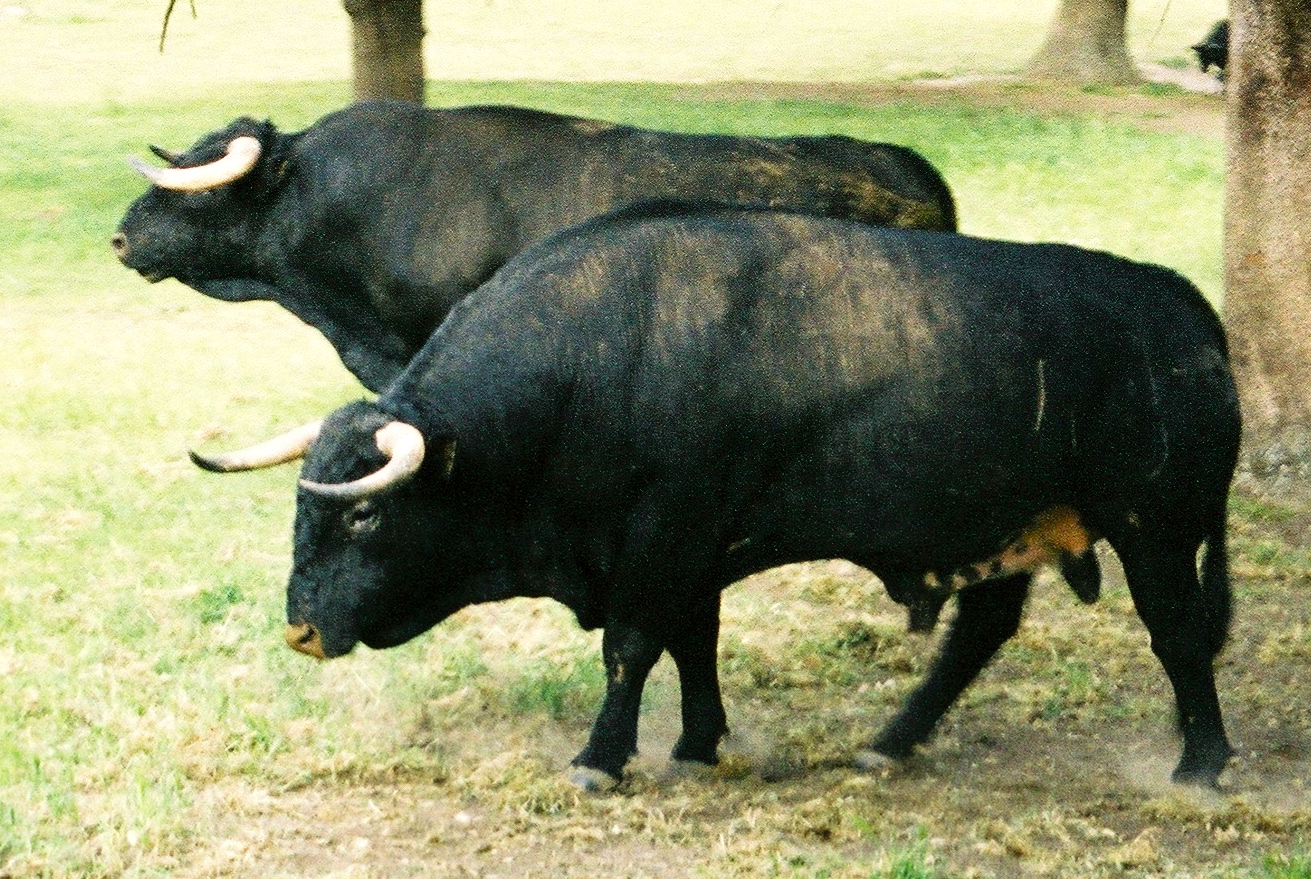
Comment: I am re-reading Puck of Pook’s Hill (Rudyard Kipling). It was given to me for a Christmas present (1955) by my father’s younger brother, my Uncle Frank. His signature is there, on the fly leaf, and his hand writing is as I always remember it. As I write these words, I can still hear his voice. The Song to Mithras, on which this poem is based, can be found on page 191, my edition (MacMillan, 1955), as a prelude to The Winged Hats. Without these clues, the poem operates in another space, more personal and more morbid, perhaps. The rites to Mithras were associated with the sacrifice, at midnight, of the black bull. The upper photograph shows one of the Bulls of Guisando (Los Toros de Guisando), which have stood in the province of Avila, in Spain, since time immemorial. So old are they, that the Roman legions left their mark on them in Latin, as you can see from the photo, when they conquered Spain after the Carthaginian wars.  The lower photo shows fighting bulls on a bull farm in Salamanca, Spain. Born from generations of fighting stock, these animals have been bred for thousands of years to die in the bull ring, as the bulls dedicated to Mithras were bred to die in the Roman temples. This is not a defense of the cruelty of bullfighting or the sacrifice of animals. It is rather a statement regarding the longevity of cruelty, of sacrifice, of the natural flow that leads men and women from birth, through childhood, to maturity, and on to old age, and death. My father is long gone now, as is his younger brother. Who will have access to these memories of mine when I go? Who will remember my family when I am gone?
Plein Air


IMG_0018 (2)

Plein Air
(for Ruby Allan)

“Plein air,”
she said, and I imagined her
sitting before the blank spread of a canvas,
a ship’s sail waiting for a sea-side breeze
to fill that empty space with color and mood.

What routes will her paintbrush take
as it wanders over the new world
lying before her?

Plein air, al fresco,
in garden and street,
before the shops and then
on headland and shore,
alone or accompanied,

with sea birds wading
and the gull’s cry echoing its sea of sound
as the sun sets in its bonfire of brightness
and throws light and shadow,
chiaro-oscuro,
all around.

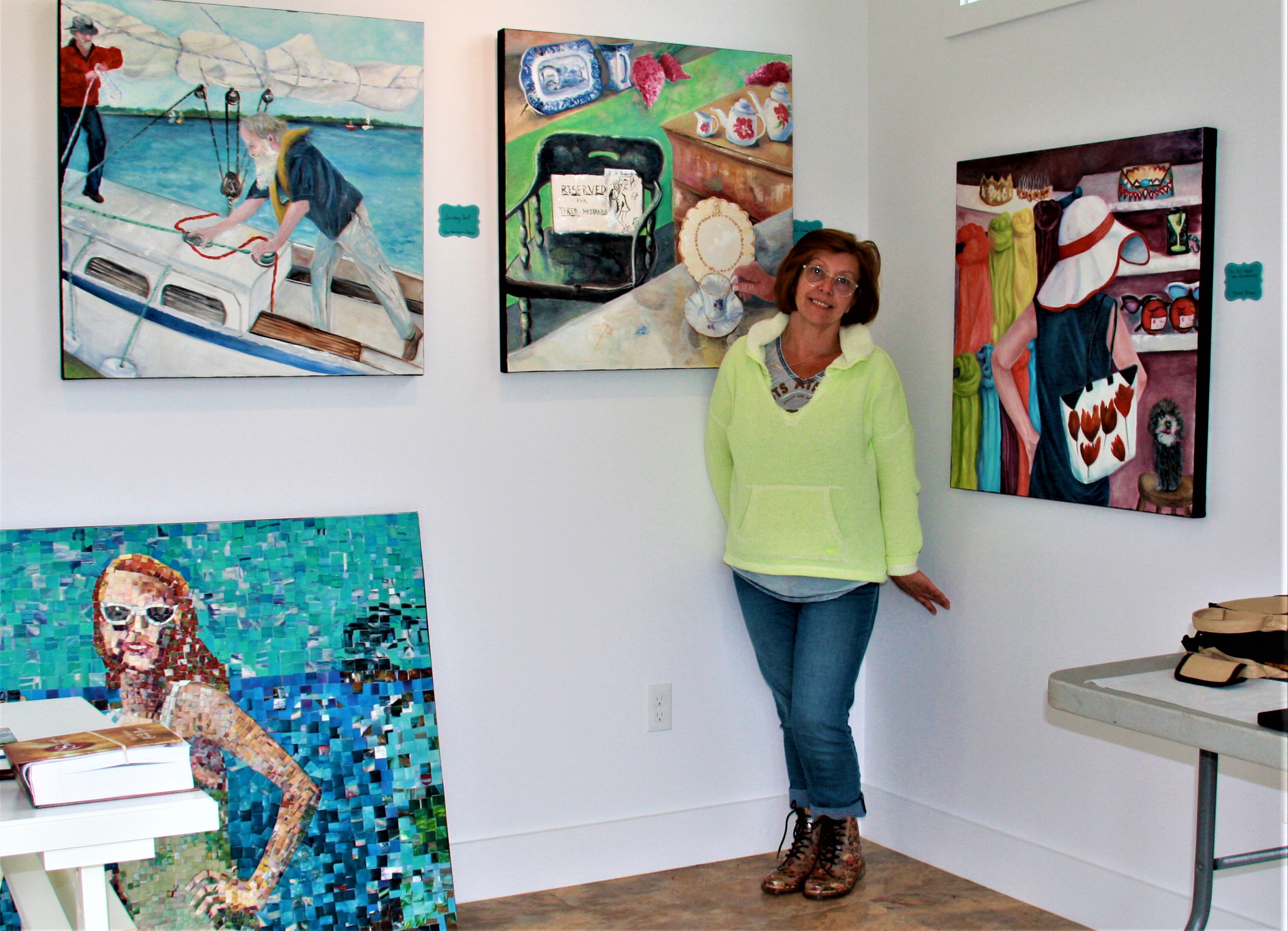
Comment: The lead photo of Ruby Allan in her studio was taken in her KIRA studio in June, 2017, by my friend and fellow artist, the Peruvian pan-piper and flautist / flutist, Carlos Carty. The poem comes from my book, One Small Corner (2017), written in KIRA during my residency. It can be found on page 94 in the section entitled Artists.

In this poem I have tried to capture the idea of Ruby painting in the fresh air (plein air / al fresco) in St. Andrews-by-the-sea. Clearly, as you can see from the above photo, the sea is so important to this town, as are harbors and boats and the men that man and sail them. The light is important too as it changes throughout the day or with wind and weather. As you can see, Ruby’s paintings are filled with light and she catches those magic moments when the world seems to freeze and stand still. I try to imitate visual art when I write, and I try to fill my poetry with those magic moments as I create verbal pictures that seize the seconds and  hold them, even if it be for just a little while.


Empty Nest

fundy 05 mist+wolfepipers 153

Emptiness
is an
Empty Nest

The wind at the window
scratches tiny notes.
I can no longer hear the tune
nor read the words.

Who walks beside me
as I pace my lonely path,
abandoned
in this empty house.

My self-portrait
stares back at me:
a splintered selfie,
framed in a sliver
of silvery glass.

Above me,
the monkey-faced moon,
that itinerant tinker,
walks a fractured way
over broken glass.

The knapsack on his back
is cobbled together
from a finery of cobwebs
and clumsy clouds.

IMG_0039