Word without end

IMG_0937 (2)

Word Without End
Antonio Machado

Tree: rowan, mountain ash, larch, tamarack,
hackmatack, spruce, birch, maple, passerines
flying from branch to branch. Birds: more words,

woodpeckers, downy, hairy, pileated, cardinals,
finches, purple, house, golden, rain-rusted robins,
crows, aerial magicians, wondrous in flight.

Spring: fresh branch tips, tiny fox gloves, leaf buds,
folded fiddleheads soon to open their spring magic.
Open: hearts worn on sleeves, open to the world,

wounds, eyes, everything open to beauteous
sun-warmth, snow’s slow disappearance, rising river,
freshet flow freshening this Renaissance,

every day a rebirth, a new beginning,
fresh starts, the world reborn beneath a rising sun,
its yellow disc growing, the new day glowing.

The word as it was in the beginning, head in hands,
heart in mouth, words without meaning, words whirling
golden autumn leaves, words caught in a whirligig,
words all powerful in a word-world without end.

Comment: “La palabra: una palptiación honda del espíritu / The word: a deep palpitation of the spirit.” Antonio Machado (1875-1939). In The Meaning of Meaning, Bertrand Russell discusses what words mean and how they construct, with their endless associative fields, a net of emotions that take us beyond logic into new realms of meaning. As poets and creative artists, we are conscious of the emotions we attach to each word we use. If the poetry is good, then that network of emotional associations reaches out to a wider audience and draws them into our own world view. If we are less skillful, then the emotions are trapped in our own claustrophobic words and fail to reach out, to lift up from the page, to achieve take-off. As we develop as poets and writers, we become more and more aware of the ways in which the microcosm, our own world in miniature, reaches out to the macrocosm, that wider world outside. When we achieve a blend between those two worlds, even if it be in nothing more than a metaphor, nothing more than a felicitous phrase or a delicately timed rhyme, then we reach a new level, a level that we strive to retain and attain anew every time we create.

For me, many of the secrets of poetry can be found hidden in the rhythm of words, the music of their joining, the harmonies they create when they play off each other, old and older meanings reflecting off the newer meanings we give them as we shuffle them anew and put them through their paces.

img_0146-3

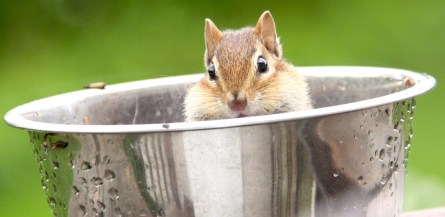
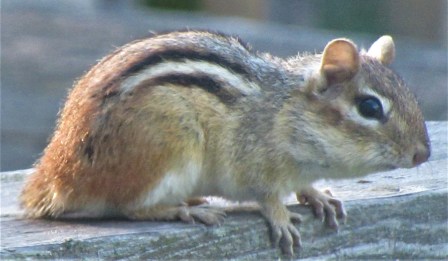
Yesterday, my beloved placed seeds on the back porch, and a chipmunk, her pet chipmunk, came and sat on her foot as he chomped the seeds. Today, this first chipmunk was followed by a second chipmunk. Patience my friends. Keep writing. Keep striving. Keep experimenting. Keep your faith and your creed. Your words will one day reach out, like seeds to chipmunks, and will sow themselves in the mind’s of your readers. And those readers will beget other readers, much as one chipmunk plus one chipmunk will eventually equal many more than two chipmunks. Oh the joy of words, the loving search for le mot juste and the meaning of meaning. In the words of the immortal Cervantes: Paciencia, y barajar / patience, and shuffle your words. The results will creep upon you one morning, unaware and, like the chipmunks, they will catch you by surprise.

Duende

F1000008

Duende
Federico García Lorca

It starts in the soles of your feet, moves up
to your stomach, sends butterflies stamping
through your guts. Heart trapped by chattering teeth,
you stand there, silent, wondering … can I?
will I?what if I can’t? … then a voice breaks
the silence, but it’s no longer your voice.

The Duende holds you in its grip as you
hold the room, eyes wide, possessed,
taken over like you by earth’s dark powers
volcanic within you, spewing forth their
lava of living words. The room is alive
with soul magic, with this dark, glorious
spark that devours the audience, heart
by heart. Magic ends. The maelstrom calms.

Abandoned, you stand empty, a hollow shell.
The Duende has left you. God is dead, deep
your soul’s black starless night. Exhausted,
you sink to deepest depths searching for that
one last drop at the bottom of the bottle to save
your soul and permit you a temporary peace.

Comment: “Todo lo que tiene sonidos oscuros tiene duende / All that has dark sounds has duende.” Federico García Lorca (1898-1936). García Lorca, an inspired and inspirational vocal performer, well understood those dark artistic powers that rise from a combination of earth, air, and fire to possess artists as they weave their magic, be it musical or verbal or a combination of both. Those who possess it know that they never really possess it, for it comes and goes with a will of its own and possesses them, body and soul, taking them over. Deus est in nobisit is the god within us, wrote the Romans with their understanding of the power of performance. And they are right. Those who possess it are changed by it, no longer know themselves, turn into something other than what they are and becoming something special. “Ah would some power the giftie gie us, to see ourselves as others see us” (Robert Burns). But what happens to us when the wondrous gift is taken away, when drab reality takes over from the glory of the stage, the spotlight, the performance of the play? That indeed is the question. And the answer varies with each of us.  I look with dismay on the comedians who, for one reason or another, when deprived of their audiences, have chosen the darkest of exits. The hollow shells of the performers who have given their all are sad things to behold. The existential emptiness that is left when the powers drain away is difficult to live with. That is why so many, faced with this darkness, akin to St. John of the Cross’ Noche Oscura del Alma / Dark Night of the Soul, chose not to live. That is not a choice that I will ever make. And I encourage all my friends to wait, to wait in patience and hope for the light, the glorious light and fire of the Duende, the Spirit that will return, will pluck us from the depths, and will raise us to the heights again.

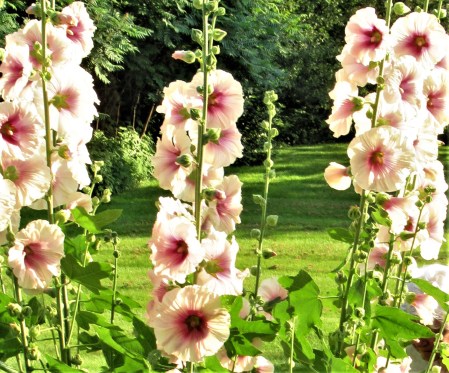
Still Life with Hollyhock

IMG_0206

Still Life with Hollyhock
Geoff Slater

How do you frame this beaver pond,
those paths, those woods? How do you
know what to leave, what to choose?
Where does light begin and darkness end?

Up and down: two dimensions. Easy.
But where does depth come from?
Or the tactility, the energy, water’s
flow, that rush of breathless movement
that transcends the painting’s stillness?

So many questions, so few answers.
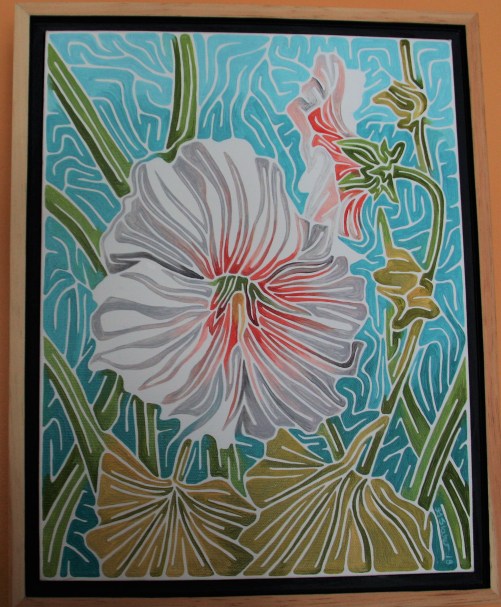
The hollyhock that blooms in my kitchen
is not a real hollyhock. It is the painting
of a photo of a genuine flower that once
upon a time flourished in my garden.

A still life, then, a nature morte, a dead
nature, portrayed in paint and hung alive,
on display in this coffin’s wooden frame.

Comment: I love the way language changes the way we look at life.  A still life painting becomes nature morte in French and naturaleza muerta in Spanish. Still life becomes dead nature. Fascinating. I also love the way in which the camera captures nature and the natural world. We think it is an accurate depiction, but really it isn’t necessarily that accurate. Filters, light and shadow, mood: they all fluctuate and sometimes we capture that which we never saw and sometimes that which we saw is never captured. Oh the subtle enigmas of creative art.

IMG_1005 (3)

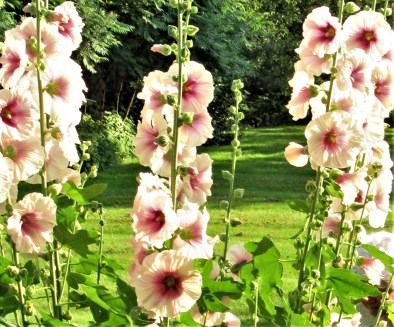
And it is the same with the hollyhock, my hollyhock, Geoff’s hollyhock. At the top of the page is Geoff’s painting of my hollyhock. The above is a photo of my hollyhock. Which bloom did Geoff capture and reproduce in paint? Language: and what do I mean when I say ‘my hollyhock’? My indicates possession, ownership. How and in what way does one own a hollyhock? How does one possess a garden, a flower bed, a tree? Are they not free, living, beings with a life and maybe even a mind of their own? Does one hollyhock talk to another hollyhock as the trees are said to converse with the trees? Do the trees in the garden possess a soul and if they do, in what sense do they possess one? And what is a soul anyway? I guess it depends upon the church and creed to which you belong. Certainly the garden has a life of its own and we discover that every spring when the grass and flowers grow back and the dandelions return.

image5

Questions: dangerous things, questions. Several of the questions posed above could have landed me in an Inquisitional institute in Spain in the 1500’s and 1600’s. That is a frightening thought. Alas, the philosophy of all that is way too deep for this poor poet and apology for a philosopher. One thing I do know, though: I love the garden going on outside my window and it is a privilege to be allowed to watch it, admire it, and follow its progress as the sun returns and the draws the birds back with it.

IMG_0198

¡Vale! Hail and fare thee well.

Bird’s Nest

No.5 1948 Jackson Pollock.jpg

Bird’s Nest
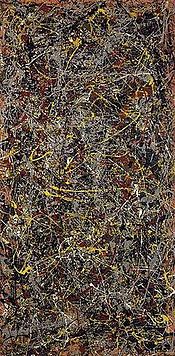
Jackson Pollock No 5 (1948)

This bird’s nest starts with a startling tweet
that wins a trilled, thrilled response. A flutter
of heart-string wings, creator, viewer, join

with the creation. Thin threads of life mix
and match their tangled weave, existential
tapestry, fathered in a feathered nest.

World without end, this labyrinth without
an entry point, without a beginning,
with a spaghetti-thread middle that meets

not in a breath-catch of the mind, but in
a brush-flick of coloured rain, a cycle
recycled of circled paint, circular

in its circumnavigation, its square
eight by four-foot globe of a new world whirled
in stringy whorls, reinvented beauty

drawn haphazardly from the bicycle
tour de force of this artist’s inner mind.

Comment: In my latest poetry book entitled The Nature of Art and the Art of Nature, I explore the relationship between art and the natural world. I have always been fascinated by what we see, how we see it, and how it affects us. The tiny print above is scarcely representative of the eight by four-foot world that the artist creates, or re-creates. And what is modern art? Is it a re-creation of the world as we see and feel it or a representation of a new internal world glimpsed by the artist’s mind and hand-turned into a new reality, the work of art? I guess it depends on the artist, his or her way of life, the way they approach the macrocosm, and how they view the microcosm of their own inner lives.

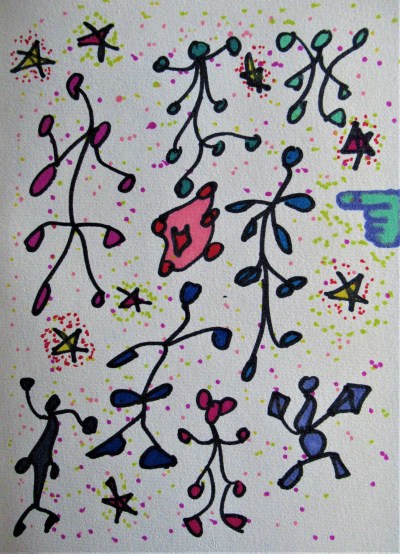
Creation: such a lovely word. Such joy generated as we create something new, be it something verbal, visual, or tactile. For me, it is more a verbal world than a visual one. My forays into art are wonderful, enjoyable, but very personal and artistically limited, even though I love taking a line for a walk or allowing the marker to trace images on the page. Dreams and a dream world: we need them. Sometimes reality is too much for us and we have to shut out the noise of the world and, in Antonio Machado’s words, ‘saber estar solo entre la gente‘ / know how to walk alone among the crowd. The loneliness of the long-distance runner. The isolation of the loving heart trapped within its cage of flesh and bone. The solitude of the spring nest on the pillars at Long’s Creek, overlooking the head pond at Mactaquac, as it waits for its restless occupants to return from their long journey back to the north from the south and start the rebuilding process, each twig, each straw, a minor miracle. And then the hatching and the fledglings and the return flight south that gifts the empty nest such loneliness as it waits for the cycle to begin again once more.

IMG_0824 (2)

Applause

DSC02548

Applause

All that I hear
around me:
the mixing and matching
of shingle and stone,
waves hissing,
grinding the beach down
as they move in and out.

Comment: We are surrounded by news, fake news, false news, and systematic deception. What can we now trust? I no longer know. But I do know that the above poem is not nihilistic. It expresses the reduction of applause and insubstantial glory to the minutiae of the daily doings of the natural world, in comparison to which we humans are nothing. “Look on my works ye mighty and despair” … hand gestures, smiles, thunderous applause from the chosen gathered to bear witness and paid to applaud, whatever the event. Alas, I cannot say it as well as Shelley. Here’s his Ozymandias (11 January 1818).

I met a traveler from an antique land
who said: “Two vast and trunkless legs of stone
stand in the desert . . . Near them, on the sand,
half sunk, a shattered visage lies, whose frown,

and wrinkled lip, and sneer of cold command,
tell that its sculptor well those passions read
which yet survive, stamped on these lifeless things,
the hand that mocked them, and the heart that fed:

and on the pedestal these words appear:
‘My name is Ozymandias, king of kings:
look on my works, ye Mighty, and despair!’

Nothing beside remains. Round the decay
of that colossal wreck, boundless and bare
the lone and level sands stretch far away.”


Biopsy

UNADJUSTEDNONRAW_thumb_2788

Biopsy

Driving home
from the hospital
after the biopsy,
thinking of the indignities
inflicted on my body,
cold, exploratory fingers,
the insertions,
the ardent desire
to say
“Enough,
no more!”

Oh God,
I am so cold.

Fierce winds
push me
along a snow-packed road.

I dream of sunshine
of summer flowers,

IMG_1005 (3)

of chipmunks and squirrels,
of bird seed scattered
so others may survive.

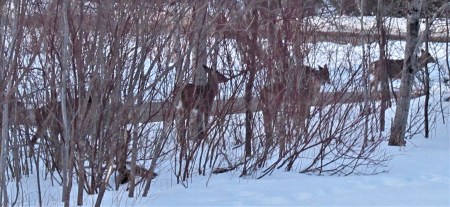
I dream of five deer
walking at midnight
through my garden.

IMG_1740 (2)

Magic,
their shadows
under moonlight
on the snow.

I skid into a snow bank
and my world shakes in shock.

A thirty-wheeler slithers by:
there are so many ways to die.

IMG_0266

Comment: Was it really only five years ago that I wrote those lines? I hadn’t even started this blog back then. So much melted snow, so much water under so many bridges. I look back at my journal and read that on April 1, 2020, in the USA, there were 3,800 dead from Covidis and 300,000 people affected. This morning, when I got up, those figures were higher, much higher: 63,019 dead and 1,070,032 affected. What a difference a month makes, let alone five years.

Affected, such a silly word when each individual person that these figures represent is, or was, a living, thinking, loving, human being, with an extended network of family and friends, each one of whom is in turn affected by the loss or sickness of a group member, be it a brother, a child, a sister, a mother, a father, a son, a daughter, or just a friend …  just a friend, another silly thing to say, as if just friends were not important, collateral damage, so to speak … and now, throughout our world, in macrocosm and in microcosm, we are, each one of us affected, in one way or another. Here in New Brunswick, Canada, we wash our hands, we wear masks, we stay home as much as possible, we maintain distancing when we go out on essential errands … I know it is different in other parts of Canada, and of the world, but we are all affected, and some so much more than others.

So, wherever you are, whoever you are, be strong, be brave, dance when and if you can, sing to yourself, sing for your family and friends, reach out to others, and above all take care of each other and survive. 

IMG_0171

My heart and these words go out to you: Byddwch lawen a chadwch eich ffyd a gwnewch y pethau bychain mewn bywyd / be joyful, keep your faith, and do the small things in life as Dewi Sant, St. David of Wales, a real person, is said to have said, almost 1500 years ago.

Black Angel

img_0178

Black Angel

You cannot hide
when the black angel arrives
to knock on your door.

“Wait a minute!” you say,
“While I change my clothes
and comb my hair.”

But he is there before you,
in the clothes closet,
pulling your arm.

You move to the bathroom
to brush your teeth.

“Now!” says the angel.
Your eyes mist over.

You may know you are there,
but you can no longer see
your reflection in the mirror.

IMG_0003

Comment: Another Golden Oldie from the same dusty manuscript (as if e-files could get dusty), but a little bit more sinister, this one. As long as you can see your reflection and as long as your shadow is still clipped to your heels when the sun shines, you are probably all right. A friend of mine had a nasty turn the other night. He woke up with cramp at 3 in the morning, got out of bed to stretch, blacked out while he was stretching, and came round on the bedroom floor an hour later. It took him 10 minutes to roll over, perform a push up, get onto his knees, crawl to the chair, and pull himself upright. He climbed back into bed and forgot all about it until it was time for him to get up the next morning. Then he lay there worrying until the forces of nature forced him to his feet. Now he says he’s fine … he might be. I checked his shadow and it’s still there and when I talked with him on Messenger, he’d managed to shave.

Empty Nest

IMG_1258 (2)

Empty Nest

The wind at the window
scratches tiny notes.
I can no longer hear the tune
nor read the words.

Who walks beside me
as I pace my lonely path,
abandoned in this empty house.

My self-portrait
stares back at me:
a splintered selfie,
framed in a sliver
of silvery glass.

Above me,
a monkey moon,
that itinerant tinker,
walks a fractured way
over broken glass.

The knapsack on his back
is cobbled together
from cobwebs and clumsy
veils of drifting clouds.

Comment: Another Golden Oldie from that same throw-away manuscript that I discovered a couple of days ago. I wrote this one the year after my mother’s death. My father was in hospital and I had flown back to Wales to visit him. When I was not with him, I wandered alone in a large house, empty of people, but filled with memories. The whole experience was rather surreal, just like the imagery I conjured up to describe it. Early spring, but a cold one. After hospital visiting hours, I wandered an untidy house and an unkempt garden. My mother had departed. My father was on the way out. I was alone with a life-time of memories. “No hay pájaros en los nidos de antaño” wrote Cervantes in the Quixote. “There are no birds in last year’s nests.” With no brothers, no sisters, no close family, and no friends left in Wales, I found that out the hard way. Those days of wandering, ‘upstairs, downstairs, in my lady’s chamber,’ taught me that most difficult of lessons in the hardest of ways.

IMG_0456 (2)

With my angel

IMG_0258

… with my angel …

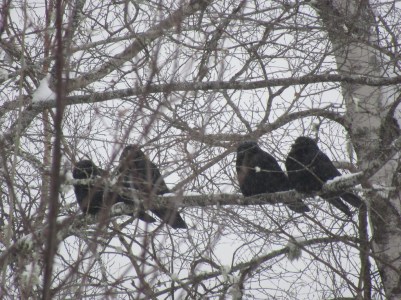
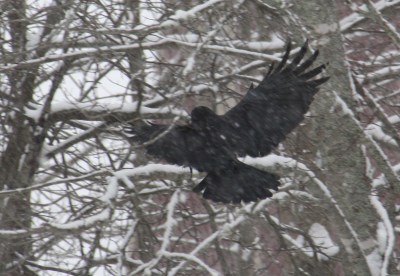
            … with my angel … face to face … the one I have carried within me since the day I was born … the black-one … winged like a crow … the one that hovers over me as I lie asleep … the one who wraps me in his feathered wings when I am alone and chilled by the world around me … the one who flaps with me on his back when I can walk no further … the one who creates the single set of footprints that plod their path through the badlands when I can walk no more …

img_0122

… ‘the truth’ my black angel says to me … I say ‘he’ but he is a powerful spirit, not sexed in anyway I know it … and yet I think of him as ‘he’ …awesome in the tiny reflection he sometimes allows me to glimpse of his power and glory … for, like Rilke, I could not bear meeting his whole angelic being face to face … as I cannot bear the sun, not by day, and not in eclipse … not even with smoked glass … when earthly values turn upside down and earth takes on a new reality … wild birds and bank swallows roosting at three in the afternoon … and that fierce heat draining from the summer sky … I remember it well … and the dog whimpering as a portion of the angel’s wing erased the sun until an umber midnight ruled … a simple phenomenon, the papers said … the moon coming between the earth and the sun …but magic … pure magic … to we who stood on the shore at Skinner’s Pond and sensed the majesty of the universe … more powerful than anything we could imagine … and the dog … taking no comfort from its human gods … whimpering at our feet …
… I saw a single feather floating down and knew my angel had placed himself between me and all that glory … to protect me … to save me from myself … and I saw that snowflake of an angel feather bleached from black to white by some small trick of the sunlight … and knowledge filled me … and for a moment I felt the glory … the magnificence … and there are no words for that slow filling up with want and desire as light filters from the sky and the body fills with darkness … and I was so afraid … afraid of myself … of where I had been … of where I was … of what I might return to … of my lost shadow … snipped from my heels …
… I don’t know how I heard my angel’s words … ‘the time of truth is upon you’ … ‘all you have ever been is behind you now’ … ‘naked you stand here on this shore … like the grains of sand on this beach … your days are numbered by the only one who counts’ … I heard the sound of roosting wings … but I heard and saw nothing more … I felt only midnight’s cold when the chill enters the body and the soul is sore afraid …
… ‘it is the law’ my angel said … I saw a second feather fall … ‘and the law says man must fail … his spirit must leave its mortal shell and fly back to the light’ … ‘blood will cease to flow … the heart will no longer beat … the spirit must accept and go’ … ‘do not assume… nobody knows what lies in wait’ … ‘blind acceptance … the only way … now …  in this twilight hour …  now when you are blind … only the blind shall receive the gift of sight’ … ‘all you have … your wife … your house … your car … your child … everything you think of as yours … I own … and on that day … I will claim it from you and take it for my own … now I can say no more’ …
… the sea-wind rose with a sigh and one by one night’s shadows fled … the moon’s brief circle sped from the sun … light returned, a drop at a time, sunshine flowing from a heavenly clepsydra filled with light …
… birds ceased to circle … a stray dog saw a sea-gull and chased it back to sea … and the sun … source of all goodness … was once again a golden coin floating in the sky …
… on my shoulder a feather perched … a whisper of warmth wrapped its protective cloak around my shoulders … for a moment, just a moment, I knew I was the apple of my angel’s eye … and I hoped and still hope that one day I might meet him again and understand …

Comment: An article on Marcus Aurelius in this morning’s paper made me think of this piece that I wrote, way back when, in the days when I was studying Francisco de Quevedo and the Neo-Stoic movement, courtesy of my good friend and colleague Henry Ettinghausen. “The day we were born we took our first steps on the road to death,” Quevedo wrote in one of his poems. With my angel is my own Neo-Neo-Stoic attempt to come face to face with that very personal reality, one which we all face, and to stare it down, eyeball to eyeball. Alas, in these troubled times, we must confront the knowledge that troubled times have been here before, that other generations have suffered them, and luckily, other generations have survived. We wouldn’t be here if they hadn’t. As another good friend, of mine Victor Hendricken, wrote on this blog just yesterday: “We continue to live on between inhale and exhale; we continue to live on between intake and exhaust, food and faeces. And in this time of self-isolation, we still abide by many of the same personal rules, including morning ablutions, setting and shutting off the alarm. Chin up, old boy. This too shall pass.” I found these words from Victor very comforting. With friendship, solid advice, and the ability to learn from those who have gone before us how to confront difficult times, this too shall pass.

Daffodils

IMG_0617

Daffodils

My daffodil day-dreams carry me back to Wales, that Land of Song where every valley conducts choirs of daffodils and their pale, brass voices are raised in an annual springtime hymn of hope. Beneath the trees, in Bishopston Valley, between Pyle Corner and Pwll Ddu, sheltered bluebells tinkle sweet tunes, lilies-of-the-valley bloom, and primroses raise their faces to the sky while hearkening to those springtime airs that sound where’er you walk. In Blackweir Gardens, the Feeder Brook flows into the castle moat and the castle’s central keep stands on the mound the Normans dug when they converted into a motte and bailey the old Roman camp that was built on an earthworks constructed by the Silures long before that countenance divine shone forth upon these clouded hills and long before the Roman came to Rye or out to Severn strode. Generation after generation, all those who witnessed the birth of these flowers and strove to be the first to hear the cuckoo’s call, come alive again in this floral tribute. Oh, Land of Song: the bluebells may have gone, the larks may sing no more, cuckoo and cowslip may have fled the valleys, but all is not lost, not while the daffodils still toss their heads in sprightly dance and spring breaks out its freckled sunshine.

Comment: Win some, lose some. Survival is all. At the same time as I mourn everything  that is lost, I also celebrate all that survive. The grosbeaks have left us, moving further north as the weather warms. They have left more room for cardinals and hummingbirds have moved in to replace them, as have turkey vultures. Turkey Vultures, Zopilote, The Trickster, in Oaxaca, the bird that flew high up into heaven, stole the fire of the gods, and brought it back on his wings, now flies over the St. John River Valley, having moved up here with the warmer air from the south.

“The olde order changeth lest one good custom should corrupt the world” … indeed it does. And we must mourn and celebrate the olde order while preparing for, and celebrating, the arrival of the new. For the world has changed and is changing as I sit here and type these words and it will have twitched and changed again by the time you read them. Who knows exactly what is coming? How do we prepare for the unknown? How do we open our arms and embrace an uncertain future? Good questions all. I cannot answer them for anyone but myself, but I must ask them. Many of them were discussed today by Suzanne Moore in an article entitled: The way we once lived is now redundant. We must reinvent ourselves. Read it and start thinking about how we can be strong, daring, caring, and best prepare ourselves, not for our own extinction, but for our own reinvention.