As Right as Rain

As Right as Rain

It’s the day after the night before
and I awake to an ache
in each of my arms.

I went to bed early, at ten,
and slept until eight-thirty,
but my AI watch tells me
that I only got six hours sleep.

I found a bump in the bed,
on the right side,
when I look towards the window.

I must have lain my arm against it,
during the night. It was so sore,
my right arm, the Covid arm,
when I got up this morning,
but the left arm, the flu arm,
was perfectly alright, except for
a little itch, and a tiny tingle,
like the jingle of elf-bells.

Black coffee and an aspirin
soon cleared it all up, and now
I am as good as new,
as right as rain,
except the rain that fell last night
brought power losses, cold,
and an absence of warmth and light,
and that sort of rain is not all right.

Commentary:

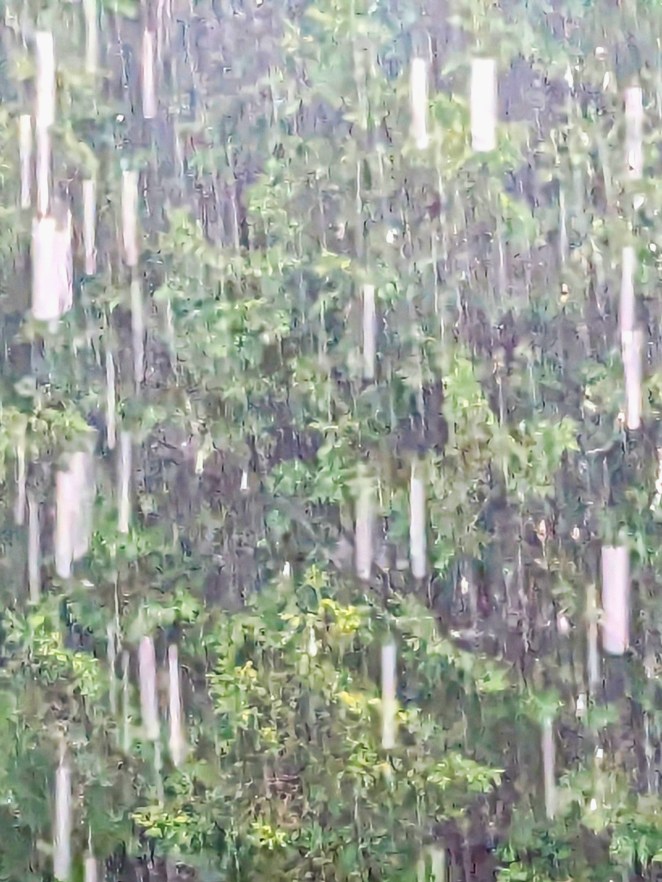
That’s a golden oldie from a couple of years back. I did both jabs in the same arm this year and didn’t feel a thing. It didn’t rain either, but look at the muck coming down in the photo – we had a bit of that a couple of days ago. Welcome to our Canadian half-winter. We used to get 3 metres / ten feet of snow every winter. Last year I only used the snowblower of three occasions. No wonder I think of it as a half-winter – winter ain’t what it used to be.

Dorset Knobs and Old Vinny

Dorset Knobs and Old Vinny

Five Lysol wipes remain in the can.
As rare as hen’s teeth or Dorset Knobs
and old Vinny, they have become precious
items sold in marked up prices online
by people who stocked up at the beginning
of the crisis on commodities they were able
to seize before rationing stepped in
and limited quantities were permitted
to each purchaser who waited patiently,
in line, to enter the super-market.

I place my leather glove on my hand
and move to the gas pump. How many people
have used it, pumping gas with bare hands,
and the metal surface retaining how many germs
who knows for how long? I cannot wear my mask
while pumping gas. Cover my face and they will
not serve me for fear I may flee without paying.
I finish pumping, open the car door, remove
my glove, put on my mask, pick up my cane,
and walk into the gas-station shop to pay.

As I limp towards the door, a man, mask-less,
holds the door open for me, his face less
than a foot from mine. “There you are, sir,”
he says, showing his teeth. “Service with a smile.”

I return to the car, remove a precious sanitizing wipe,
clean my glove, the car door handles, every spot
my gloved hand touched. Then I wipe the handle
of the gas pump and dispose of the precious wipe
in the garbage can nestled between the pumps.

Commentary:

Well, I am willing to place a bet with my favorite bookmaker, at Covey’s Print Shop, that not many of you out there know what Dorset Knobs and Old Vinny is or are. Moo has joined me in my wager and he is willing to bet that very few of you know where the line “où est le papier?” comes from. Even fewer will be able to sing the whole song! Oh dear, our world is only artificially intelligent, not really intelligent. In my teaching days I would ask the class if we were in a smart classroom. “Yes, sir,” they would reply. I’d then walk to the wall, tap it and ask it “What’s 2 + 2?” The wall never answered. I’d try again. “What’s 2 + 2?” – Silence. “Not such a smart classroom then,” I’d say to the students.

But I bet you all remember Covid, the days of taking all sorts of precautions, of wearing masks and gloves, of washing everything that came into the house, of washing hands, and not touching surfaces in public places where the unwashed may have left a winning lottery ticket with your Covid Number upon it. Oh dear, those were indeed the days. And this little poem, a golden oldie, recalls them. Let us hope they do not return. And let us doubly hope they do not return with a mutating or mutated helix of sinister proportions.

Hair Cut

Hair Cut 

Curly locks, wisps of grey and silver,
curve around my ears, cuddle my collar.
I stand in the bathroom, look at my scissors,
glance in the mirror, and start to hack.

I turn my head swiftly from side to side,
watching white hair falling, like snow.

“All done!” I look at myself in the mirror:
hair shorter, still sticking out in clumps,
but some curls still tickle and cling.

Not bad for front and sides. I still
can’t see the back, but if feels fine.
“Right” I say. “I’m ready for the show.”

What show? The one where I sit before
the computer screen and admire myself
before I click in the code, type the password,
and join the virtual meeting that today,
in the pandemic, passes for face to face.

Commentary:

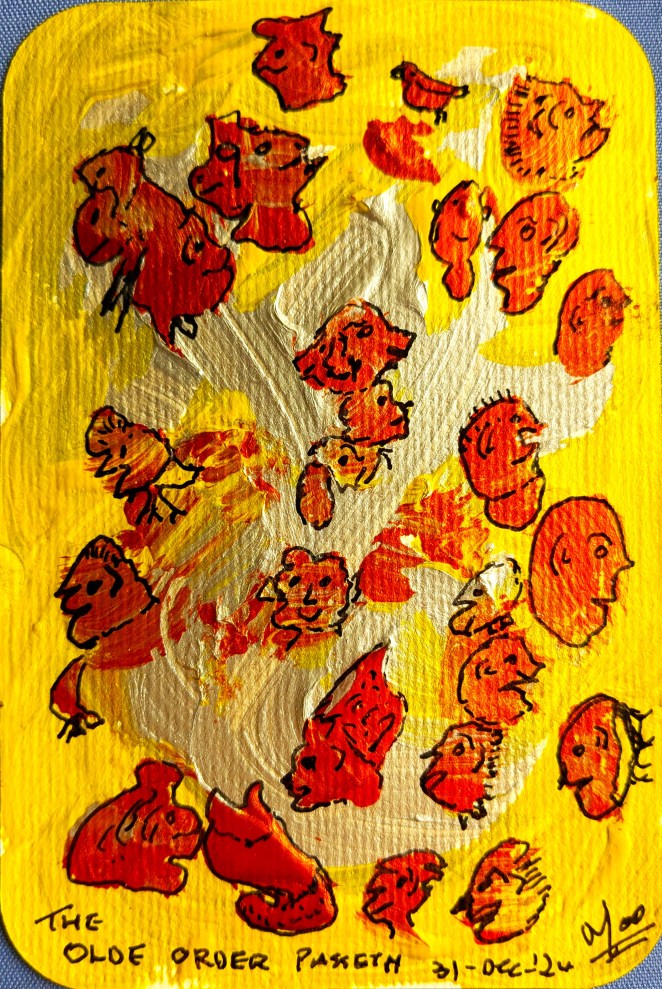
Face to Face – Moo helped me with this one by allowing me to have one of his ‘face to face’ paintings. Thank you, Moo. Sorry I said you weren’t too bright yesterday. And we both got the singer of All Shook Up wrong – it was Tommy Steele of course. Also, as you explained to me, you may not be great at adding two and two and making four, and you may be unenlightened with words, but wow, when you add a colour or two to the palette you are enlightened and enlightening and dazzle people with the lightness of your enlightenment. There – hope we can be friends again now. I would miss your paintings if you withdrew your services.

And this is a Golden Oldie. In 2020, when Covid walked with us, I started cutting my own hair – hacking might be a better word – and I have continued to do so ever since. In fact, I have only been to the barber’s three times since 2020. Each time, the hair lay so thickly upon the floor behind the barber’s chair that we walked knee deep in the white stuff. Great fun. How the young lady made fun of me. Right down the middle of the back of my head she found a large mullet that I couldn’t reach with either hand. She found that so funny. Asked me if I wanted to keep it. Of course, I said no!

I remember those face to face on the computer days. At least we couldn’t catch Covid from an image talking back to us on a screen. I always find those online meetings so difficult and awkward. I love the awkwardness of that word – awkward. The facilitator always began with – ‘Now, let’s all introduce ourselves.’ What on earth do you say on such occasions. ‘Easy,’ Moo told me. ‘I always say “Hi. I’m Moo. I’m a painter.” Nobody bothers me after that. Once somebody asked me what I painted and when I replied ‘houses’, everyone lost interest and the facilitator moved on.’

I always get tongue-tied and can never manage to be coherent. In fact, I am neither coherent nor cohesive and I often fall apart. “Hi! I’m Roger. I’m a writer.” This always opens the doors and the windows to all sorts of questions. ‘What do you write?’ ‘Have you published anything?’ ‘What’s your latest work?’ Of course, if I had any sense – and often I have less sense than Moo – when someone asks me ‘What do you write?’ I should reply. ‘English.’ Or ‘Italics.’ Or ‘Greeting cards.’ That last would be as much of a show stopper as Moo’s response – ‘houses’! Of course, I could get really inventive and say ‘Bilingual jokes for Christmas Crackers.’ Another pet peeve – have you noticed how the French and the English don’t match up? I could have a great old rant about that one. But don’t let’s talk about Fortune Cookies!

And suddenly, we have strayed a log way from the act of getting our hair cut during Covid. But, like many diversions, the journey is often more important than the destination, especially if we are amusing ourselves! And I hope you had some fun and took some joy from my words.

This Vessel in which I Sail

This Vessel in which I Sail

Trapped in this fragile vessel, with the pandemic
a passenger waiting to board, I drift from port to port,
looking for a haven, safe, to have and to hold me.

No harbour will let me dock. “No room at this inn,”
they say. “No haven here.” They wave me away.

Now I have no destination. Aimless, I float and every
where I go the message is: “No vacancy: no room at all.”

Unwanted, abandoned, I wander with wind and waves,
my only friends seals, porpoises, and whales.
I walk the whale road, leaving a frail, white wake behind.

This vessel has become a gulag now, a prison
camp where I exist just to survive. Each hour of each day
endless, boundless, like this shadowy, haunted sea.

Today there is no motion, no goal. What is there to achieve
but survival? Each day’s journey is sufficient unto itself.

Commentary:

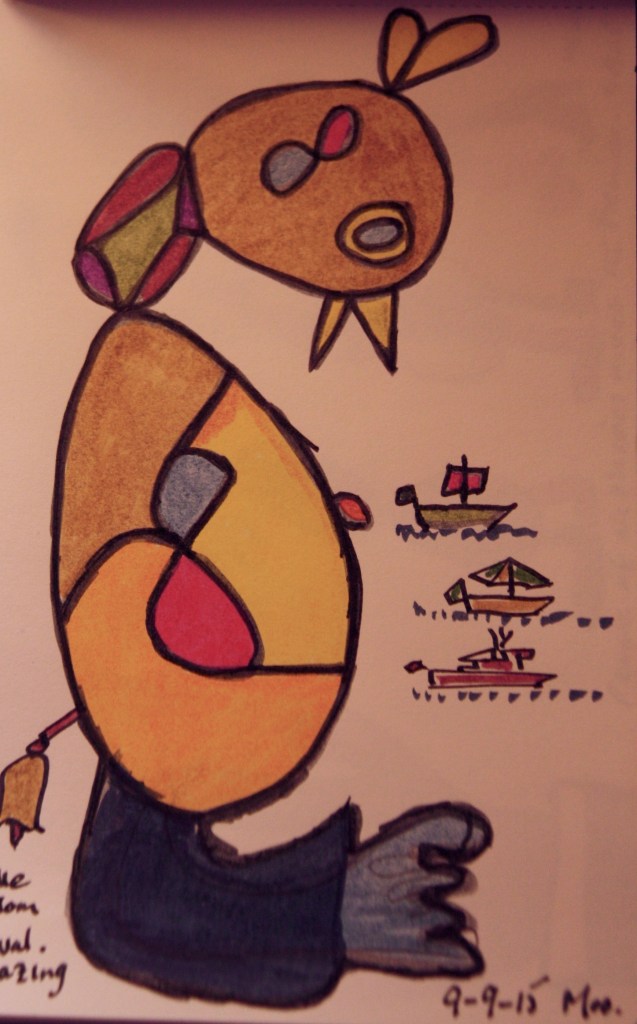
Moo’s cartoon, Naval Gazing, dates from 2015. That year I spent eight weeks in Moncton at the Georges Dumont, gazing at my navel while waiting for my anti-cancer radiation treatment. Naval gazing / navel gazing, indeed. Good one, guys. You make a great pairing.

The poem dates from 2020 when Covid stalked the streets and we wore masks when we were not confined to our houses. I thought of the tour ships, wandering the seas, with the disease on board, and no port wanting them. It was a strange time.

Golden Oldies, then, both poem and painting. There are signs, small at present, but still visible, that such days are on their way back. We must each ask the question – What is there to achieve but survival? Hopefully we will come up with a similar answer – Each day’s journey is sufficient unto itself. Journey well and journey safely, my friends.

Hello again – our old friend is back!

Hello again – our old friend is back!

Co-[vidi]-s
17 March 2020

I saw time change with the clocks
and my body clock
is no longer in sync
with the tick-tock chime
that denounces each hour.

Hours that used to wound
now threaten to kill.
They used to limp along,
but now they just rush by
and I, who used to run
from point to point,
now shuffle a step at a time.

Around us, the Covidis
thrives and flowers.
Wallflowers, violets,
we shrink into our homes,
board up the windows,
refuse to open doors.
We communicate by phone,
e-mail, messenger, Skype.

Give us enough rope
and we’ll survive a little while,
fearful, full of anguish,
yet also filled with hope.

Comment:

A Golden Oldie, written on 17 March 2020, St. Patrick’s Day.

Only yesterday, I read that Covid is back once more, in a new and mutated shape. Masking is once again demanded in the local Horizon hospitals especially in areas where patients and the public gather. I lost a couple of good friends to Covid last time round. I hope I don’t lose any in this new session. Guess I’ll be continuing to get my vaccinations and keep them up to date.

Whoever is reading this, I wish you all the best. May you stay Covid and illness free. May you also enjoy a long and happy life with sunshine days – and enough rain to keep the forests cool, the trees happy, the flowers flourish, and the wildfires at bay.

What strategies do you use to maintain your health and well-being?

Daily writing prompt
What strategies do you use to maintain your health and well-being?

What strategies do you use to maintain your health and well-being?

Covid changed the world and my outlook on the world. Since the first rumors in 2019, I cut my own hair and stopped eating out. I avoided crowds, left home as little as possible, wore a mask everywhere, and maintained as much distance as possible between myself and other people. I stopped inviting people around to the house, and, as a result, we have hardly had a visit or a visitor in the last four years. We got regular shots and boosters. So far, with those precautions and a little bit of luck, we have avoided Covid.

My health care deteriorated during the Covid period. I had very few visits to my GP’s office, and most business, like prescription renewal, was done over the phone. Consultations were by telephone as well. I missed out on the regular blood tests that my urologist / oncologist had been scheduling for me, after a bout with prostate cancer. These picked up again in late 2021, and were resumed in 2022 and 2023. Things seem to be moving well currently. Thank heavens.

I interpret well-being as my state of mind, rather than my state of body. I would say that my well-being suffered from my lack of human contact, although I have slowly developed a series of online support groups. In this way, I was able to continue my writing, for example, in Zoom sessions. I also missed my family visits. I no longer travel well, and due to Covid restrictions, I did not see my daughter or my granddaughter from 2019 to 2022. Clearly, we all missed the family closeness and we were all affected. However, we are used to isolation from family. Boarding schools, travel abroad in the summer, emigration to Canada, saw our family connections broken. That said, the advent of social media, Skype, Zoom, Messenger, texting, free phone calls, have all lessened the miles between us and maintained a contact that we never had, post migration, with our parents and grandparents, and extended family. The isolation and loneliness have been hard. They are hard upon all ageing, isolated people. We have suffered less than most.

As for strategies, I really have only three: 1. to adapt 2. to survive 3. to create beauty via my writing and my painting. Painting, prose, and poetry – these I can share with my friends. Vita brevis, ars longa – life is short, but art endures. Pax amorque – peace and love.

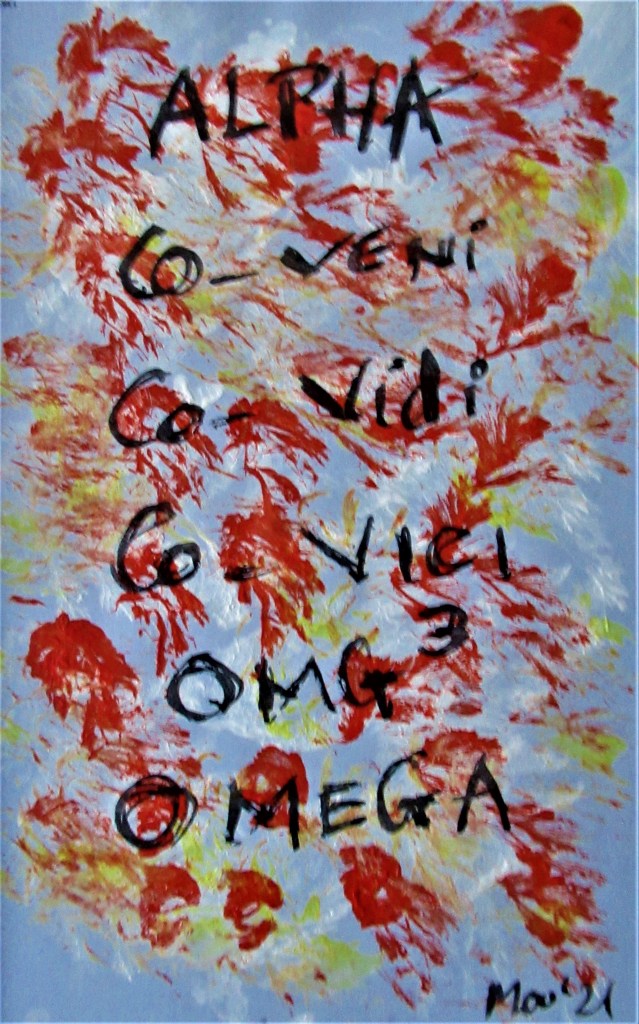
OMG-3

OMG-3

55-54 BCE. Julius Caesar visits Britain, but he doesn’t come as a sight-seeing tourist. When asked later about his trip across the channel, he replied with three little words that have echoed through the halls of history: veni, vidi, vici / I came, I saw, I conquered.

Filled with a desire to paint, I prepared a floral background. Overnight, those words came to mind: veni, vidi, vici. To them I added Alpha (the first letter of the Greek alphabet) and Omega (that alphabet’s last letter), these being the Greek letters currently being attached to the various variants of Covid-19. It being Sunday and me, having years ago sung in the choir of the ancient, 12th Century Anglican Church at King’s Stanley, I thought of the words of the old hymn “Omega and Alpha He”. Then, with a stroke or two of the pen, I added them to the painting.

Last, but not least, I added co- to -vidi to get co-vid-i. The painting was almost done. OMG-3 (OMG cubed in the painting) was the final touch and there you have it. The ultimate Covid-19 painting, or is it a poem? Whatever it is, it is a warning, or rather a series of warnings. (1) It is here. (2) It is real. (3) It is killing people. (4) We are currently at Omicron. (5) There’s still a long way to go to Omega. (6) It’s not over yet, not by a long way.

So my friends: keep well, keep safe, keep out of trouble, keep believing, and keep visiting this site! There’s something new here every so often. And once in a while it’s pretty and / or unique.

Migrants

Meditations on Messiaen
Why do the people?

4

Migrants

Think natural disasters. Think famine,
wars, violence, plague. How our world changes
when refugees arrive, blend, contribute,
offer so much, their languages, cultures.

Yet we still exploit them, stealing subtle
things, their identities, their energy,
their ability to adapt, to give
so much and really to take so little.

Who would want to build a wall,
to reject them, to deny entry?
Maybe a million Indigenous people
can actually claim the right

to belong here. Most of us are immigrants,
late-comers in one way or another.
To accept, to grow together in peace,
to establish a nation where people

need not fear imminent expulsion
for the color of their skin, their language,
their religion, their political thoughts,
the fact they may not even vote for us.

Click on the link below for Roger’s reading.

Migrants

A Rainbow of Clichés

Meditations on Messiaen
Why do the people?

2

A Rainbow of Clichés

It’s raining outside. A tympany of raindrops
drums rhythmically on roof and window.
Thunder rolls. Lightning flashes, lighting up the sky.
our lights flicker, but we don’t lose power.

“It never rains in the bars,” they say in Spain.
Yet it’s raining in my heart, a sad song,
raindrops, tear drops, my best friend,
tested for Lyme disease, now tested for Covid.

“It never rains unless it pours,” they say in Wales.
And here it comes again, that nineteenth session
of Covid nerves, heart fluttering, nostrils twitching,
that unmasked girl standing six inches behind me,

texting, all thumbs, totally absorbed in the medium
that delivers massage after massage, click here,
out from the empty spaces between her ears and into
the void beyond, bouncing from tower to tower,

small stones cast in a tranquil pond, rippling their way
to whatever eternity lies out there, external realities ignored,
enveloped in the smoke screen of the texting self,
mask-less, fearless, coughing, not covering her mouth.

Here come those clichés. ‘I’m all right, Jack.’ ‘It’s all
about me.’ ‘My life, my freedom to do what I want.’
“It ain’t the cough that carries you off, it’s the coffin
they carry you off in.” A coughing fit, fit for a coffin.

Better, I suppose, than World War One trench warfare,
when it’s over the top, and look: officers, chaplains, men,
the whole battalion, hanging from that old barbed wire.

Click on link below for Roger’s reading.
A Rainbow of Clichés

Real Friends

Real Friends
Thursday Thoughts
23 September 2021

A good friend of mine wrote to me the other day. “Have you noticed,” he asked, “that you have less REAL friends the older you get?”

In my reply, I said the following. “Oh dear yes, and triply so since Covid set in. I have a few remaining friends who correspond regularly on e-mail, a couple of friends who talk regularly on the phone, and the rest, in spite of all the Covid-19 promises of TLC for the aging, have been AWOL for the best part of two years. Mind you, I have kept myself to myself. In fact, I have become rather anti-social in face to face / mask to mask situations!”

This question-asking friend, now lives in another province, in a care home for the ageing. Over the ages, such homes have had many names. In South Wales they were called the Workhouse, and that’s where the broken old men from the mines and the industrial smelters ended up. Places of shame. Places to be feared. Then we had Old Folks Homes. Some were called Sanctuaries. Others are now called Hospices or Care Homes and the Hospitals themselves have been forced to take on the task of looking after our old and frail senior citizens. Some of our seniors were lucky, fell into good homes, and were blessed. Others were cursed, poor things, fell into hopeless surroundings, and lost all hope. As for the homes themselves, some were run by religious groups, others by charities, a few by the state or local health authorities. Some were non-profit, others, well, we are having a debate, here in Canada, about some of the more unscrupulous and unhealthy care homes that are run for healthy profits right now.

And that debate was caused by Covid-19. Under-paid employees, working several care homes, not just one, travelling from home to home, and the pandemic entering those homes and settling in there, causing immense suffering, damage, and death. I look on this as CCD. Originally, the initials spelled out Colony Collapse Disorder, the death moth that entered the bee-hives and caused their buzzing to end in silence. Now, for me, they stand for Covid Collateral Damage. And that form of CCD is everywhere.

You can see it in families that are breaking up. One partner loses their job, their self-respect, and goes out looking elsewhere for comfort and for pastures green. Another is forced into excessive overtime because other members of their team, now working from home, all of them, cannot cope with home-schooling, house-work, partner, and children present all day long. They break down under the stress, can function no longer, and society starts to fall apart.

Mind you, it has been falling apart for years. When I lived in Spain, I was adopted by a family in Santander who owned and lived in a huge house. The grand-mother was the matriarch and she shared the house with three siblings, two unmarried, and one divorced. The parents lived there, on and off, as they had jobs elsewhere. A country cousin, same age as the grand-parents’ generation, also lived there and did the cooking and cleaning. And the grand-children settled in there too, during term time. When the family gathered for the Sunday meal, there were 22-24 of us around that dining-room table. In such a large family setting, there were baby-sitters at hand, somebody was always employed, somebody always knew the solution to a problem, or could find one pretty quickly.

When we lived in Swansea, two sets of grand-parents were close, as were aunties, uncles, cousins, and a network of friendly faces, all of whom gathered round in an emergency. But, bit by bit, that family disintegrated. Some went to London, others to Bristol, a few to Birmingham, we moved to Cardiff. In Cardiff we went from a family network to a nuclear family, consisting of my mother, my father, and I. Both my parents worked and I was at a boarding-school, term-time, but a latch-key kid during school holidays, cooking for myself, looking after the house, waiting for my parents to come home. When I, in my turn, left for Canada, my parents were left as a family of two, then, when my mother died, a family of one. Of course, there were Social Services. Social Workers visited every so often, but the gaps got longer, the loneliness grew, and a terrible isolation took over every aspect of my father’s life. When I flew back from Canada to Wales to visit him in Wales one year, I found no food in the house, my father totally uncared for, unwanted and, by this stage, unwilling to cooperate. he wanted to stay in his home. He wouldn’t move. In truth, he had become a miserable old man who wouldn’t change, wouldn’t accept help, and could no longer look after himself.

On the anniversary of my mother’s death, I called him from Canada. He did not pick up the phone. I called his brother, who lived in another town some forty miles away. He’s like that now came my uncle’s reply. He’s fine. Don’t worry. But worry I did. Three days later, his brother called me back. My father had suffered a heart attack and a stroke on the anniversary of my mother’s death. He had lain on the bedroom door for three days, no food, no water, no visitors, until his brother had finally got worried and decided to come round and see what was happening.

“When the going gets tough, the tough get going.” We all know that phrase. Unfortunately, many are not that tough. They get going all right: they go right out through the door and vanish into the sunset. So, my thoughts for today: what exactly is a friend, what do friends actually do, what is a fair-weather-friend, what are friends for, how many real friends do we really have, and yes, the question that started me on this rant, do real friends diminish in number as we grow older?

As my grand-mother told me, a long, long time ago, in the warmth of her Welsh kitchen: “Roger, a friend in need is a friend indeed.” Luckily, I still I have some real friends who are there when I need them. Thank you, real friends. You know who you are and I am very grateful to you. Covid-19 and CCD have not been easy.