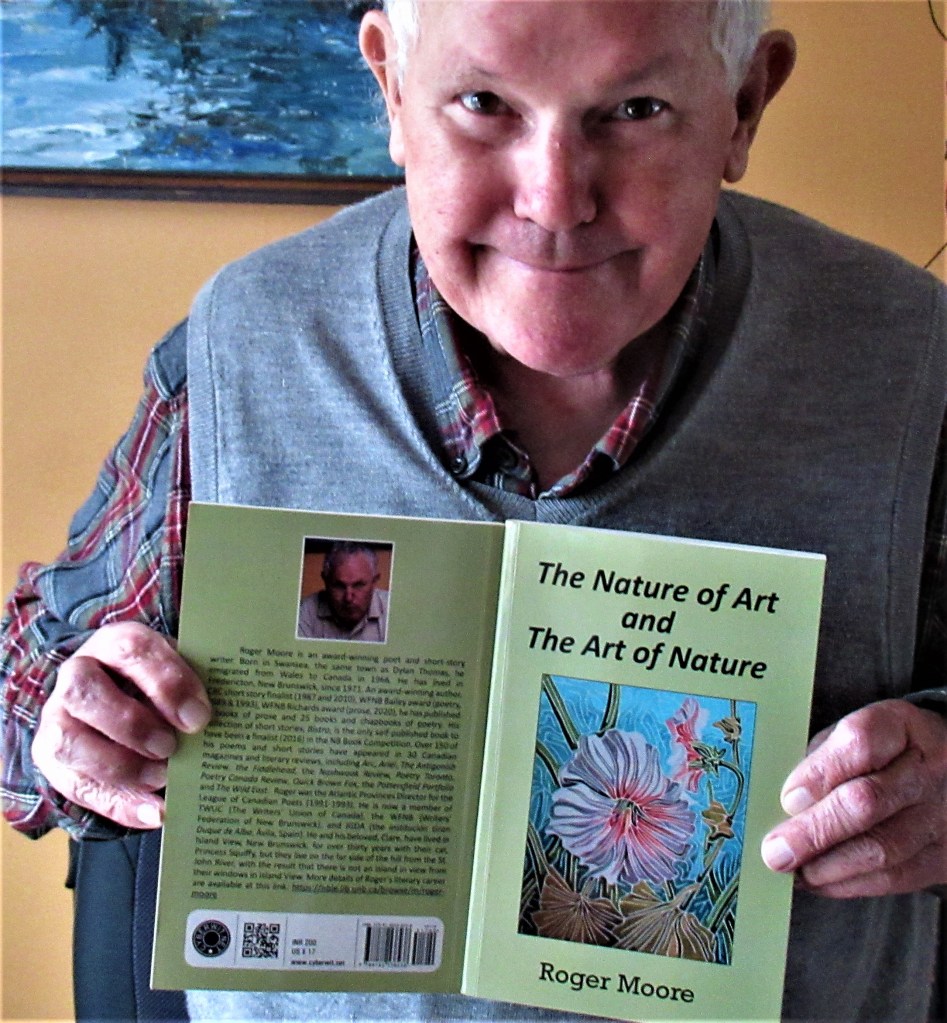
It’s here and it looks beautiful. The photo does not do the cover justice as Geoff Slater’s painting is just phenomenal. The book holder wishes to announce that the photo does not do him justice either. He is much more good-looking in real life. I don’t have the Amazon / Kindle details yet, but I’ll post them as soon as they arrive. meanwhile, you will all have to make do with one poem. But remember: “A poetry book is a dream you hold in your hands.”
Still Life with Hollyhock Geoff Slater
How do you frame this beaver pond, those paths, those woods? How do you know what to leave, what to choose? Where does light begin and darkness end?
Up and down: two dimensions. Easy. But where does depth come from? Or the tactility, the energy, water’s flow, that rush of breathless movement that transcends the painting’s stillness?
So many questions, so few answers. The hollyhock that blooms in my kitchen is not a real hollyhock. It is the painting of a photo of a genuine flower that once upon a time flourished in my garden.
A still life, then, a nature morte, a dead nature, portrayed in paint and hung alive, on display in this coffin’s wooden frame.
She surveys her empire from a tall tree, then steps into space, plunging her body’s weight downwards, diving into fragile air.
A feathered arrow, she makes contact, feet first, and pins the unsuspecting robin to the ground. His shrill shriek emerges from a beak that shreds failing life.
The hawk’s claws clench. Her victim weakens. His eyes glaze over. One final spasm, a last quick twitch, the robin is gone.
One wing drags, flaps weakly, borne skywards in the hawk’s triumphant claws.
Jane gave me the honor of writing the foreword to her book and I did so with great pleasure.
Jane Tims: Niche. KDP. Book Review
Niche, the fourth poetry book published by Jane Tims, is a neat configuration of six segments that elaborate and illustrate the poet’s original definition of the multiple meanings of her title word niche. It is very difficult to separate the author from the act of narration as her keenly observed and skillfully executed drawings, together with their verbal representation on the page, are so autobiographical and so much an extension of her artistic and professional abilities that the objective separation of writer and text is scarcely possible. It is hard to forget that Jane Tims was, and to a great extent, still is, a highly competent professional botanist. The harnessing of the professional botanist, with her unique drawing skills and scientific knowledge, to the poet and auto-biographer is a key factor in the reading and interpretation of this text in which acute observation blends with an intimate knowledge of the observed botanical world, both flora and fauna, and this allows the poet, in her role of poetic narrator and lyrical voice, to weave a network of poems that are, at one and the same time, objective and intensely subjective.
The author emphasizes this when she writes in the Preface that “In biological terms, the niche is the quality of a space occupied by a living thing, the sum total of physical, nutritional, biological, psychological and emotional needs gathered together in one place.” She also reminds us that in human terms “niche can be a metaphor for home, community or personal space” and it is within these metaphoric spaces that the poetry text is elaborated. The text becomes a linked mixture of visual drawings, iterative thematic imagery and associative fields, all centred on the multiple meanings of niche. These terms are both biological and human in nature and the poet’s named world meets at this juncture between the human and the natural.
The section occupying space (1-19) bears the subtitle satisfying need and begins with a setting out of what this means in the following 12 poems and 4 accompanying drawings. The poem ‘apples in the snow’ with its companion drawing stands out for me. The section strategy, subtitled solidifying position (21-43) outlines in poetic terms, how plants, animals, and humans ensure their own survival. The section praying for rain, subtitled, avoiding danger and discomfort (45-68), offers views on discomforts and dangers. It also opens the discussion—relocate or stay where we are? The section mapping the labyrinth or places I have occupied (69-83), which contains the wonderful sentence “When I get lost on the road ahead, I look to the road behind me,” throws open the multiple meanings of home. The section new ways for water, subtitled coping with change (85-98), offers a double landscape, first, external, the things seen, touched, examined, remembered and described, and then the internal landscape that reflects upon them and is reflected in them. Finally, forgetting to move, with its subtitle getting comfortable (99-111), presents an autobiography that links observer (the twin personage of author and narrator) to observed (nature, both flora and fauna, and the added element of autobiography and self) via the symbiotic relationship of botanist to botany.
Two moments stand out for me. (1) Sadness is in seeking the space that is never found. (2) Loneliness is in trying to return to a space once occupied but no longer available. The whole concept of the Welsh word hiraeth is summed up in these two lines. Carpe diem, Jane Tims’ poetry indeed seizes the day and, with its minute, intense observation, it preserves so many precious moments. It also pays attention to that which has been lost, those moments that are irretrievable. They will vary for each reader, but hopefully, like me, you will take great pleasure in discovering them for yourself.
Comment: Brian Henry of Quick Brown Fox picked up this review and published it on QBF. Thank you, Brian and thank you Jane, you both do me great honor. Here’s the link: Niche on QBF 14 March 2021
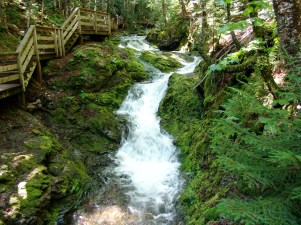
What is it about running water that it explodes like long, blonde hair over moss and rock frothing with sunlight the diamond sparkle, the freckling sound, light flickering downwards, fine threads of angel hair tumbling from above, falling,
white, over earth’s rocky shoulders, pillowed across soft green quilts
poured down from heaven’s skies watering the earth’s dark throat,
sinking through the soil emerging in rivulets and brooks until all waters are one and the rains join hands to splash, rejoicing,
dryads and naiads bathing together in deep, cool pools, nymphs reborn, acrobats over rocks as water falls to seek the sea.
March 1 is St. David’s Day: Dewi Sant, patron saint of Wales. While we are here, immersed in cold and snow, in Wales, spring is arriving, the daffodils are out, trees are budding. This poem is a reminder that winter will end and sunshine and spring will return. So for St. David’s Day, I wish you joy and hope.
Earth to Earthlings
“Get out and about,” she told me. Take off your socks and shoes. Walk barefoot on the earth and grass: twin pleasures, you can choose.”
I took two canes, one in each hand, and left the house to walk the land.
In the garden I took off my shoes to walk barefoot on the lawn; when grass sprang up between my toes I was instantly reborn.
I stood in the shade of the crab apple tree and let leaf and flower spill over me.
Sunlight took away my frown and freckled a smile on my face. I was blessed again with hope and light; earth and grass filled me with grace
When white blossoms filtered down they gifted me a flowery crown.
I stooped to reach my shoes and carried them home in my hand, maintaining as long as I could my contact with this magic land.
“Blue and green should not be seen without a color in between,” thus spoke my mother.
What did she know of the Peace Park grass sweeping spring-clean to head pond waters?
Didn’t she sense the frail brown fringe of rock scarfing between green grass and head pond blue or the white caps lacing cow parsley on the stones?
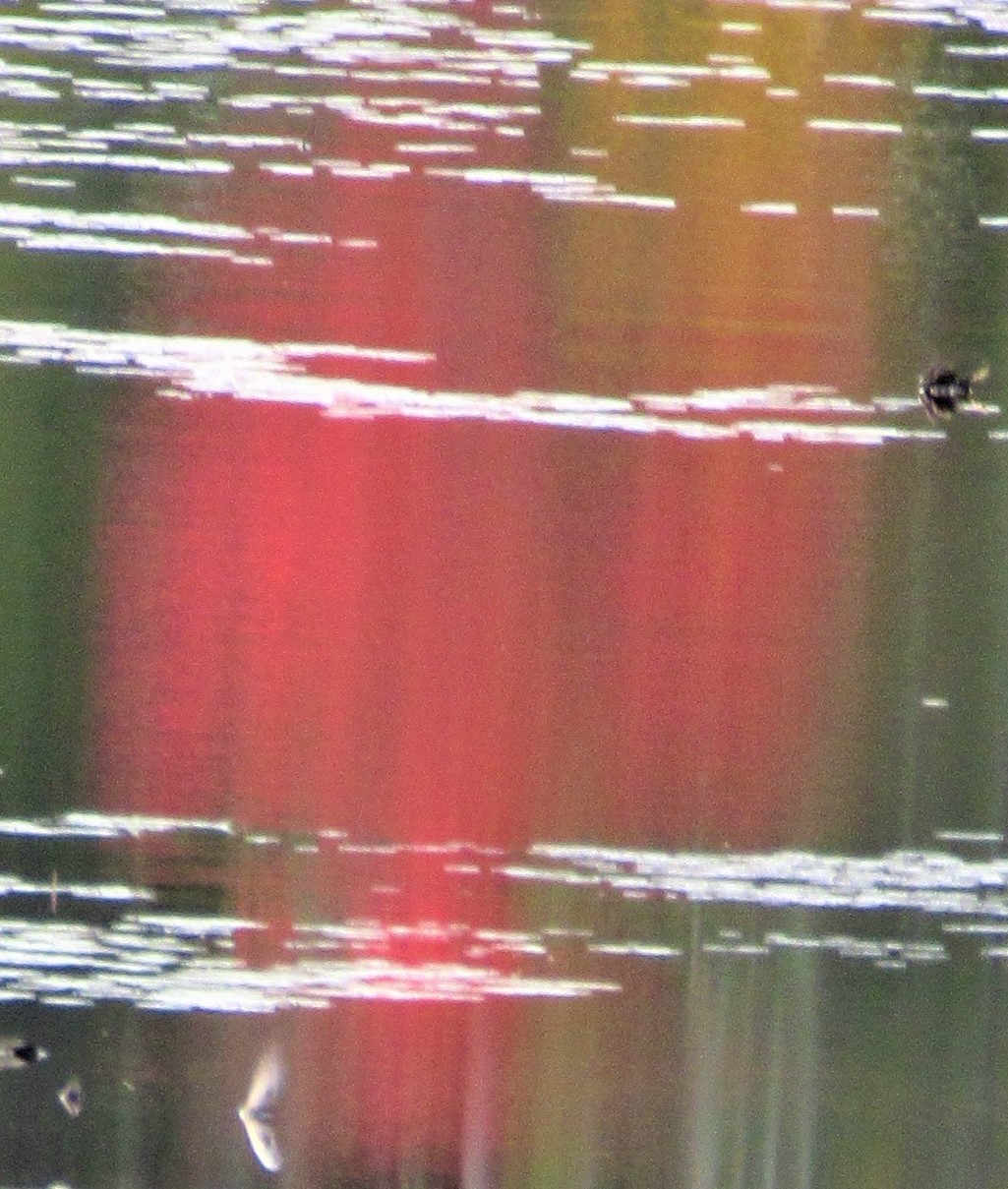
I know she knew nothing of yellow and red leaves, brown spotted like an old man’s hands, freckling waters, fretting at the fragility of nature’s delicate balance.
Beaver Pond, Mactaquac, on a fine spring day:
so sad to sit here knowing you can no longer
walk the trail. I remember the sun on your hair,
white, a flag of surrender to old age besieging
your mind and body. It cannot be seen on the board
walk where you stopped to commune with newts,
frogs, birds, fish, ducks, and the great blue heron
you disturbed. Remember? He rose from the reeds
with an anguished cry and a crack of mighty wings.
The wind in Island View is chill today, not a day
for walking in the wild. Monday: men arrive in a truck
and haul our garbage away. So much detritus,
such a mess at the roadside as winter ends and spring
brings thoughts of freedom to roam beyond spells
of ice and snow. Memories: I pack them into a green
green plastic bag and stuff them in the dustbin.
I want to be free. I want you to be free. I want to sit
and watch you wander, like you did last summer
contemplating the multiple meanings of grass, sun,
bird-song, herons, ospreys, beavers, their lodge,
this dam they constructed, this pond in which
they swim, nocturnal creatures, who live far away
from this lock-down and from our silent visits banned.