Last night, a cataract of flame flowed down the cathedral wall. A wooden bull danced in the square, sparks struck fire from his horse-hide hair. A red speck on my shirt burned through to my skin.
Today a heart of fire burns in an iron barrel: who will be chosen for the daily sacrifice?
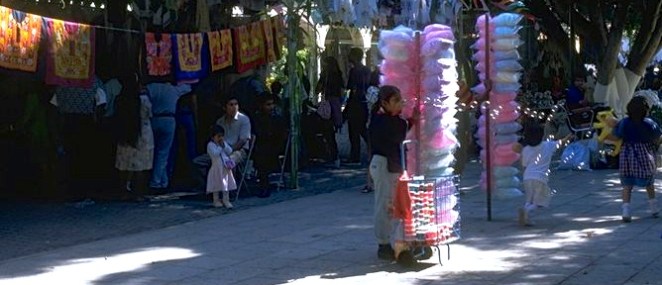
A sharp blue guillotine poised between buildings: this slice of morning sky. Scorched circles, open mouths: wide-open butterfly eyes burn holes in the crowd’s dark cloud of a face.
A street musician stands in the shade beneath the arches playing a marimba. Sun tip-toesits danse macabre across bamboo tubes. Sunlit bubbles float dreams across the square.
Five reasons why a Teddy Bear is much better for you than a Kitty Cat. I know, I know: cat lovers will go wild. They think cats are such lovely cuddly things. And they believe strongly that nobody can resist a warm, loving, darling, purring bundle of fur. Well, I can resist cats. And I can give you five good, sound, solid, 25 carat reasons why Teddy Bears beat Kitty Cats any day of the week.
One Teddy Bears do not need to be fed on a regular basis. In fact, one piece of kibble will last a Teddy Bear for a very, very long time. And you can’t say the same for your cat. So less expense, no need to feed, don’t have to put that fresh water down every day, no constant fawning attention when hungry or just plain greedy, don’t have to worry about treading on the cat’s tail … In fact, a Teddy Bear wins out every time.
Two “Don’t mention cleaning out the kitty litter. Promise?” “I promise. I won’t mention it.” “Word of honor?” “Word of honor. Fresh Walnut and all that.” “You just mentioned it.” “Mentioned what?” “The kitty litter.” “I didn’t.” “You did: you said ‘Fresh walnut.’” “So?” “So that’s what keeps the kitty litter from smelling.” “Does it smell much?” “Quite a bit. I hate cleaning it out.” “Why?” “It’s so smelly, filthy, grainy, lumpy, stinking …” “So, why do you do it, then? What you need is a nice, clean, environmentally friendly Teddy Bear. There’s no cleaning up after a Teddy Bear. Who’s ever heard of Teddy Bear Litter?” “You said you wouldn’t mention it.” “Mention what?” “Kitty litter.” “I didn’t, you did.”
Three Teddy Bears don’t have off-spring. You don’t need to neuter them, and they don’t need taking to the vet. Nor did they sit and wait in family groups for their photos to be taken. What we have below is a fake photo placed there by the unscrupulous enemy for their own pro-cat propaganda purposes.
Four Teddy Bears are very obedient. If you tell a Teddy Bear to “sit” or to “stay”. He does so. Immediately. And he stays where you put him. There’s no clash of wills and egos, no conflict at all. Teddy Bears are easily trained and very obedient. Also, they don’t want to go out in the garden and wander beneath the bushes to shriek and whine when the moon is full. Now, if you have cats and you want them to sit and stay still, you must give them something to watch or to play with. Chipmunks and garden birds aren’t cheap, you know, and they are less trainable than cats. How long do you think it takes to train a chipmunk to just sit there quietly to entertain your cat? Especially when it’s being hissed at and the cat is bouncing the window with anguish? Also, Teddy Bears don’t climb on furniture, nor do they break ornaments, nor sink their claws into your hair as you pass beneath them, nor do they drop on you, unexpectedly, from great heights.
Five Five and finally, when there’s a moth, a fly, or a mosquito on the ceiling at night, you can’t train your kitty cat to fly into the air and snatch it off the ceiling. But as for Teddy: grab him by one leg, preferably the back one; give him his commands “Ready, Teddy, Go!” and hurl him skywards. With a little practice, he’ll nail that nocturnal buzzing monster every time.
No: all things considered — and I promise I won’t mention, you know what, that little box the cat sits in — there’s nothing better than a Teddy Bear. Wise, silent, friendly, cuddly, obedient, friendly (did I say that?), needs no training, always there when needed, waits patiently for you when you’re away, never stalks off with tail in air, never gets out and hides in the garden where you can’t find him, adorable, cuddly (did I say that already?) … Give me a Teddy Bear anytime.
“Meeting her, unexpected, with another man, and me, with another woman, all four of us looking bemused by what the other had chosen in each other’s absence — suspense and silence — then the halted, faltering politeness of a nod, a handshake, ships passing in the night, signals no longer recognized.”
The iguana that guards the front door of our house. At night he comes alive, goes round on patrol, checking and securing everything and everybody. Beware the jaws that bite, the claws that clutch!
Striations
There are striations in my heart, so deep, a lizard could lie there, unseen, and wait for tomorrow’s sun. Timeless, the worm at the apple’s core waiting for its world to end. Seculae seculorum: the centuries rushing headlong. Matins: wide-eyed this owl hooting in the face of day. Somewhere, I remember a table spread for two. Breakfast. An open door. “Where are you going, dear?” Something bright has fled the world. The sun unfurls shadows. The blood whirls stars around the body. “It has gone.” she said. “The magic. I no longer tremble at your touch.” The silver birch wades at dawn’s bright edge. Somewhere, tight lips, a blaze of anger, a challenge spat in the wind’s taut face. High-pitched the rabbit’s grief in its silver snare. The midnight moon deep in a trance. If only I could kick away this death’s head, this sow’s bladder, this full moon drifting high in a cloudless sky.
Comment: a fitting ending for the month of February: ubi sunt? Where have all those days gone: Ou sont les neiges d’antan?
Flowers from Oaxaca. They will be carried by the young girl who will place them on her head. Her brother will walk beside her on her pilgrimage around the twelve central Oaxacan shrines.
Pilgrims
On the cathedral steps, a boy pierces his lips with a cruel spine of cactus.
The witch doctor catches the warm blood in a shining bowl.
The boy’s sister kneels before el brujo, who blesses her in an ancient ritual.
Walking the pilgrim road, she will visit all twelve central Oaxacan shrines.
On her head she will carry this basket filled with flowers and heavy stones.
El Brujo casts copal on his fire. Brother and sister girl inhale the incense. The witch doctor marks their cheeks with blood.
Looking back at my old photos from Oaxaca I am amazed at the contrasts between sun and shade, light and dark. I will never forget that ultimate glory: a sunbeam through a stained glass window, casting fragmented light.
San Pedro Oaxaca
A single sunbeam descends. Sharp blade of a heliocentric sword, it shatters the chapel’s dark. Fragmented light stains me with glazed colors.
A pallid lily truncated in the dawn’s pearly light, Peter, the young widower, kneels in prayer.
His head wears a halo. His pilgrim palm presses into the granite forcing warming fingers into a cradle of cold stone.
His flesh clings to the statue’s marble hand. A mingled maze: marble and human veins.
Light in dark bright yellow stridence shrill golden dog’s bark to warn off death’s wolves that freeze her blood
she dreaded night’s unease the devil’s wintry anti-spring life’s darkest sparks
but loved the daffodils’ sunny March cadence of brief piercing dance
Comment: A Golden Oldie. My mother loved daffodils and planted them all over the garden in Cardiff, Wales. They are the national flower of Wales and break into blossom just in time to welcome St. David on St. David’s Day, soon to be upon us, Dydd Dewi Sant.
Daffodils A poem for the lady who brought some to us when Clare fell
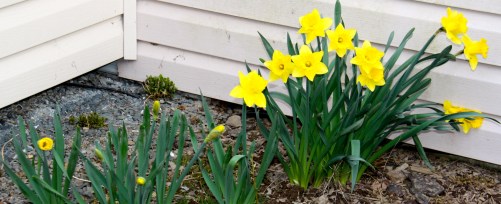
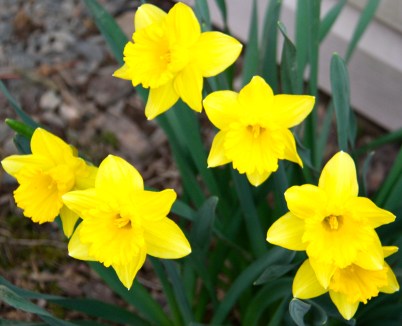
Daffodils in our garden, last year in Island View. We won’t see the live ones until May, at the earliest. I dream of them at night, tossing their heads in sprightly dance’, in Roath Park and Blackweir Gardens, Cardiff. They will be out now, all ready to welcome Dydd Dewi Sant on March 1.
Daffodils
For ten long days the daffodils endured, bringing to vase and breakfast- table stored up sunshine and the silky softness of their golden gift.
Their scent grew stronger as they gathered strength from the sugar we placed in their water, but now they have withered and their day’s done.
Dry and shriveled they stand paper- thin and brown, crisp to the touch. They hang their heads: oncoming death weighs them down.
from an original painting by Rogier van der Weyden (1399/1400-1464)
Black Angel
You cannot hide when the black angel comes and knocks on your door.
“Wait a minute,” you say, “While I change my clothes and comb my hair.”
But she is there before you, in the clothes closet, pulling your arm. You move to the bathroom to brush your teeth.
“Now,” says the angel. Your eyes mist over.
You know you are there, but you can no longer see your reflection in the mirror.
Comment:
I first saw the Black Angel in Aldebarán’s cultural store in Ávila (2006). She sat there, in the shop window, along with several other angels, and I worshiped her from the distance of the street. Her image was taken from an original painting from Rogier van der Weyden (1399/1400-1464). This was turned into a 3-D image and then converted into the statue I saw in the shop window.
I brought the statue back to Island View, placed it on the shelf above the fireplace, where it still rests, and wrote several poems on the theme of Angels. I gathered them together in a chapbook entitled All About Angels that I self-published in Fredericton in 2009. The chapbook was dedicated to Clare’s great-aunt, D. E. Witcombe who departed this world on October 15, 2008.
All About Angels was also based on a book of a similar title, Sobre los Ángeles, written by Rafael Albertí, one of the major poets of Spain’s Generation of 1927. I avoided the ambiguity of the Spanish title — Sobre (in Spanish) can mean Above or Beyond as well as About — by limiting my own title to All About Angels.
For Carl Jung, angels are the messengers sent to inform people of the state of their world. For me, they are also the wild creatures that inhabit the world around me and often take the form of chickadees, crows, mourning doves, woodpeckers, deer, foxes, chipmunks, the occasional bear, and other spiritual creatures. They can be best seen in those moments of solitude when we are most open to the natural world around us. Then, and sometimes only then, we can hear the urgent messages they bring.