What are your thoughts on the concept of living a very long life?

Daily writing prompt
What are your thoughts on the concept of living a very long life?

What are your thoughts on the concept of living a very long life?

A simplistic question in so many ways as so many definitions are needed. How long is long? 100 years? 200 years? Back to 1066 to watch the Battle of Hastings? 1588 to see the Spanish Armada sailing up the channel? 1815 to see the Battle of Waterloo and talk with Wellington and Napoleon – why not? I am Anglo-Welsh and New Brunswick is bilingual, French and English, so why shouldn’t I – or anyone else who wants to live such a long life – have a talk with both of them?

And does living a very long life include the concept of being healthy, and happy, and wise, and not living in squalor or poverty or in a permanent war zone? How about being kept in an incubator, or an iron lung, or on permanent life support? How long is long under those (or similar) conditions. And what about friends and family? In the Celtic myths, men who visit the fairies in Ireland and live and eat with them, come back to reality [now define that word in this day and age] only to find their friends and families long dead and gone. So what would the conditions of the ‘return’ be like if a long life meant watching the passing of everyone and everything you know or returning to a world you no longer recognized?

And change is so rapid nowadays. AI is developing so quickly, how can anyone keep up? I know that as I slow down (mentally and physically) I understand less and less about the machines I use, including my Nexus Rollator. Does a ‘very long life’ include sipping from the Fountain of Youth? Or does it consist of an enlarged old age – post molestam senectutem, nos habebit humus after a troubled old age, the earth will have us. I am sure we all recognize Gaudeamus igitur, in Latin, and its theme of Ubi sunt qui ante nos in mundo fuerewhere now are those lived in this world before us, and if we don’t, then how swiftly we have forgotten the power of Latin is with its memorable phrases and omnipresent seeds of memento mori .

For me the question is a clear one – do you wish for quantity (a very long life) or quality (a very happy and successful one, even if it is a bit shorter)?

A close friend of mine, one of the most honest and courageous people that I have known, suffering in a horrific way from terminal cancer, asked for, and received, MAID (Medical Assistance In Dying). It was a long legal and medical process to get MAID, involving famiy members, lawyers, doctors, and many other things. As the Romans used to say mors omnia solvit death resolves everything. My friend and his family preferred to shorten life – on their own terms – rather than prolong it under such prolonged suffering and torment. My friend, I salute you and your family and commend you for your bravery.

So, define the terms within which that very long life would be lived – and then ask yourself the question once more. Because as it stands right now, with no further understanding, the answer should only be “depends”. And remember, lives are like swimming pools – they have shallow ends and deep ends. All too often when you talk about life and the end of life, so much depends.

Comment:

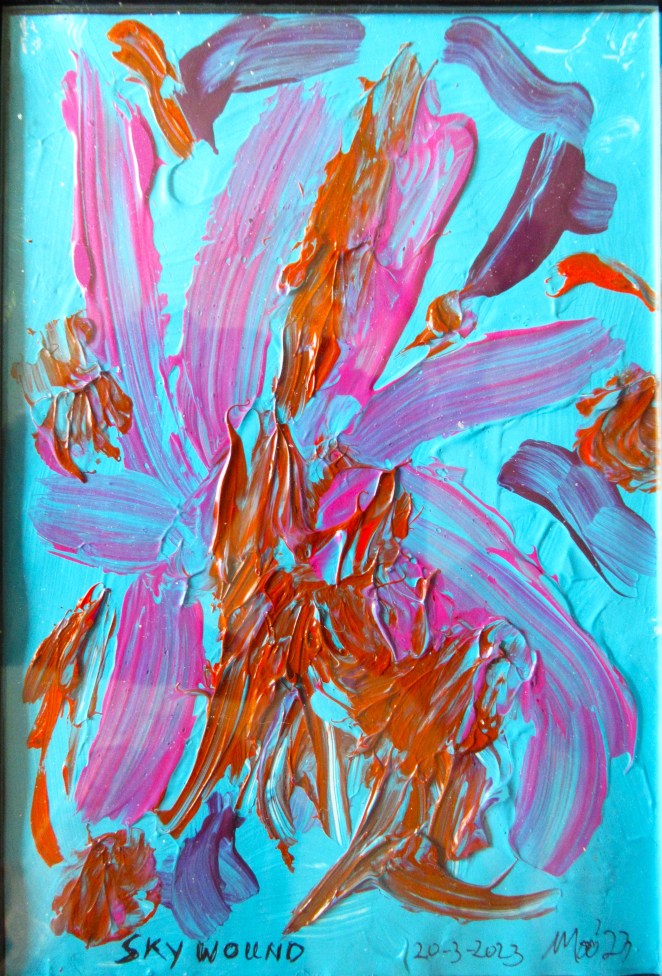
I must thank my friend, Moo, for his depiction of the fireworks from New Year’s Eve. Sky Flowers, he calls it. The fireworks have gone already – but – vis breve, ars longa – his painting still survives.

Nightmares

Nightmares

The jaws that bite,
the claws that snatch,
the hands grasping you
through the railings
as you scuttle upstairs.

Those same hands descending,
beating, shaking you,
back and forth, a rag doll,
then thrusting you into
that cold, dark cupboard
beneath the stairs, no story,
your childhood reality.

And now, those dreams come back
and you lie awake watching
as the grey revenants return
and the nightmares repeat
themselves, again and again.

And return they will, until
that final curtain call,
when the stage turns black,
and you’ll never be taunted,
haunted, and hunted ever again.

Comment:
On Thursday night we discussed the difference between poetry of play and poetry that expresses the authenticity of being. Into which category does this poem fall. Intertextuality – the idea of texts talking to texts. How many different texts can you count, talking to each other in this poem that may even be a Jackpine Sonnet?


When are you most happy?

Daily writing prompt
When are you most happy?

When are you most happy?

What on earth does that mean? When? Are we talking time of day, or time of night? Are we talking a season of the year? Are we talking mood swings – happy now, oh dear, mood swing, not happy now? Are we talking Hen Wen, the magic white pig at the feeding trough? “I am at my happiest, oink-oink, when I am eating a big burger from …” – and here you name your favorite burger outlet. None of that Hen Wen nonsense applies, of course, if you are vegetarian, vegan, or have an allergy to burgers or buns!

I can tell you when I am least happy – 7:30 am, on a wet, damp, cold, icy, snowy winter morning, when I have to get up, get dressed, and go out in the mush and the slush to have an early morning blood test – no food or drink for 12 hours – at the local hospital. Last time I did that, I couldn’t find a parking spot, and drove round and around until eventually one opened up, as far away as possible from the hospital of course. No, I was not a happy camper on that occasion. Especially when I slipped on the ice, returning to my car, and then found someone had driven into my side while I was parked there. Oh, that made me so happy and so jolly, I laughed until I cried. [I do hope you can recognize sarcasm when you see it.]

So, let us reverse the question and reframe it by saying that I am perfectly happy when the things that make me miserable do not happen. No fender-bender in the ice and snow – I am a happy man. Caught speeding or jumping a red light – totally by accident, of course, – and the man in blue asks me for my license, sees that it’s my birthday, and lets me drive away with a verbal warning and a jovial ‘happy birthday”! Ah yes, reverse psychology, that sort of thing does make me happy.

So, above all, it’s the little things in life that go right, and not wrong, that make me happy. This morning’s boiled egg, boiled to perfection – not too hard, not too soft. My coffee a perfect blend designed to bring joy and happiness. Marmalade on blue cheese, the Welsh equivalent of Chinese sweet and sour – oh yes, and actually making someone laugh or smile when they read this nonsense I write. Even Hen Wen grunts with joy – oink! oink! – at that one. So if you have enjoyed this post, please take the time to send me an oink or two, and I will be happy. Thanking you in advance is, yours sincerely, Hen ‘oink!’ Wen ‘oink!’ Wink, ‘oink!’

What was the last thing you did for play or fun?

Daily writing prompt
What was the last thing you did for play or fun?

What was the last thing you did for play or fun?

I guess it depends on how you define ‘play’ and ‘fun’. The first snow storm of the winter left us without power for 39.5 hours. That should have been horrible – the temperature outside dropped to -7C overnight, and the temperature inside fell to 58F. Rather than sit and suffer, we turned it into a fun time. A candlelight supper, a bright log fire burning in the grate, reading by torchlight and candlelight. The flames flickering across my beloved’s face and making her countenance softer and more beautiful than ever.

When we lose power, we lose everything, except our fireplace and our cell phones. Recharging them was fun. We have a portable charger, and we also recharged them in the car while driving around. The roads were good – and driving was warm – so that was fun as well.

When the power came back, we called the local tree company (Treecological) and they took down the trees, young, bendy birches, that had bent onto our power lines. When we lost power, a second time, exactly a week later, it was a much shorter power loss. While the first was a power out[r]age, the second was a power outage. Both times, when the power came back on, that first buzz of energy renewed really made us happy.

In between the two storms, we had some warmer, sunnier weather and cleaning the snow with our trusty snowblower was much easier than we expected. Mind you, it is always difficult the first time, when the body is unaccustomed to the machine and all the old tricks must be learned once more. Luckily, you can teach new tricks to an old dog, well, to this one anyway, and I managed to cut a few corners and had fun doing so.

After four consecutive days of snow blowing – one does it bit by bit when one is eighty years old – otherwise no, it isn’t much fun. But bit by bit, step by step, and the job gets done. So there we were, playing in the snow and having fun. Mind you – once in a while isn’t too bad. But for this to happen every day, over a series of years, that would not be fun. And doubly not in winter, with the cold outside and supplies inside running out or down.

Poppy Day

Poppy Day

Remembrance Day
11 November 202
4

I wasn’t there
I never saw the gas clouds
            rolling over our positions
            never felt the barbed wire’s bite
            nor the bayonet’s jab

I never hung out my washing
            on the Siegfreid Line
            (“Have you any dirty washing, mother dear?”)
            never broke out of barracks
            never did spud bashing
            nor feasted on bread and water
            nor heard the rifle’s rapid rattle

I wasn’t there
            to see them carried away in carts
            coughing spluttering vomiting
            or bandages over their eyes
            walking slowly to triage a hand on
            the shoulder of the man ahead
            the sighted leading the blind

I wasn’t there
            but both my grandfathers were
            both decorated
            one mentioned in dispatches
            signed by Winston Churchill
            that one uninjured
            the other one gassed
            coughing up his lungs
            bit by bit for forty years

I am here now
    to remember
    and to honor them
           though so much
    has been lost

Comment:
My friend, the painter known as Moo, painted this poppy today. My generation, unless they served voluntarily, as many have done, was never conscripted. As a result, the horrors and tragedies of combat were never known to us, except as seen through they eyes of other people. I think of Wilfred Owen and his magnificent, heart-rending poems from WWI.
Today, I pay tribute to those members of my family who served in the armed forces by land, sea, and air. I also pay tribute to the veterans who survived, and to those who gave their lives in the defense of our country.

What’s your favorite word?

Daily writing prompt
What’s your favorite word?

What’s your favorite word?
Seems like a daft question to me. Just one word?

Llanfairpwllgwyngylldrawbwlchllantisilioggogogoch – how’s that for a single word? And what’s wrong with married ones anyway. Or should I go for something like – home, health, morning (good or bad), night, how? -as in How! And what about the vast quantity of expletives that are found in so many languages? Many of them are single words, although many others are found in fertile and creative compound structures.

Of course, wrth gwrs, we are thinking of how many single words in how many languages? Or are we? I personally think that phrases might be more important than single words. Thank you becomes gracias (in Spanish) or te / se lo agradezco (more formally). It changes to merci (in French) or merci bien, or merci beaucoup, or grand merci, or merci mille fois, or je vous remercie. Then, in Welsh it becomes diolch, though many prefer diolch yn fawr.

Mind you, when living in Mexico, especially in some of the more isolated villages where food and water are not always the cleanest, bathroom may be a key word. Quick is also an important one. Put them together and you get bathroom quick! Help is also very useful when travelling alone and lost. As is Please! Por favor, in Spanish – two words of course!

Single words, in isolation, can be very dangerous. Especially when using a second language that one doesn’t dominate. Examples of embarrassing mistakes are multiple in the language-learning text-books. Speaking of which, it is interesting how infrequently they offer phrases like “Where is the bathroom?” or “I need the toilet. Now.” Alas, they also avoid the inevitable consequences like – “Too late!” “Sorry!” “Where is the nearest dry cleaners?”

A funny thing, language. And other people’s languages are equally funny. By funny, I mean weird, strange, and unpredictable, especially without a sharp cultural knowledge to permit the speaker to actually understand what he or she wants to say and how to phrase it correctly. Simple example – embarazada, in Spanish, does not mean embarrassed, it means pregnant. You would be surprised at how many young ladies, learning Spanish in Spain, have amazed their hosts and teachers by the simple announcement, often in class, that ‘estoy embarazada’‘I am pregnant’ – and I have seen the looks of amazement adorning the sympathetic faces of the families gathered round the table or the looks on the faces of the classes being so addressed.

So, a little knowledge is a dangerous thing. I can think of very few words, single words, that I would use on their own. But I can think of many, many phrases, most short, that I would be happy to use, and many more that I would avoid at all costs. As the students in the lower grades of Spanish used to say – “Buenas Nachos” and “I only want to be able to ask for a beer.” “Can’t we watch the Smurfs?” Have you ever tried to understand humor in another language, another culture? It is one of the hardest things to master, especially when it depends on the double-meaning of words, words which, all too often, only have one meaning in the pocket dictionaries people carry around with them. Caveat emptor. Buyer beware. And tread carefully, for you may not know just whose toes you are treading on, nor why, nor how they will react – the people, not the toes. Dangerous things those pronouns.

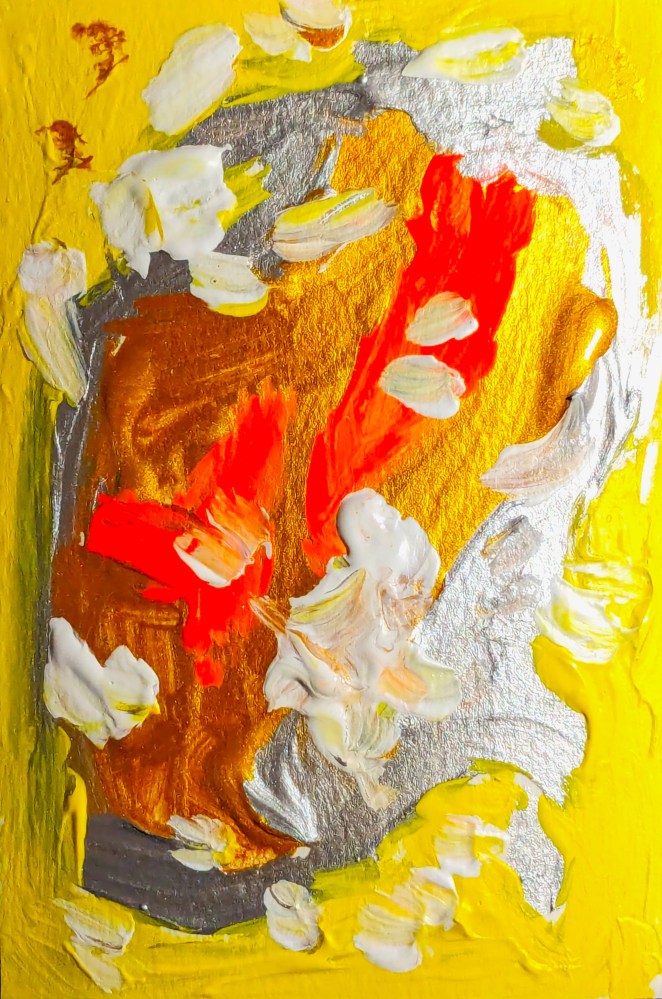
On the other hand, we can always go religious and turn to the Bible for advice. There we find “Faith, hope, and charity, and the greatest of these is charity.” So. Problem solved. I have found my one word – Charity. That said, I do like the painting Moo offered me for this prompt. He calls it Hope. And remember, you can’t go wrong with any of those three words – Faith, Hope, and Charity. Tolle lege. Amen.

Solitary 1 & 2

Solitary 1 & 2

1

They drove me there,
passed through the gates,
unpacked my trunk,
chatted with the head,
shook my hand,
then drove away.

The metallic clang
of the closing gates
still lives with me.

How old was I?
Six? Seven?
I no longer know
and there’s nobody
left alive to tell me.

I remember so well
the woodgrain on the desk,
the carved initials,
the loneliness that bit,
the barred windows
of that empty classroom.

2

An only child,
taken away,
left among strangers?

Why, why, why?
Doubt’s pinball
bounces round
my empty skull.

What am I?
Who am I?
Why am I?

How did I become
whatever it is
that I became? 

mea culpa
mea culpa
mea maxima culpa

Was I the one to blame?

Comment:
I prefer it as two poems, rather than a poem and a commentary. It may even be better written in the third person. I’ll have to think about that! It’s always a good way to work. Thank you to all who commented, by email or otherwise! Your comments always help me think, and re-think.

Solitary

Solitary

They drove me there,
passed through the gates,
unpacked my trunk,
chatted with the head,
shook my hand,
then drove away.

The metallic clang
of the closing gates
still lives with me.

How old was I?
Six? Seven?
I no longer know
and there’s nobody
left alive to tell me.

I remember so well
the woodgrain on the desk,
the carved initials,
the loneliness that bit,
the barred windows
of that empty classroom.

Comment:
Looking back, I wonder just how and why I ended up in a series of boarding schools, starting when I was only six years old. What does that abandonment do to an only child, taken away, and left among strangers? I still have nightmares and wake up screaming, from time to time.

Why, why, why? The pinball of doubt bounces round the interior of my head as I struggle to plot different paths, different ways, how life could have, might have, been so different.

I guess that schooling, force fed, made me what I am. But then the pin ball starts again – what am I? Who am I? Why am I? And how did I become whatever it is that I became? Mea culpa, mea culpa, mea maxima culpa – was I then the one to blame?