Fish Nets

Fish weirs in Fundy
Poles in Passamaquoddy
anonymous local artist

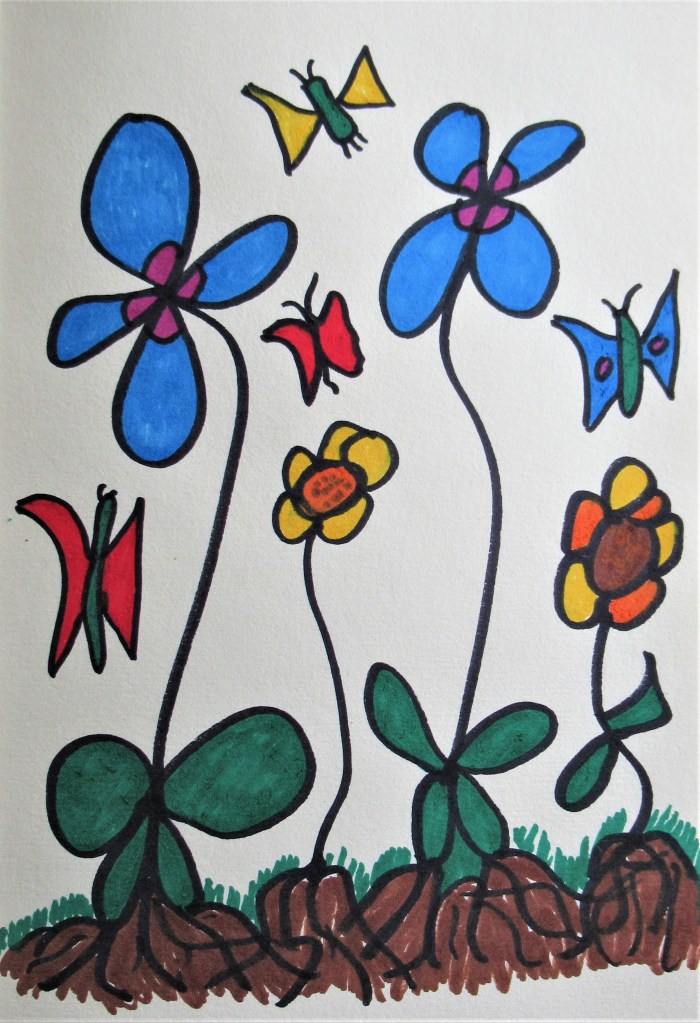
              … and speaking of fish, there are the fish nets on their poles stretched from horizon to horizon, at low tide, and the fishermen in their waders walk out to the nets where the mud is squishy from the sewage system which dumps all the sewage in Swansea bay, but the tide was younger then, and stronger, and there weren’t so many people, so the beach was always swept clean in those days by the tide, and the sewage was always swept out to sea … and the fish were nice and fat and healthy and you could buy a couple of whiting or flounders, dirt cheap, and bring them home, if you asked nicely, and plaice and sole, well, they’re all flat-fish, really, and our cousins from London could never tell the difference between them, but we can, and I’d tell you, but it’s so long ago, that I’ve almost forgotten, and it’s partly size and partly colour, and partly spots, and I forget so many things now …  but I don’t forget the sea as it licks at your toes, and you standing there, early in the summer, as white as an ice cream, and the sea climbs up to your ankles, and then your knees, but on Swansea Sands, at the Slip, or at Brynmill, you have to walk miles and miles before it reaches your waist … especially when it’s out and low … but you have to be careful for there can be deep holes and the mud can be slippery … though nobody ever falls down, oh, we were so much cleverer when I was young, … but there are rumours of quick sands out there at low tide, out beyond the fish nets … out where the banana boats ride … out where the bright lights are seen at midnight … the flashes and flares … the mysteries of the unidentified flying objects, saucers and the like, that visit us in Swansea, to learn to speak Welsh, or so the locals say, so that later they may n=mingle among us, and eventually take us over … once upon a time, when I was young, and the world was all new-born, that was not a conspiracy theory … and it was not fake news … maybe that’s why we moved to Cardiff …
Summer in Swansea

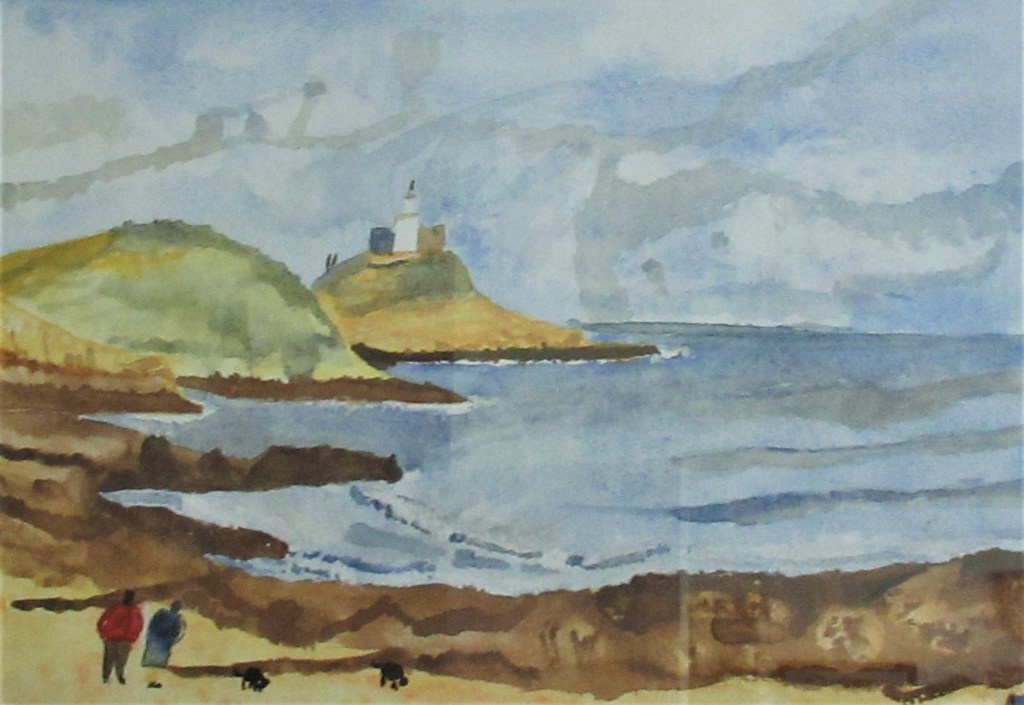
My Uncle Frank’s first water color:
the Mumbles Lighthouse from Limeslade

              … but it’s watch out for the dog, for the dog gets everywhere because he’s on holiday too and everybody’s on holiday in this little sea side town and the cousins have come down from London with their cockney accents, born within the sound of Bow Bells, though they’re half Welsh by blood, though you wouldn’t believe it with those incredible accents which nobody can understand … and they’ve never seen the sea, though their mother was born here, beside my mother, beside this self-same sea which has never left and which still flows in and out, even now, and it still flows through my bones and “Look at all the water!” my youngest cousin cries and then he really cries because London, the capital of England, is concrete and tarmac and all petrol smell and smog and fumes and busses and he’s never ever seen the sea, the sea’s open spaces, the wide open arms of the bay held out to embrace you with Swansea Docks on the left, a working area of ships and shipyards where my grandfather labours and takes me on workdays, even in summer, and shows me the ships and his friends and everyone is happy and laughing because it’s summer and it’s hot and there’s lots of employment and the banana boats are lining up in the bay, at low tide, waiting for high tide, when they can enter harbour and be unloaded and this happens all year round, but it’s really in summer, when the sun is as yellow as the bananas, that the banana boats become significant and we show them to my cousin who has never seen the sea nor the banana boats, though he knows what a banana is and where to buy them and what they cost, but he never knew they came in on these boats, these great white summer boats, from Africa and the Caribbean,  with their funnels all yellow and their bright stripe of blue, Elder and Fyffe, and the boats all lined up in the bay and look: to the right there’s the Mumbles and the Mumbles has a pier and a playground and you can go out and walk on the pier and at the end there’s the life boat and the life boat has a slipway for the life-boat to run down into the sea to rescue people who are shipwrecked, but only in winter because in summer the sea is calm and shiny and it runs in and out twice a day, like an obedient dog, and why is the beach wet? Because the sea weed … and the pier is a world full of wonders, with its peep shows and its games and the old men fishing off the end, chatting and gossiping, and not ever worrying about whether or not they catch the fish which many of them throw back anyway, so they can catch them again tomorrow  …

Summer in Wales

Summer in Wales
aka
Cricket, lovely cricket!              

Summer in Wales is always as I remember it: glorious days of sun and sand and blue skies and warm winds … and especially the sun on the beaches with the water sparkling and little boys and little girls playing cricket on the dry wrinkled sand packed hard when the tide goes out and leaves the land stranded … and uncles and aunties bowl under arm, not over arm, so the little ones could manage to score lots and lots of runs … and I remember us, standing breathless between the wickets, or at the wicket, if there was only one set of stumps, or a picnic basket stood on its side, or three pieces of driftwood, with sea-weed for bails, and what are bails, you ask?

              Well, bails are the sea-weed that is draped over the driftwood that stands as stumps. And we guard our stumps with the cricket bat that somebody has brought and we bowl with wet tennis balls, because nobody will risk a red, leather ball on the sands, with the wet tide standing there, waiting for the ball to be hit at it, or into it, and it’s cold, but not that cold, and when uncle hits the ball, right out so sea, someone has to run after it, then dive, and then swim after it, and if it’s real runs you want, then uncle runs two or three quite quickly; then the aunties tell him to stop running so fast or he’ll have a heart  … so he slows down and trots four or five; then he walks six and seven; and when you throw the ball back, he’s walking eight or nine; and then the dog intercepts the ball, catches it in his teeth, and starts running around with it in his mouth and everyone is trying to catch the dog except my uncle who is now limping very, very slowly between the wickets, but he’s already up to eleven or twelve; and then the little ones start crying because “It’s not fair!” Loud sniff! Then uncle stops in the middle of the wicket and sits there, waiting for somebody to run him out; except everyone is tired, except the dog, who is tireless and completely energized, and now the centre of attention; and nobody is going to catch him;  and finally uncle walks to the wicket and he lifts the piece of seaweed with his bat and everybody appeals, then he’s finally “OUT!” because officially he’s hit his own wicket and that’s illegal and now the game can go on once more, with everyone happy and God’s in his heaven and all’s right with the world …

And the dog has dropped the ball right at the edge of the waves and is barking furiously at the incoming waves as time and tide march up the beach and sweep us and our memories all away.

Forget-me-not

Forget-me-not

sitting in the kitchen
crouching by the coal fire
hands quite warm
back quite cold
checking the windows
peeling back the curtains
blackout curtains
frayed and old
looking at raindrops
sliding down the windows
chill greasy raindrops
grey and cold

wondering who wants me
wondering who loves me
wanting my teddy bear
longing for my pussy cat
wanting my little dog
longing for his tail wag
so much missing
my nose so cold

now I am seventy
everything has changed
changed town and country
changed clime and weather
everything is different
nothing is the same
longing for my childhood
longing for my home land
watching the ocean
that comes rolling in

ocean of waters
ocean of memories
ocean of people
now long departed

Comment: Rhythm is everything here. I have just re-read The Sing-song of Old Man Kangaroo from Just So Stories (Rudyard Kipling). My mum and dad gave me copy when I was seven years old. Did they really think I could read it and understand it at that age? Whatever! The rhythms have stayed with me all my life and today I tried to reproduce them. My soul and my fingers danced as I thought of old man kangaroo and how he lost so much to gain so much. And what of the Elephant’s Child with his insatiable curiosity? I lost so much when I came here to Canada but I gained so much from this wonderful country. I tore my world apart then put it back together. How to explain it? It may not be explicable.

Hot Water Duck

Canada Geese at Mactaquac

Hot Water Duck

The worst punishment of all was to be sent to bed early.  You climbed upstairs by candlelight, if you were lucky, or groped your way upwards in the dark, if you had been really bad. You entered the cold, dark, damp of the bedroom and punishment was not to have supper, and not to have a warm hot water bottle or a warm baked brick to keep you warm in bed. I loved that hot brick, baked in the oven or by the fireside, then wrapped up in a towel. Bricks and bottles: they banished damp from the bed and kept you warm for a while, or burned if the wrapping fell off. The hot water bottles: they were made of tin not rubber, and once, I remember a cast iron duck, that my grandmother baked in the oven, then wrapped in swaddling clothes, like a little baby. But if the grown-ups said you had been naughty, or nasty, or cheeky, or just plain wicked, then you were given nothing to keep you warm, and you lay in bed and shivered until you cried yourself to sleep.

Canada Geese and Fall Foliage at Mactaquac

Rain Again

The rain in Spain
does not stay on the plain

Rain
              When it rained in South Wales, it rained everywhere soaking rich and poor alike. There was no escaping the eternal wetness of Welsh Rain. Whenever we traveled, especially by bus, to another part of Swansea Town, it would be raining there too, but, as my auntie used to tell us when we came back home: “Smile now. Look happy. And remember: we had lovely weather all day. The sun was shining over there where we were. Raining here, at home, all day, was it? What a pity. You should have come on the bus with us!” I remember her smiling, all wrinkles round the eyes, her false teeth shining white, as she flashed a horse’s collar coal-scuttle of a grin, absolutely shameless. But we’d back her up. We’d all smile happily and laugh, and dance, and jump up and down, basking in the joy of the falsified sunshine of her wonderful smile, her shining false teeth. And she was right: where we had been together, the sun had shone all day, in spite of the umbrellas, our wet, cold feet, and all the undoubted evidence of a day of rain.


Empty Nest

IMG_1258 (2)

Empty Nest

The wind at the window
scratches tiny notes.
I can no longer hear the tune
nor read the words.

Who walks beside me
as I pace my lonely path,
abandoned in this empty house.

My self-portrait
stares back at me:
a splintered selfie,
framed in a sliver
of silvery glass.

Above me,
a monkey moon,
that itinerant tinker,
walks a fractured way
over broken glass.

The knapsack on his back
is cobbled together
from cobwebs and clumsy
veils of drifting clouds.

Comment: Another Golden Oldie from that same throw-away manuscript that I discovered a couple of days ago. I wrote this one the year after my mother’s death. My father was in hospital and I had flown back to Wales to visit him. When I was not with him, I wandered alone in a large house, empty of people, but filled with memories. The whole experience was rather surreal, just like the imagery I conjured up to describe it. Early spring, but a cold one. After hospital visiting hours, I wandered an untidy house and an unkempt garden. My mother had departed. My father was on the way out. I was alone with a life-time of memories. “No hay pájaros en los nidos de antaño” wrote Cervantes in the Quixote. “There are no birds in last year’s nests.” With no brothers, no sisters, no close family, and no friends left in Wales, I found that out the hard way. Those days of wandering, ‘upstairs, downstairs, in my lady’s chamber,’ taught me that most difficult of lessons in the hardest of ways.

IMG_0456 (2)

Striations

IMG_0299

Striations

There are striations in my heart,
so deep,
a lizard could lie there,
unseen,
and wait for tomorrow’s sun.

Timeless:
this worm at the apple’s core
waiting for its world to end.

 Seculae seculorum:
the centuries rushing headlong.

Matins:
wide-eyed this owl
hooting in the face of day.

Somewhere,
I remember
a table spread for two.
Breakfast:
an open door,
a window that overlooks
a balcony and a garden.

“Where are you going, dear?”

  Something bright has fled the world.
The sun unfurls shadows.
The blood whirls stars around the body.

“It has gone,” she said.
“The magic.
I no longer tremble
at your touch.”

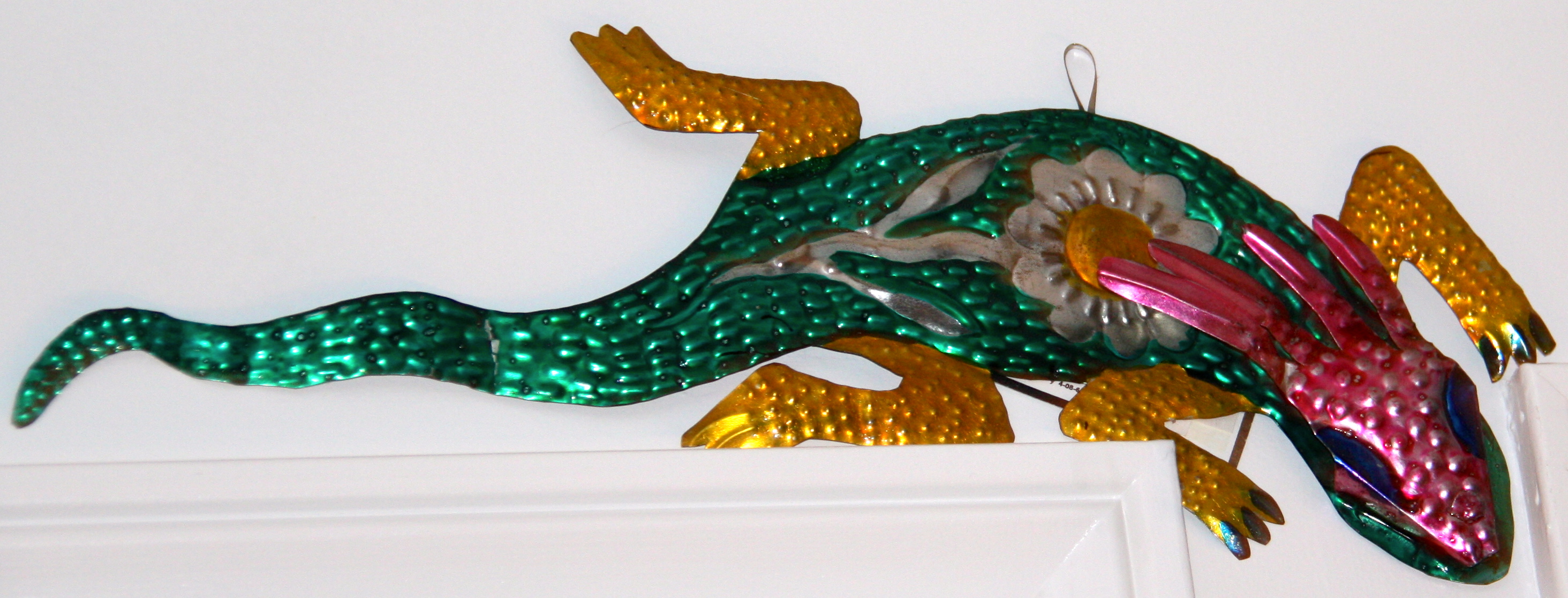
Comment: A real Golden Oldie. The lizard, it’s probably an iguana, came originally from Oaxaca, Mexico, and now sits over the door on the front porch. I had to bend his tail to get him into my carrying bag, poor thing. I found this poem in my poetry discards file, though what it was doing in there is a mystery to me. I think I discarded the longer manuscript in which it was included. Never mind, I have re-found, rediscovered it and it merits a place here, on my blog, along with the iguana. Byddwch lawen: rejoice and be glad.