Do you still sleep in your childhood bedroom?

Do you still sleep in your childhood bedroom?

Good question. A better one might have been – “Did you have your own bedroom as a child?” The answer is “No, I didn’t. Not that I can remember.” As a war baby, I was moved around quite a bit in my childhood. I remember sleeping in three different bedrooms in our first house. Then we moved in with my maternal grandparents, and I slept in three more bedrooms, often in the same bed with one or other of the grandparents, sometimes on a makeshift bed on the floor. Later, or it may be around the same time, those early childhood memories are so hazy, I went to live with my parental grandparents – three more bedrooms there – same conditions. The family also had a bungalow close to the beach on the Gower peninsula. It had three bedrooms and I slept in all of them, under similar conditions, and seldom alone, until my later years.

I was bundled off to boarding school while I was still a child. Two dormitories at the first boarding school. I was between six and eight years old, and the memories of that school are not sharp, though I recall with total clarity the canings and the shaming of myself and the other young children. It was a religious school. And I need say no more on that subject.

My second boarding school , a preparatory school, saw me inhabiting four dormitories that I can remember. My clearest memory of that place is running away one night, only to be brought kicking and screaming back to the place. Both my parents worked. During the holidays, I was shipped around to various members of the family – aunts, uncles, and grandparents. When I left that school, for the last time, age eleven, my grandparents drove me to my new forever home in a city far from my birthday place. There, three bedrooms witnessed my sleeping habits.

My third boarding school, the Junior School of a larger college, provided me with two dormitories, one per year while I was there. This was the time at which I started to travel with my mother during the vacations. A coach tour on the continent once saw us visiting six countries in two weeks, and that wasn’t the only coach tur I did with her. A succession of hotel bedrooms, then, and no nocturnal stability at all.

I stayed in my fourth boarding school, the Senior School of that Junior School, for five years and received a new dormitory each year. From there I went to study in Paris – more bedrooms – then down to Spain for the summer courses at the International University in Santander, but by now, age eighteen, my childhood was over.

So, a quick count shows that I slept in at least twenty-five bedrooms during my child. And that’s without counting holiday hotels, flats, apartments, and other forms of lodgings, including Youth Hostels.

So, remind me – what was the question? Ah yes, I remember now. “Do You still sleep in your childhood bedroom?” Well, my friends and readers, the answer is a very loud “NO!” Think about it – how could I have? I am not sure that I even had a childhood bedroom!

What’s the most delicious thing you’ve ever eaten?

Daily writing prompt
What’s the most delicious thing you’ve ever eaten?

What’s the most delicious thing you’ve ever eaten?

No single item of food stands out. That said, eating is a cultural thing – does one eat on one’s own, or does one eat with family and friends? What role does food play in one’s life? For me, for example, food is cultural, an occasion, not a meal. For example, a fresh, Spanish croissant, for breakfast, a late breakfast, at the bar in the Rincon, Avila. Before me, the daily newspaper, open at the page with the daily chess problem. The coffee, freshly brewed, a cafe con leche, and the croissant, waiting to be dipped in the coffee, and the resulting delight transported to my mouth. Sometimes, there are no croissants left. Then, one of the world’s best kept secrets, un sobao pasiego, a small sponge cake, from the Vega de Pas in Cantabria. It holds together when dunked and can be eaten moist or dry.

By extension, when younger, after an afternoon’s soccer on the beach – la Segunda Playa del Sardinero, in Santander – cool red wine from a porron, and selected seafood in the form of tapas, nibbled with the other players, as thirst is quenched, and the appetite that comes from running on warm sand under a hot, summer sun, is slowly sated. Seafood – this includes octopus – pulpo a la gallega – or squid – calamares rellenos en su tinta – or caracoles de mar – sea-snails – or oysters, fresh, with a squeeze of lemon – or mejillones en salsa de tomate – mussels in tomato sauce – gambas a la plancha, roasted shrimp – or gambas al ajillo, pan fried shrimp in garlic – or almejas a la marinera, clams, Spanish style – the point is to ganarse el puchero / to earn your food, by dint of hard work, and to share it with your friends.

When I think of Welsh food, once again, it is the family gatherings and the love around the table that dominates. Under these circumstances, a simple boiled egg – not everyone can boil an egg properly – with hot toast and fresh salt butter, can be an overwhelmingly delicious meal. Eggs – so supple, so creative – scrambled eggs, creamy and lightly curded – an omelette aux fines herbes, with a lightly tossed green salad – a tortilla espanola, easy to prepare, but incredibly difficult to prepare to perfection. Free range eggs, fresh from the hen house, sea salt prepared locally, olive oil from a local terroir, potatoes, also local, onions from the garden. Each of these contains within it the taste of the same earth, the same air, the same rain.

Speaking of which, to travel to the high hills in the Province of Avila, and to smell the herbs that grow in the sheep pastures, thyme, rosemary, and to know that the flesh of the spring lamb will be flavoured by the herbs it has been eating – even the lechazo, a lamb still on its mother ‘s milk, tender, so tender, and so small that it broke my heart to see it. A lamb so small that I couldn’t eat it. I watched it appear on the family table and vanish in a couple of mouthfuls, washed down by a specially selected wine. I enjoyed the company and the rest of the meal. But I’ll never forget that tiny lamb.

However, it’s never just about food – it is about the cultural content of the room, the family, the table, the friends, the joy of sharing and caring. Oh dear, and I never got around to telling you about the paella I made, the ones that appears in the lead photo!

Which food, when you eat it, instantly transports you to childhood?

Daily writing prompt
Which food, when you eat it, instantly transports you to childhood?

Which food, when you eat it, instantly transports you to childhood?

That’s an easy one – diolch yn fawr / thank you very much – and the answer is Bara Lawr / laverbread of course.

What does laverbread taste like? I must thank Wikipedia for the answer below.

Welsh Laverbread (PDO) | Business Wales - Food and drink

Welsh Laverbread is made from cooked laver (seaweed) which has been plucked by hand from the Welsh coastline. It has a unique texture and salty flavour which provides a taste of the fresh, Welsh sea. Laver or Laver porphyra umbilicalis is the only seaweed which is only one cell thick.

And click on the link for a video from YouTube on the Traditional Welsh breakfast.

Laverbread could be found all around the Gower Peninsula in my childhood. When I was very young, you could buy it at Swansea Market for three pence a pound. Later, the price went up to sixpence a pound. When I lived in Cardiff, back in the early sixties, it sold at a pound per pound. Later, as the coast around Wales became more and more polluted, the sea weed had to be imported from the West of Ireland, and that certainly drove the price up – five pound a pound in the eighties.

But laverbread has two histories – the scientific / culinary one, and the personal one. Laverbread, on the plate, looks suspiciously like a cowpat. So much so, that when the cows visited the bungalow field where we had our summer home, the cowpats were called laverbread. “Don’t step in the laverbread, dear.”

Field rolling was a childhood joy. Start at the top of the slope and roll all the way down to the bottom. Born and bred in a laverbread field, we would plot our route between the patties before we rolled. Alas, our London cousins, with their cockney accents, were city and street wise, but not laver bread wise. Down the field they rolled, without looking, right through the laverbread patches. I leave the ensuing scene to you imaginations – and remember that the bungalow had no electricity in those early days, and no running water.

I remember the first day my beloved came to visit us at home. My mother served her fresh hot laverbread. Of course, she had never seen anything like it, except genuine Somerset cowpats. She picked around her food, left the laverbread on her plate until it cooled and – “Hold on a moment,” said my mother, “your laverbread’s cold. Here – I’ll warm it up for you.” Poor Clare. I am ashamed to say, I ate her helping while my mother was looking elsewhere – just devoured the extra portion, enjoying every moment, and Clare was so happy to see it disappear.

Here, in New Brunswick, while Clare was away one weekend, Becky and I decided to make laverbread from dulse. We followed the recipes and they worked. The laverbread was delicious – but – ah yes, there’s always a but – but the house stank of the sea shore at low tide and the first thing Clare said when she got home was – “What is that awful smell?”

I remember, opening a closet to get a clean shirt, about six weeks later, and that familiar whiff of the seashore immediately assaulted my nostrils. Alas, Becky and I love our laverbread, but -there’s that word again – but making it in our house long been banned.

What notable things happened today?

Daily writing prompt
What notable things happened today?

What notable things happened today?

One of my best friends passed away today at approximately 2:30 pm. She had been rushed into the Hospice and perished within days of being admitted. Such things are never easy, especially when the deceased person is younger than you.

My friend was a wonderful cook. To mark her passing, I made a traditional Welsh leek and onion dish for my beloved, who pronounced it good. Concentrating on the cooking enabled me to come to terms with a loss that is not only mine, but belongs to her family and the larger writing community as well.

My friend wrote prose, but was a poet at heart. Her creativity went beyond the written page and entered into her life, her relationships, and her cooking. A ray of sunshine in the kitchen, she brought the sunshine of her life to her guests when she presented the gifted poems of her food.

The title of the prompt includes the word “things”. A mutual friend contacted me with news of her passing. I contacted two more mutual friends and we shared happy memories – horas non numero nisi serenasI count only the happy hours.

Covid came between so many of us, especially the older generation. It drove a wedge between friends, shut out mutual meeting places, destroyed regular reunions and contact. This passing of a loved one, beloved to many of us, helped us reconstruct the spider webs of friendship, allowed us to share our grief, and enabled us to see the world in a slightly different light – one of joy and happiness – joy in the love we all shared, happiness in recalling the best of those moments.

Vis brevis, ars longa.
Requiescat in pacem.
Pax amorque.

And no, Latin is not a dead language.

Coming Soon ….

Coming soon ….. to a Rollator near you.

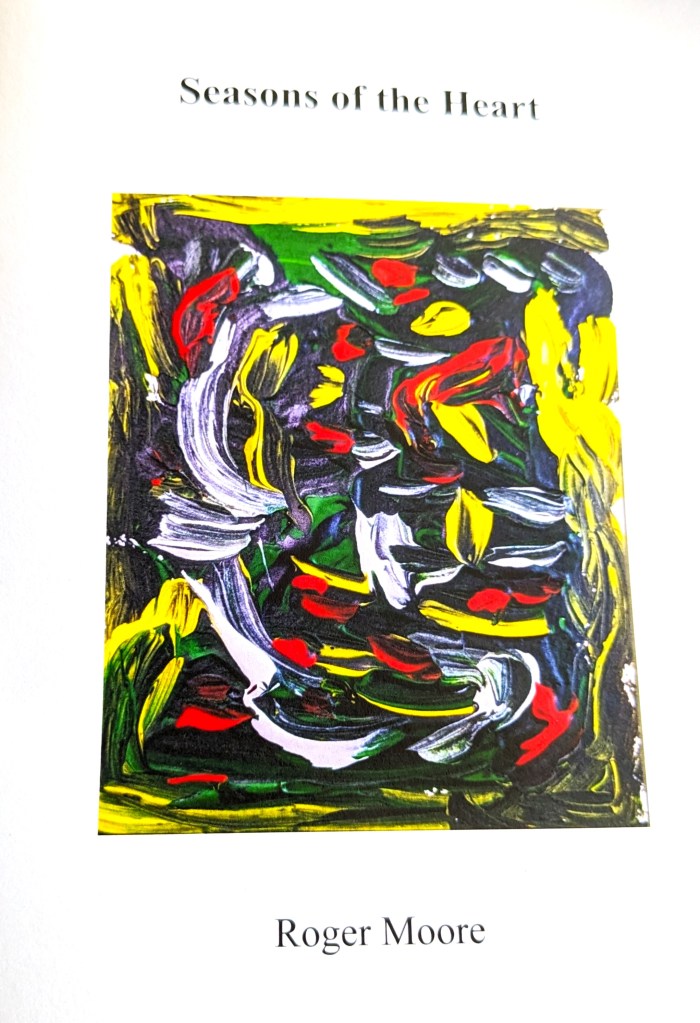
Yesterday I checked the galley proof and all seems well. The distortion on the photo above is all mine (!) and the original cover is much clearer, better, straighter, and brighter.

I have not posted for two weeks, and yet some of my faithful followers have still clicked on this site to see how I am doing. Thank you so much.

Several things happened last month. (a) I started a stretching and exercise program. (b) I upped my walking to 4000 steps a day. (c) I used a combination of Rollator [Nexus 3] and shopping cart to build up, slowly, to an hour a day of aerobic exercise.

That’s all good news for the physical body and the mental state, but not such good news for the creative cycle. Blog postings have suffered and my online social presence has been greatly reduced. On the good side, I have been out and about, around the garden and around the block, and have re-established contact with neighbors, friends, and the local canine newbies and golden oldies.

I also managed to edit and correct and revise Seasons of the Heart and this chapbook of poems, based on my meditations on Anam Cara (by John O’Donohue) will soon be available to gift to my closest friends.

As you probably know by know, I do not sell what I call my “Covey Collection” of self-published chapbooks and books. If you wish to support my efforts as an artist, you can do so by clicking on this link and seeing if there is anything that fancies your tickle, sorry, I mean tickles your fancy.

B & W

“Slim words couched
in the empty whiteness
of the page.”
John O’Donohue,
Anam Cara

black words
          white page
thoughts
          floating in space

airs and graces
          whirlwind words
blowing through
          freshening
cleansing

cotton clouds
          silky sky
that one word
          waiting
to be spoken

that one thought
          soon to be word-borne
out from the dark

a new existence
          to brighten us
blind us with light

Son Spots

Sun Spots

A painting and a poem dedicated to an only child who, in spite of all his achievements, was never good enough to earn the love of his parents.

Emptiness

The emptiness of air
          leaves the birch standing there,
framed by a space
          that will fill with chatter
and a flock of birds.

When evening comes,
          darkness frames the ash.
It sparkles
          with the gold dust of stars,
that swim through space.

Beneath snow’s empty page,
          grass and flowers root.
They will grow green tongues
          and rage next spring
at the coverlet
          keeping them in place.

A touch of warmth.
          Tiny flowers start to show.

What language do they speak
          as they spread their petals
and let fresh spring words flow?

My head fills with emptiness.
          My mouth is a silent space.

I sit and wait for words
          to break like sea waves
and create, who knows what,
          when they fill that empty place
within my heart and head.

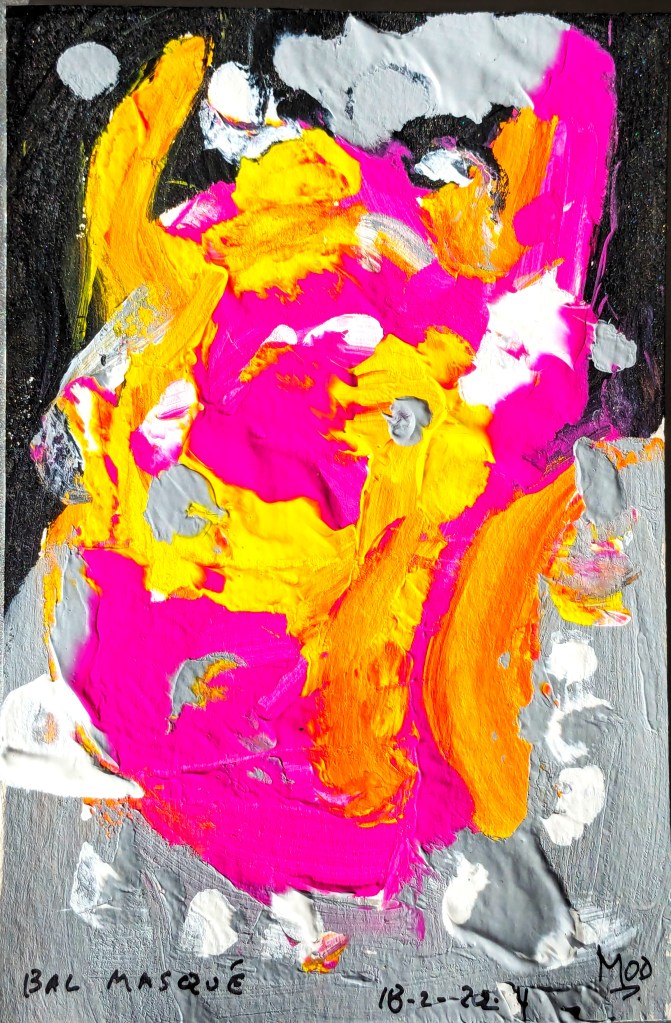
A Masked Ball

Masked Ball

After a two-week lay-off, the Dance of Colors returns. What caused the lay-off? Absolutely nothing. I grew tired of posting, of writing, of throwing my paint on the waters of the web and waiting to see what, if anything, happened. Well – nothing happened.

Steven King, On Writing, says “Paper your walls with rejections.” And I have done, pages and pages of them. The secret is ‘never surrender’ – ‘never give up’ – or, in the language of the WWII Prisoner of War Camps – Nil carborundum illegitimi. You can Google the meaning, if you can’t read Latin. It is a euphemism for ‘never despair’.

Rejection is one thing. Silence is something else. When I check my notebooks I find submissions, some sent several years ago, that are still unanswered. There is simply no response. It is as if the writer – submitter – does not exist, is not even worthy of a form letter.

I ran into that wall of silence during this two week lay-off. Does it matter? Probably not. The creation of art is as much a monologue as it is a dialogue. Bakhtin calls it ‘a creative artist’s dialogue with his time and place.’ I think of it as ‘this creative artist’s monologue with his time and place.’

Footsteps – I leave them here, I leave them there, you can find those footsteps anywhere. But beware the footsteps left on the beach at low tide. You will not find them on the beach the day after you leave them. The tide will have risen and washed them all away. In spite of that, some footprints are here to stay.

Sun Flowers

Comment:
The poetry flows. But if I publish it here, I cannot use it in competitions and there are many around right now.

So, instead of a poem in words – a poem in colors and lines. I have portrayed several of my acquaintances and friends in the flower faces. Luckily, I am such a terrible artist that you will be unable to recognize yourselves! So choose one you like – and pretend that it’s you.

I hope this painting will cheer your day and bring some happiness and sunshine to you wherever you are.

Choices

Choices

Winter-low sun in my eyes,
I sit at the breakfast table
blinking back rainbows.

Light quivers into fragments.
Too much light and my world
turns dark. I can no longer see
the computer screen, nor am I
able to write in the old-fashioned
way with pen, ink, and paper.

To continue working, I must lower
the blinds or move to the other room
away from the sunlight.

Another option:
to forget deadlines and schedules
to lay down my pen, to close my eyes,
to bask in early morning pleasures,
purring like an ageing cat
enjoying the sun.

Comment:
A Golden Oldie that suddenly surfaced from “among my souvenirs”, as Connie Francis once sang. Or was it twice? Sunshine is certainly a magic balm for old bones. Only now am I starting to understand the wisdom of animals, that old dog, lying in the sun, the ageing cat curled up in a sunny window, the ancient donkey, seeking warmth, away from the shade. Such joy in the small things that make life so much better.

What relationships have a positive impact on you?

Daily writing prompt
What relationships have a positive impact on you?

What relationships have a positive impact on you?
I think one of my poems answers this question best. I write “one of my poems” but it is really my ‘free’ translation of one of Francisco de Quevedo’s sonnets – Retirado en la paz de estos desiertos. I have changed the poem slightly, but I am sure Don Francisco (1580-1645) will excuse Don Roger’s impoverished effort (2023).

On Loneliness
29 December 2023

Resting in the peace of these small rooms,
with few, but welcome books together,
I live in conversation with my friends,
and listen with my eyes to loving words.

Not always understood, but always there,
they influence and question my affairs,
and with contrasting points of view,
they wake me up, and make me more aware.

The wisdom of these absent friends,
some distant from me just because they’re dead,
lives on and on, thanks to the printed word.

Life flits away, the past can’t be retained.
each hour, once past, is lost and gone,
but with such friends, I’m never left alone.

The painting, by my friend Moo, is called Fiat Lux – Let There Be Light. It is reminiscent of Dylan Thomas’s poem, Light breaks where no light shines. Intertextuality – Quevedo drew inspiration from the Stoics. I drew inspiration from Quevedo. Moo drew inspiration from Dylan Thomas. The nature of creativity and its continuing links throughout the ages shines clearly through these wonderful associations.