Early Bird

untitled

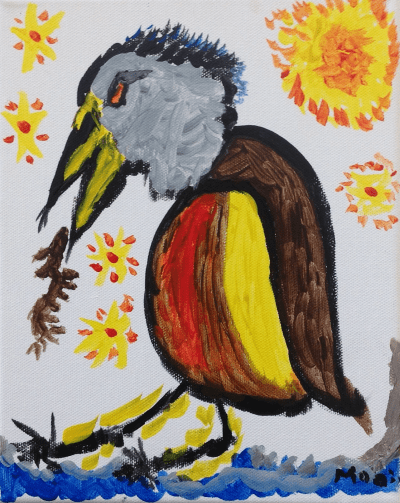
This is the first painting I ever did on canvas. Kingsbrae held their painting session for children in June 2017, and I joined in with the five and six year olds. It was such wonderful fun. They slapped the paint onto the canvas with unbounded joy. It was hard not to be joyful with them. Many of them expressed curiosity about my painting: “What is it?” then later “What are they saying to each other?” The conversation between bird and worm (or whatever it is) was of incredible importance to them. I thought of it as my “Bonjour, Monsieur Courbet” moment. Now that’s confidence for you.

My strange accent, slowly developing as mid-Atlantic Welsh, with a touch of West Country English and a dab of Upper Canadian and a touch of New Brunswick also fascinated them. “Where are you from?” “Fredericton.” “No. Where are you really from?” “Island View, New Brunswick.” “No. Where were you from before that?” The questions continued until they had ascertained that indeed, I was not a Canadian, a real Canadian, even though I was in Toronto in 1967 to see the Maple Leafs win the Stanley Cup. 1967: that’s 51 years ago, and I still support the Maple Leafs and I still have my strange overseas accent. “You’re weird,” they told me. “I’ve been in Canada a lot longer than you,” I told them. “Where did you grow up?” They asked. I silenced them with my answer: “I don’t think I have yet.”

Happy paint-splashers, we dabbed on and on in alternating mirth and silence. Some left the table and walked away. Geoff collected our paintings and left them to dry. Later that day, we hung this painting on the wall in the KIRA dining room. It sat there for several days and nobody noticed it. Alas, a hawk-eyed young lady finally spotted it the first night she came over for dinner and “What is that?” she asked, pointing at my painting. Bold and italics combined cannot reproduce the scorn and disdain rolled up in the single word: that. I remember the butler in a country house in Somerset removing with a pair of tongs the Communist newspaper The Daily Worker from the weekend newspapers left on the doorstep. He, too, was very disdainful.

I also remember the tone of an Old Etonian, well he said he was an Old Etonian and had a rasping, high-pitched nasality that made him sound the part. This jolly goof fellow summed me up at a dinner party one night in Toronto when I first came to Canada: “Oh, you’re Welsh.” The grate of his voice was the scrape of a stick removing a dog turd from a shoe. “No,” I said. “Irish, actually.” I used my broadest Welsh accent. “My family is Irish Catholic not Capel Cymraig / Welsh Chapel. Moore is an Irish name. Llewellyn ad Jones are Welsh names. I am not called Llewellyn or Jones.”

And this reminds me of my father, standing in the elevator in a posh hotel in Bordeaux, when three Irishmen walked in. They scanned him for a moment, and then one said, in the broadest of Southern Irish brogues: “T’is the map of Ireland written all over your face.” “Yes,” says my father in his thick, Welsh accent, “I am Irish. But I was born in England.” And that brings me back to my painting. Is it the early bird that catches the worm or the late worm that gets caught by the bird? And which came first, the chicken or the egg?

Ah, the beauty of children. They accept, often without judgement and often without speculation and I love their readiness to befriend the growing child within the old man as he ages. They may not hold doctorates in philosophy, but by golly they are true philosophers in their finest moments. And then of course, they go to school to learn how to behave … and may the good Lord have mercy on them.

Surrealism

IMG_0124

Surrealism
KIRA Retreat Day 4

Only one of the Kingsbrae alpacas could understand and illustrate what we did today. This one showed us so many things. Luckily we smuggled him into the writing classes and the art classes and nobody was any the wiser. In fact he taught one class himself, and one participant served as translator, moving from Spanish to English with almost as much ease as he taught.

He began this morning with a reading that linked Symbolism to Surrealism to Magical Realism. It was a fascinating piece that nobody in the room, myself included, had ever heard before. So, we began with a concrete, literary example, then moved to a theoretical session. The alpaca began by explaining the difference between a lama, an alpaca, and a vicuña. This was extremely interesting, and something we hadn’t considered before. Luckily, these three creatures, two of them mythical (but which two?), do not have-isms attached to them and were therefore much easier to understand.

The lama began the theoretical session by offering some meditation exercises, very peace-giving.  Then he moved into the nitty-gritty of automatic writing. He followed this with some examples of how, rather than copying the automatic writing, we could select prime elements from it. This selection process allows the writer to mine the subconscious while avoiding some of the repetitious nature of the automated pen on the suppliant page.

In all cases, all participants read from their work and the sharing of subconscious inanities was a great way to break any ice that came with the overnight change in the weather.

After lunch, we had a second writing exercise that stretched into two exercises. These were courtesy of a second lama and entailed describing unknown and known objects. One of the participants was very uncooperative and instead of writing words drew pictures in his notebook. This drew comments of ‘Naughty, naughty,” from the lama and that student was given a time out on the golf cart driven round the lawn by the KIRA equivalent of Mad Max.

In our final session, the art lama appeared. He had carefully plucked all the flowers in Kingsbrae and then eaten them. However, in an incredible act of bravery, the ladies present stole some from his hoard and placed them in water cups. The participants then scattered random dots of paint upon a canvas and agreed that, seen from a distance and in the dark, they looked like flowers on a tarmac road under storm clouds on a thundery night when nothing could be seen.

By now, the lama who had been tied to the fishing weir, oh, I forgot to tell you about that, sorry, had been rescued when the Old Sow let the water out of the Passamaquoddy bath tub (aka low tide). Luckily no harm was done and a delicious, fossilized piece of Turkish Delight was shared by the participants all of whom agreed that nothing like this had ever happened to them before, and I believe them.

Mad Max took everyone for a ride on the Golf Cart and we all chased deer round the Kingsbrae Gardens while singing “I’ve been working on the chain gang” and “For it’s a jolly good yellow.”

Green

39948917_706398923049634_3046174897211441152_o (1).jpg

Green
KIRA Day 3

Where has the time gone? Don’t answer that question. The Retreat has settled into a structure of its own and outside time no longer has any meaning. The internal time of the retreat runs smoothly as clockwork, a wooden, self-oiling clockwork, of the most delicate kind.

08:00 – 09:00 Breakfast. We gather in the kitchen and the conversations begin over breakfast. We talk about the previous night’s readings, the plans we have for the day, or whether we want to workshop of just retire to our studios and write.

09:00 – 10:30 Workshop time. Each morning we have a topic and we illustrate it and discuss it fully. Each workshop also comes with ideas and prompts for writing. At the end of  each workshop, we plan the rest of the day. We hold regular Blue Pencil Cafés in which facilitators and participants discuss submitted work. We suggested about 20 minutes for the BPCs, but my first one last over an hour and we managed to get through half a poem. Jeremy’s first one lasted an hour and a half (prose) and he covered more ground than me. My second one was marvelous: we spent an hour or more on one paragraph, three lines.

What happens in the BPCs is unbelievable. It’s not just the revision of the poem or the piece of prose, but a wide-ranging discussion on theories, ideas, prompts, the nature of writing, directions a piece may take, the nature of creativity, where inspiration comes from, how it may be channeled, how writing occurs, where it can lead … incredibly exhausting at times, yet energy fills us and we are always ready to write, re-write, revise, and talk again.

14:00 – 16:00 Art School. On Tuesday, Geoff Slater sat us down with paper and paint and we experimented with color, the creation of color, the basics of primary colors, how to make secondary colors, how to create the color wheel. Geoff enthralled us: never will the color wheel ever look the same again. Never will I use a color again without thinking in depth about it’s composition and meaning. Green no longer means Green: it means so much more. I read Lorca’s Romance Sonámbulo, this morning, and it took on all sorts of different and very new meanings. Verde, que te quiero verde. Green, for I love you green … green wind … green branches … green flesh … green hair … 

I sat opposite Geoff this morning. Behind him, green bushes, green trees, green leaves, green grass, green foliage … Yesterday, I paid little attention to all that green-ness. Today it fascinated me and I was able to distinguish between the amount of yellow, the amount of blue, the lightening factor, the darkening factor, the tinges of red and brown and oh to be able to capture it all, all that green-ness, all that certainty, blurred into a sea of green.

16:00 -17:30 BPC time. We pair up facilitator / participant and share our work. Each day a different piece, a different conversation, an advancement of yesterday’s talks, another step or two forward. Sometimes we take tiny steps. Other times we make gigantic leaps. Time and space lose meaning. We have been gifted with something different and we are truly blessed.

18:00 – 19:30 Dinner. This is a sumptuous meal provided by the Garden Café, our very own award-winning Kingsbrae Garden Café. The group is open. The man who provides us with desserts, he makes them in our kitchen, specially for us, joins us as we sit at the table and we add culinary art to the poetry, prose, and painting that we are always discussing.

19:30 – 21:30 Readings. We read what we have written during the day and facilitators and participants share together. I try to choose work of mine that reflects the day’s themes. Linking theory (morning) to practice (evenings) is also a fascinating procedure. We finish the evening by planning the next day’s work. The key to the retreat is flexibility. We respond to each others’ needs. Colors are important? We concentrate on colors and read about them in our evening sessions. Today we talked symbols. Tonight I will offer a reading in which symbols play an enormous role.

Alas: my free time is over. Now I must descend and return to the joys of BPCs, discussion, dinner, and the evening’s read. Farewell for now: I will be back as soon as I can.


KIRA 1

IMG_0170


KIRA 1

Our first full day at KIRA, and it’s not over yet.

Last night we had our first dinner together, courtesy of Kingsbrae Garden Café. Wonderful food and a dessert to live for. All of the participants gathered around the table and we were graced with the presence of Mrs. Lucinda Flemer. Conversation was lively, with each of us defining our position and interests in various art forms ranging through painting, print-making, poetry, photography, short stories, and memoirs.

After dinner, we discussed the nature of the retreat itself. This centered on several areas: Establishing Goals, Towards a Shared Experience, Building a Creative Community, and Managing Expectations. We discussed an agenda for this morning (Monday) and agreed upon an action plan for our first day. We also agreed that we would achieve what we could during the first day and then change, as necessary, if change were needed. The main things: be flexible, be creative, talk together, work together, support each other, and cater, small group, to each individual.

This morning we discussed the creation of a personal time and space for writing. Each one spoke of where and when they wrote. We made some suggestions as to how time and place might be achieved, even during a busy working day. We then spoke about journals, pocket notebooks, hard work versus inspiration, and the need to recognize gems when we created them. Genius is 99% perspiration and 1% inspiration. The hard yards must be put in at the beginning. Before long they will no longer be hard. The idea of the artist as a traveler was discussed. We are all making similar journeys, but we are all on different points along the way. Many of us were helped in our beginning days, and we in our turn must now help others.

We then worked on specific goals for each person, facilitators and participants. This was very person-specific. We agreed upon a schedule for Blue Pencil Cafés and gave the first ones later in the afternoon. We finished with a ten word exercise, courtesy of Jeremy Gilmer. Write a ten word story. We took time off to write and then ended the session by reading our efforts to each other. Great fun and a good time was had by all.

My own BPC went very well. More about that later, perhaps. It went on much longer than I expected and we both had great fun looking at a poem in all it’s different shapes, meanings, and possibilities. Tonight, we have our first set of readings and we will see how they go. The BPC material, reworked, should be ready for later. Again: it will be fun and words, thoughts, and ideas, will creatively take wing and fly.


Butterflies

img_0189

Butterflies

Butterflies, as large as elephants, stamp through my gut, just when I thought I was too old for butterflies. As my old Holly-Hock told me this morning: “You’re never too old for butterflies.”

So, what’s it all about, Holly? I am packed and almost ready for the trip to St. Andrews to participate in the inaugural KIRA Boutique Retreat. And yes, I am happy, excited, and very nervous. Hence all those butterflies, walking the tight-rope of my tum.

IMG_0068 (2)

One of the elements of creativity that we will talk about next week is the importance of attention to small details. I attach an article on how small words, lapidiary (carved in stone) phrases, can light up our lives, in the best sense of the word. We should all work on them, for such phrases glow in the dark, unlike those cutting and damning words, so hurtful, that cut people down and cause so much harm. Hope, my friends, hope in the breaking of day. We can leave the dark night of the soul to the cynicism of our current politicians. Hope: for all is not doom and gloom and, with our best words, our best works, we can write through the gloom and bring light to lighten the darkness.

How poetry can bring light to darkness


Holly-Hock

IMG_0026

Holly Hock Hangs on …

I keep calling my Holly-Hock ‘he’, but I am beginning to think that if Holly Hobby was a lady, then this tough old plant is a lady too. A limpet lady. She has gone through three quite hard frosts now, one early, and two back to back, earlier this week, followed by two days of heavy rain. The rest of the garden is withering or withered. Clusters of dry blackened stems surround this old lady, but she still stands tall and proud. Not only that, but she casts more and more flowers out to greet us.

We have kept lots of seeds and will sow them soon, some are in the ground already, in the hopes that she and her offspring may flourish. For this lady is a symbol of hope. Hope in the face of frosts, cold winds, heavy rains. Hope in the seeds that she produces and scatters. Hope in the generation and the regeneration of a beauty and a strength that, if lost, may never be found again. Hope in old age that our children will survive and lighten our countenances with their love.

So go, you Holly-Hock seeds. Bury deep, send out roots, sleep for a while if you need to, and when the spring sun peeps over the horizon after a hard, long winter, be ready to bloom again. We, your faithful followers, will be waiting for you, with hope in our hearts.

Bistro

Bistro Cover

Bistro

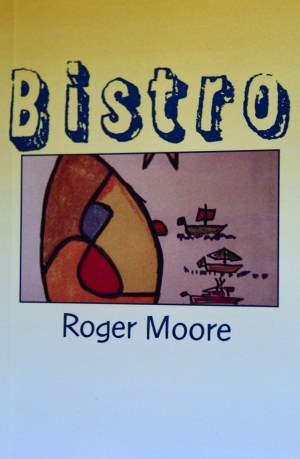
Thank you, Allan Hudson, for your kind words about my book of short stories entitled Bistro. Allan has also set out a brief introduction to five other novelists, several of them close friends and admired acquaintances.

Bistro was one of three finalists in the New Brunswick Book Awards (2016-17). I think it was the only self-published book to make the finals. So, all of you struggling self-publishers, it can be done and we can get recognized, as we know from the results of one of this year’s major French book awards, awarded to another self-published author, much to the chagrin of all the French publishers who had already turned his book down. The message to everyone is simple: “Don’t get off the bus. Keep believing. Finish the journey.” And remember, you’ll never finish the journey if you get off the bus / train / boat / plane / tram / trolley / whatever … before you reach your final destination.

The cover photo, incidentally, is one of my cartoons that has appeared on these pages before. It shows a bird-man, beak open in astonishment, watching three ships approach his belly-button, as he sits there, naval-gazing, or should that be navel-gazing? “I saw three ships come sailing by …”

You can link to Allan’s Blog, the South Branch Scribbler, by clicking on the link. Bistro, incidentally, is available for purchase on Amazon and Kindle.

Seeds

20180916_183415-1_resized

Seeds

As creative artists, we seek to leave seeds and plant seeds. Just one idea, seeding elsewhere authenticates us as artists and creators. Some seeds fall on stony ground, we know that. Others do not take immediately, but lie dormant for some time. Some, a few, a very few, a happy band of siblings. drop, root, and grow into the flowers we always wanted to create.

We must always have confidence in our seedlings. We must believe that they will survive, somehow, somewhere, in spite of the random nature of the universe. Write with that belief. Create with that belief. Be strong. believe. Even when others doubt you and, what is worse, you doubt yourself. Never doubt yourself.

My Hollyhock doesn’t doubt. It came from nowhere and gifted itself upon us. Now it has gifted us with pod after pod of wonderful seeds. Some will be lost. The squirrels, chipmunks, and mourning doves, not to mention the passerines, will get others. But some will survive, take root, and flourish, just like this one did.

Believe, my friends, believe. And never stop creating.


KIRA Writing Retreat #2

KIRA Writing Retreat #2

IMG_0084

A second KIRA Writing Retreat will be held from Sunday, October 14, 2018 to Saturday, October 20, 2018. A maximum of five participants will be selected to work with the Kingsbrae  Artistic Director, Geoff Slater, Professor Emeritus and Award-Winning Poet, Dr. Roger Moore, and Award Winning Short Story Writer, Jeremy Gilmer. Full details are available from the Program Director, Mary Jones, at kira@kingsbraegarden.com or by telephone at 506-529-8281.

Click on the attached link for A Brief Overview of Life and Art at KIRA.

 KIRA Promotional Video


Sentence

SENTENCE

IMG_0279

Never underestimate the importance of the sentence, the power and placement of each word, the dynamism of the parts, the wisdom of the whole. I could write about this at length but, much more important, others have done so. My thanks to my friend and fellow artist, Jan Stoneist, for choosing the above sentence from my book, Stepping Stones, and carving it in Old Red Sandstone, from Wales. Cymru am Byth.

This article, attached below, illustrates the theory much better than I can.

THE SENTENCE