Prophet and Loss

Prophet and Loss

I have sown so often on stony paths
and harsh roadside ways where thistles
bloom in purple patches and weeds choke
the fertile soils, closing flowers down.

Who knows what cold winds blow when
new seeds are shuffled, then cast, like bread
upon water, into the mind’s frustrated furrows?

Will flowers flourish, or will they perish,
still-born, in the depths of their stony graves?

I do not know for I cannot read the runes
the wind scatters across the sky when it shuffles
clouds and scrawls shadow-writing on the land.

Careless, I cast out word-seeds, knowing full well
that many will perish. But I also know that one
or two will put down roots. Eventually, developing
shoots will nourish my labor’s burgeoning fruits.

Comment: There is no profit in being a prophet.

Les croulants

Les croulants

That’s what they called the older
generations, in Paris, in 1963, when
I lived there, in St. Germain-des-Près.

Now, a member of that generation,
I remember those words and see myself
crumbling, failing, falling slowly down.

A façade, it’s all a façade. Here I am,
white-haired, wrinkled, watching time’s
oxen plowing furrows in my face as
winter’s snow layers a silvery thatch
of patchwork hair upon head and chin.

How much longer can I sustain my life,
exist in this metatheatre of give and take,
where each day takes its toll, and I give
away bits of myself, slowly, reluctantly,
sloughing them, snake-like, to dance,
then vanish, into the gathering dark.

Author’s Note
I used this painting as the cover for my novel People of the Mist.

People of the Mist
A Poet’s Day in Oaxaca

Click here to purchase this book.

Themes from this poem can be found in my poetry collection Poems for the End of Time. It is a series of metaphysical meditations written while listening to Messiaen’s Quartet for the End of Time. It is followed by Lamentations for Holy Week, a sequence based on the Spiritual Exercises of St. Ignatius of Loyola, as imitated by Francisco de Quevedo (1601 – 1613) in a series of poems composed during Holy Week. This poetry is written from the heart and expresses the authenticity of the poet’s being. Here, the poet indulges in a dialog with his time and place – much in the manner outlined by Mikhail Bakhtin in his theory of Chronotopos. This poetry is not written for the simple minded. Rather it invites the reader to explore the nature of the world, the philosophy of time and place, and the metaphysical exercises necessary to prepare for the inevitable end of time.

Poems for the End of Time
and
Lamentations for Holy Week

Click here to purchase this book.

Souvenirs

Souvenirs

Where have they gone,
the old days, the old folk,
the old ways of doing things?

I search for them, day after day,
but my cell phone isn’t
the old-fashioned circular dial,
nor the pick-up phone
with the shared party line,
when everybody listens in.

The garage is a mad hatter’s
maze of a workshop,
in which things grow legs
and walk this way, that way
every way to Sunday,
constantly getting lost.

I think I can hear them.
chittering, chattering.
but I cannot see them
nor hold them,
even though I would like
to clutch them tight.

Bats in the belfry,
and in the attic
mislaid items,
pens, ink, paints,
a tuck box, with keys,
a cricket bat,
cracked and yellow,
abandoned,
and forgotten.

What was the last thing you searched for online? Why were you looking for it?

Daily writing prompt
What was the last thing you searched for online? Why were you looking for it?

What was the last thing you searched for online? Why were you looking for it?

The last thing that I searched for online was a prompt that I wished to be prompted by, but I promptly lost it before I could respond to it. Then I went looking, but still couldn’t find it, even though I searched everywhere I could think of.

I grow forgetful as I age, and now I can’t remember what the prompt asked for, and that’s a pity because I remember that I had a lovely answer. Now I can’t remember my answer either. So I am stuck in a sort of one-way street, going in the wrong direction, as I draw near to a roundabout that will lead me back the way I came.

I am afraid some Minotaur or other will seek me out, because I am lost in a labyrinth without the thread of Theseus to lead me out. And its no good searching online, because I no longer know what I am looking for. And that’s a bit like my life at the present time – a pointless search for meaning as I wander, amazed, through a baffling maze of days, seeking, I know not what, and never finding it. I don’t want to give up on it yet, because I know that the answer lies just around the corner, lurking like the last sardine in a sardine can, or the last piece of squid, cowering blackly in its own ink, in the tin, not wanting to be eaten.

Life leads me a merry dance, as king-like, a one-eyed man in the kingdom of the blind, I rule my world. For, en el reino de los ciegos, el tuerto es rey / in the kingdom of the blind, the one-eyed man is king. And no, I didn’t search for that online. It came to me in a sort of dream because, as Goya says, el sueño de la razón produce monstruos / when reason sleeps, monsters are born. And now I see them everywhere, those monsters, and I search online for solutions, but none appear. And so I continue on my merry-go-round way, leading my ragamuffins around those ragged rocks.

What does your ideal home look like?

Daily writing prompt
What does your ideal home look like?

What does your ideal home look like?

My ideal home looks exactly like the one I am living in right now. In the country, surrounded by trees, with blossoming crab apples in the front garden and a mountain ash in full view from the kitchen window, what more could I ask for? Blossoms in the spring, a gradual flowering throughout the summer, and now, as fall approaches, the fruit ripening.

Verde, que te quiero verde. – Green, for I love you green. But what exactly is green? I sit on the front porch in the cool of summer, and look out on a sea of greens – green grass, green leaves, light green, medium green, dark green, and all kinds of shades and hues as the sunlight filters a subtle dance of colors through the leaves. The eye distinguishes so many different shades of green. Alas, I do not have the vocabulary to distinguish verbally what I see visually. Ah, poor poet, linguistically damaged, and writing with one hand tied behind my back, I suffer from an ability to feel and an inability to express. Terminological inexactitudes, Winston Churchill called them. But in my case, they are the lies I must create when the truth overwhelms me with its beauty.

And in winter, when the cold winds blow, and the leaves lose the safety of their trees to be blown hither and thither at the wind’s will, what then? A blanket of whiteness, shadows shifting beneath the moon by night, and a million brilliant sparkles beneath the sun by day. And the visitors, every night the deer come, stay awhile, then vanish, only to reappear the next day. At midnight, in the moonlight, I watch them from my window as they dance on their hind legs and nibble the hanging fruit that the mountain ash reserves, just for them, so that they will survive, as they have done for millennia, in this paradise that surrounds my ideal home.

Hide and Seek

Hide and Seek

Pictures and memories play hide and seek.
They hunt the slipper that hides in the words
that slither and slide across my page.

They long to emerge, fully formed, and to step,
without effort, into your mind. They want
to linger there, to baffle, taunt, and haunt you.

Digging through the verbiage, a thought,
a metaphor, a grouping of words will join and
rejoin. This is the grit that the oyster slowly shapes
into the pearl of great price that glows so bright.

Consider the opal. Plain at first sight, yet changing
color, shimmering in sunlight, a chameleon
adapting to mood and shadow, its moon dance
hovering, a butterfly over burgeoning blossoms.

Who could ever forget, once seen, star light
illuminating the bay, the moon gilding the sea,
those summer nights, our secret love flowering.

The veiled will unveil itself and tease its way,
its path over the sparkling waters of the bay.
Knock and it will open. Seek and you will find.

Comment: I had a specific, named place in mind when I first wrote this poem. Then I realized that my secret place was not necessarily the remembered place of other people who had undergone similar experiences. So, I removed the specific and made it generic.

I know you have been there, to your own special place. A warm summer night. Star light over a bay. Or maybe it was an estuary, or perhaps a river bank? The moon appearing, lighting up the waters. Walking, perhaps, hand in hand. Or sitting, as I remember it so well, in a late-night café, watching the night lights on the fishing boats, as the moon spread its golden carpet over the bay.

Flight

Flight

Such a miracle: those first steps to flight
taken by the cormorant over water.
That first one heavy, creating ripples,
the second one lighter, and the third one
scarcely touching the water.

The need to take flight lies deep within me.
Fleeing from what? Flying towards what?
Who knows? All I know is that the future
lies ahead where my bird’s beak points and
the past, a rippling wake, lies behind me.

That white water, trailing its kite’s tail,
tells me where I have been. Machado’s
voice calls out from the past: “Traveler,
there is no road, just a wake across life’s sea.”

Comment: The photo is a golden oldie, one of the first I ever posted on this blog. The poem is part old, part new. In reality, it is a revision, completed today, of the earlier poem associated with that old blog post. It is interesting to compare the two visions – with those seven extra years of creative experience between them. Let me know what you think!

A special thank you to my long-time friend, Dale Estey, for commenting and suggesting an improvement for the fourth line. Spot if if you can!

What do you enjoy most about writing?

Daily writing prompt
What do you enjoy most about writing?

What do you enjoy most about writing?

I love it when a special friend reads one of my books and then takes it to the place where it was composed, and sends me a wonderful photograph of the book cover and the exact spot, at Hopewell Cape, where the cover was drawn. Wow! That is so special. Thank you, Sara, my friend and accomplice, for making even more art out of art and involving nature in the process.

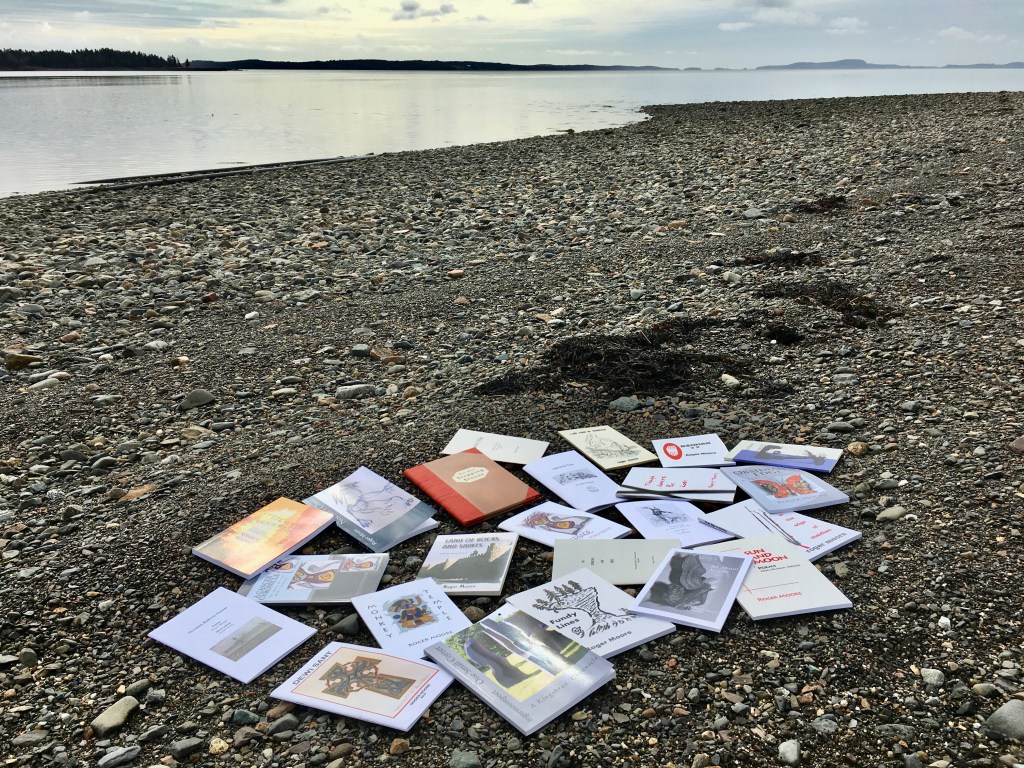
Other friends have done similar things. Here is a collection of my books on the sea shore at Holt’s Point. And yes, Fundy Lines is in there as well. Can you spot it? Another very good friend, Geoff, contributed this very meaningful photo. So much of my life, there, upon the sea shore, waiting for the tide to come in.

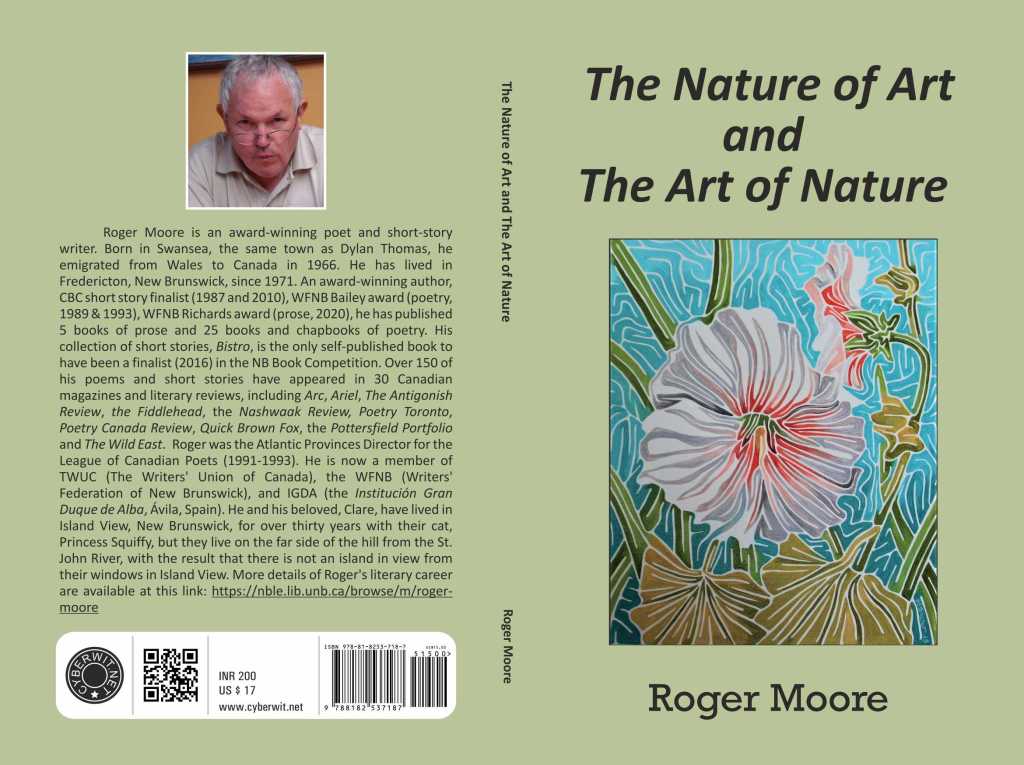
This book, and its cover, are also very special indeed. And here’s why.

Still Life with Hollyhock
Geoff Slater

How do you frame this beaver pond,
those paths, those woods? How do you
know what to leave, what to choose?
Where does light begin and darkness end?

Up and down: two dimensions. Easy.
But where does depth come from?
Or the tactility, the energy, water’s
flow, that rush of breathless movement
that transcends the painting’s stillness?

So many questions, so few answers.
The hollyhock that blooms in my kitchen
is not a real hollyhock. Intertextuality,
visible and verbal: this is a poem about
a painting of a digital photograph of a
hollyhock, a genuine flower that once
upon a time flourished in my garden.

A still life, naturaleza muerta in Spanish,
a nature morte in French, a dead nature,
then, portrayed in paint and hung alive,
on display, in this coffin’s wooden frame.

So, what do I enjoy most about writing? Everything – for whenever creative people create they draw in others into a web of intertextuality that spins its way from mind to mind and, especially in Canada, links shore to shore to shore.

Crossing the Bridge

Crossing the Bridge

When I got to there, I couldn’t cross it.
I sat in the coffee shop, over-looking
the River Severn and ordered a cup
of cafeteria tea. Time limped slowly by
and I let my untasted tea grow cold.

What was there for me on the other side?
Empty stood the house where I was born.
Sold, the bungalow, built by my father
and his father, the summer home I loved
so much. Lost the kitchens I remembered
so well, kitchens in which I had come of age.

I tried to picture the ghosts of Christmases
past walking the logs that flamed in the fire.
Ghosts? They inhabit my mind, share my life,
dwell in my days, dream with me most nights
when a golden moon sails past my window,
and silver stars fill my dreams with light.

Skype or Zoom

Skype or Zoom

I sit and watch the grandfather clock,
listening to every tick and tock.

So slow, the sullen pendulum swings
as time limps by on leaden wings.

When they arrive, the house will fill
with youthful joy and much goodwill.

Age will flee for a week or two,
then we’ll be alone, just me and you.

Watching the telly, watching the clock,
counting each tick and every tock.

We will be lonely, left here alone,
waiting for them to telephone.

The very best thing to lighten the gloom
is to see them again on Skype and Zoom.