Two Poems

1
The Day Before
My Birthday

Warm air.
Cold snow.
Grey ghosts of memory
drift beneath the trees.

If it were fall …
… if the sun were to shine …
rainbows would grace
the spun webs of spiders
clinging to the trees.

If, if, if …

A warm winter day,
or so they say,
snow diminishing,
a wind from the south,
up from Florida,
rain on its way.

My birthday tomorrow.
The temperature to fall
way below the date.

-16C on January 16.

My fate
to be a winter baby,
to never know
what the weather
will be like
on that date.

2
My Birthday

I won’t sit here
with head in hands
fearing the future
or brooding on the past.

Every day I survive
is a bonus now,
each sunrise
a celestial celebration.

I welcome daylight
with open arms and now,
on my birthday,
I will accept
all gifts with joy.

Sunshine floods through me.
It fills me with hope.
Its beacon beams .
A full tide of love
overflows in my heart.

Comment:

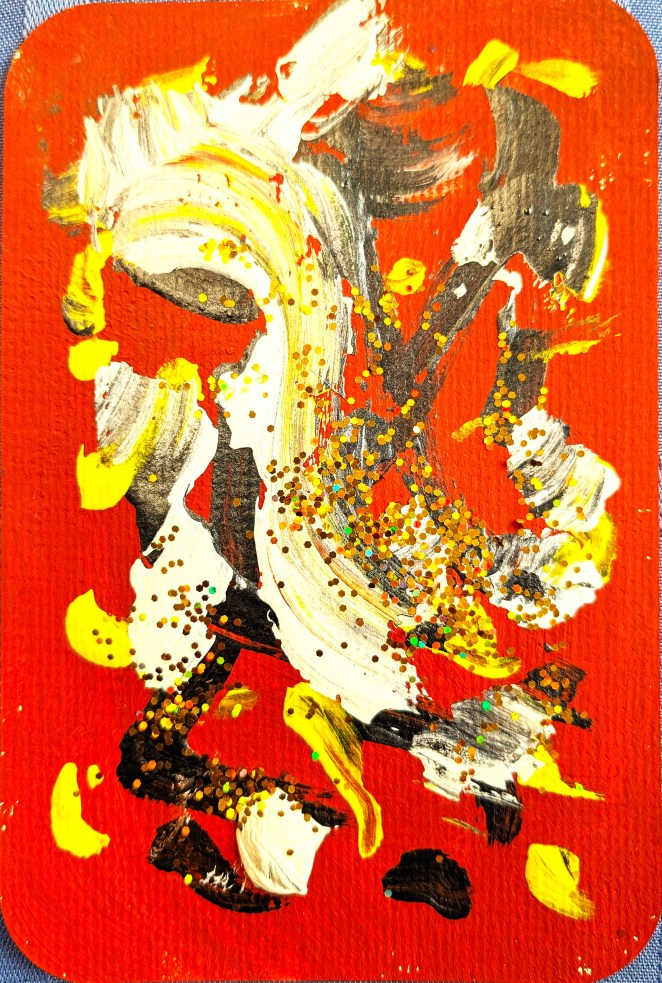
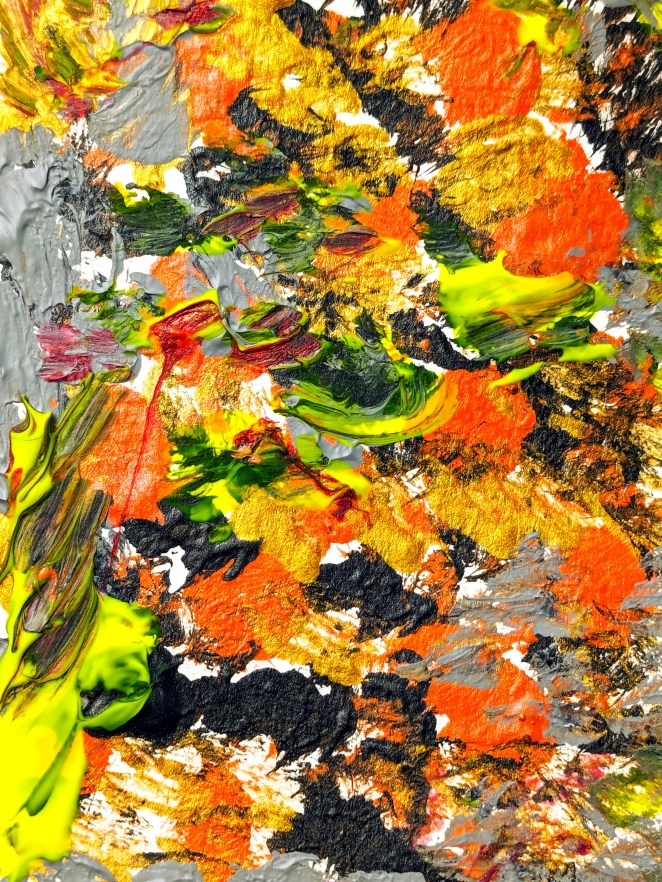
Bilbo Baggins gave away presents on his birthday. Today it is my birthday and I have joined with Moo to give away two poems, the first written yesterday, and the second today. Moo painted the picture, as always, and presented it to me for my birthday. A nice gift. Thank you, Moo.

I got some other nice gifts too. In the local superstore I discovered Polvorones. I have never seen them there before. It is a long time since I have seen them here in New Brunswick. So, what a lovey find that was. Tengo polvorones.

I don’t make New Year’s Resolutions. That’s why I never break them. That said, I do intend, and Moo agrees with me, to start posting regularly once more. So hang on to your hats – and let’s see how long that intention lasts.

Carved in Stone 51 & 52

Carved in Stone
51

Time, shape, and location –
the Templars’ Castle
in Ponferrada,
considered impregnable,
but it had no water works,
no moat.

Napoleon placed his cannon
on the hills above
and fired down into the bailey,
shattering walls, gates, and doors.

Again, only the ruins remain
inhabited by choughs
that nest in the walls,
and rise up in stormy clouds
when visitors disturb them.
 
I go there on a sunny day
and wonder when the castle drowses
if it dreams of its former glories,
ground down into the dust.

52

I climb a ruined wall
and watch white clouds
as they gather over the hills,
then roll down into the valley –
a cavalry charge of plunging horses.

So easy to see
Santiago Matamoros,
St. James the Moor Slayer,
descending from the clouds
to rescue the Christian army.

I study the skies
and see something secret,
almost mythical,
carved from the mists of time.

But this not my land
and these are not my people
nor my legends.

I sense I am not welcome here,
that I can never belong,
and I decide to move on.

Commentary:
“I sense that I am not welcome here, that I can never belong, time to move on.” Sad words – but we live in a world that, all too often, has turned its back on people. More, it has turned them into numbers and statistics, and number sand statistics are not flesh and blood. Tragic really. And doubly tragic the labels that are stuck on people. So hard to get off, those sticky labels, for they are designed not to come off easily, but to linger, like sticky plastic wrappers in the grocery store.

James Bond – 007 – interesting – but I am not a number, though I have had numbers attached to me all my life, as have you and all the people you know. Number plates on cars, telephone numbers, Medicare numbers, dental care numbers, bank account numbers, driving license numbers, student numbers, graduate student numbers, library card numbers – and now passwords, a mixture of numbers, letters (small and capital), and signs, all jumbled in such a way as to make things inaccessible for those who do not know the numbers. An alien world, my friends, for the numbers, those numbers, are much more important than we are, and each of us, like it or not, is reduced to a number, or a label, or a recognizable feature or nick-name.

So, how do we belong? How do we fit in? How do we survive? If we are lucky, we have small communities that thrive around us and look after us. But sometimes we are left alone. All alone. And then we have nothing to belong to, no sense of being, of belonging, no sense of a valued place in life, of being worthy. And when our worthlessness sinks in, then we sink lower, and lower, and we wake up one day and realize that it is all over and that the end is near, for we have nothing, not even the desire to live on.

Growing Old Together

Growing Old Together

You and I are growing old together.
We have been together for 59 years
and married for 54 of those.

We watch each other slowly breaking down,
the memories going,
the body parts not functioning
the way they used to.

In some ways,
it is incredibly beautiful.
In other ways,
it is so tragic, this slow waltz
around life’s dance-floor
towards who knows what
that last dance will bring?

It gets harder and harder
to find the right things to say,
sometimes to find anything to say.

There are days
when we just sit in silence,
filling in time,
doing a crossword or a sudoku,
or just gazing into space,
trying to avoid
the mindlessness
of endless adverts
on the television.

Commentary:

Not much to say, really. The poem and the photo speak for themselves, as good art always should. Sometimes the artist plans everything, and out it pops, all ready-made. On other occasions, a small miracle takes place and words and images tumble out, fluff their feathers, settle down and wow! – it’s a work of art. As long as one other person, other than me, thinks so, then I will be happy. “If I can reach out and touch just one person.”

I often wonder how many people are touched by traditional art nowadays. There is so much shock and awe out there, that the humble homely corner with its two doves or the image of an elderly couple dancing slowly around their kitchen, hanging onto each other – for what? And both of them waiting – for what, exactly? I expect it varies with each couple. But what I pity most are the lone doves, abandoned, autonomous, living on their own-some with nobody to talk to and only the TV to listen to. How many of them are out there, I wonder? When I walk around town, I see the street people, the homeless, the really lonely ones, just sitting, or slowly pushing a grocery cart with all their belongings tied up in plastic bags. Heads down, they plod on, never stopping, never looking.

“A sad life this, if full of care, we have no time to stop and stare.” W. H. Davies.

Clepsydra 49 & 50

49

… I am walking backwards
     a step at a time
          into my second childhood


my face in the mirror
     is no longer that of the little boy
          I used to be


I open so many boxes
     stored in my mind’s attic
          but find only dust and ashes
               the burnt-out remains
                    of long-gone days …


50

… sitting in the car
     waiting for my beloved
          to finish her shopping

who are they
     these faceless people
          these ghosts
               who look at me
                    then avert their eyes

I see their faces
     distorted in the puddles
          left by last night’s rain

why don’t they speak to me
     why do they always
          avoid my eyes

is it the blue sticker
     in the windscreen …  

Commentary:

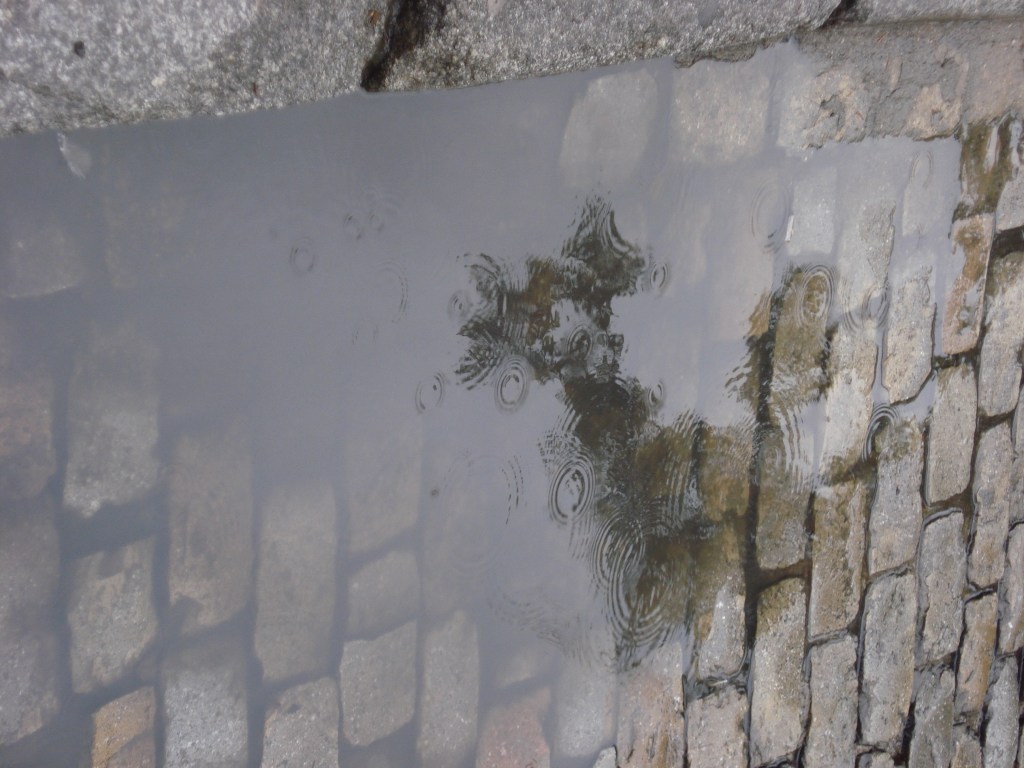
I see their faces distorted in the puddles left by last night’s rain.

Clepsydra 43 & 44

43

… a mouth stopped with silence
     a pen that can’t write

a river that won’t flow
     no safe place at night

when I lit that candle
     I turned out the light

and sat in the stillness
     all flickering with fright

to whom can I turn
     to make things right

silent in the darkness
     I yearn for a light

a moth in life’s flame
     I flare and burn bright
 
scorching a hole
     in the shade of the night …

44

… but to lose my language
     is to lose my butterfly soul
          as it flutters to reach
              life’s sweet-scented rose

does the soul leave
     the body at night

released from its prison
     of earthbound clay
          does it wander
               in dreams
                    among the stars

Commentary:

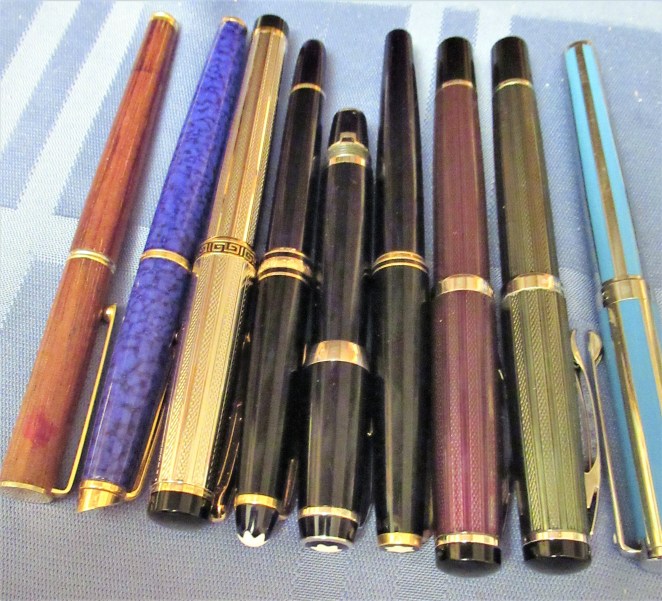
“Cette plume n’est pas une plume.” This pen is not a pen. A mere photo of a pen, and I won’t be able to write a word with it. Nor will you. Not that it matters, for we are nearly at the end of our journey. Only eight more sections remain, and then the poem will be done.

I thank all of you who are travelling this road with me. Not much longer. The poem is coming to its end.

Loss

Loss of …

By the time I remembered your name
I had forgotten your face,
and then I couldn’t recall
why I wanted to talk to you
in the first place.

Words and phrases bounce,
water off a duck’s back.

They sparkle like a high tide
rejected by the retriever
as he shakes his coat dry
on emerging from the sea.

This book I read is a word parcel,
a clepsydra of droplets
a rainbow strung with colored beads
each scoring a bull’s eye
on the world’s taut literary hide.

Mapa mundi of forgotten lands,
I trace dark landmarks
on the back of scarred hands
and wonder why I have never visited
faraway places with names
I cannot even pronounce.

Tourist guide to a failing memory,
I track the trails of drifting ships
as their white sails vanish,
blank butterflies from a distant summer,
floating over a darkening horizon.

Commentary:

I notice how my memory fails a little bit, day by day. I mis-spell a word. Forget a telephone number. Have to check a recipe three or four times – was it twenty minutes at 400F or 30 at 350F? Then I wonder how many spoons of sugar I put in my coffee. Worse, I forget whether I have taken all my tablets or not. I line them up in order, take them one by one, and still forget whether I took the last one or not. Oh dear.

I make shopping lists and check each item off as I put it in the cart. Then I check the cart to see if I did put the items in. Impulse buying. I haven’t seen Marmite on the shelves for some time now. So, every time I see it I buy it. Now I have four pots of Marmite in the cupboard. Animal Farm – Marmite good, Vegemite bad. And I can even say that in an Australian accent.

I forget words in English, but suddenly remember them in Welsh, French or Spanish. Then I forget them in the other languages as well. Last night I remembered callos in Spanish but forgot what they were in English. I had to ask my beloved and she reminded me that callos meant tripe. Great. I now knew what they were but I couldn’t remember why I wanted to know what they were in the first place.

This afternoon I looked everywhere for my glasses and then I remembered that I was wearing them. I have a little name tag that I wear when I go out. That way I will at least remember who I am. Now, I have just changed my coat – so where’s my name tag? As for my cell phone, I never call myself on it, so why should I remember the number anyway? I guess that’s it for now. I am sure I had something else I wanted to say, but I can’t remember what it was. Oh dear!

Autumn Leaves

Autumn Leaves

I used to run,
jump, and catch them
in mid-air,
one, two, three
in each hand.

Now
I stand and wait
for them to fall
and land, perhaps,
on my clothes
or catch in my hair

the Leprechaun luck
of my Irish heritage,
so long-denied,
with its pot of golden leaves
waiting for me
at summer’s cast-off
rainbow’s end.

Commentary:

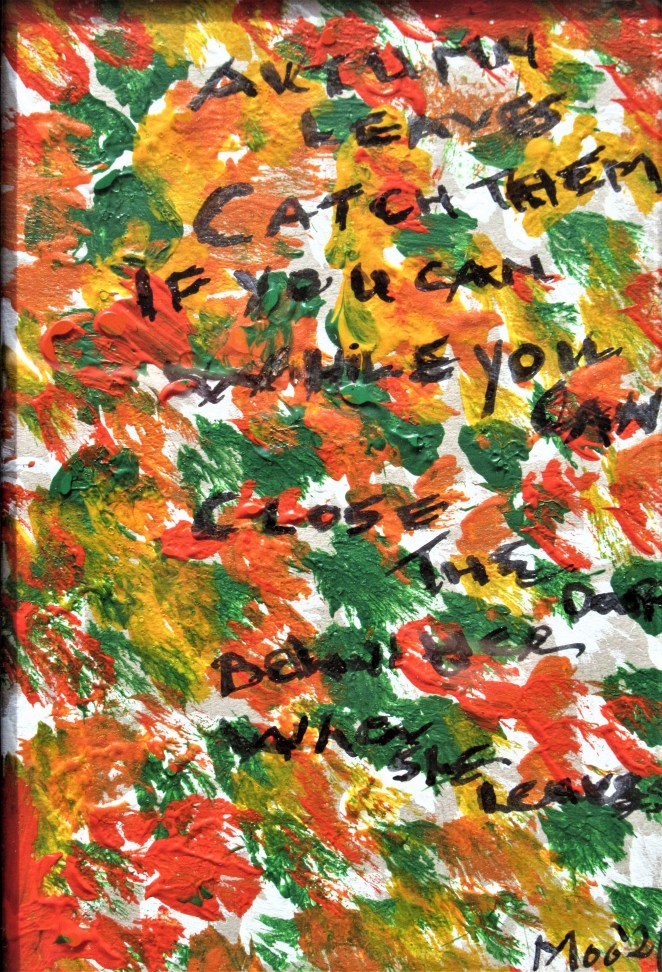
Autumn Leaves, but where does it go to. Good question. Moo asked me that the other day. I just had to tell him that I didn’t know. However, he did offer me the perfect painting for the fall and the changing leaves. Fall Folly Age. I never realized that he could play with words like he plays with paint. Anyway, I know that last winter he painted a picture of little white dots with wings. “What are they?” I asked him. “Snow flies,” he replied. “You know, when the snow flies …” “When the snow flies do what?” “I don’t know.” Moo and I live in a mysterious world, as you have probably come to realize.

Any way, the combination of fall foliage and fall folly age is quite a good one and it shows the folly of ageing and trying to chase down falling leaves when gadding about in the garden with two sticks, one in each hand. Of course, in case you don’t like that painting, and I hope you do like it, because I do, then here’s another one for you.

The text reads – “Autumn leaves – catch them if you can – while you can -and close the door behind her – when she leaves.” Oh witty Moo. Painting and occasional poetry too.

Gorilla Drives the Zoo Bus

Gorilla Drives the Zoo Bus

Gorilla drives the same zoo bus
all day, every day;
same starting time, same finishing time,
same route, same stops,
different passengers,
but every passenger the same:
faceless.
Gorilla doesn’t want to know their names.

“Please tender the exact fare!”
Not a penny less, not a penny more,
and he polices every penny.
Bus conductor and master
of every passenger’s destiny,
he opens and shuts the door,
letting passengers on and off the bus,
but only at official stops.

Every passenger has a ticket,
and he punches every ticket
with a neat, round hole.

He never makes mistakes.
He grinds, like God’s own mills,
exceedingly small.

He has spent all his life in uniform.
He has a belt and braces to hold his trousers up.
He’s always prepared for the worst.  

Ten, fifteen, twenty years:
an anonymous wife;
anonymous little babies;
at shift’s end, a pension,
and another bus.

St. Peter’s at the wheel.
He doesn’t want to know
where gorilla wants to go:
he wants to know where he’s been.

Commentary:

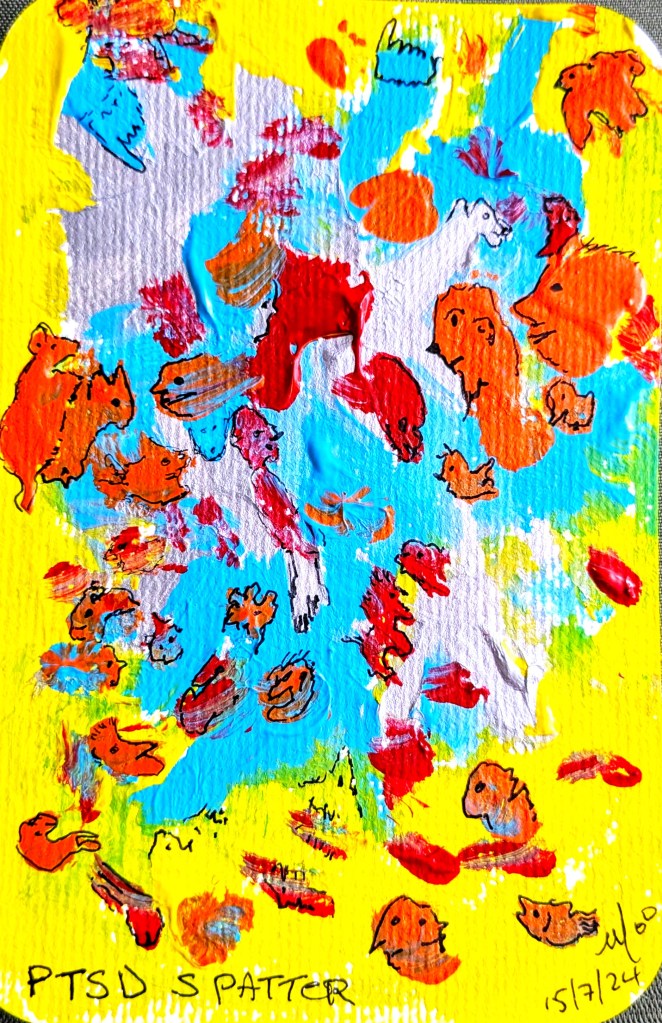
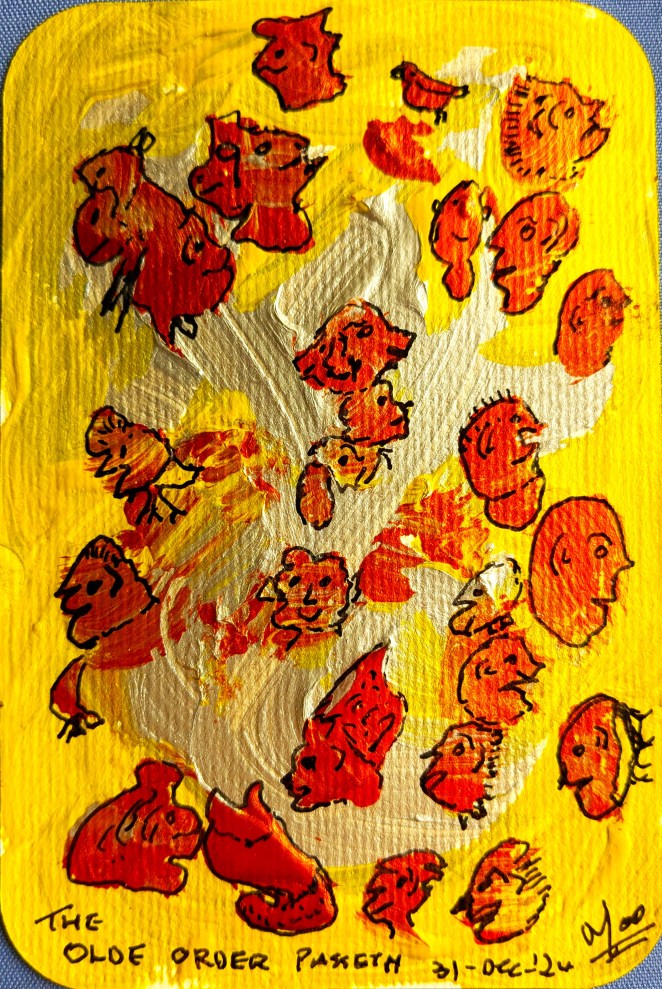
Moo didn’t have a painting of a gorilla driving a bus, so he offered me a painting of the passengers instead. Look carefully – you might even find a portrait of me or you in there. Who knows where Moo goes and who he sees? I certainly don’t. Remember Picasso – he used to run downstairs, out into the street, see a face he liked, and run back upstairs and paint it from memory. I wonder if Moo does the same thing. I’d ask him, but if he doesn’t want to answer the question, he just grunts. And I can imagine him grunting at that one.

Anyway, we all know and recognize the gorillas when we meet them. They are totally unimportant, have a miniscule job to do, but do it with absolute authority and the utmost perfection. Like Gorilla – “Not a penny less, not a penny more, and he polices every penny.” – “he opens and shuts the door, letting passengers on and off the bus, but only at official stops.” – “he punches every ticket with a neat, round hole.” – and probably in the exact same spot of every ticket! – “He never makes mistakes.” – and if he does, it’s the passenger who suffers, because ‘Get on, get off, who ever you may be, I am the lord of the bus,’ says he.

What will happen to us at the end of our shift? I really don’t know. And I don’t think anyone else does, either. Will St. Peter be there to greet us? (I don’t know.) Has the Zoo bus replaced the ferry over the River Styx? (I don’t know.) What will we be asked when we get there? (I don’t know.) How will we answer? (I don’t know.) Is there a little book in which all our deeds, good and bad, are written down? (I don’t know.) Are we to be divided into sheep and goats? (I don’t know.) What will poor monkey do when he is turned into a sheep or a goat? (I don’t know.)

So many questions, deep questions, packed into one small poem. Most of those questions unanswerable. But that’s one of the joys of poetry – to open a poem is to open a tin of calamares – there’s always another something or other left in the corner. Look, over there, bottom left, right at the bottom of the can, I spy with my little eye another question. ‘What is that question?’ you ask. Sorry, mate, I’m afraid I don’t know.

Rock

Rock

You are the rock
on which I build
my life.

You are the fairy castle
planned in paradise
where the sun always shines
and stress is distant.

How often have I mapped
your inner islands,
traveled your well-known ways,
always discovering
new sacred spots
where I can immerse myself
in your inner serenity?

You are the fortress
within whose walls
I can forget my past
and create my future.

If you were forced to wear one outfit over and over again, what would it be?

Daily writing prompt
If you were forced to wear one outfit over and over again, what would it be?

If you were forced to wear one outfit over and over again, what would it be?

Oh dear – such a difficult question. I have seen so many people puzzling over which dress they would choose, which blouse matched the skirt, which tie best highlighted the shirt, what color hanky, suitably folded, best suited the little breast pocket of the suit. Why do we have to have outfits? Couldn’t we have infits.

Now that’s a great idea. The one infit that I wear, every day, regardless, is my birthday suit. I have worn it, day in, day out for 80 years and it still (in)-fits me and, quite honestly, I have never spent a day without out it. Of course, it has worn a bit over the years. And no, I will not show you any photos.

However, I can say that the six pack that I once sported has become a rubber tire. There are bruises and scars where once the skin was white and tight, or bronzed and shining bright. Muscles have shrunk. Back has bent. Arthritis kicks in, now and again, but my birthday suit adapts to everything. It really was a wonderful invention.

And, guess what! Every day is my birthday now and today I am 29,370 days old. Not everyone can say that. And yes, I can also tell you, in all confidence, that I wear my birthday suit every day now in celebration of each passing birthday.

In Spain everybody has two birthdays – the day they were born and their saint’s day. The saint’s day is the day on which the saint after whom they are named is celebrated. Two birthdays is lovely – but to have 365 birthdays a year, to wear my birthday suit for every one of them, is spectacular. And it’s even better to have 366 birthdays in a leap year.

I know you know that a leopard cannot change its spots, but did you know that a leopard had 365 spots on his coat – one for every day of the year? Now that’s a fact that not everybody is aware of. What about a leap year, you ask. Well, on the 29th of February, every four years, to find that extra spot, you just have to lift the leopard’s tail. And don’t ask me how I know, because I am not going to tell you.