True Love

True Love

True love flows so much deeper
than an exchange of body fluids
or a handing over of ritual rings.

Our advancing lives are no longer
ruled by nature’s primal urges.
Our bodies have been taken over
by old age stiffness, aches, and pains.

Some nights, I wake up to find
she no longer breathes. I reach out
in panic, touch her gently, and when
she breathes again, I heave a sigh
redolent with love and relief.

Listen to podcast here.
True Love

Pianissimo

Pianissimo


            You sit at the piano, my old piano, still extant in my father’s house, yet soon to be given away, though we don’t know that yet. It’s an upright, iron-frame Bechstein, a piano that I was given when I was the same age as you are now. Handel’s Largo, the Harmonious Blacksmith, hours and hours of scales. They locked me in the front room, my mum and dad, and there I stayed for an hour, two hours, or more. I came to hate music. As soon as I could, I gave up the piano, I rejected piano practice, I turned my face away from the discipline of the lock up.
            Now, I listen to you. Your untaught fingers tickle the black keys, then the white keys, one after another. You are six years old. You’ve never had a lesson, but you have music in your blood and some residual instinct latches on to rhythm and sound. Your fingers are long and supple and your touch is light, so much lighter than mine used to be, and now, on the deep bass notes of the left hand, your stronger hand, you pound away, awakening the dark ghosts of soul music that pour through my memories awakening echoes in this piano.
            I think of you as a jazz musician. Thelonius Monk, perhaps, a tinkle here, a light touch there, now a chord or two, inexplicable, and who would want to explain. It is a joy to sit here, to see your smile of absolute absorption. Mood music you call it, and today your moods are as dark as the shadows that tug at my heart, and as light as the sunlight that floats through the windows and makes the dust motes sparkle. It also frames a halo round your head. You hum to yourself as the morning sunshine fragments into colored gems and you sculpt your rainbow of sound.
            “Stop that noise. You’re driving me mad,” your grandfather, my father, stumbles into the room. He has taken his last cigarette out of the packet and the white cylinder hangs down from his lips, like an extraneous chalk outcrop hanging from the lip of an errant teacher. He pats his pockets. “Where are my matches? Has anyone seen my matches?”
            “They’re on the table in the kitchen,” I reply. “Where you always put them.”
            “I thought I left them in here,” my father leans on his stick then turns and stumbles out of the living room and into the kitchen.
            You hop off the piano stool, take the matches from your pocket, and carefully place them on the arm of your grandfather’s favorite chair.
            “Sssssh!” you say, putting a finger on your lips. Then you skip back to the piano and start playing pianissimo on high notes that float like tiny raindrops of sound produced by miniscule angels.          
            Your grandfather returns, glances round the room, spots the match box, and pounces upon it, a caged tiger finally served his red meat.
            “That’s funny,” he mutters. “They weren’t there a moment ago.” He takes out a match, strikes it, lights up his cigarette, inhales a lungful of smoke, then exhales it in a great locomotive puff of cloud. He grimaces at you through a haze of smoke.
            “There’s nice music you’re playing.”
            Your young lungs, unaccustomed to a house of smokers, can’t cope with this thin, grey, choking cigarette waste. You stop playing, put a hand over your mouth, and start to gag.

Listen to the Podcast here:
Pianissimo

Blood and White Wash

Blood and Whitewash
A Thursday Thought

2-September-2021

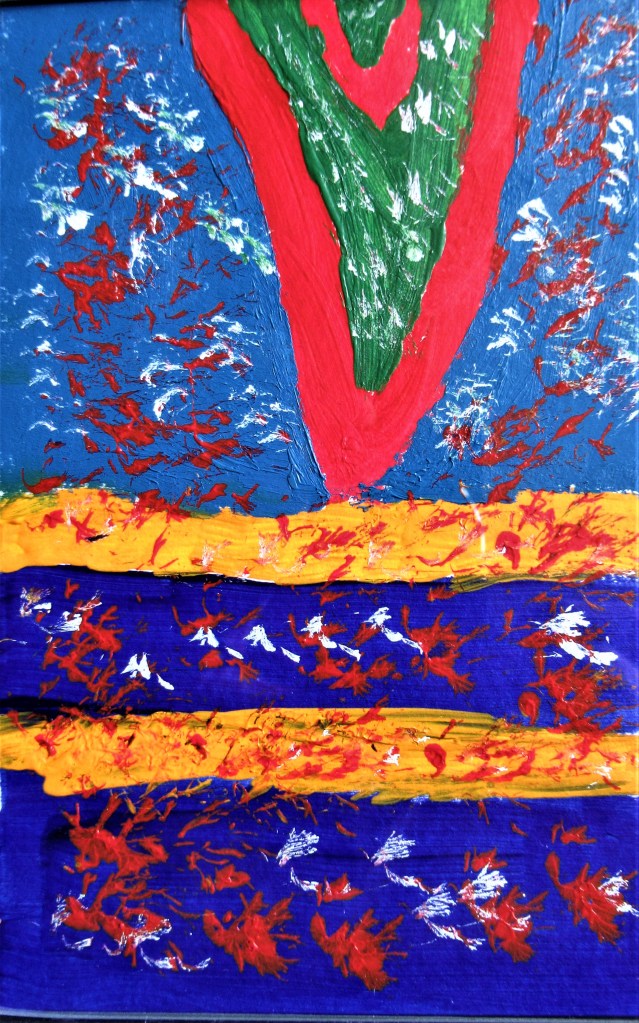
Blood and Whitewash is the title of this painting. It has a subtitle: My Plan of Attack.

The origins of the title, and hence of the painting, go back to the Goon Show, with Spike Milligan, Peter Sellers, and of course / wrth gwrs, Harry Secombe, the Swansea Comedian and Master Singer. Away in boarding school back in the late fifties, one of my greatest pleasures was listening to the Goon Show on one of the dormitory’s transistor radios. As a teenager, I found the jokes and the accents incredibly funny. Still do. That’s why I painted this painting. Alas, it is silent, and you cannot hear the accents.

The following snippet of dialog occurred on one such Goon Show, I cannot remember which.

“What are we going to do?”
“Well, this is my plan of attack.”
“That’s not a tack, it’s a nail.”
“No it’s not. It’s a tack.”

So above you have my painting of My Plan of Attack, resurrected after all those years. I throw my mind back to the First World War.

The General:
“He’s a cheerful Cove,” said Jimmy to Jack,
as he walked to Arras with his pack on his back.
But he did for them both, with his plan of attack.

And there in essence is the history of the painting. First, the plan of attack, then the failure and the blood-letting, and then the white-washing of the whole history, a white-washing that turns failure into success, defeat into victory, and loss into gain. But in WWI, it was the poor Tommies who bore the burden, and all the other front line troops who obeyed orders, went blindly over the top, and charged unbroken wire with fixed bayonets.

“If you want to find the sargent,
I know where he is, I know where he is,
If you want to find the sargent,
I know where he is.
He’s hanging on the old barbed wire.”

“If you want to find the chaplain,
I know where he is, I know where he is,
If you want to find the chaplain,
I know where he is.
He’s hanging on the old barbed wire.”

“If you want the whole battalion,
I know where they are, I know where they are,
If you want the whole battalion,
I know where they are.
They’re hanging on the old barbed wire.”

Singing as they marched to their deaths, obeying orders, like sheep, and nipped on by the eternal sheep dogs. Things were so bad at Verdun that instead of singing, the men marched, bleating, like sheep. “Sheep unto the slaughter.” There was so much ill-feeling and rebellion in the face of orders and certain slaughter, that French regiments were decimated, one man in ten shot for mutiny, as they marched bleating, instead of singing, to their deaths.

“Oh, we’ll hang out our washing on the Siegfried Line,
have you any dirty washing, Mother dear?”

“Those who do not learn from history are condemned to repeat it.” So, tell me, “where have all the young men gone, gone to graveyards everyone, when will they ever learn, when will they ever learn?”

And that, dear friends, is my thought for today: The History of My Plan of Attack. When, indeed, will we ever learn?

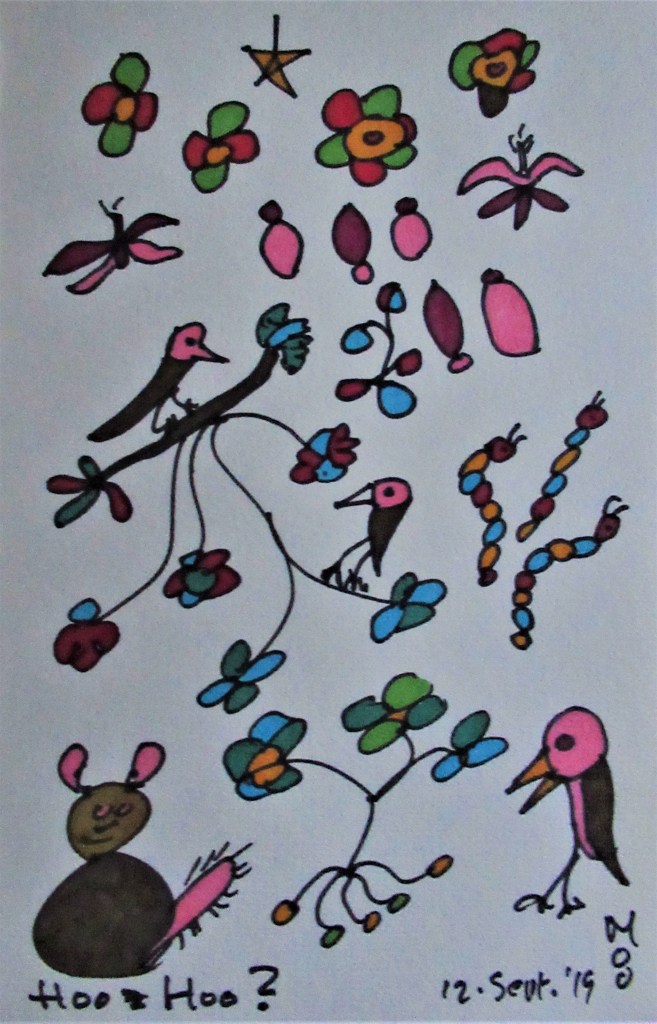
The Art of Narrative

The Art of Narrative

            Art has almost always told a story, even though, as in the case of the Cave Paintings in Altamira, Puente Viesgo, Lascaux, and elsewhere, we may not know exactly what that story is. On the other hand, many of the great paintings of the Spanish Golden Age (1525-1680) have a hidden narrative that we can often work out. Take, for example, Vulcan’s Forge (1630), painted by Diego Velázquez after his first trip to Italy (1629). On the surface, this is a painting of a typical Spanish Forge of the seventeenth century. Ordinary workmen labour away at their daily tasks, but, and there is always a but, the figure on the left is adorned with a god-like halo. Why? Because he is the bearer of a message. Vulcan’s wife, Venus, has been having an affair with Mars, the god of war. Vulcan has forged a net of fine, golden chains and placed it over the bed where they will loiter. Now, Mars and Venus are trapped in that net, caught in the act, so to speak. No wonder the mouths of Vulcan’s helpers are open in wonderment.

Bisonte Parado: Cenicero de Altamira.

            Before the arrival of photography, painting was the only way to record the world, to make a picture of what was happening, to tell a story in paint. That is why a picture is worth a thousand words. I have retold the narrative of the painting of Vulcan’s Forge in 128 words. There is, of course, a great deal more to tell about his and other paintings and how they represent the artist’s narrative reality. The advent of photography changed the artist’s vision of the world. As photography developed and became quicker, faster, and offered what some might consider to be a more accurate version of reality, so artists rethought their role. Was it to capture, in paint, the world as they saw it, with a single visual entry point, and a constant perspective? Or was it to catch the way light fell upon objects (Monet), or to offer multiple entry points (Braque), or to paint the turmoil of the inner mind (Picasso, Miró, Pollock)? Artists could do such things. Until recently, with the advent of the computer, it was much more difficult for the camera to do so. The camera recorded, but artists created and re-created their own narratives of the world around and inside them. Now we can enter photoshop and the equivalent and play around with out own photos of reality, distorting them and twisting them as we please.

Verbal to Visual to Verbal

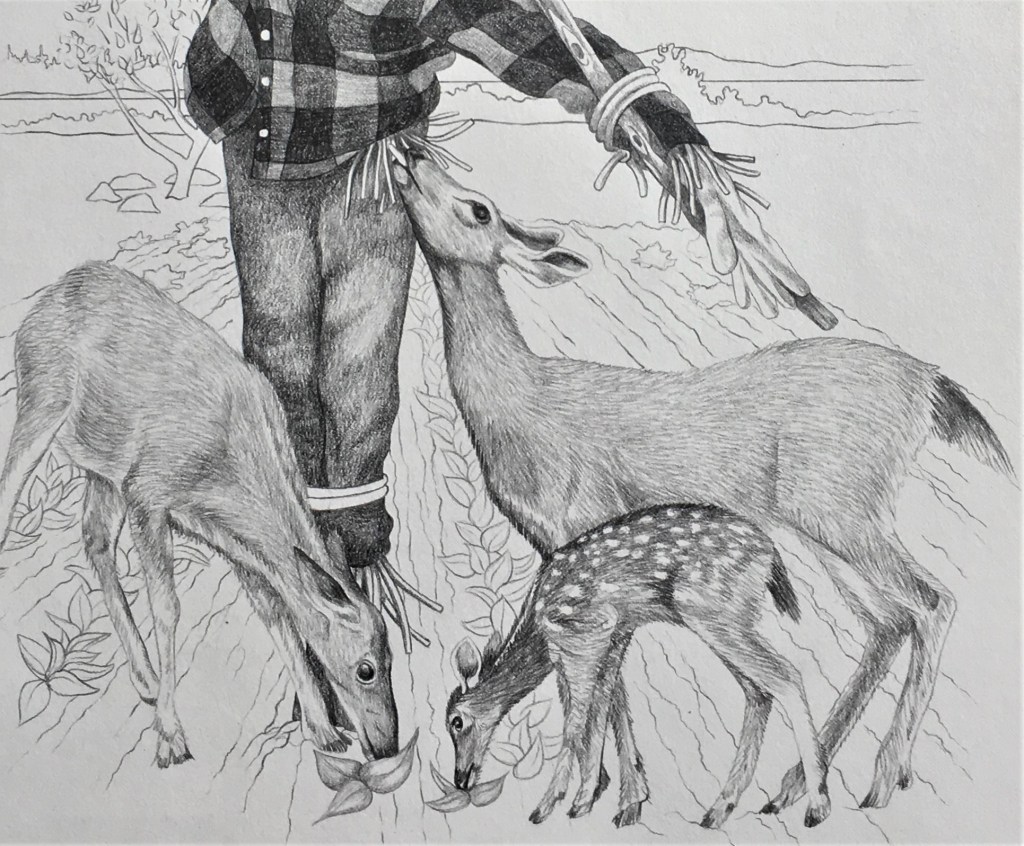
            Which came first, the chicken or the egg, the verbal or the visual? Or was there a sort of spontaneous combustion? In the case of Scarecrow, the artistic collaboration between myself, the author, and Geoff Slater, the artist, the words came first: “In the beginning was the word.” He heard me reading my story, started to sketch the characters, and within six months we had produced an illustrated book.

Wonderful drawings. Thank you, Geoff.

Words and narrative first, then an artist’s rendition of key moments in the narrative. However, in the case of Twelve Days of Cat, our second artistic collaboration, Geoff sent me 12 drawings of a cat and I looked at them and worked out a narrative that would join them together in a symbiotic relationship. Scarecrow is an illustrated narrative in prose. Twelve Days of Cat is a narrative in poetry based on what was once an independent series of charcoal sketches. Who cares which came first, verbal of visual, when the results are so pleasing to ear and eye.

Waiting

The story of one man’s journey

Spotify
Scroll down to correct episode.

Waiting

I remember pushing
my father around the ward
in the hospital.
Two weeks we had together.

My father sat in his wheel chair
and I wheeled him
up and down.

“Cancer,” they told me.
“But it’s kinder not to let him know.”
In those days, it was better to die
without knowing why.
Did I betray him by not letting him
know what I now need to know?

One day, he begged me for help
and I lifted him out of his wheelchair
and placed him on the toilet.
He strained and strained
but could not, would not go.

“Son,” he said, sitting there,
“Will you rub my back?”
How could I say no?

That strong man,
the man who had carried me
in his arms, on his back,
and me standing there,
watching him,
his trousers around his knees,
straining hopelessly,
and me bent over him,
rubbing his back,
waiting,

for him to go.

Comment: Thank you, once again, Alejandro Botelho of Diverse TV. This was a great reading. If you, dear reader, are interested, you can listen to it HERE. Alejandro’s reading of my poem begins at 40.52 and ends at 42.33. But remember, the other poems are also well worth listening to and Alejandro has a great voice and wonderful interpretation. A further comment: first there is the text. Then there is Alejandro’s excellent reading. Then there is my own reading. From each of these the observant reader and / or listener will extract a slightly different emphasis and meaning. In my own case, following Alejandro’s reading of the original text, I have added some minor changes, to add to the intertextual rhythm of the words. Tolle, lege et vade mecum. A Cancer Chronicle is available HERE.

Bird’s Nest

Jackson Pollock it ain’t. But just look at those fledgling storks launching themselves into the air. And yes, those are their nests!

Spotify
Scroll down to appropriate episode.

Bird’s Nest
Jackson Pollock No5 (1948)

This bird’s nest starts with a startling tweet
that wins a trilled, thrilled response. A flutter
of heart-string wings, creator, viewer, join

with the creation. Thin threads of life mix
and match their tangled weave, existential
tapestry, fathered in a feathered nest.

World without end, this labyrinth without
an entry point, without a beginning,
with a spaghetti-thread middle that meets

not in a breath-catch of the mind, but in
a brush-flick of coloured rain, a cycle
recycled of circled paint, circular

in its circumnavigation, its square
eight by four-foot globe of a new world whirled
in stringy whorls, reinvented beauty

drawn haphazardly from the bicycle
tour de force of this artist’s inner mind.

Comment: This is a tongue-twister of a poem, much as Jackson Pollock’s painting is a twisted vision twisting the viewer’s eye. And, no, it is not easy to read. Nor is the painting easy to view. Click here for a link > Jackson Pollock < to the painting. Click here for a link to Alejandro Botelho’s reading of < My Grandfather >. Note that Alejandro’s reading of My Grandfather begins at 17.58. And note too that the other poets are also well worth listening to. Once again, thank you for this, Alejandro: your work is very much appreciated.

My Grandfather

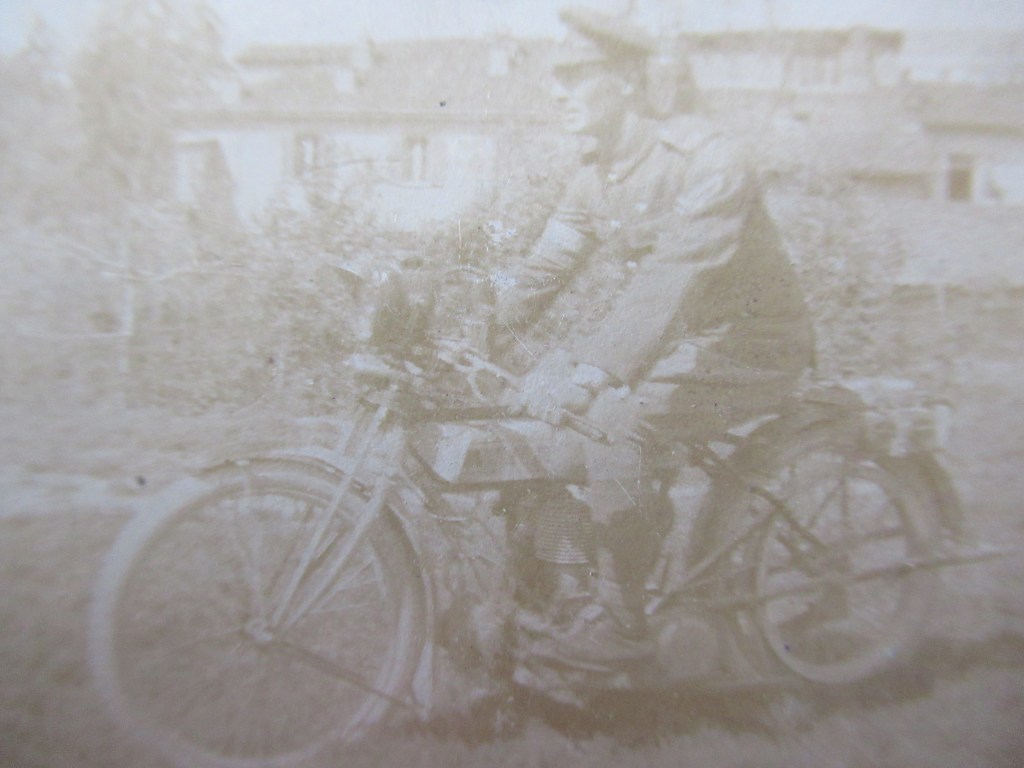
WWI Dispatch Rider. A friend of my grandfather’s.

Spotify
Remember to scroll down to correct episode.

My Grandfather

My grandfather gave me my first sewing lessons.
He sat before the kitchen fire and put a grey
wooden darning mushroom inside the sock,
stretching woolen threads to expose the hole.

He chose with care his colors: bright yellows,
oranges, reds, sky blues, anything that stood out
against the sock’s dark rainy-day drabness. If
the socks were thin, he split new wool, pulling it
into individual strands that he would dampen
with his tongue. Then he would thread the needle.

Wool in place, he would cross-hatch the sock’s hole,
slowly forming a life-raft that he’d fill with color.
All my life, I have darned socks, sewn buttons,
and mended my sweaters. I use bright colors,
to my friends’ dismay. I still have my grandfather’s
World War One sewing kit, all wrapped up in
a canvas bag with his needles and some wool.

It’s wonderful to touch where his strong hands were.
There are dark blood traces where he pricked his thumb
and deeper stains where he sewed up wounded friends.

Comment: My Grandfather, the poem, is available on DiversityTV where it is read by Alejandro Botelho. Thank you, Alejandro, for a great reading and a fine interpretation of this poem. Click here > My Grandfather < for Alejandro’s reading. Note that My Grandfather begins at 13.30. Note too that the other poems on this site are worth listening to as well.

Crocodile Tears

Crocodile Tears

The crocodile lives in the wind-up gramophone. The gramophone lives in the top room of the house. The boy winds up the gramophone with a long brass handle, round and round, till the spring is tight. A tight spring frightens the crocodile and he sits quietly in his cage. But as the record goes round and the spring loosens up, the crocodile roars and demands to be freed. He’s the Jack that wants to jump out of the box. His long-term dream is to eat up the witch who looks out of the window and watches the boy as he plays in the yard.
            Last week the boy decided to dig. He picked up a spade and dug a deep hole that went all the way down to his cousin in Australia. The little dog laughed and joined in the fun, scraping with his front paws and throwing earth out between his back legs like happy dogs do. The witch in the window cackled with laughter and the rooks in the rookery rose up in a cloud and cawed in reply. Only the boy is able to see the witch and he only sees her when she sits in the window. But he knows she wanders through the house, and the air goes cold when she enters and exits the rooms, especially when she brushes past the boy and sweeps his skin with her long, black gown.
            When the boy got tired of digging, he drove the spade into the ground and left it standing by the hole. When his father came home it was well after dark. He didn’t see the hole but he saw the spade. So he didn’t fall in to the shaft of the coal-mine that went down to Australia. No free trip to the Antipodes for that unlucky dad. He beat the boy for that, for digging that hole. Then he beat him again for lying because the hole didn’t go to Australia. Australia was too far away and the angle was wrong. The boy laughed when he saw that his dad didn’t know where Australia was.
            “Ha-ha,” he laughed. And his dad beat him again, this time for laughing.
            Sometimes at night the boy can hear rats running through his bedroom walls. They scuttle and scuffle as they hunt through the guttering. The crocodile growls from time to time in that upstairs room. The witch cackles with laughter. The boy puts his head under the blankets and cries himself to sleep. Sometimes he wishes the crocodile would come and eat up his dad. But he loves his dad like the dog loves his dad even though his dad beats both the boy and the dog. Sudden beatings, they are, that arrive without warning: hail and thunder from a sunny summer sky.
            “Well, you’re not laughing now,” his father announces as he beats him one more time. “A beating a day keeps disobedience away. There will be no disobedience in this house.” When the father beats the boy, the dog cowers beneath a chair. The boy hears the crocodile growl and smiles through the tears as he wipes salt water from his eyes.
            “Are you laughing at me? I’ll make you laugh on the other side of your face,” the father taunts the son and beats him again.
            The crocodile growls. The old witch cackles. The rooks in the rookery rise up in the air and the father’s hair stands up on end like it does when lightning lights up the sky, and thunder rolls its drums, and the sky’s wheels rattle like an old warrior’s chariot whose wheels have not been greased. The veins stand out in his father’s cheeks as the old man once more raises his hand to the boy.
            The old man tells the same old jokes again and again. The boy must always remember to laugh at them as if he had never heard them before. If he doesn’t laugh, his father gets angry. Some of the jokes are good, and the boy likes the one about the Catholic with the pet crocodile who goes into a bar in Belfast and asks the barkeep if they serve Protestants. ‘Of course we do,’ says the barkeep. ‘Good,’ says the man. ‘I’ll have a pint of bitter for myself and a Protestant for the crocodile.’  Or is it the one in which the Protestant goes into the bar and ask the barkeep if they serve Catholics … anyway … whatever … one night, the boy dreams and it happens like this. The crocodile escapes from the gramophone. The witch hands the boy a leash and a collar and between them they restrain the crocodile.
            “Walkies?” says the boy.
            The crocodile nods his head and crocodile and boy walk down the street to the Kiddy’s Soda Fountain on the corner. When the boy walks in with the crocodile, the waitress raises her eyebrows and opens her mouth.
            “Do you serve grown ups in here?” the little boy asks her.
            “Of course we do,” says the waitress.
            “Good. I’ll have a glass of Dandelion & Burdock for myself and a grown-up for the crocodile. Please.”
            The witch says grace, the boy sips his Dandelion & Burdock, and they all shed crocodile tears as the boy’s pet crocodile chomps on the fast-disappearing body of the boy’s dad.
            Next morning, the boy wakes up. The witch and the crocodile are sitting on his bed.
            “I had a funny dream last night,” says the boy.
            The witch cackles. The crocodile burps, then sheds crocodile tears. The boy starts to laugh. He laughs until he cries and then the witch sheds crocodile tears too.

Teddy Bears’ Nit-Pick

Teddy Bears’ Nit-Pick
Friday Fiction
27 August 2021


            “So, Teddy, how did we all end up in here like this?”

“Kicked him out, she did, just like that, Freddy. Told him to sleep in the spare bedroom. She couldn’t take it any more. She couldn’t sleep. He had to go.  It was the diuretic that did it, mind, the diuretic.
            After the radiation treatment, they gave him hormone injections, told him he’d put on ten to fifteen per cent of his current body weight, but not to worry. It was quite natural. It was the hormones, see?
            He told me all about it. Told me how he used to stand on the bathroom scales without a care in his heart. Watched his weight rise, five per cent, ten per cent, fifteen per cent. When he reached twenty per cent, he started to worry. Swollen ankles. Swollen knees.
            At twenty-five per cent, he was really worried. Socks no longer fitted. Couldn’t put on his shoes. Couldn’t bend to tie his laces. Had to wear sandals and slip-ons.
            At thirty per cent, he started to cry. He told me he was ugly, so ugly. He was down to one pair of shoes and one pair of sandals that fitted. He went to the pharmacy. The pharmacist took one look at his feet and gave him a long list of Latin names. Told him he’d need a prescription, from his doctor, to get pressure socks, and medical shoes that would help him walk.
            ‘It’s the feet, see, the feet,’ the pharmacist told him. ‘Once they start to swell, you’re in big trouble. There’s nothing we can do. Go see your doctor.’
            ‘I’ve seen the doctor.’
            ‘Go see him again.’
            So he did. Told me he broke down crying when he entered the surgery.
            ‘I’m down to one pair of shoes. You’ve got to do something, doc.’
            So the doctor wrote him out a prescription for pressure socks, medical shoes, appointment with a psycho-something, attendance at a clinic, everything the doc thought he needed. Then, just as he was about to leave, the doc stopped him.
            ‘Hang on a sec,’ doc said. Sat at the desk. Checked the computer. Wrote out another prescription. ‘New tablets,’ he said. ‘Take these brown ones. Stop taking those white ones.’
            He went away happy. Stopped at the pharmacy. Got the new pills. Went home. Took them. And straight away started to pee. Told me he’d peed all day and then I watched him as he peed all night. Every 15 minutes. That’s when the missus kicked him out of bed.
            ‘Go. Sleep in the spare room,’ she said. ‘You’re peeing every fifteen minutes. I can’t sleep anymore. I can’t stand it. And take that teddy bear with you.’
            So he went. Grabbed me, his faithful Teddy Bear, tucked me under his arm, and we went to the spare room with its cold, lonely bed. Except he had me, his Ted.
            Lost four pound that first night. Twelve pound the first week. Twenty pound the first month.
            ‘Ted,’ he said to me one morning, ‘I feel good. Time for us to go back to the old bed.’
            We tried. But the missus wouldn’t let us back in.
            He’s looking pretty good now. Back down to ten per cent body weight up. Says he can live with that. Likes sleeping with all his Teddy bears he tells me. Says we don’t snore. Unlike that missus of his.
            It’s the first anniversary next week. He told me to gather all the bears, Rosie, and Blanche, and you, and Blueberry, and Basil of course. And that French bear, Pierre.
            ‘We’re going to have a midnight dormitory feast and a Teddy Bears’ Nit-Pick.’
            Sorry Fred, I don’t know what the missus is going to say about that.”

Dance of the Spheres

Dance of the Spheres
Thursday Thoughts
26 August 2021

I thought for a moment that, yes,

I was an angel and I was dancing

on a pinhead with so many other

angels, and all of us butterflies

spreading our wings with their peacock

eyes radiant with joy and tears spark

-ling in time to the music that wanders

up and down and around with inscrutable

figures held spell-bound in a magic moment

… and I still feel that pulsing in my head,

that swept up, heart stopping sensation

when the heavens opened and the eternal

choir raised us up from the earth, all

earthbound connections severed and all

of us held safe in an Almighty hand.


Comment: This poem is from my book A Cancer Chronicle (2017) where it is published under the title Sewing Circle. While in the Auberge Monsieur Henri Cormier, in Moncton, undergoing treatment, I joined the quilting group. What fun, one anglophone man learning French from, a dozen Acadian women. What fun: and yes, I did learn a tremendous amount about so many things, including the peace, mindfulness, and inner concentration of sewing and quilting.


A Cancer Chronicle
The verse-story of one man’s journey
Click on the link below to purchase this book

A Cancer Chronicle