Describe a man who has positively impacted your life.

Daily writing prompt
Describe a man who has positively impacted your life.

Describe a man who has positively impacted your life.

Does it have to be a man? Many women have impacted my life in a positive fashion. My Welsh grandmother taught me how to cook. She would stand me on a small stool placed beside the stove and I would watch as she explained what she was doing and why she was doing it. She allowed me to stir the various mixtures, to help beat the eggs, and when she baked, she always gave me a small piece of cake mix or dough so that I could create something for myself and bake it in the oven with the all the other things. It is hard to beat that type of impact. The small stone she threw still sends ripples through my kitchen and that of my daughter and granddaughter.

When I think of kitchens, I think of the many, many kitchens that I visited when living in France, Spain, and Oaxaca, Mexico. In each of them I picked up so many hints and ideas. In Santander, how to make a tortilla espanola / Spanish omelet. Every evening, my first landlady would leave, on the kitchen counter, one egg, one potato, and one onion. That was my supper – but I had to make it myself. I have made Spanish omelets for 60 years now. Some are simple, others combine different ingredients. All come from the kitchens I have visited in Spain.

In France, I learned the Parisian way to scramble eggs. Again, my landlady taught me how to scramble them her way, the only correct way. My scrambled eggs, learned as I was perfecting my knowledge of French language and culture, are still the talk of the table, when I serve them. Oaxaca was a total revelation, as I have said on many occasions, as was Oaxacan cooking. The first thing I learned – how to prepare quesadillas. Alas, there are no offerings of flor de calabaza with wish to garner them, not here in Canada, not that I have seen, anyway. Next came pico de gallo, that inimitable blend of cilantro, onion, jalapeno, tomato, lime, and salt. All of these recipes came, verbally, and practically, from the wonderful women who have enriched my world, as did the bacon and eggs, on a tortilla, with salsa mexicana, and the eggs scrambled in orange juice. And we won’t talk about the chapulines, grass-hoppers fried in garlic, nor the avocado with tuna delicacies.

Of course there have been men as well. Mon, the friend who spent twenty-three years in a Franco jail as a political prisoner, and survived. He built his own boat, powered by an old engine from a bakery that he adapted, and together we fished the Bay of Santander, every Sunday, for three consecutive summers. He taught me the secrets of the bay, where the fish were, where they hid, how they moved with the tides. He would encourage me to jump over the side, in deep water that lifted me up with the surge of the Biscay, under my armpits, and wouldn’t let me back on board until I could name every part of the bote. I became a very quick learner, especially as he was eating the omelet and drinking the wine as I was speaking. It was another incredible enrichment.

 Juanra, from Avila, was another such teacher. He would take me on his Sunday excursions to buy the week’s wine for his hostal-restaurante, and together we would visit La Seca, and other local wine-growing regions. I remember the day he and the lady who owned the vineyard we were visiting baptized me. We stood, thirty five feet underground, beside a wooden barrel, one of twelve in that cellar, that contained 5,000 litres of white wine. Juanra climbed a six foot ladder, and stood beside a tiny feather that acted as a plug to keep air out of the barrel. The lady, who performed the role of high priest, gave me a glass, showed me where to hold it, beneath the spigot, so that the wine would fill it and I could taste and test it. She turned the tap on – but no wine came out – then she held my hand ‘to keep it and the glass steady’. “Ahora / Now!” she gave the command. Juanra withdrew the feather, the wine flowed, and the lady jiggled my arm and soaked me from wrist to elbow, shrieking with a high-pitched laughter that blended with Juanra’s bass guffaw. “Ya te hemos bautizado,” they cried in unison. “Now we have baptized you.” And there I stood, a child of the vineyard and an adopted son of the land.

Just one? Only one? How could you be so cruel? I remember with great fondness one of my rugby coaches. Many of the people who surrounded him thought he was a clown, and told me so behind his back. But he had a certain something – and I wasn’t sure what it was. One day, at a national coaching conference, he took me on one side. “You already know everything that people here can teach you. But, somewhere, there is one piece of gold. You may find it here, or there, or in the bar. But that one piece of gold is what you will take home with you.”

When I coached the provincial junior team, one summer, I invited that coach to visit and to help me coach. We walked onto the field together. “Leave this to me,” he said. I asked him what I could do to help and he said – “Nothing. Just sit in my back pocket. See what I see. keep quiet. Ask questions later.” He started with a warm up game of rugby, which he refereed. “Whenever I blow the whistle three times – like this peep! – peep! – peep! – I want you to stop wherever you are. Don’t move until I tell you to.”

Then followed the most wonderful master coaching session I have ever witnessed. A ruck – peep! – peep! – peep! – – “Who was first to arrive?” No answer. he pointed. “You were. What did you do? Why did you do it?” This went on and on – scrums, lineouts, kick-offs, penalties, 25 yard drop outs – we weren’t metric yet. “Peep! – peep! – peep! – What did you do? Why did you do it? What else could you have done? Why didn’t you do that?”

They had called him a clown, the ones with the papers, and the coaching certificates, and the education, behind his back, and to them he was clown. But to me, he was a master coach. He taught me how to look, to listen, to see, to ask questions, and never to judge anyone until I had walked in a person’s shoes, or sat in their back pocket, not just for a mile, but for a whole wonderful weekend. He had a wonderful sense of humor and the clown left everyone laughing. Clown? He might have been the Prince of Clowns, but I have never forgotten what he taught me, nor how he taught it.

Change

1

Change

Waters rise, tides get higher,
streams wash roads away.
grey, rainy skies, day after day.

Temperatures drop down at night.
Water turns to ice. Northern Lights
burn bright, set the sky alight.

I forget my gloves. Fingers, cold,
fumble at buttons, and my zip
is not the easy zip of old.

My life cries out for change,
but change is out of reach.
I change the things I can arrange.

Some days I’m weary and sore.
Most days I can do no more.

2

Change

Waters rise, tides get higher,
streams wash roads away.
Grey, rainy skies, day after day.

Temperatures drop down at night.
Water turns to ice. Northern Lights
burn bright, setting the sky alight.

I forget my gloves. Fingers, cold,
fumble at buttons, and my zip
is not the easy zipper of old.

Some days I’m weary and sore.
Most days I can do no more.

My life cries out for change,
but most changes are out of reach.
I change the things I can arrange.

Comment:

I decided to change my format today and go back to the left margin alignment, rather than the central alignment that I usually use for poetry. Your comments on the adjustment would be welcome. I have included both formats so you can see how the poem flows in each one. As for this poem – a rhyming sonnet, wow!

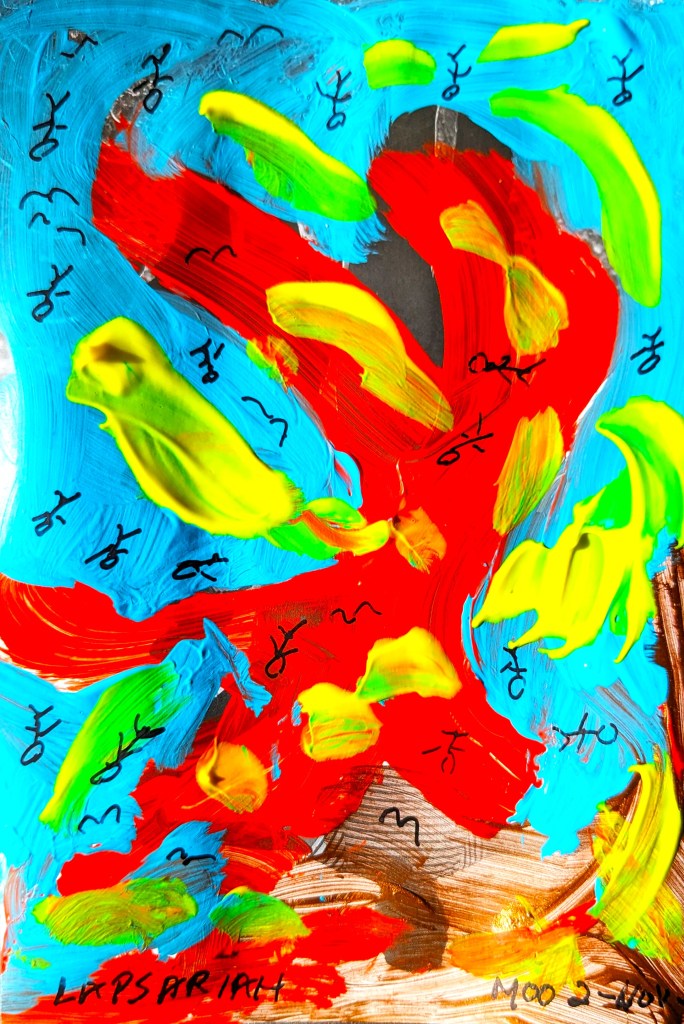
Moo’s painting, executed late last night, is his way of showing how rage can suddenly build and, like a runaway river, suddenly and unstoppably break out. It is extraordinary how his paintings so often mirror my moods and word flows.

Tell us about your first day at something — school

Daily writing prompt
Tell us about your first day at something — school, work, as a parent, etc.

Tell us about your first day at something — school

My father held my hand all the way to the convent. I wiggled, squirmed, dug in my heels, but it did me no good. Too firm, his grip, too determined his grim, muscled chin. When we arrived, he dragged me up the gravel path leading to the stark, red-brick building, and jangled the bell that hung from an iron clasp. He kept a tight hold of my hand as the bell’s echoes faded away into the interior corridors. A tapping of feet, and the wooden door opened just enough to let a small, four-year old boy in. My father pushed me through that gap. I turned to wave good-bye, only to see his back as he walked rapidly down the drive.
            “Come along, child, we’ve been expecting you,” a figure in flowing black robes with a white wimple framing her face emerged from the shadows.     The nun closed the door and banished the sunlight. “Welcome,” she said. “Wipe your feet.”
            “It’s not raining. My shoes are clean.”
            “When you enter this convent, you do as you are told. Wipe your feet. Blow your nose and dry your eyes. You should be ashamed: crying at your age.”
            A rough brown coconut mat lay by the door. I stood on it and moved my feet backwards and forwards, sniveling as I did so.
            “Now follow me.”
            The nun walked down the shadowy corridor, her leather sandals flip-flapping against the polished wood floor. The scent from the highly waxed boards rose up and flooded my nostrils. I looked down to see my face distorted by the floor’s polished woodgrains.
            We approached a classroom from which a babble of young voices echoed down the corridor. The nun opened the door and all chatter stopped. She led me to an empty seat on a wooden bench and there I sat. The nun went to the teacher’s desk in front of the class.
            “Class: you will all stand. I ordered you to be silent in my absence. You were talking when I opened the door. Who started the talking?”
            My new classmates stared silently at their feet.
            “I heard voices, many voices. Who started talking? Was it you? You? You?” She stabbed her finger at the class. Nobody said a word and nobody moved. “Will someone tell me who was the first to disobey my orders?”
            Silence.
            “Then I shall punish you all. You will kneel on the floor. You will raise your arms to shoulder height. Like this.” The nun imitated the arms of Christ as he hung from the Cross. “You will recite ten Hail Mary’s,” she turned to me. “Your new classmate will count them. His name will now be Joseph, a good Catholic name that will help him establish his convent identity. Joseph: you may stand, not kneel. Class, begin.”
            The piping of shrill voices chorusing a prayer filled the room.

I looked at the girls as they knelt there, arms out, all dressed alike, and I realized that I was the only boy in this particular class.

Have you ever performed on stage or given a speech?

Daily writing prompt
Have you ever performed on stage or given a speech?

Have you ever performed on stage or given a speech?
I began teaching in 1966 and continued until 2009. In those 43 years of academia, I performed on stage almost every day and gave speeches at least once or twice per class. I began as a top down teacher – I had all the knowledge, and I shared it with the individuals in the class room who had oh-so-much-less knowledge than me.

One morning, later in my career, I looked at myself when I was shaving. I looked deep into my own eyes and asked myself the vital question – “What are you teaching?” I looked at myself, razor in had. My mind was as blank as the look on my face, covered as it was with shaving soap. Then I awoke to a new world – I was not teaching a subject, I was teaching people, real, live human beings who were searching for knowledge, real knowledge, not just book knowledge.

Up until that point I had looked upon teaching in the same way as most of my colleagues did, filling empty heads with knowledge. As one of my old professors, in my first university back in the UK, once told us, after a senate house lunch swilled down with expensive sherry – “Knowledge is that which passes from my notes to your notes without ever passing through anybody’s head.”

That was the day I got down off the stage. I stopped giving speeches – aka lectures – and I asked the people in my class what they wanted to know. The answers surprised me. That was the day I began my teaching career, my real career, teaching people to become better learners, self-teachers, and hence better people. I stopped teaching my subject, and started teaching my students. I taught them how to teach themselves, how to assess the teaching material they were using, how to express themselves verbally and in writing, how to think critically for themselves, how to question everything, including me.

In short, I no longer taught them. I introduced them to Chaos Theory, how to teach themselves, how to assess their own work, how to develop the skills necessary for life-long learning, and how to love the pursuit of knowledge, for its own sake and for their own self-development.

The day I made that decision, I left the stage, retired as an actor and a speech maker, and became a teacher, a real, live teacher, of real, live human beings. It was one of the best days of my life. When I meet my former students, I realize that the stones I cast that day are still rippling round the universal pond of knowledge. Long may those ripples continue to enrich the world of teaching and learning.

What could you do less of?

Daily writing prompt
What could you do less of?

What could you do less of?
I shall deliberately misinterpret that prompt / question and answer it my way. I could do less of listening to stupid adverts, repeated ad nauseam, sometimes with gimmicky tunes – one to two lines maximum – again and again, all day, every day. Surf the channels to escape an ad, and what do you get? A synchronized set up where almost every channel is blasting out the same, or similar, ads at the same time. Have you noticed that when you leave the TV room, and retreat to the kitchen to get some limited peace, the ads follow you because the volume is turned up at ad time so you just can’t escape.

I remember my grandfather, back in the sixties, with the advent of ITV in Wales – the Independent TV channel that used ads – sitting before the TV set, his foot up before the screen and his fingers in his ears so he would not be able to see or hear those ads. Alas, once heard, seldom forgotten, and I can still sing most of those meaningless jingles heard back in my childhood. How it I hate when I go shopping in the supermarket and shoppers tunelessly whistle a TV ad as they shuffle along behind their carts. Alas, ad free programming, all too often, is either expensive or non-existent.

And what about those telephone calls when they put you on hold until the next agent is free to attend to you? I won’t mention names, because I don’t want to get sued, but I guess we have all had the same experience. I had a ninety minute online wait one day, with horrible music, an exhortation to stay on the line so I wouldn’t lose my place in the queue aka line-up, and a 90 second ad that glorified the joys of the company’s product, repeated once every five minutes. I suffered through that ad 18 times on that one call alone. Another local firm gave me the similar treatment, except that it was a one minute ad, repeated once every ninety seconds. I suffered through 10 repetitions in a wait of 15 minutes, got fed up, and hung up the phone.

Look at the peaceful scene above. That’s the view from my bedroom window in Island View. Even the crows are absent, and the early morning silence, like the sun, is golden. Two birds with one stone – a morning person or an evening person? A morning person with dawns like this, but an evening person when a sunset like this one miraculously occurs.

Do you ever see wild animals?

Daily writing prompt
Do you ever see wild animals?

Do you ever see wild animals?

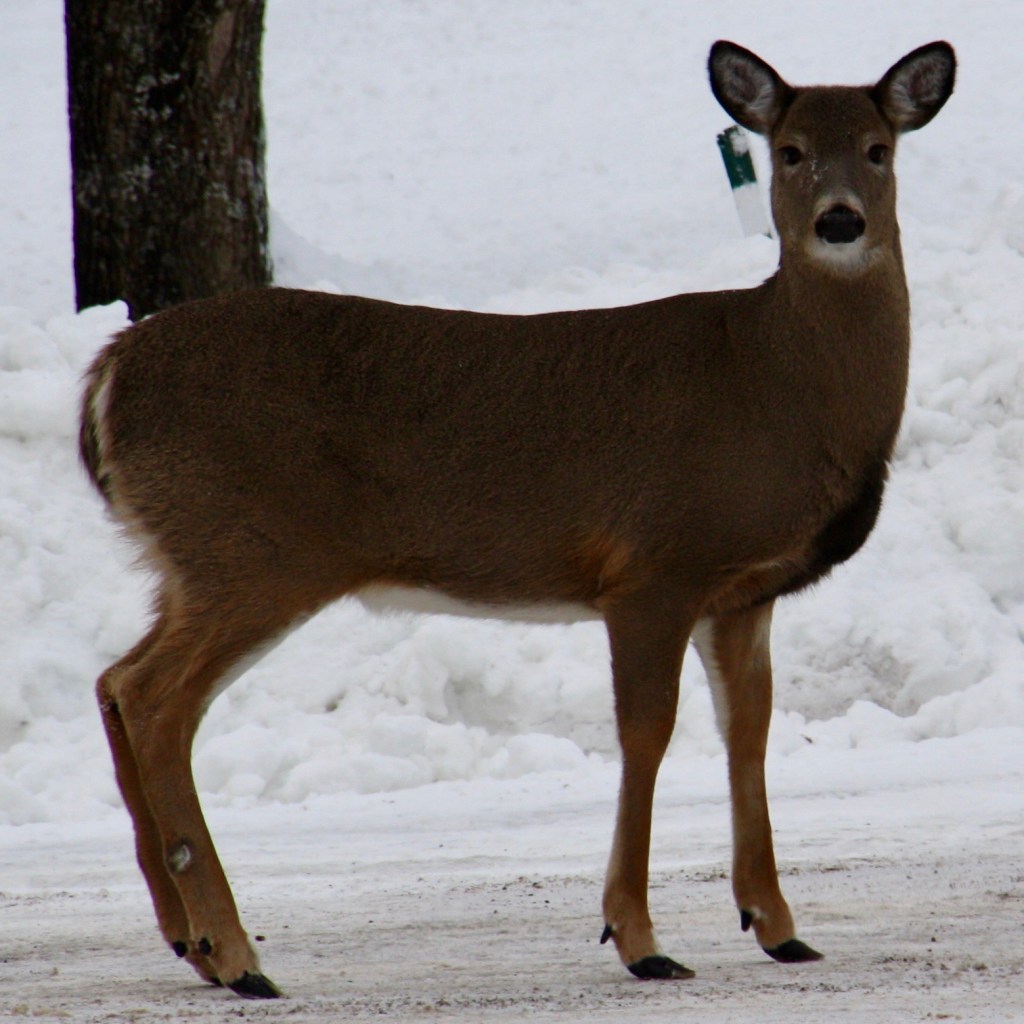
Indeed I do. And sometimes, just like this Wapiti, or White-Tailed deer, they see me as well. Some are camera shy. But this one, caught one morning walking past my garage door, heard the click of the first camera shot, stopped, turned towards the sound, then kindly waited until I had shot him, in the only way I would ever shoot a wild animal, with my camera. Isn’t he a handsome fellow – very photogenic.

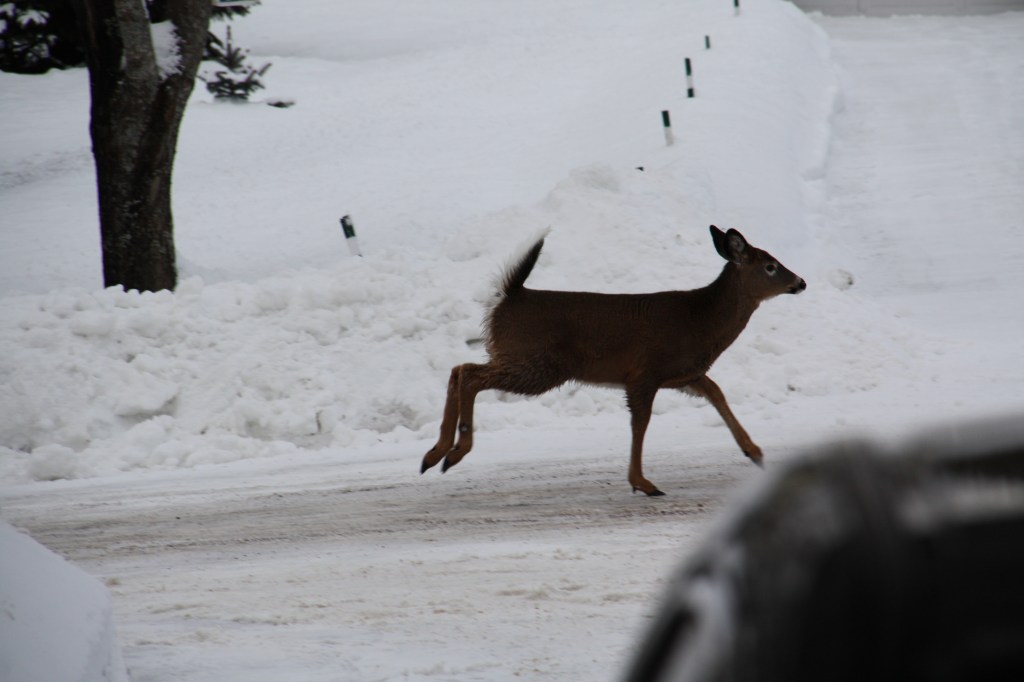
Some of the animals that pass through our yard do not seem that wild. This one lay down for a little rest about forty feet from the house. Early morning light, not easy to shoot, but he sat there and waited for me. Alas, I was using a camera with a laser focus and the red flash of the light disturbed him. I didn’t mean to do so. Whoops – there he goes, tail-up and now you know what they mean when they say ‘high-tailing it’ out of the woods and up the road.

And what about the chipmunks, and the squirrels, and the skunks, and the raccoons, and the jack-rabbits, and the porcupines? They all drop in from time to time. Look at this happy couple. Aw! Aren’t they sweet?

And don’t forget the birds – but give us another prompt – all about our feathered friends -and we’ll talk about them next time

Do you have a favorite place you have visited? Where is it?

Daily writing prompt
Do you have a favorite place you have visited? Where is it?

Do you have a favorite place you have visited? Where is it?

Just one place? So difficult to choose. I have been very lucky in my travels. I haven’t gone far, but I have tried to go deep, returning to the same places again and again. One place I often visited was St. Luce-sur-Mer in Quebec. It is a wonderful little town on the banks of the St. Lawrence River. The sunsets are sheer marvels and the views of the Northern Lights across the bay are just outstanding. Site of the wreck of the Empress of Ireland, it is filled with mystery and memories, as is the nearby Rimouski. Ste. Luce sur Mer would be my third choice.

Oaxaca, Mexico, would be my second choice. The city itself, capital of the state, is packed with history. I taught there for a couple of weeks (maximum six) every year from 1995-2001 and every time I returned I found something different and more mysterious. The dancing and music in the capital, the cascades of fireworks flowing down the facade of a church, the Christmas Cribs that grew day by day as people added to them, the incredible food, and above all the people – dancing in the Zocalo on Sundays to the music of the State Orchestra, crowding the markets with color, and the markets themselves, the scents of peppers, coffee, chocolate – to visit Oaxaca, in those days, was to visit the heart of Mexico. Imagine sitting beneath the tree that Hernan Cortes had sat beneath when he visited Oaxaca just after the Conquest of Mexico City – Tenochtitlan – and talked to the Mixtecs and Zapotecs of the Oaxaca Valley. And the codices – wonderful – I cannot say enough in praise of Oaxaca.

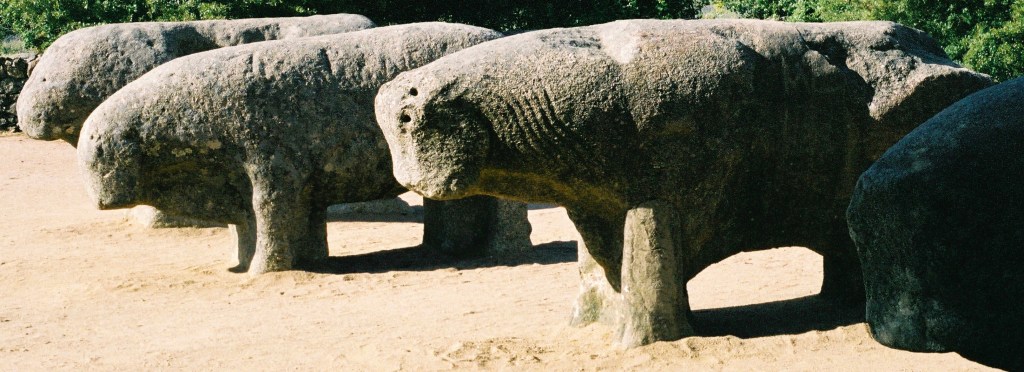
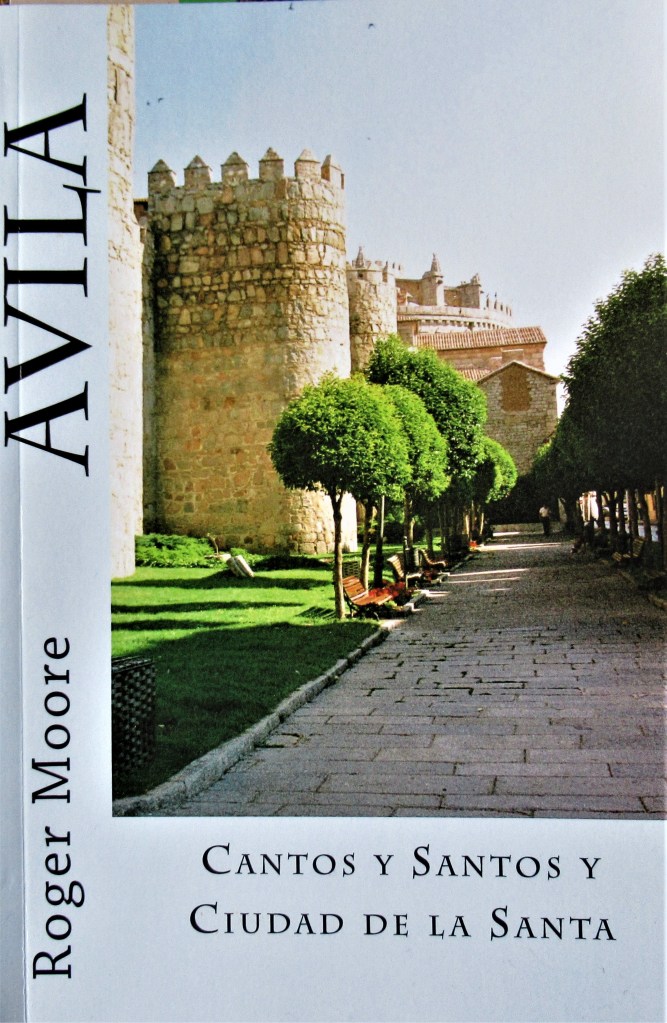
My number one choice: Avila. The lead photo shows the Toros de Guisando. Pre-dating Christianity, these four stone bulls – verracos – were often used as boundary markers by the Vettones who lived there before the Romans. One of these four bulls bears, carved into its side, the marks of one of the Roman Legions that passed this way. The countryside around Avila has to be seen to be believed. The walled city itself is a wonderland – three kilometres of walls, 9 gateways, a Cathedral that shows an enterprising mixture of styles, museums, libraries, squares, and a welcoming people who make you one of the family. I visited here for four summers, 2005-2008, staying for between 6 and 8 weeks on each visit, and always residing in the same place, El Rincon, close by the Mercado Chico.

My Knapsack

My Knapsack

Throughout my childhood,
I carried a knapsack on my back.
Into it I stuffed my darkest secrets.
Along with all my dirty washing
they filled every cranny and nook.

Words of hate, carved into my life-slate,
shuffled and cut, but unchanged,
unchangeable, remained engraved
on the tombstone I took from above
 the hole I dug to bury the casket
in which I hid the shards of my heart.

On a rainy day, when push came
to shove, I left my childhood home
to wander the world, alone, on my own.

I walked to the station, boarded a train
and never went back home again.

At journey’s end, I left my knapsack
and its contents in the luggage rack.
I never want to see them again.

Comment:
“Pack up your troubles in your old kit bag, and smile, smile, smile.” My maternal grandfather used to sing me this song from WWI. “While you’ve a Lucifer to light you fag, smile, boys, that’s the style.” I wonder how many people now remember what a Lucifer is, let alone a ‘fag’, in that sense of the word. It has, of course, morphed into many other meanings, some of them not necessarily pleasant. I remember my grandfather, standing in the kitchen, before the coal fire, and saying “I remember when Wills’ Woodbines were a penny a packet.” Wills’ is still with us, but may not be for much longer. I can’t remember when I last saw a Woodbine. I certainly never smoked one, in fact, I never ever smoked at all. But as for that kit bag aka knapsack aka backpack aka rucksack, well, put all your troubles in it, tie them up tight, and take it somewhere safe where you can leave it and forget about it, and then start life again. “Good-bye old friend, I am on the mend. And that’s the end.”

As for the painting, by my good friend Moo, that shows The Fall – Pre-Lapsarian / Post-Lapsarian – when all the devils, demons, and black angels were tumbled out of Paradise and abandoned to the depths below, where, alas, they still roam. So, if you meet any of them along the way, shove them in that old kit bag and get rid of them too. You’ll feel much better afterwards.

The Banks of the Seine

Banks of the Seine

Gnawing at the carcass of an old song,
my mind, a mindless dog, chasing its tail,
turning in circles, snapping at the fragment
of its own flesh, flag-flourished before it,
tournons, tournons, tournons toujours,
as Apollinaire phrased it, on a day
when I went dogless, walking on a mind-leash
before the Parisian bouquinistes who sold,
along the banks of the Seine, such tempting
merchandise, and me, hands in pockets,
penniless, tempted beyond measure,
by words, set out on pages, wondrous,
pages that, hands free, I turned, and turned,
plucking words, here and there, like a sparrow,
or a pigeon, picks at the crumbs thrown away
by pitying tramps, kings, fallen from chariots,
as Eluard wrote, and me, a pauper among riches,
an Oliver Twist, rising from my trance, hands out,
pleading, “Please, sir, can I have some more?”

Comment:
This is a fusion / confusion, if you like, of The Kingston Trio’s song – The Seine – with a quote each from Guillaume Apollinaire – Alcools – and Paul Eluard – Il ne m’est Paris que d’Elsa, and Francisco de Quevedo’s – El Buscon – and a tip of the old chapeau nouveau to R. S. Thomas and Charles Dickens. Fools rush in, I am afraid, where angels fear to tread. Go on. Rush right in. Sort it all out. I double-dog dare you – and thank you for that one, Jude.