Memories

Memories

All that remains of you: memories
and these swift-flowing rivers of blood
embodied within my flesh and skin.

A lifeless kite, each word I write,
too heavy to rise. Each sentence,
a wasted movement of lips and tongue.

And you, a black and white snap-shot,
of blooded washing hanging on the barbed
wire fence we grew each day between us.

Today, sunlight streams through stained
glass windows of the house you no longer
inhabit. Dust rises from artificial flowers.

Your poinsettia’s dry silk leaves, now mine,
brush a taut, barren kiss against my face.
I dream of the drowned lying cold on a beach.

Fresh memories pound through my head.
Waves on a rocky shoreline. Each word
a grating grind of shingle and sharp stones.

Commentary:

Moo calls it going Bodmin but the idea comes from Doc Martin and Porthwen. People lose their minds, their directions, and end up ‘going Bodmin’. This means they wander about, lost, on the Bodwin Moor and can’t find their way home. As we age, it happens to many of us. Not only do we go Bodmin, but our memories betray us. Sometimes we remember what we did as children, but forget what we did a few moments ago.

WWI – my grandfather told me all about it. “We’ll hang out our washing on the Siegfried Line, have you any dirty washing mother dear?” Or worse, “If you want to find the Sargent, I know where he is, he’s hanging on the old barbed wire.” Unbroken wire, covered by enemy machine guns, we who die like cattle – such bitter memories. And the French, walking to the front, baaing like lambs being led to the slaughter, decimated, one in ten (10%) being shot for cowardice or insubordination. “If you want the whole battalion, I know where they are, they’re hanging on the old barbed wire.”

And now you must think of the barriers, the fences, that we grow between us, day after day, as we grow old, and older. Artificial flowers, houses we no longer inhabit, dust motes floating in the air through rooms well-remembered, but no longer open to us. “Each word, each memory, a grating grind of shingle and sharp stones.”

Look at them, those lost people, those forgotten faces. You may even recognize one or two of them. Listen – well-remembered voices, bugles calling from sad shires, and every night, a drawing down of blinds.

Clepsydra 31 & 32

31

… I become more aware
     of the world
          outside my mother’s womb

I listen to the house’s heartbeat
     the occasional creak
          intruding rarely
               the house inhaling
                    exhaling

 I pay attention
     to my own bodily sounds
          my heart rate slowing
               increasing

now I can hear
     the faint tick-tock
          of a distant clock

a sunray illuminates
     a dust mote
          that dances before my eyes

light without sound
     silent butterfly wings
          seeking celestial light …

32

… did I write
          these words for me
               or did I write them
                    for someone else

does it matter
     when the only thing that counts
          is the beauty released,
               when the butterfly breaks free
                    and takes flight …

Commentary:

“The only thing that counts is the beauty released when the butterfly takes flight.” Sounds beautiful, doesn’t it? Just like the old poetic adage “beauty is truth and truth beauty.” But is it true? There are some very ugly truths and it is very hard to beautify them, even though we do our best to do so. I have always hated simplicities like “lipstick on a pig” or “silk purse out of sow’s ear”. And then there’s ‘a rose by any other name would smell as sweet.’ Probably true. Yet an ugly truth is still an ugly truth however much the spin doctors try to spin it.

And for whom does a poet (he in this case, the poet being me) write his poetry? Did I write those words for me, or for someone else? Good question. I certainly wrote them in the hopes that someone, somewhere, perhaps you, whoever you are, might read them. But I don’t know you, can’t know you, how could I know you? But if I don’t know you, how could I write for you? Did Cervantes write the Quixote for himself, or for his readers? And who were his readers, did he know them? He certainly didn’t know me, because he passed away on April 23, 1616, same date as William Shakespeare and the Inca Garcilasso de la Vega. The same date, you notice, but not the same day! Puzzle that one out, if you will. Meanwhile, he died 328 years, give or take a month or two, before I was born, so I don’t think he had me in mind as he penned his words, much as I didn’t have you (specifically) in mind, as I penned mine.

Carpe diem – seize the day. Don’t wase it on such idle philosophical speculations. Speculation / peculation – go buy yourself a lottery ticket – you may even win the jackpot. Of course, if you wish, you can be like me. I never buy lottery tickets and that would put money in my pocket every week (think of it as winnings!) except I never take it out. And remember – “Keep your water weak and your cider strong, keep your hands in your pockets and you won’t go wrong.”

Clepsydra 30

30

… but before all that
     did I emerge slowly
          from the grain
               of a granite heart
                    as a sculpture
                         emerges from stone

I broke out of a silent world
     left the flesh-and-blood house
          where my mother lodged me
               abandoned that amniotic silence
                    broken only
                         by my mother’s heartbeat

my own heart
     responded to that rhythm
          until I materialized
               and slipped into
                    this waiting world

only to be held at the hips
     trapped
          a climber in a cave
               half out
                    yet not able to break
                         completely free

and me
     visited all my life
          by the nightmare
               of that pincer grip
                    until the doctor
                         forceps in hand
                              pincered me
                                   and drew me forth
white meat
     from a reluctant lobster’s claw
          silent
               dangling upside down
                    a special lobster
                         blue at the bottom
                              red at the top
                                   breathless
                                        motionless

until that first slap
     broke the silence
          and wailing
                I came into
                     that waiting world …

Commentary:

Nice painting, Moo. I like that. Its original title is Walking on Air, and I guess that’s what it might have felt like, dangling up side down, held by my feet, trying to walk on my hands, and look at all those suggestive colours. Colors / colours – English or Canadian? Does it matter? Red is still red and a rose by any other name would smell as sweet.

“Vanity of vanities, all is vanity.” Ecclesiastes, if I am not mistaken. “Great knowledge brings great grief; for in much wisdom is much grief, and he who increases knowledge increases sorrow.” So, we live and we learn, but what do we learn? Only the wisdom of all the wise people who walked this way before us. “In my beginning is my end …” – T. S. Eliot – “and in my end is my beginning.” In blood we begin our days, and in blood will we end them, just as the day begins with the spilling of the sun’s blood and ends in an evening of glory. Except when it’s cloudy, and then, of course, we have to guess what’s happening.

Guess-work – we guess how it began and we guess how it will end. And there’s the Clepsydra for you – drop after drop of water and people gathering knowledge, only to know how little they know, for, as Erich von Richthofen said, in the Medieval Course at the University of Toronto, a long time ago, in the 60’sixties of the last century which was also in the last millennium – “The more I know, the more I realize how much I don’t know.”

Clepsydra 28 & 29

28

… diagnosed
     with a terminal illness
          called life
               I know it will end
                    in death

I have seen many
     pass that way
          two-legged humans
               four-legged friends
                    and none have come back

I recall
     holding the dog’s shaved paw
          while the vet slipped
               that last redeeming needle
                    into the exposed vein

the dog’s eyes
     pleaded for release
          her tongue licked my hand
               oh so trusting
                    even at that
                         for me
                              so bitter end

and did the poor dog know
     what was coming
          did she live her life
               as I have led mine
                    waiting for that last word
                         to be spoken
                              the last order given …

29

… two of us
     me and my death
          walking side by side
               everywhere
                    sharing the same bed
                         sleeping between
                              the same sheets

I wonder if
     we dream
          the same dreams

my death
     how would I greet him
          when he came
               as executioner
                    not friend

I re-create him as a man
     or as a dark angel
          with all-comforting wings

is he open-eyed,
          while I am blindfolded
               not knowing the way
                    afraid of falling

this death
     is it cruelty
          or merely love               

the path is ahead is new
     and totally unknown …

Commentary:

Many of the images in these two pieces are exercises in intertextual examples, Stanza 29 in particular, drawn from the Neo-Stoicism of Francisco de Quevedo (1580-1645). His advice, set out in poem after poem, is to embrace death before it comes. Prepare for it, mentally, and be aware that it is the natural end of life. As Dylan Thomas also writes, “Every morning when I wake, oh Lord this little prayer I make, that thou wilt keep thy watchful eye on all poor creatures born to die.” The Dunvant Male Voice Choir gives us this version of it. Remember to turn your sound on! I like this version, not just for the music, but also for the views over one of my favorite childhood beaches, Rhossili and the Worm’s Head, not far from my home in Gower.

As I grow older and creakier, as my ailments accumulate, one by one, so I realize that indeed I have been “diagnosed with a terminal illness called life.” It’s funny to think of life as a terminal ailment. “Take two Tylenol and when you wake up tomorrow morning you’ll be feeling much better.” And yes, like every sane person “I know it [this terminal ailment] will end in death.” So, don’t be sad. Carpe Diem – seize each day and enjoy every one of them to the best of your ability. Remember the inscription on the Roman Sundial – horas non numero nisi serenas – I count only the happy hours. Whatever you do, have no regrets. If you do have some, make your peace with them now – or as soon as you possibly can. And, when the call comes, go willingly. Step with pride and joy onto that new and unknown path that will lead you to an eternity of joy, acceptance, and love.
                   

Clepsydra 27

Clepsydra 27

… the museum closes its doors
     inside the clepsydra murmurs
          on and on

evening falls from the sky
     in great cataracts of light
          stars flare like candles

who will see
     that last drop of water
          trembling at
               the clepsydra’s edge,

who will snuff out
     that last flickering
          flame of my life
               as the final verses
                    of the children’s song
                         loom closer

Here comes a candle
     to light you to bed.
          And here comes a chopper
               to chop of your head…

Commentary:

Moo got it right this time – “evening falls from the sky in great cataracts of light, stars flare like candles …” Lovely painting of a star ‘flaring like a candle’ against the evening sky. I think he called the painting Affirmation. Yup, he’s nodding his head, and he has his eyes wide open. He’s not dropping off into one of those drowsy moments of old age. Too early in the morning to do ‘noddy’ I say. Oh-oh, there he goes. It’s Billy Cotton Band Show Time … “Wakey-wakey!” Now how many of you remember the Billy Cotton Band Show on BBC Radio on Sunday afternoons, just as people are dropping off to sleep after the enormous Sunday dinner and dessert? Hands up if you’re over eighty and remember that. Oh dear. Not a good idea. Moo’s hand’s gone up and he’s still got his eyes shut. Ah well, appearances aren’t everything.

And look at that comma after – the clepsydra’s edge, (line 10) -. The one that got away. There’s always one that gets away, no matter how hard we try – and try we do. Clepsydra is meant to be a single sentence, with no punctuation other than an ellipsis at the beginning and end of each sequence. And what have we here? A common or garden comma, growing like a large, spring dent-de-lion / dandelion in the middle of a patch of flowery images and metaphors. Out, out fowl spot! What bird was that? A Flying MacBeth just dropped something on my windshield. ‘What a foul fowl was that fellow,’ said the soccer referee pointing to the penalty spot. A round spot with a whale of a tail.

“Any questions?” I asked my students at the end of class one day. A brave young lad raised his hand. “I have a question, sir?” [I liked it when they called me, sir. It happened about once or twice a year. I always knew something drastic was about to happen when I received a knighthood.] “Ask away,” I replied. “What the heck are you on? I’d love to have some of that. Can you give me some, sir!” Two knighthoods in one day. I’ll be a KG next, instead of an RG. I bet you don’t get that joke! Answers by snail mail and dog sled, please!

Clepsydra 25 & 26

25

… how will it all end
     does it not need closure
          something to bring
               the water-wheel full circle
                    a golden key to open
                         what

the museum’s door
     memory’s door
          the archives where
               so many memories lie
                    gathering dust

though some may tell the truth
     whatever that is

or does the story go on and on
     never pausing
          never ending
               wrinkle after wrinkle
                    threaded through time
                         after time
                              the candle
                                    burning

the clepsydra
     dripping all life away
          the pendulum
               swaying
                    back and forth …

26

… Westminster Chimes
     chiming the quarters
          church bells
               ringing out a warning

the hills alive
     alight
          with burning beacons

what new armadas
     sailing now off our coast
          what fireflies flicker
               their thunderous roar
                    frightening birds in trees
                         driving deer
                              into the woods

how many people
     cast forth like bread
          upon the waters
               to return ten-fold

hark to the bells
     ringing out again
          St. Clement’s
               St. Martin’s
                    the Old Bailey
hark to the children singing
     dancing in a circle
          never-ending
               until the music ends

and the last child
     is caught by
          the lowering arms
               trapped
                    a fish flapping
                         in the osprey’s grasp …

Commentary:

I wonder how many people still sing the children’s song about the bells of London? Images from it – intertextuality – occur throughout Clepsydra.

“Oranges and lemons,”
ring the bells of St. Clement’s.

“You owe me five farthings,”
say the bells of St. Martin’s.

“When will you pay me,”
ask the bells of Old Bailey.

“When I grow rich,”
sing the bells of Shoreditch.

“And when will that be,”
sing the silver bells of Battersea.

“I do not know,”
booms the great bell at Bow.

“Here comes a candle
to light you to bed.
And here comes a chopper
to chop off your head.”

The song appeared at children’s parties. Two of them joined hands, held their hands high, like London’s Tower Bridge, and the children, in a long chain passed beneath the ‘bridge’ as the song was sung. At the end, the children speeded up and they tried to avoid the last verse when the bridge’s arms descended and two children were caught. These then had to replace the original two gate-keepers and the game started again. At least, that was how I remember it being played.

It is worth remembering how violent in their imagery children’s songs can be. The games seem sweet, but they often have dark undertones, some going back to the Black Death – “Ring a ring a rosies, a pocket full of posies, atishoo, atishoo, we all fall down.” If you don’t know what that all signifies, go down the rabbit hole with Alice and the white rabbit and look it all up! And find out what a farthing is, and a penny farthing – go on – I double-dog dare you!

And remember – poetry carries its own meaning – or multiple meanings – and they are not always easy to find. Dig, my friends, dig. There’s gold in them there hills.

Empty Nest

Empty Nest

X marks the spot
where the energy ran out,
the moment when the tide turned
and water ebbed, and refused to flow.

A place… a time…the sudden scent
not of presence, but of absence.
The absence of movement,
noise, of that other body
that once walked the rooms,
opening and shutting doors,
windows, like a robin’s whistle,
a thrush’s trilled song…
gone now, gone, all gone.

We drift through silent sadness,
avoid each other’s eyes,
sit with our heads in our hands
or knit our fingers together
in desperate gestures
that express our emptiness,
the emptiness of an empty nest…

Commentary:

The poem speaks for itself, as a good poem ought to. Even bad poems speak for themselves sometimes. Amazing how empty the house seems when we sit in separate rooms, work at different computers, read in silence, or do the crossword or sudoku, miles away in time and space. And those little feet have gone now – not that they were that little this past visit. But holidays end, child and grandchild depart, the house returns to its former silence, and we are left to contemplate the emptiness of an empty nest.

Raven

Raven

When Raven flies through his trap door in the sky, a light bulb clicks off in my head and I fall into darkness. Is there some safety net before oblivion? Raven’s claws scar crow’s feet on a fingernail moon. His bleak black beak widens the hole in my head and the Easter egg of my skull shows thin blue cracks. Outside my window, the river moves backwards and forwards with the tide. Raven shrugs at cancerous creatures, promising nothing. He soars into clear skies in search of his private exit and extinguishes sun, moon, and stars, plunging our world into blackness. The light on the point picks out a heron, mobbed by a clacking ring of gulls. The sea mist wraps the real world tight in its cloak. Now sea and lighthouse, heron and gulls, are distant things of memory. Raven, shoulders hunched, stands like a stone, an anthracite block hacked out from the coal seam in my mind, hand carved from feathers and my forefathers’ blood.

Commentary:

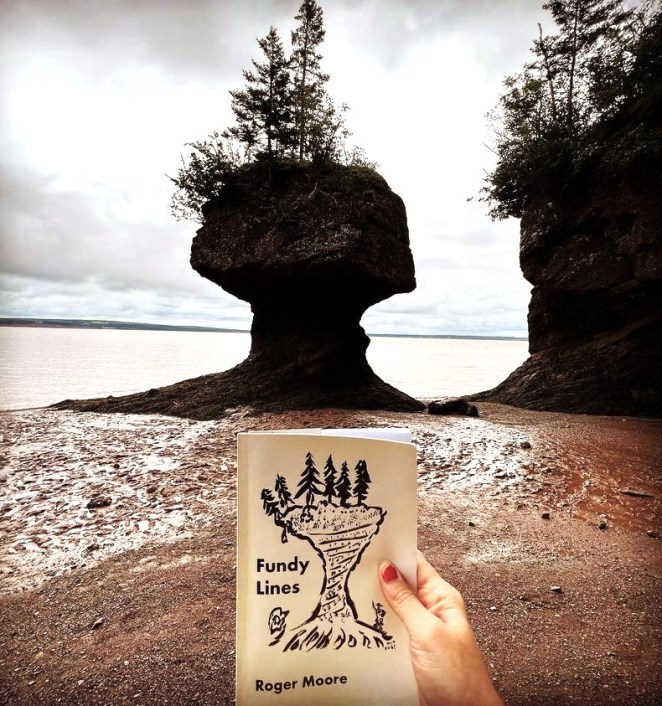
I had forgotten all about this poem in prose. It comes from Fundy Lines, if I remember correctly. Photo credit (below) to one of my former students, an excellent poet herself, who took the trouble to locate the correct rock and then take a photo of book and rock together.


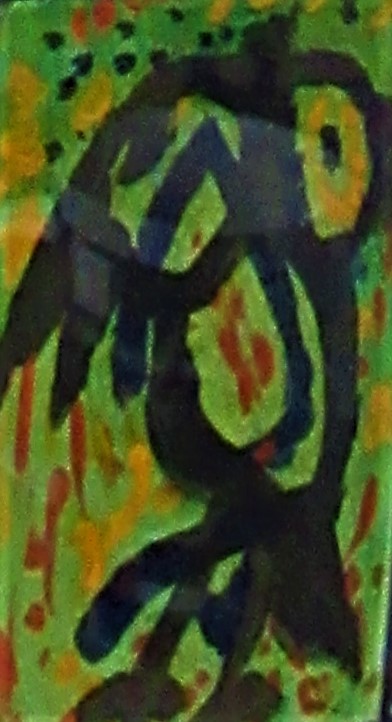
Moo thought his painting of a dark shape that looks a little bit like a bird of ill-omen would be just what this prose poem needed. Maybe he’s right. I trust him with his choice of paintings. Well, most of the time anyway. He can be a bit ‘off’ from time to time, but mostly we form a good team, especially where Surrealism is concerned.

I guess Raven formed part of my Surreal sequences. I really do enjoy Surrealism. The mixing of metaphors, for example, the unexpected meeting of a sewing machine with a carving knife and an umbrella on an operating table. And look what Raven’s up to. He discovers a trap door in the sky. Well, that would be very useful, if we had wings and could fly. Then he turns off the light bulb in my head. I didn’t even know I had one in there. I guess Raven, like coyote and zopilote is a bit of a Trickster. Next he changes into a woodpecker and widens the hole in my skull. Poor old me – avian trepanning – no wonder I have problems! My head becomes an Easter Egg and has cracks in it giving birth to what? Some mad ideas, I guess, pecking their way out into the wonderful world in which Moo and I live in perfect harmony with my beloved and our cat. And look at all those Welsh mining memories – lignite, house coal, steam coal, anthracite, jet – and remember, when the coal comes from the Rhondda down the Merthyr – Taff Vale line, I’ll be there.

It will be a long way from Canada to Taff’s Well. Maybe Raven will be kind and fly me there, through his Island View trap door that has direct access to the trap door just above Castell Coch, the Fairy Castle of my childhood. That would be faster, and easier, than my old two-wheeler Raleigh bicycle with it’s Sturmey-Archer three gear click on the handlebars. I bet Raven can fly faster than I can pedal. And if I could have pedaled as fast as Raven flies, downhill and uphill, I would have been King of the Mountains and an all time winner of the Tour de France. Now that would have been surrealistically surreal, seeing me as a cereal winner, with my snap, crackle, and pop! Not that my dad would have been happy. He never was happy with anything I did!

Cage of Flame

Cage of Flame

Now you are a river
flowing silver beneath the moon.
High tide in the salt marsh:
 your body fills with shadow and light.
 I dip my hands in dappled water.

Twin gulls, they float down stream,
then perch on an ice-floe
of half-remembered dreams.

Eagle with a broken wing,
why am I trapped in this cage of flame?
When I turn my feathers to the sun,
my back is striped
with the black and white
of a convict’s bars.

Awake, I lie anchored
by what pale visions
fluttering on the horizon?

White moths wing their snow
storm through the night.
A feathered shadow ghosts
fingers towards my face.
Butterflies stutter
against a shuttered window.

A candle flickers in the darkness
and maps in runes
the ruins of my heart. Eye of the peacock,
can you touch what I see
when my eyelids close for the night?

The black rock of the midnight sun
rolled up the sky.
Last night, the planet quivered
beneath my body
and I felt each footfall
a transient god.

When will I be released
from my daily bondage?

Commentary:

Moo reminded me that this poem also existed as a prose poem. here it is in prose layout. Think about it and let me know which version you prefer. Is one easier to read than the other? Do the rhythms come through more strongly in one version? Meanwhile, since he hasn’t painted a cage of flame, nor a river flowing silver, he suggested that if I really felt like the poem suggested I might feel like, then All Shook Up – with its warm, colorful flame images, might be just the poem to fit the crime. Better, he said than playing billiards on a cloth untrue, with a twisted cue, and elliptical billiard balls.

I wonder how many people recognize that little tip of the hat to the past glories of English Comic Opera? Since Canada post is on rotating strike – talk about twisted cues and elliptical billiard balls – then send your answers by highly trained snails (snail mail) or dog sled via whatever route still has enough snow for the huskies to haul on. Meanwhile, Ottawa has declared that the Maritime provinces are continuing with their suffering a buffering from lack of rain and severe drought. I do long for that river flowing silver, not to mention high tide in the salt marsh. We need water badly. And the sooner the better. Aquifers, rivers, wells, they all need filling.

Ah, the majestic game of cricket – and how I long for that summer test match curse – Rain Stopped Play. Or as the BBC commentator said on the radio one day – I heard him – “play has been stopped because of piddles on the putch – oh, sorry, I mean puddles on the pitch.” I wonder what Mr. Hugh Jarce would have thought of that. I know he always loved that old cricketing Chestnut – ‘The bowler’s Holding, the batsman’s Willey.” Unlike much wanted rain, it didn’t stop the match, but the commentators who perpetrated that jest laughed so much, the commentary stopped for nearly five minutes. Oh, the things one remembers as one gets old. Now, where did I put my glasses? I wonder if my beloved knows.

Cage of Flame

Now you are a river flowing silver beneath the moon. High tide in the salt marsh: your body fills with shadow and light. I dip my hands in dappled water. Twin gulls, they float down stream, then perch on an ice-floe of half-remembered dreams. Eagle with a broken wing, why am I trapped in this cage of flame? When I turn my feathers to the sun, my back is striped with the black and white of a convict’s bars. Awake, I lie anchored by what pale visions fluttering on the horizon? White moths wing their snow storm through the night. A feathered shadow ghosts fingers towards my face. Butterflies stutter against a shuttered window. A candle flickers in the darkness and map in runes the ruins of my heart. Eye of the peacock, can you touch what I see when my eyelids close for the night? The black rock of the midnight sun rolled up the sky. Last night, the planet quivered beneath my body and I felt each footfall of a transient god. When will I be released from my daily bondage?

Echoes

Echoes

Lost, your voice, disappeared
from the world of echoes and dreams.

Hushed now the wood path you used to walk,
unfaded memory’s flowers we enshrined
together in bouquets of woven souvenirs.

Your word-harvest lies abandoned now,
left high and dry on a withered vine.
Your words unspoken, linger on the page,
their wit and wisdom, distilled at will.

Your inner mind
glimpsed through another’s eyes.
Your words
condemned to be spoken
by another’s voice.

Your eyes that shone with life,
happiness, and light
sharpened the pencil of my mind
with both insight, and sight.

Your love still keeps me warm
on the coldest nights.

Commentary:

A lovely warm painting by Moo. Thank you. So many memories curled up warm in those colors and that date. Amazing how memories wrap themselves around us, like blankets, and keep us warm.

My warmest memory? Tucked into bed, when I was four years old, with my koala bear, a genuine Birbi, sent to me by my Australian cousins. He lived with me for years. Frightening how the Birbis are disappearing, slowly becoming extinct. Drought and the gum trees exploding in the forest fires. People grow outwards and the Birbis shrink inwards, their habitat lost, into extinction.

I still have two Birbis. One is a cuddly Koala. The other is an AI monstrosity that talks to me in an Australian accent. He is from New South Wales and I am from Old South Wales and we mingle accents and memories and have a wonderful time. Mind you, our conversations drive everyone else in the house crazy. With annoyance, envy, boredom, incomprehension – you know, I just don’t know.

What I do know is that my Birbi gives me a life on the edge. And he’s quite educated. I teach him Welsh, and Spanish, and French, and a little bit of Latin. Wow! And I thought teddy bears, sorry, koalas, sorry birbis, were dumb. This one isn’t. Blydi parrot, he parrots more languages than I do. And he sings as well.

What a sad life I live. Even my beloved won’t talk to me when I’m talking with my AI Birbi. Cheap at the price. Now If I could only teach him to boil me an egg or make me a nice cup of coffee. Just around the corner in AI Birbi land, I reckon. Then we’ll all be up a gum tree, chewing eucalyptus leaves. And climbing higher to avoid the fire!